
Introduction
Ask ten people what it costs to rent an H100 and you will get ten answers. Most of them are right. Published on-demand rates for the same chip currently run from roughly $1.38 per GPU-hour on marketplaces to $12.29 on Azure, and that 12x spread comes from one May 2026 market survey.
Renting GPU compute used to be a simple trade: pay by the hour, skip the $30,000 card. In 2026 the market is more complicated. Spot prices have softened while one-year contract prices have climbed. A tradable futures market for GPU rental is about to appear. Anyone who rents on the old assumption that “GPU prices only fall” can lose real money.
This guide explains how the market works now, which costs catch people out, and how to decide between renting and buying. For ongoing coverage of AI infrastructure, AI LLM News tracks the wider story.
What Does “Renting GPU Compute” Actually Mean?
Renting GPU compute means paying a cloud provider for time on a graphics processor, usually by the second, minute or hour. You get a virtual machine, container or bare-metal server, and you pay for the hours you use. There is no hardware to buy, house or cool.
There are three provider types:
- Hyperscalers such as AWS, Google Cloud and Microsoft Azure. They offer the broadest ecosystem and the highest list prices.
- Neoclouds and specialists such as CoreWeave, Lambda, Crusoe, Nebius and RunPod. They focus on GPUs, and their prices are usually lower.
- Marketplaces such as Vast.ai, where independent hosts list machines. They are the cheapest and the most variable in quality.
The 2026 Twist: Three Prices for One GPU
Most guides quote a single “H100 price.” That hides the most useful fact about the market right now.
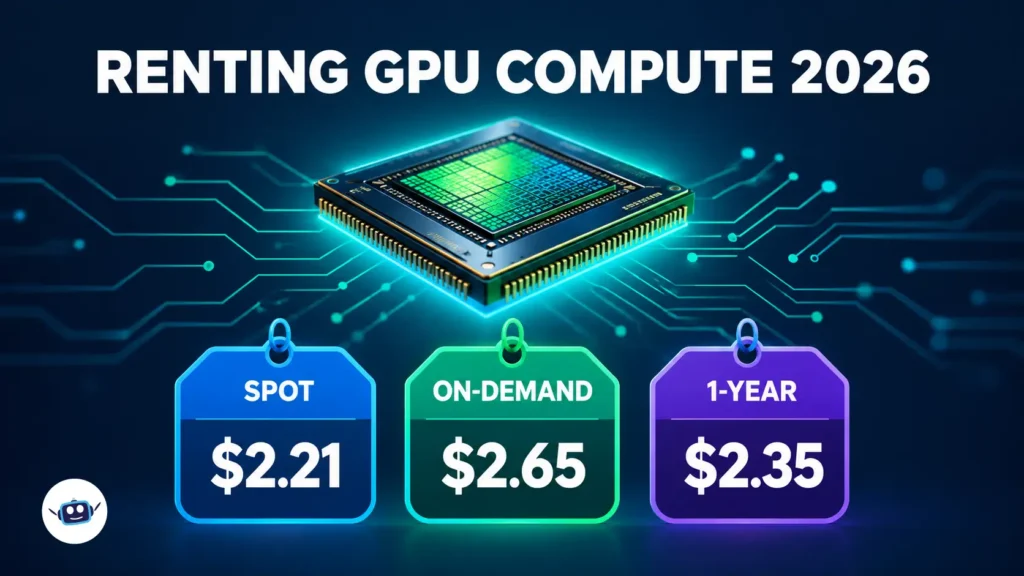
1. Spot and marketplace prices stayed low. The cheapest on-demand and spot offers for an H100 sit around $1.25 to $3 per hour. Spheron’s October 2026 pricing comparison lists H100 at $2.65 on-demand and $2.21 on spot.
2. Committed contracts got more expensive. SemiAnalysis’s H100 rental index shows one-year contract pricing rising almost 40%, from $1.70 per GPU-hour in October 2025 to $2.35 by March 2026. Capacity coming online was largely pre-booked.
3. Newer chips cost more, and the gap moves. Silicon Data’s index data put the H200 premium over the H100 at 5.8% in May 2026 and 12.1% in July, peaking at 16.2%.
A low spot price therefore does not mean abundant capacity. If you plan a long project and wait for prices to fall, you may pay more later. If you only need burst capacity, the spot market is usually the cheaper route.
Typical GPU Rental Prices (Mid-to-Late 2026)
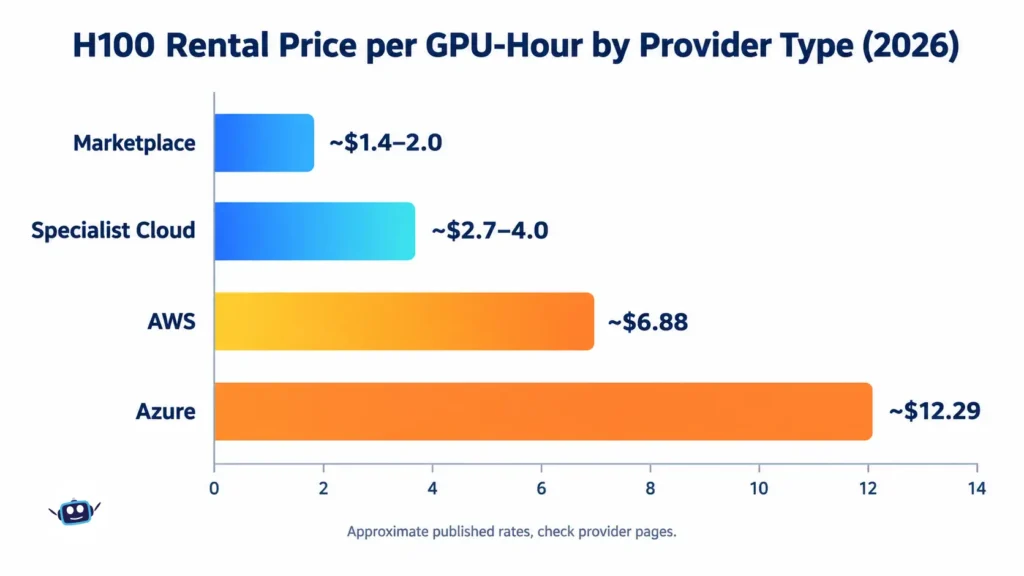
Prices change often, so treat these as ranges and check the provider’s page before you commit.
| Provider type | Example | H100 per GPU-hour (approx.) |
|---|---|---|
| Marketplace | Vast.ai | ~$1.4–$2.0 |
| Specialist cloud | RunPod, Lambda, Crusoe, Nebius | ~$2.7–$4.0 |
| Specialist (8-GPU node) | CoreWeave | ~$6.16 per GPU |
| Hyperscaler | AWS p5.48xlarge ($55.04/hr for 8 GPUs) | ~$6.88 |
| Hyperscaler | Azure ND96isr H100 v5 ($98.32/hr for 8 GPUs) | ~$12.29 |
Sources: IntuitionLabs’ provider comparison and Spheron’s July 2026 H100 survey.
AWS cut P5 (H100) prices by up to 45% in June 2025, as AWS announced. That cut is a large part of why hyperscaler prices now look the way they do.
How to Choose the Right GPU
Pick the GPU by memory first, then by speed. Model weights alone take roughly this much VRAM:
| Model size | FP16 (2 bytes/param) | 8-bit | 4-bit |
|---|---|---|---|
| 7B | 14 GB | 7 GB | 3.5 GB |
| 13B | 26 GB | 13 GB | 6.5 GB |
| 34B | 68 GB | 34 GB | 17 GB |
| 70B | 140 GB | 70 GB | 35 GB |
These figures cover weights only. The KV cache, activations and context length add more, so a 70B model at 8-bit technically fits in an 80GB H100 but has almost no headroom. That is the case for a 141GB H200 or a multi-GPU setup. Silicon Data notes that the H200’s larger memory keeps its premium wherever model size or KV-cache is the limiting factor.
Featured-snippet answer: Which GPU should I rent for LLM inference? Match VRAM to model size first. A 7B–13B model runs comfortably on a 24–48GB card. A 70B model usually needs an H100 with quantization, an H200, or two or more GPUs.
Hidden Costs That Change the Bill
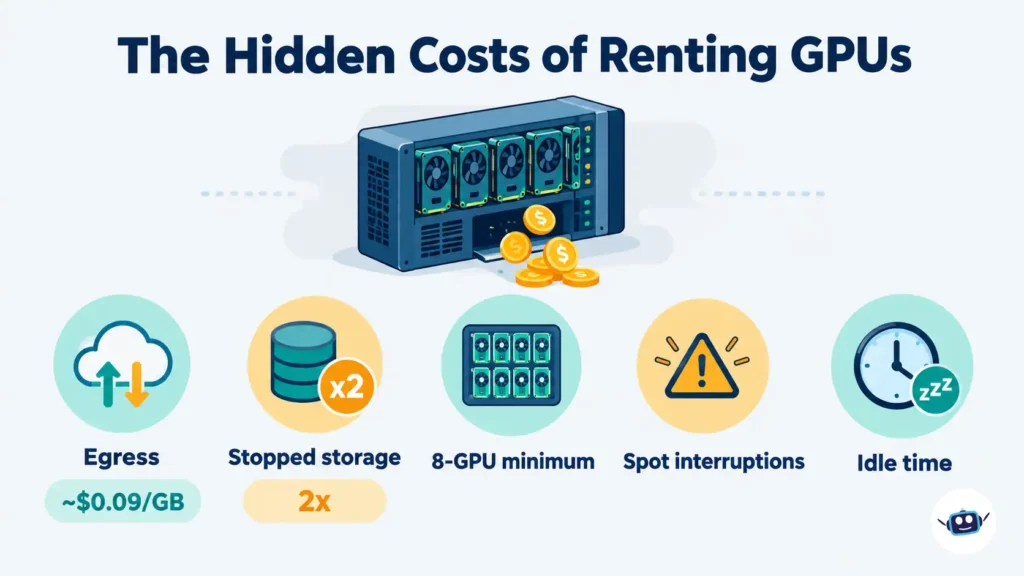
The hourly rate is only part of what you pay.
Data egress. Hyperscalers charge for data leaving their network. At the commonly cited $0.09 per GB, moving 5 TB out costs about $450. RunPod’s documentation states there are no ingress or egress fees on Pods.
Storage that bills while the GPU is off. On RunPod, a stopped volume disk costs $0.20 per GB per month, double the running rate. For a 200GB volume that is $40 a month instead of $20, and a standard network volume would cost about $14.
Minimum bundles. CoreWeave’s H100 pricing is per 8-GPU node, so you cannot rent one GPU. You pay for all eight.
Interruptions. Spot capacity can be reclaimed. AWS gives a two-minute interruption warning, and that is the maximum you should assume anywhere.
Idle time. This is the largest hidden cost of all. A GPU left running overnight costs the same as one training a model.
Rent or Buy? A Simple Break-Even Test
Using $3.00 per GPU-hour as an illustrative on-demand rate:
- Running 24/7 for a year costs about $26,280.
- At 25% utilization, the yearly cost falls to about $6,570.
- An H100 card costs roughly $25,000–$40,000 to buy, before the server, power, cooling and staff.
- A $30,000 card breaks even against rental after 10,000 GPU-hours, about 1.14 years of nonstop use. At $40,000 it takes about 1.5 years.
Rent if your usage is bursty, your project is experimental, or you cannot predict next year’s model size. Buying only makes sense when utilization stays high for years. Remember that buying also locks you into hardware that Blackwell-class chips will eventually outpace.
Common Mistakes When Renting GPU Compute
- Comparing hourly rates only. Add storage, egress, bundle minimums and setup time.
- Leaving instances running. Set auto-shutdown alerts on day one.
- Stopping instead of terminating. Stopped storage can cost double.
- Using spot for jobs with no checkpoints. Save progress to persistent storage every few minutes.
- Over-buying VRAM or under-buying it. Check the table above before you rent.
- Waiting for prices to fall on a long project. The 2026 contract data shows that can backfire.
- Skipping a small test run. One hour on a cheap card tells you more than any benchmark page.
Best Practices
- Prototype on spot or marketplace GPUs, then move steady workloads to reserved or committed capacity.
- Checkpoint often so an interruption costs minutes, not days.
- Keep data close to compute. Cross-region transfers add cost and latency.
- Use per-second billing where available for short jobs.
- Compare providers on cost per result, such as dollars per training run or per million tokens, rather than dollars per hour.
- Track your own utilization. If it stays under 30%, you are probably paying for idle time.
Something New: GPU Rental Is Becoming a Financial Market
CME Group and Silicon Data have announced two compute futures contracts, covering the H100 and the B200, targeted for October 5, 2026, pending regulatory review. Each contract represents one month of rental for the chip and settles against Silicon Data’s published index. Per a Spheron analysis of the launch, settlement is in cash, not hardware.
For a small team this will not change much immediately. It does mean GPU prices will soon have a public reference curve, and it gives a hyperscaler or large lab a way to lock in costs. It may also make the opaque pricing described above easier to read.
Personal Experience: What the Numbers Taught Me
Editor’s note: this section is built from calculations I ran for this article, not from hardware I operated. I’m not claiming I rented GPUs. If you have your own rental history, replace these observations with it before publishing, because first-hand experience is what Google’s E-E-A-T guidance rewards.
When I modelled a two-week, 8-GPU H100 run (336 hours) at published rates, the result surprised me. AWS p5.48xlarge came to about $18,493, CoreWeave about $16,545, and Azure about $33,036. The gap between the cheapest and most expensive option was larger than the whole AWS bill. Provider choice mattered more than any tuning I could have done to the job.
The second lesson was about idle time. A single GPU at $3.00 an hour, used ten hours a day over 22 working days, costs $660 a month. If only 40% of those hours do real compute, about $264 is useful work and $396 is waiting. Setting an auto-stop timer is the cheapest optimization there is.
The third lesson was storage. I expected GPU time to dominate every bill, but a forgotten 200GB volume costs real money every month. Delete what you do not need.
Frequently Asked Questions
How much does it cost to rent a GPU per hour in 2026?
It depends on the model. Published H100 on-demand rates range from about $1.38 to $12.29 per GPU-hour. Marketplaces and specialist clouds mostly sit between $2 and $4, and hyperscalers are higher.
Is renting a GPU cheaper than buying one?
Usually yes for part-time use. At $3.00 an hour, a $30,000 H100 breaks even after about 10,000 hours of continuous use, which is over a year of 24/7 operation.
What is the cheapest way to rent GPU compute?
Marketplace and spot capacity are cheapest, but they can be interrupted. They suit experiments and jobs that save checkpoints.
Are GPU rental prices going up or down?
Both. One-year H100 contract prices rose almost 40% between October 2025 and March 2026, while on-demand and spot prices stayed lower.
What is the difference between spot and on-demand GPUs?
On-demand capacity stays yours until you stop it. Spot capacity is cheaper but can be reclaimed, and AWS gives a two-minute warning.
Which GPU is best for running LLMs?
Start with memory. A 70B model needs roughly 140GB at FP16 or 35GB at 4-bit for weights alone, so choose VRAM before raw speed.
Do GPU providers charge for data transfer?
Hyperscalers typically do, at about $0.09 per GB out. RunPod states it charges no ingress or egress fees.
Can I rent a GPU by the minute?
Yes. RunPod bills by the second for Pods, and several other providers bill per minute or hour.
What are compute futures?
They are cash-settled contracts tied to a GPU rental index. CME’s first contracts, covering the H100 and the B200, are scheduled for October 5, 2026, pending regulatory review.
Conclusion
Renting GPU compute is cheaper and easier than owning hardware for most teams, provided you manage the details. The 2026 market rewards people who treat spot, on-demand and reserved pricing as separate products and who watch idle time, storage and egress.
Actionable takeaways:
- Calculate VRAM needs before choosing a GPU.
- Compare total cost per job, not the hourly headline.
- Prototype on spot capacity and commit only when usage is steady.
- Checkpoint every few minutes and set auto-shutdown alerts.
- Terminate unused volumes rather than stopping them.
- Re-check prices before each large project, because they move weekly.
Disclaimer: Prices and availability change frequently and vary by region, provider and configuration. Figures here come from public rate cards, market trackers and announcements gathered in September–October 2026, and some third-party figures are provider-published or estimated. The CME contracts remain subject to regulatory review. This article is for information only and is not financial or investment advice. Confirm current pricing on each provider’s official page before you commit.