
Introduction
Most funding announcements about “AI agents” are about the agents themselves. The doxx.net round is about the plumbing underneath them.
On October 1, 2026, Miami-based doxx.net announced a $38 million Series A led by Andreessen Horowitz (a16z), with participation from Animo Ventures and Focal.vc, as it opened its platform to the public in beta. The pitch is a private, parallel network where people and their AI agents can browse, message, call and move files, and where the agents can help configure the network itself.
If that sounds abstract, here is the practical question it answers: what happens when software acts on your behalf, with access to your accounts and files, over a network you don’t control?
This article covers what was announced, how the technology works, what it costs, and the questions the press releases skip. It draws on a16z’s own announcement, the company’s pricing page, and independent reporting.
Quick Answer: What Did Doxx.net Announce?
- Company: doxx.net, based in Miami, founded in 2025 by Barrett Lyon
- Funding: $38M Series A led by a16z, with Animo Ventures and Focal.vc
- Product: an “Agentic Defined Network” (ADN), a private network for people and AI agents
- Status: open beta, after a closed beta that began in December 2025
- Platforms: native apps for iOS, macOS and Android, with Windows and Linux supported
- Pricing: $6/month (Essential) and $16/month (Pro), with a 30-day free trial
Funding and product details come from Refresh Miami’s report and the company’s own pricing page.
What Is Agentic Defined Networking (ADN)?
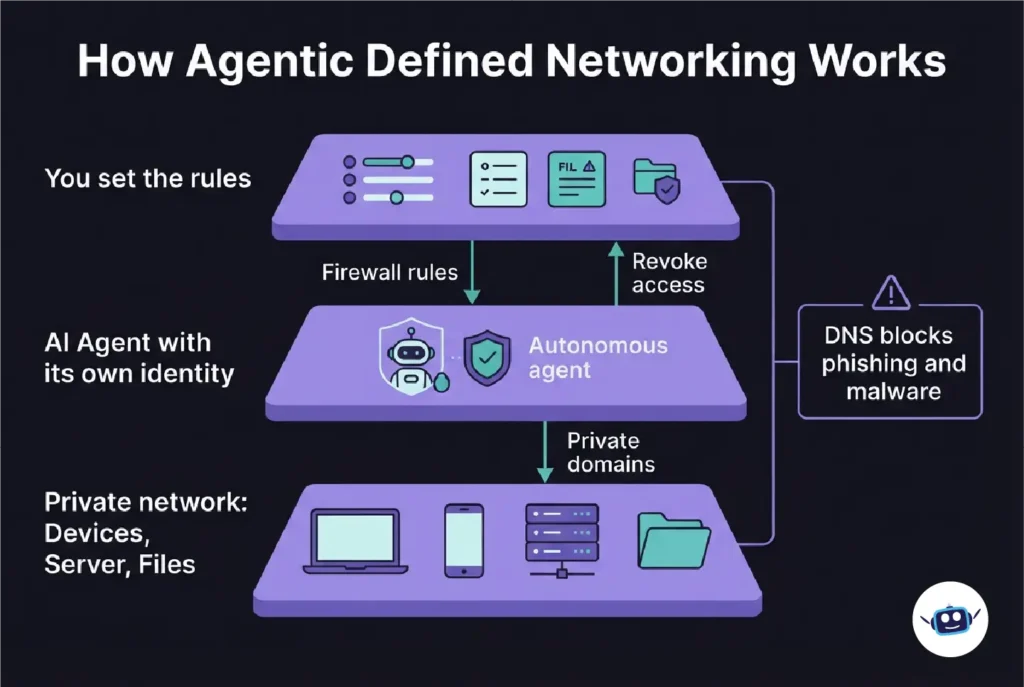
Agentic Defined Networking is doxx.net’s name for a network where AI agents get their own network identity and can configure parts of the infrastructure through an API, within limits the human owner sets.
The idea borrows from software-defined networking (SDN), where network behavior is controlled by software instead of manual hardware setup. a16z’s announcement says doxx.net runs on a software-defined global network where users can create non-internet domains that resolve inside the private network, secured by doxx.net’s own certificate authority.
In plain terms, an agent on the platform can:
- connect devices to the private network
- set firewall rules
- create internal domain names
- open private channels to other devices or agents
A network API with native support for the Model Context Protocol (MCP) is what lets agents do this. The important qualifier is that the agent works under the user’s policies. It isn’t meant to have free rein.
Why a16z Backed It: The SDN Connection Nobody Mentions
The funding story is usually told as “Barrett Lyon is a famous security founder.” That’s true. Lyon founded Prolexic, the DDoS defense company later acquired by Akamai. He also helped build BitGravity (acquired by Tata Communications), XDN (Fortinet) and Defense.Net (F5), according to Refresh Miami.
What gets less attention is who signed the investment post. It’s co-authored by a16z partners Joel de la Garza and Martin Casado. Casado is a networking figure in his own right: he co-founded Nicira, the software-defined networking pioneer that VMware bought for about $1.26 billion.
So this isn’t only a privacy bet or an AI bet. It’s an investor who helped invent software-defined networking backing a team that wants to extend the same idea to autonomous software. For readers following AI infrastructure trends at AI LLM News, that’s the thread worth watching. Money is moving from models toward the layers that make agents safe to deploy.
How the Technology Works
Owned infrastructure instead of rented
The company says its network runs on its own IP space, DNS root, certificate authority and bare-metal servers, according to ZeroHour’s summary of the announcement. Founder Barrett Lyon described the contrast this way: most privacy products route your traffic through rented infrastructure they can’t fully verify. The doxx.net argument is that privacy should come from architecture, not policy.
Peer-to-peer communications
Calls, video, messages and file transfers go directly between devices instead of through a central communications server. The company’s site lists tools such as NetDrop (file transfer) and encrypted group chat with on-device translation.
DNS-level protection for agents
DNS-level security is designed to stop agents from reaching known or suspected phishing and malware destinations. The company says it has blocked more than 38 million threats since its closed beta began in December 2025.
Agent identities and seats
Agents can hold their own network identity. The pricing model treats agents as seats alongside devices, which tells you how the company thinks about them: as first-class network members, not as add-ons to a human account.
Pricing: The Detail Most Coverage Skipped
Funding articles rarely tell you what the product costs. Doxx.net’s pricing page does:
| Plan | Price | Seats | Agent features |
|---|---|---|---|
| Essential | $6/month ($60/year) | 2 devices, 1 agent | DNS protection, private calls, chat and files; no agent network controls |
| Pro | $16/month ($160/year) | 5 devices, 5 agents | Agent network management, Agent Gateway, Agent Identity, MCP and API, private PKI |
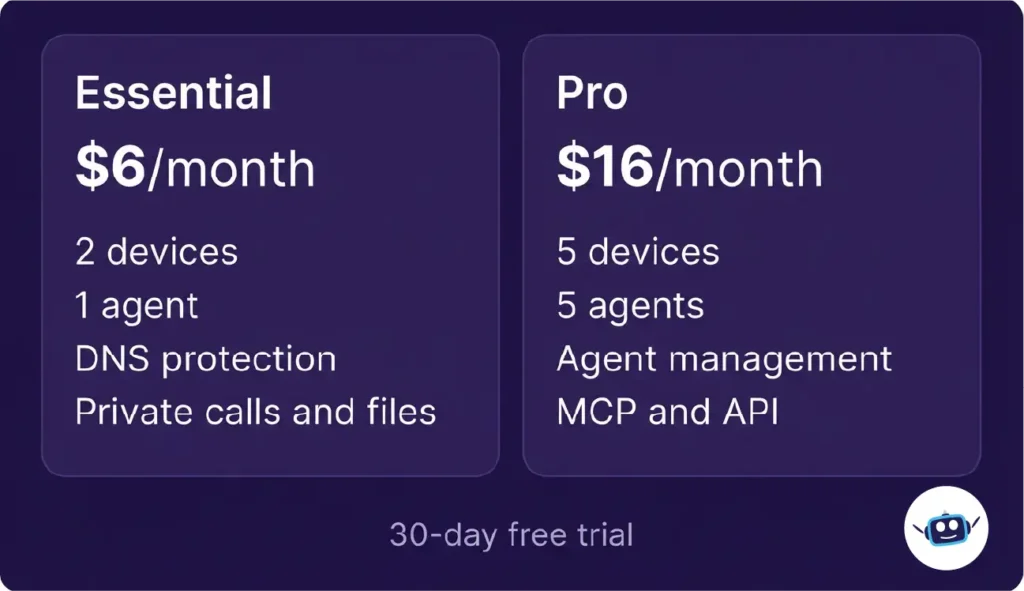
Add-ons are $1/month for an extra device or agent, $10/month for a dedicated IP and $1/month for a doxx.net domain. The beta trial runs 30 days with every Pro feature included.
The detail that matters: the agent-specific features that justify the “agentic” label (agent management, gateway, identity, MCP and API) are all Pro-only. Essential gets you a private network and one agent seat, but not the ability to let that agent configure anything.
The Question the Press Releases Don’t Ask: Who Do You Trust?
The marketing line is “no server in the middle.” That’s accurate for communications paths: independent analysis of a16z’s post makes the point that this is different from saying the service has no company-operated infrastructure. Doxx.net still runs a backbone, DNS and a certificate authority.
That means trust doesn’t disappear. It moves. Instead of trusting a VPN provider’s rented servers, you trust one company that owns the whole stack, including the CA that vouches for your private domains. That can be a stronger model or a more concentrated one, depending on your threat model.
Two claims are worth separating:
- Verifiable in principle: what the architecture is and how many devices or agents your plan allows
- Taken on trust: the “zero-log” claim. In the sources I reviewed, I did not find an independent audit of it
Neither point is a knock on the company. It’s the same diligence you’d apply to any privacy provider.
Doxx.net vs. Tailscale: Is It Really “Tailscale for Agents”?
An early crypto-news writeup described the product as “Tailscale built for AI Agents”. That’s a third-party analogy, not the company’s own positioning, but it’s a useful starting point.
Tailscale connects your devices into a private mesh. The difference described in that coverage is that on doxx.net, agents don’t just connect to the network. They can actively change it: onboarding devices, adjusting firewalls, creating domain names. The platform’s job is to scope each agent to the machines and services it is authorized for, and to revoke access instantly.
My view: the comparison works for the mesh idea but undersells the part that is new, which is agents as network administrators with limits.
Real-World Examples
A solo developer with an always-on agent. You run an AI agent on a Mac mini at home. You want it to reach one server and nothing else. With agent-level network scoping, you restrict it to that single destination and cut access when the job ends.
A small team sharing files with agents. Instead of uploading sensitive documents to a cloud service, devices and agents on the private mesh transfer files directly.
A privacy-conscious professional. A journalist or lawyer wants calls and messages that don’t pass through a central communications server, plus DNS filtering while an agent browses on their behalf.
These are use cases the company’s materials describe. Whether they work smoothly at scale is what the beta is for.
Benefits
- Scoped agent access: each agent reaches only what it’s authorized to reach
- Fewer intermediaries: peer-to-peer comms reduce the number of third-party servers in the path
- Built-in DNS filtering: known phishing and malware destinations are blocked at the network layer
- Low-friction signup: you can start without an email address, phone number, username or password, according to Refresh Miami
- Transparent pricing: a published, simple seat-based model
Common Mistakes to Avoid
- Treating “private” as “unaccountable.” An agent that can change your firewall needs tighter review, not looser.
- Giving agents more seats and permissions than the task needs. Start with the minimum and expand.
- Skipping the trial. The 30-day trial includes Pro features, so test agent controls before committing to a plan.
- Assuming Essential covers agent management. It doesn’t.
- Confusing beta with production-ready. The platform is in open beta. Don’t move critical workloads without a fallback.
Best Practices If You Try It
- Test with a low-stakes agent first, and give it a single destination.
- Confirm you can revoke access instantly, then actually do it once.
- Review which agent actions are logged on your side, since “nothing to log” refers to provider-held logs, not your own audit needs.
- Keep a conventional backup path (a standard VPN or direct connection) while you evaluate.
- Read the privacy policy and terms linked from the company’s site before sending sensitive data.
Personal Experience: What I Learned Checking the Sources
I’ll be upfront about what this section is. It’s not a product review based on months of use. It’s what stood out when I cross-checked the announcement against primary sources.
The headline number isn’t perfectly consistent. One Dealroom summary of an Axios Pro report lists $24.6M in its description but $38M in its headline. a16z’s investment post, the company’s launch announcement and coverage in Refresh Miami all point to $38M. When one outlet’s numbers disagree with the rest, I defer to the investor and company statements, and I say so.
The pricing page told me more than the funding stories. I expected “agentic” to be a feature across the product. It’s not: the agent controls sit in the $16 tier. That’s a useful filter for anyone deciding whether this fits.
“No server in the middle” needs a footnote. The more I read, the clearer it was that the claim is about the communications path, not about the absence of company infrastructure.
What I haven’t done: I haven’t run packet captures, tested the zero-log claim, or put an agent through a production workload. If you try the 30-day trial, those are the tests I’d run first, and I’d publish what I found.
The lesson: with funding news, read the pricing page and the investor’s own post before the coverage.
FAQs
What is doxx.net?
Doxx.net is a Miami-based networking company that offers a private, parallel network for people and AI agents. It calls the category Agentic Defined Networking.
How much did doxx.net raise and who led it?
It raised a $38 million Series A led by Andreessen Horowitz, with Animo Ventures and Focal.vc participating.
Who founded doxx.net?
Barrett Lyon, who previously founded Prolexic (acquired by Akamai) and helped build BitGravity, XDN and Defense.Net.
What is Agentic Defined Networking?
It’s a network model where AI agents have their own identities and can help configure network settings, such as firewalls and private domains, under the owner’s rules.
How much does doxx.net cost?
Essential is $6/month and Pro is $16/month, with yearly options of $60 and $160. A 30-day trial includes all Pro features.
Can AI agents really change my network settings?
According to the company and a16z, agents can connect devices, set firewall rules and create private connections under the user’s policies. Agent controls are in the Pro plan.
Is doxx.net the same as a VPN?
Not exactly. It includes private browsing and DNS protection like a VPN, but adds peer-to-peer communications, agent identity and an API for agents.
Is doxx.net safe to use?
It’s in open beta, and its zero-log claim is the company’s own. I didn’t find an independent audit in the sources reviewed, so evaluate it against your own risk level.
Which devices does it support?
Native apps for iOS, macOS and Android, plus support for Windows and Linux.
Conclusion
The $38M round matters less for the dollar figure than for what it signals: investors are starting to fund the infrastructure that decides what autonomous software is allowed to touch. Doxx.net’s answer is a private network that agents can help configure, but only within limits you set.
The idea is credible, especially given the backgrounds of Lyon and a16z’s Casado. The open questions are the ordinary ones for any beta privacy product: independent verification, how the trust model holds up, and how well agent permissions work in practice.
Actionable Takeaways
- Use the 30-day trial to test one low-risk agent on one destination.
- Choose Pro only if you need agent management, MCP/API or private PKI.
- Verify revocation works before you rely on it.
- Keep a fallback connection during the beta.
- Follow AI LLM News for updates as agent-infrastructure funding and security stories develop.
Disclaimer: This article is for information only and is not financial, investment or security advice. Details are based on public sources as of October 4, 2026, and the product is in beta, so features, pricing and claims may change. Verify current terms on the company’s website. Privacy and security claims are the company’s own unless stated otherwise. The author has no financial relationship with doxx.net or its investors.