

Last verified on October 8, 2026 against Anthropic’s launch page, model documentation and migration guide.
On October 7, 2026, Anthropic released Claude Haiku 5.5, and the headline wrote itself: small-model API prices down about 75%. If you run summarization, classification or subagent workloads on Haiku 4.5, that number deserves a closer look before it goes into a budget. The cut is real. But “75%” is an average built from a 90% list-price drop, a 50% drop on long prompts, and a tokenizer change that quietly pushes token counts up. Where your own bill lands depends on how long your prompts are and how hard the model thinks.
This guide works from the primary sources: Anthropic’s announcement, its migration guide and its deprecation table. It adds a few things most launch coverage skipped, including a 100,000-token pricing cliff, a way the new tokenizer can push a prompt across it, and what independent testing says about the cost of a finished task rather than a single token.
Claude Haiku 5.5 in one paragraph: Claude Haiku 5.5 is Anthropic’s cheapest, fastest small model, released October 7, 2026 under the API ID claude-haiku-5-5. It costs $0.10 per million input tokens and $0.50 per million output tokens for prompts up to 100,000 tokens ($0.50 and $2.50 above that), offers a 1M-token context window and up to 128K output tokens, and Anthropic says it costs about 75% less to run than Haiku 4.5 on average.
What Is Claude Haiku 5.5?
Claude Haiku 5.5 is the newest model in Anthropic’s small-model tier, and the company calls it the cheapest, fastest and most capable small model it has released. It is aimed at high-volume work such as summaries, compactions, database queries and classification, plus speed-sensitive jobs like live customer support and browser use. Anthropic also pitches it as a subagent that runs alongside Opus 5.5 and Sonnet 5.5 on coding work.
The specs, as listed on Anthropic’s models overview page, are a 1M-token context window, 128K maximum output, adaptive thinking with a default effort of medium, and a reliable knowledge cutoff of June 2026. It is the first Haiku-class model with an adjustable effort setting, so you can trade intelligence for cost the way you already can with larger Claude models. It takes text and image input and returns text only. At launch it is available on the Claude Platform, Amazon Web Services, Google Cloud and Microsoft Azure.
Claude Haiku 5.5 Pricing at a Glance
| Price per 1M tokens | Haiku 5.5 (prompt ≤100K) | Haiku 5.5 (prompt >100K) | Haiku 4.5 | Sonnet 5.5 |
|---|---|---|---|---|
| Input | $0.10 | $0.50 | $1.00 | $2.00 |
| Output | $0.50 | $2.50 | $5.00 | $10.00 |
| Cache reads | $0.01 | $0.05 | $0.10 | $0.10 (was $0.20) |
| Cache writes | $0.125 | $0.625 | $1.25 | $2.50 |
Those figures come straight from the pricing table on Anthropic’s launch page, and the full rate card, including batch discounts, lives in the Claude pricing docs if you need it.
Why the headline says 75% when the list price drops 90%
Anthropic’s footnote explains it. List prices are 90% lower than Haiku 4.5 for requests up to 100,000 tokens and 50% lower above that line. About 90% of Haiku 4.5 requests fell under it. The calculation then accounts for an updated tokenizer that makes Haiku 5.5 use slightly more tokens per task. Blend all three and you get roughly 75%.
The footnote doesn’t publish its weighting, so I backed into it. Weight by request count (90/10) and add 30% more tokens, and the saving comes out near 82%, not 75%. To land at 75%, longer prompts would need to represent roughly 23% of spend, which is believable, because one 150,000-token request costs far more than a 3,000-token one even at the lower rate. That is my own reverse-engineering, not an Anthropic number. It does explain the practical split: short-prompt workloads should beat the headline, and long-context workloads will fall short of it.
The Costs the Headline Doesn’t Show
The tokenizer adds roughly 30% more tokens
Anthropic’s migration guide says Haiku 5.5 uses the same newer tokenizer as Claude 4.7 and later models, and the same text produces approximately 30% more tokens than it did on Haiku 4.5, with the exact increase depending on content. The consequences are practical: usage fields climb, a max_tokens limit tuned for Haiku 4.5 may cut off equivalent output, and every old cost estimate needs recomputing. Count your prompts with the model set to claude-haiku-5-5 instead of reusing old numbers.
The 100,000-token cliff
Pricing jumps fivefold once a prompt passes 100,000 tokens. Anthropic labels the tiers “prompts up to / over 100k,” and coverage that works through example bills, such as this VentureBeat breakdown of the tier boundary, treats the higher rate as applying to the whole request rather than only the tokens above the line. The arithmetic fits: a call with 200,000 input and 20,000 output tokens comes to $0.15.
Here is what that does to a single call with 2,000 output tokens, calculated from the published rates:
| Input tokens | Haiku 5.5 cost per call |
|---|---|
| 90,000 | $0.0100 |
| 100,000 | $0.0110 |
| 100,001 | $0.0550 |
| 150,000 | $0.0800 |
| 200,000 | $0.1050 |
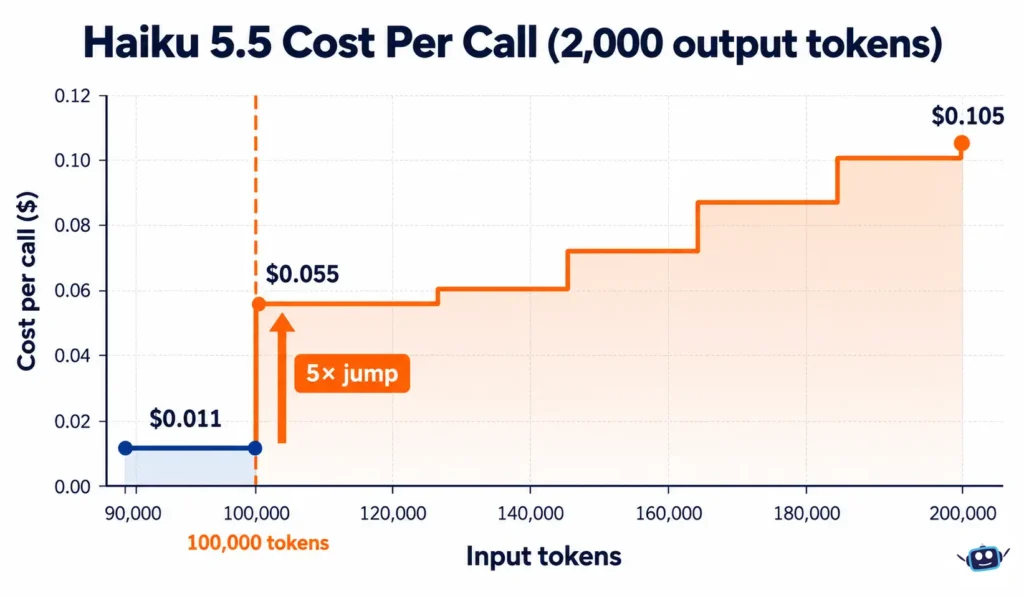
One extra token turns an $0.011 call into a $0.055 one. Confirm how your prompt tokens are counted, including cached portions, against the pricing docs before you build a forecast on this.
When the tokenizer and the cliff collide
If the tokenizer inflates counts by about 30%, a prompt that measured around 77,000 tokens on Haiku 4.5 now measures around 100,000. Anything larger than that old size can land in the expensive tier, though the real ratio varies with content. For retrieval pipelines, long-document analysis and agent loops that sit in the 70K to 100K band, this can erase most of the savings. Fine print that changes the real price is hardly unique to AI: our guide to why renting GPU compute now has three prices for the same chip makes the same point about hardware.
Effort level moves the bill more than the price list
Independent testing adds a third variable. Artificial Analysis, as reported by Implicator, found Haiku 5.5 at maximum effort used about 162,000 output tokens per Intelligence Index task, roughly three times GPT-6 Luna’s 50,000. Other write-ups citing the same testing put the max-effort cost near $0.21 per task against about $0.07 for Luna, and about $0.08 at high effort. These are launch-week figures reported second-hand, and one report notes the cost numbers didn’t yet reflect the tiered pricing, so treat them as direction rather than gospel. The direction is still clear: the effort setting you choose can matter more than the per-token rate.
Claude Haiku 5.5 vs GPT-6 Luna
On short prompts the two models share an identical sticker price. The differences sit in the tiers, the verbosity and the benchmark results.
| Claude Haiku 5.5 | GPT-6 Luna | |
|---|---|---|
| Input / output per 1M tokens | $0.10 / $0.50 | $0.10 / $0.50 |
| Where the price steps up | Above 100K tokens | Above 272K tokens (per launch reporting) |
| 200K in / 20K out, one call | $0.15 | $0.03 |
| GDPval-AA v2.1 | 1620 | 1437 |
| OSWorld 2.1 (offline subset) | 72.4% | 48.9% |
| Terminal-Bench 4.0 | 39.2% | 16.4% |
| FrontierCode 1.1 (Main) | 46.4% | 42.4% |
The benchmark rows are Anthropic-reported, so they reflect the vendor’s own test setup. They suggest Haiku 5.5 is the more capable model at the same list price, while the cost-per-task data above suggests Luna may be cheaper to run if your workload doesn’t need that extra capability. The honest answer is that neither wins in the abstract. Run your own task set through both.
Where Claude Haiku 5.5 Fits, and Where Anthropic Says It Doesn’t
Anthropic is unusually direct about the limits. Its launch page says Sonnet 5.5 and Opus 5.5 remain the better choice for complex agentic coding, and that Haiku 5.5 suits narrowly scoped work that might have been too expensive before, such as compaction, summarization and subagent tasks. The numbers back that up: on Terminal-Bench 4.0 Haiku 5.5 scores 39.2% against 70.6% for Sonnet 5.5.
The early customer results Anthropic quotes are all of the high-volume, short-task kind:
- Asana reported over 30% lower latency and up to 2.5x faster inference per agent turn in its AI Teammates evaluation suite.
- AlphaSense measured 0.84 versus 0.76 for Haiku 4.5 on 400 production-style queries for a feature that handles about 8 million calls a week.
- Box saw an 11-point improvement at about half the latency.
These are vendor-selected testimonials, so read them as signals about fit rather than guarantees. If you are still deciding how much autonomy a coding agent should get at all, our comparison of AI coding agents versus chatbots is a useful companion piece.
Good fits: ticket triage, document summarization, extraction and classification, database query drafting, context compaction in long agent sessions, and the “worker” role in a multi-agent setup. Poor fits: long, ambiguous, multi-hour coding tasks.
Migrating From Haiku 4.5: What Will Break
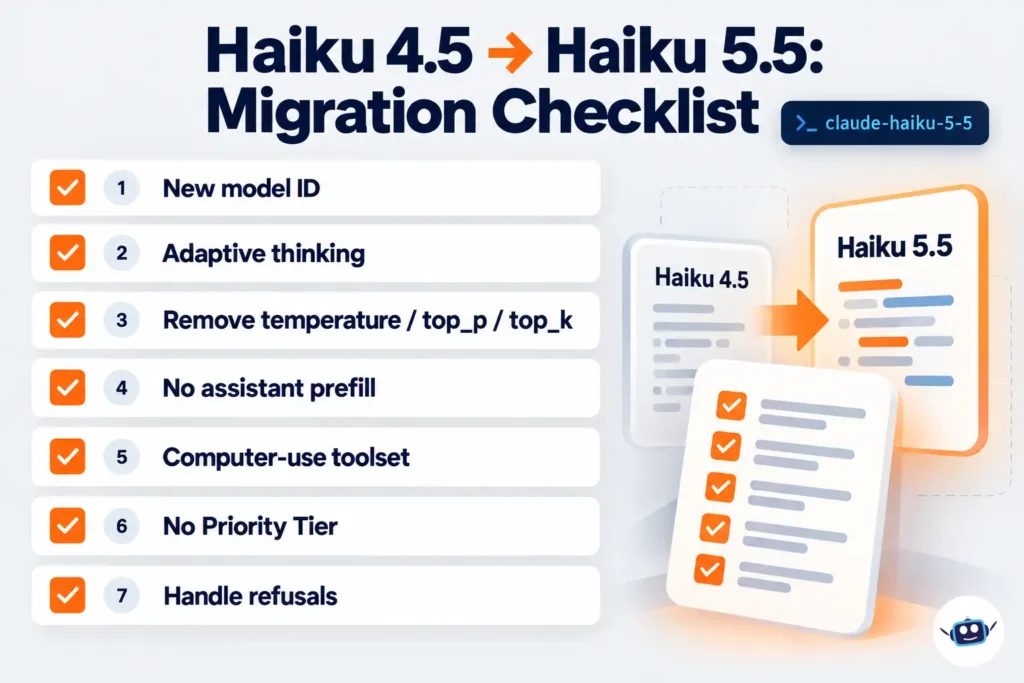
The model ID swap is the easy part. The migration guide lists changes that return errors or alter behavior:
- New model ID.
claude-haiku-5-5is a fixed ID with no date suffix and no alias. - Thinking config.
thinking: {"type": "enabled", "budget_tokens": N}returns a 400 error. Use adaptive thinking and setoutput_config.effortinstead. - Sampling parameters.
temperature,top_pandtop_kmust be removed. Non-default values return a 400 error. - Assistant prefill. A final assistant turn is rejected with a 400 error, even with thinking off. Use structured outputs or tool enums instead.
- Computer use. On the Claude API and Google Cloud, only the
computer_toolset_20260801toolset is supported. - Priority Tier. It is not supported on Haiku 5.5, so plan capacity separately if you rely on it.
- Refusals. Haiku 5.5 runs safety classifiers that can decline requests and has no server-side fallback, so handle
stop_reason: "refusal".
On safeguards, Anthropic says Haiku 5.5’s cybersecurity protections are more restrictive than Haiku 4.5’s and still block penetration testing and similar techniques. Security teams should test their own prompts early.
Is Haiku 4.5 about to be shut down?
Some coverage framed October 15 as a hard deadline. When I checked Anthropic’s model deprecations page on October 8, Haiku 4.5 was listed as Active, with a tentative retirement date of “not sooner than October 15, 2026.” That is a floor, not a scheduled shutdown, and Anthropic says it gives at least 60 days’ notice before retiring publicly released models. You have time to migrate carefully, but not an excuse to wait.
Money Beyond the Model
Two other changes landed the same day. Anthropic halved Sonnet 5.5’s cache-read price from $0.20 to $0.10 per million tokens, which it says cuts Sonnet 5.5 costs by around 20% on most agentic work. It also announced monthly API credits for subscribers: $100 for Max 5x, $200 for Max 20x and up to $500 pooled for Team, usable on any model on the Claude Platform. Details are in Anthropic’s Help Center article, and the SDKs gained beta support for computer use and browser use.
Personal Experience: What the Numbers Taught Me
I want to be upfront about what I did and didn’t do. I haven’t load-tested Haiku 5.5 on a production workload, so every performance figure in this article is someone else’s measurement and is labeled that way. What I did do was rebuild the pricing math from the published rates, because I didn’t want to repeat “75%” without understanding it. Four lessons came out of that.
The headline hides a wide range. I modeled one million support-ticket summaries at 3,000 input and 300 output tokens each. On Haiku 4.5 that costs $4,500. On Haiku 5.5, after adding 30% for the tokenizer, it costs about $585, a saving near 87%. Short, repetitive jobs beat the average easily.
Caching changes the picture even more. A 50,000-token cached prefix reused 1,000 times, with 500 fresh input and 200 output tokens per call, came to roughly $6.56 on Haiku 4.5 and $0.66 on Haiku 5.5 in my calculation. If your workload is cache-heavy, the cache-read price matters more than the input price.
The cliff was the surprise. I only noticed the interaction between the tokenizer and the 100,000-token line while recounting prompt sizes. A prompt I’d have called safely under the threshold at about 80,000 tokens could cross it after migration. That is exactly the kind of thing that turns a good forecast into a bad invoice.
Read the status tables, not the summaries. The “October 15 deadline” framing fell apart the moment I opened the deprecations page. Primary sources took five minutes and saved me from passing along an overstatement.
If I were migrating tomorrow, I would start at low effort, cap max_tokens, recount tokens on a real sample of production prompts, and only raise effort where an evaluation shows a measurable gain.
Best Practices for Using Claude Haiku 5.5
- Recount before you forecast. Use the new model for token counting, never the old counts.
- Start at low or medium effort. Raise it only where your own evals justify the extra tokens.
- Keep prompts under 100K where you can. Chunk, summarize or cache so most requests stay in the cheap tier.
- Use caching deliberately. At $0.01 per million cache-read tokens, a stable prefix is the cheapest input you will ever send.
- Pair it with a bigger model. Let Sonnet 5.5 or Opus 5.5 plan, and let Haiku 5.5 handle the many small jobs.
- Evaluate on your tasks. Vendor benchmarks and your invoice rarely agree.
Common Mistakes to Avoid
- Budgeting from the 90% list-price drop instead of the blended cost per finished task.
- Forgetting the tokenizer change and under-setting
max_tokens. - Leaving effort at maximum by default.
- Sending 90,000-token prompts and assuming they are still cheap after migration.
- Carrying over
temperature, prefill or budget-based thinking code and hitting 400 errors in production. - Using Haiku 5.5 for long, complex coding sessions where Anthropic itself recommends Sonnet or Opus.
Frequently Asked Questions
How much does Claude Haiku 5.5 cost?
For prompts up to 100,000 tokens, it costs $0.10 per million input tokens and $0.50 per million output tokens. Above 100,000 tokens, the rates are $0.50 and $2.50. Cache reads cost $0.01 and $0.05 per million tokens respectively.
Is Claude Haiku 5.5 really 75% cheaper than Haiku 4.5?
On average, according to Anthropic. The figure blends a 90% list-price cut for prompts up to 100,000 tokens, a 50% cut above that, and the extra tokens the new tokenizer uses. Short-prompt workloads can save more than 75%, while long-prompt workloads will save less.
What is the Claude Haiku 5.5 model ID?
On the Claude API it is claude-haiku-5-5. On Amazon Bedrock it is anthropic.claude-haiku-5-5. It has no date suffix and no separate alias.
Is Claude Haiku 5.5 cheaper than GPT-6 Luna?
The list prices match at $0.10 and $0.50 per million tokens on short prompts. Luna’s price steps up above 272,000 tokens, while Haiku’s steps up above 100,000. Early independent testing also suggests Haiku 5.5 can use many more output tokens at high effort, so cost per task may differ from the sticker price.
What is the Claude Haiku 5.5 context window?
It supports a 1M-token context window and up to 128K output tokens. Prompts above 100,000 tokens are billed at the higher rate.
Should I use Haiku 5.5 or Sonnet 5.5 for coding?
Use Haiku 5.5 for narrow, high-volume tasks and as a subagent. Anthropic recommends Sonnet 5.5 or Opus 5.5 for complex agentic coding, and its own Terminal-Bench 4.0 results show Sonnet 5.5 well ahead.
Is Claude Haiku 4.5 being retired?
Not yet. Anthropic’s deprecation table lists it as Active with a tentative retirement date of not sooner than October 15, 2026, and Anthropic commits to at least 60 days’ notice for publicly released models.
What breaks when migrating from Haiku 4.5?
Budget-based thinking, non-default temperature, top_p and top_k values, assistant prefill and the old computer-use tool all return errors. Token counts also rise by roughly 30%, and Priority Tier is not supported.
Do Claude Max and Team subscribers get API credits?
Yes. Anthropic announced monthly Claude Platform credits of $100 for Max 5x, $200 for Max 20x and up to $500 pooled for Team subscribers, rolling out the week of the launch.
Conclusion: Real Savings, With Fine Print
Claude Haiku 5.5 is a genuine price reset for small models. For short, repetitive, high-volume work, the savings can exceed Anthropic’s 75% headline. For long prompts, verbose settings or workloads that hover near the 100,000-token line, they can be much smaller. The model is strongest where Anthropic says it is: summaries, classification, extraction, compaction and subagent work.
Actionable takeaways
- Recount your real prompts with
claude-haiku-5-5before forecasting anything. - Check how many requests sit between 70,000 and 100,000 tokens, because the tokenizer can push them into the higher tier.
- Start at low or medium effort and measure cost per finished task.
- Audit your code for prefill, sampling parameters and budget-based thinking before you switch.
- Keep Sonnet 5.5 or Opus 5.5 for complex agentic coding.
- Follow our wider LLMs and models coverage for updates as independent benchmarks and pricing details settle.
Disclaimer
This article is for general information only and is not financial, legal or technical advice. Prices, limits and availability reflect Anthropic’s documentation as checked on October 8, 2026 and may change. Cost examples are our own illustrative calculations from published list rates, not guarantees of what you will pay. Benchmark results and customer quotes are vendor-reported unless stated otherwise, and third-party figures are early and reported second-hand. Always confirm current details in Anthropic’s official documentation before making purchasing or architecture decisions. See our editorial process for how we research and correct our content.