
Last verified: October 10, 2026, against Nvidia’s newsroom, Microsoft’s launch coverage and live retailer listings. Preorders ship from October 16.
The first wave of Nvidia RTX Spark agentic AI laptops is now on preorder from Microsoft, ASUS, Dell, HP and Lenovo, and the headline numbers are easy to repeat: prices start at $2,599.99 and the most loaded configuration reaches $6,999.99. What those numbers hide is more useful. The $7,000 figure belongs to exactly one configuration. The cheapest listings may not even use the full chip. And the memory you actually need for local AI agents costs very different amounts depending on whose store you order from.
This guide goes through every model that is available to preorder, explains what “agentic” means on a laptop, and works out the upgrade math that most launch coverage skips. If you are deciding whether to preorder before the October 16 ship date, you should be able to answer that by the end.
Quick answer: what are Nvidia RTX Spark agentic AI laptops?
Nvidia RTX Spark is an Arm-based superchip for Windows laptops and small desktops. According to Nvidia’s launch announcement, it pairs a Blackwell RTX GPU with up to 6,144 CUDA cores and a 20-core Grace CPU over NVLink-C2C, with up to 1 petaflop of AI compute and up to 128GB of unified memory. “Agentic” means the laptop is designed to run AI agents locally, meaning software that can search your files, use apps and complete multi-step tasks, inside operating-system controls.
Key facts at a glance:
- Preorder start: October 7, 2026, with shipping scheduled for October 16
- Starting price: $2,599.99 (Surface Laptop Ultra and ASUS ProArt P14)
- Highest listed price: $6,999.99 (ASUS ProArt P16 with 128GB and 2TB)
- Memory options: 24GB, 32GB, 48GB, 64GB and 128GB of unified memory
- Brands: Microsoft, ASUS, Dell, HP and Lenovo, with MSI also announced
What “agentic AI laptop” actually means
Plenty of laptops already run an AI assistant. The difference here is that the agent is allowed to do things. In the same announcement, Nvidia describes open-source agents such as OpenClaw and Hermes Agent that can run tasks in Windows applications, reason across apps and semantically search local files. The sticking point, Nvidia says, has been running them securely on a primary PC.
Two pieces address that. The first is NVIDIA OpenShell, a runtime that lets you set policies for what an agent can and cannot do, route queries to local models based on your privacy rules, and mask personal information before anything goes to a cloud model. The second is Windows itself. At the launch event, as Tom’s Hardware reported, Microsoft moved Execution Containers to general availability. These are OS-integrated sandboxes that decide what data an agent can see, and Windows will require agents to attribute their actions to themselves.
A practical example from that event: Microsoft’s Copilot team showed an agent gathering tax documents for an accountant, renaming them, zipping them and drafting an email for the user to approve. It used a mix of local and cloud models. That detail matters, because “local” on these machines does not automatically mean “offline.”
Every RTX Spark laptop on preorder right now
Pricing below combines Microsoft, ASUS and HP store listings with Best Buy preorders and PCWorld’s launch roundup. Prices are US dollars and move with configuration.
| Laptop | Screen | Starting price | Highest reported | Notes |
|---|---|---|---|---|
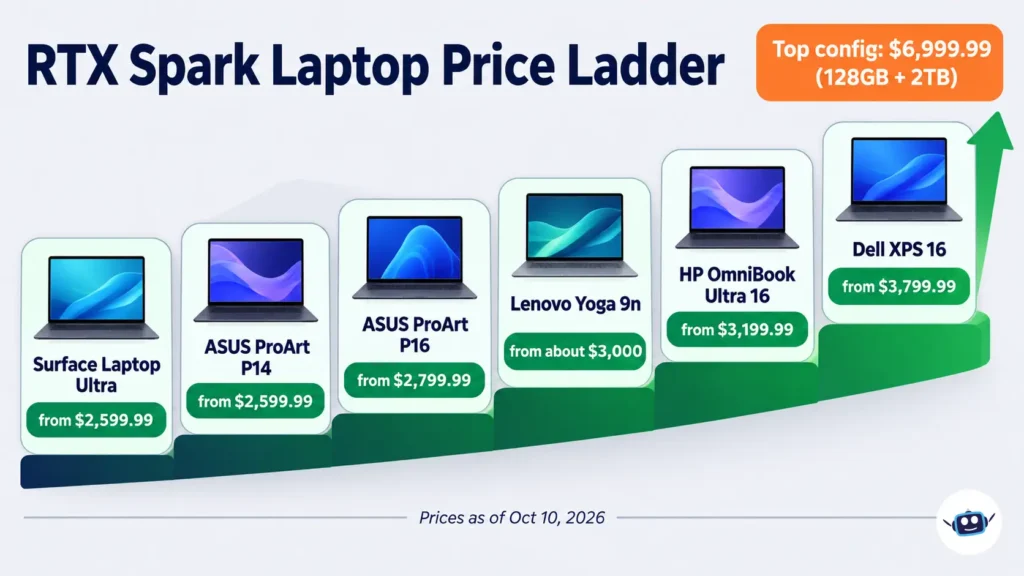
| Microsoft Surface Laptop Ultra | 15-inch touchscreen | $2,599.99 | about $5,900 | 4.41 lb, 92 Wh battery, magnetic USB-C charging |
| ASUS ProArt P14 | 14-inch OLED | $2,599.99 | about $6,500 | Lightest at 3.26 lb |
| ASUS ProArt P16 | 16-inch 4K OLED | $2,799.99 | $6,999.99 | The “$7,000” configuration |
| Lenovo Yoga 9n | 16-inch OLED 2-in-1 | about $3,000 | about $4,500 | Convertible with a stylus in the box |
| HP OmniBook Ultra 16 | 16-inch 3K OLED | $3,199.99 | $5,309 (128GB) | 128GB from $5,309; the 14-inch OmniBook X is $5,109 |
| Dell XPS 16 Creator Edition | 16-inch OLED | $3,799.99 | not yet listed | Highest entry price |
Two more notes. HP also lists a 14-inch OmniBook X from $2,999.99, although PCWorld says it did not appear ready for the October launch. And MSI has announced a Prestige N16, but no preorder page turned up in the sources checked.
Where the $7,000 figure comes from
The “up to $7,000” headline traces back to one listing. As Tom’s Hardware’s preorder tracker notes, ASUS sells the ProArt P16 with 128GB of unified memory and 2TB of storage for $6,999.99, and with 64GB from roughly $4,500. In other words, the $7,000 laptop is a particular combination of maximum memory and maximum storage from one brand, not what 128GB costs everywhere. HP’s 128GB models are listed at $5,109 for the 14-inch and $5,309 for the 16-inch, both with 1TB of storage.
The two-chip trap most buyers will miss
Here is a detail that is easy to miss when you are scanning price tables. “RTX Spark” is not one chip. Tom’s Hardware points out there are two versions: a full chip with a 20-core CPU and 6,144-core GPU, and a lower-end version with an 18-core CPU and 5,120-core GPU. Retail listings often say only “RTX Spark N1X,” so you have to read the description to find the core counts.
On the listings Tom’s Hardware reviewed, the smaller chip appeared only on 24GB and 32GB models, while 48GB and above carried the full chip. That makes the cheapest laptops a different product from the expensive ones, not just a lower-memory version of the same thing. According to VideoCardz’s launch report, the Surface Laptop Ultra’s base model is an 18-core, 5,120-core-GPU machine with 24GB, so it sits on the smaller chip.
A caution on accuracy: retailer listings and press reports conflict on a few mid-tier models. Some Best Buy entries describe 32GB configurations as 20-core, while Tom’s Hardware says 32GB models use the smaller chip. Until reviews arrive, treat the core count in the manufacturer’s spec sheet as the source of truth, and check it before you pay.
What you actually pay for memory and storage
Because the whole pitch is local AI, memory is the upgrade that matters. Here is what each step costs across the published configurations.
| Upgrade path | Price difference | What it buys |
|---|---|---|
| HP OmniBook Ultra 16: 32GB to 128GB (both 1TB) | about $2,109 | 96GB more memory, roughly $22 per GB |
| ASUS ProArt P16: 24GB/512GB to 128GB/2TB | $4,200 | 104GB more memory and 1.5TB more storage |
| HP 128GB (1TB) vs ASUS 128GB (2TB) | about $1,691 | Same memory ceiling, different brand and storage |
The HP comparison is the cleanest because storage stays at 1TB. One caveat: depending on which silicon the 32GB HP model carries, part of that $2,109 may be a chip upgrade rather than memory alone.
Storage upsells vary more than you would expect
Storage pricing is just as uneven. Using the rounded Best Buy listings from 9to5Toys’ preorder list, moving the Surface Laptop Ultra from 512GB to 1TB costs about $400, while the same step on the Dell XPS 16 costs about $200. That is a 2x gap for the same capacity jump. Dell also starts higher: Digital Trends notes it gives you 32GB of memory against 24GB on the base Surface and ProArt, but only 512GB of storage at $3,799.99.
Will your model fit? A simple memory rule of thumb
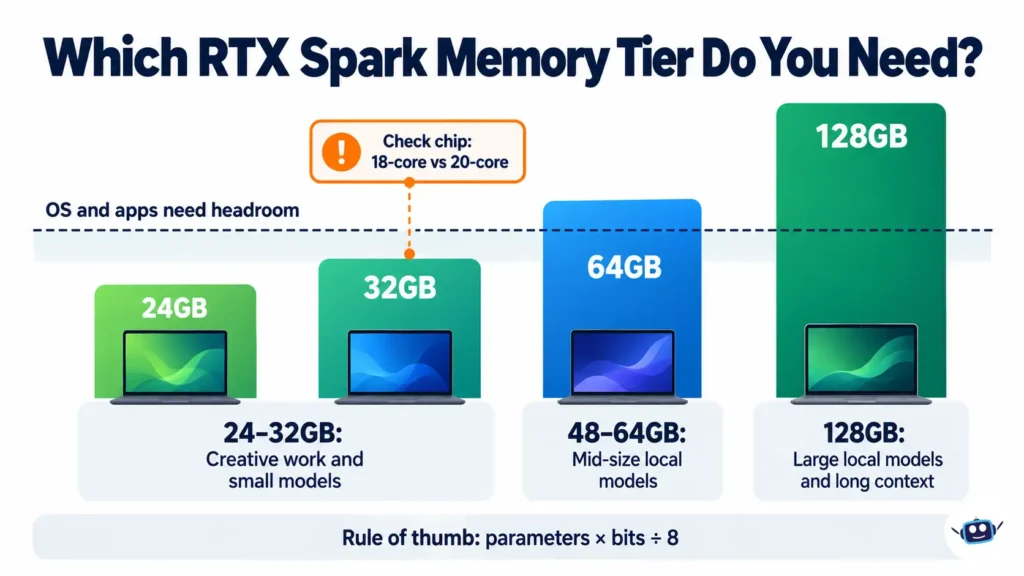
The weights of a model take roughly parameters times bits per weight, divided by eight. This gives a rough floor, and the model also needs working memory for context and your operating system.
| Model size and precision | Approximate weights | Comfortable tier |
|---|---|---|
| 27B at 8-bit | about 27GB | 48GB or more |
| 70B at 4-bit | about 35GB | 64GB |
| 120B at 4-bit | about 60GB | 128GB |
| 137B at about 3.3-bit | about 56.5GB (75.5GB reported peak) | 128GB |
These are estimates calculated from published figures, and the 137B row uses a number AI LLM News reported from a single source. Microsoft’s own demo gives another reference point. Per Tom’s Hardware’s event coverage, DeepSeek V4 Flash at 1.6 bits can run locally in about 60GB. That already exceeds a 48GB laptop before you count the operating system.
The takeaway: 24GB and 32GB machines are excellent for creative work and smaller models, but the “run a very large model locally” demos point at 64GB and above, with 128GB as the comfortable choice.
Power, battery and portability: the open questions
Nvidia says RTX Spark laptops can be as slim as 14mm and as light as three pounds, with all-day battery life. Independent proof is missing. PCWorld’s analysis notes that Microsoft said battery life details for the Surface Laptop Ultra would come closer to availability, and that the laptop ships with a 140W adapter, a sign it can draw far more power than a typical thin laptop.
That led to an interesting practical question: can you run agents all the way through a long flight? Airline seat power varies, and PCWorld’s reporting cites outlets in the 60W to 100W range as common, below what this laptop’s charger supplies. Do not plan a flight-day workflow around these machines until reviewers test sustained loads on battery.
What is ready now and what is still “coming soon”
Containment is real and shipping. Microsoft Execution Containers are generally available, and Microsoft said its hybrid local and cloud coding setup for GitHub Copilot is slated for October 15. Other features, such as Copilot’s local files and actions, were described as rolling out over the next few months. Our deeper breakdown in Surface Laptop Ultra and Agentic Windows separates the shipping features from the promised ones, so you know what you can use on day one.
Who should preorder, and who should wait
Preorder if you are an AI developer or small team that wants private, local inference, a creator who needs large unified memory for 3D, video or diffusion workflows, or someone who wants one machine for creating and gaming. For those buyers, the 64GB and 128GB tiers are where the platform makes sense.
Wait if you mainly want a thin everyday laptop, you depend on niche x86 software or drivers, or you need proven battery life. Remember that this is a Windows on Arm platform, so older apps run through emulation. Microsoft’s launch demos did not settle every compatibility question.
For context, there are cheaper ways to get on-device AI. Snapdragon X2 laptops start far lower, and our guide to AI coding agents versus chatbots can help you decide whether you need an autonomous agent at all.
Benefits worth caring about
- Large unified memory in a portable body. Up to 128GB shared between CPU and GPU lets big models stay in memory instead of being split across pools.
- Full CUDA and RTX software. Nvidia says the full stack, including TensorRT and OptiX, is available, which matters for creative and AI development tools.
- Privacy controls built into the platform. OpenShell and Windows containment give you rules for what agents can touch.
- Lower marginal cost for heavy agent use. If you hit cloud usage limits often, local inference moves some work off the meter. Our GPU rental pricing guide shows how quickly cloud costs stack up.
Common mistakes to avoid
- Buying on the starting price. The $2,599.99 model uses the smaller chip and 24GB of memory, so it is not the machine shown in the big-model demos.
- Ignoring the chip tier. Confirm the 18-core or 20-core spec yourself.
- Assuming local means private by default. Hybrid routing can still use the cloud, so check which features stay on the device.
- Trusting vendor multipliers. Microsoft’s claims of 2.1x faster time to first token, 4.3x faster image generation and 6.2x faster video generation versus a MacBook Pro with an M5 Pro are the company’s own tests.
- Skipping an app check. Test your critical Windows apps and drivers on Arm during your return window.
Best practices and tips before you order
- Decide memory first, then storage, and compare the same configuration across brands. A $400 storage step at one store is a $200 step at another.
- If a retailer lists “RTX Spark N1X” without core counts, open the full spec page or the manufacturer’s site.
- Start any new agent with the narrowest folder access that works, and widen it only if needed.
- Read independent reviews after October 16 before paying for the top tier. Many retailers allow preorder changes or cancellations, but check the specific policy.
- Remember desktops are coming later. Microsoft’s Surface RTX Spark Dev Box, with 128GB of memory, begins at $5,999, and compact RTX Spark desktops are expected in November.
Frequently asked questions
When do Nvidia RTX Spark laptops come out?
Preorders opened on October 7, 2026, and the first laptops from Microsoft, ASUS, Dell, HP and Lenovo are scheduled to ship on October 16. Some retailers may ship later depending on stock, and one price tracker reported that Dell had not yet published a ship date on its own store.
How much do RTX Spark laptops cost?
Prices start at $2,599.99 for the Surface Laptop Ultra and ASUS ProArt P14, and top out at $6,999.99 for the ProArt P16 with 128GB of memory and 2TB of storage. In the listings reviewed, configurations aimed at local AI cluster roughly between $3,200 and $5,300, with ASUS’s top tier above that.
What is the cheapest RTX Spark laptop with 128GB of memory?
Among the listings reviewed, HP’s OmniBook X 14 at $5,109 and OmniBook Ultra 16 at $5,309, both with 1TB, are the least expensive 128GB options. ASUS charges $6,999.99 for its 128GB ProArt P16, which includes 2TB of storage.
Is an RTX Spark laptop worth it compared with a MacBook Pro?
It depends on your workload. AI LLM News notes the 16-inch MacBook Pro starts at $2,999, and Microsoft makes performance claims against the M5 Pro, but those tests are the company’s own. Wait for independent side-by-side reviews on battery life and sustained performance.
Can RTX Spark laptops run AI without the internet?
Partly. Nvidia says the platform can run 120-billion-parameter models with up to a million tokens of context locally, and Microsoft’s demo showed the Surface in airplane mode. But the design is hybrid, so some agent tasks may still use cloud models.
Do RTX Spark laptops run all Windows apps?
They run Windows 11 on Arm and use emulation for many x86 apps. Microsoft says hundreds of games will be available on day one, but compatibility varies by app, so test your essential software.
Which RTX Spark laptop is best for local AI?
For most local AI work, look at 64GB or 128GB configurations from Microsoft, HP or ASUS. TechRadar’s pick for small businesses highlights the Surface Laptop Ultra, HP OmniBook Ultra 16 and ASUS ProArt P16, each for a different budget.
What is the difference between the 18-core and 20-core RTX Spark chips?
The 18-core version has a 5,120-core GPU and appears on lower-memory models, while the 20-core version has the full 6,144-core GPU. Always confirm the core count on the spec sheet.
Conclusion: should you preorder?
The first Nvidia RTX Spark agentic AI laptops are a real attempt to make local AI agents practical on Windows, and the platform is serious. But the preorder prices tell a more complicated story than “from $2,599.” The cheapest models are not the ones in the big-model demos, memory upgrades vary widely in cost, and battery life is still unproven.
Actionable takeaways:
- Choose your memory tier first: 24GB to 32GB for creative work, 64GB for mid-size models, 128GB for large local models.
- Verify the chip (18-core or 20-core) in the spec sheet before ordering.
- Compare the same configuration across brands, since HP’s 128GB option is roughly $1,700 below ASUS’s.
- Wait for independent reviews on battery life, thermals and app compatibility if you are not in a rush.
- Check the retailer’s return and cancellation policy before you commit.
Disclaimer: This article reflects publicly available information from Nvidia, Microsoft, retailers and independent outlets as of October 10, 2026. Laptops had not shipped when it was written, so specifications, configurations and prices may change, and performance and battery claims are the manufacturers’ own and unverified. Calculations are the author’s estimates. This is general information, not financial or purchasing advice. All product names and trademarks belong to their respective owners.