
A customer changes an order halfway through a phone call. Understanding the words is only the beginning: the system also has to update the order correctly and confirm what happened.
SoundHound AI builds voice and conversational AI technology for businesses, including customer service, restaurant ordering and vehicle assistants. Its consumer music-identification app is a different product, while SOUN is the company’s Nasdaq stock ticker.
As of October 2026, its business platform centers on OASYS, the Orchestrated Agent System. This guide explains what it does, what pricing is public, how privacy and human assistance work, and what the latest financial results reveal.
Which SoundHound are you looking for?
The name can refer to business software, a music app or a publicly traded company. Your next step depends on which one you need.
| Name you encounter | What it means | Relevant to you if… |
|---|---|---|
| SoundHound AI / OASYS | The company and its platform for building conversational agents | You want to automate customer or employee tasks |
| SoundHound Music | A consumer app for identifying music, including by singing or humming | You want to find a song |
| SoundHound∞ | The paid, ad-free music app | You want the music product without advertising |
| SOUN | SoundHound AI’s Nasdaq ticker | You are researching the company’s shares |
Downloading the music app does not give you a business phone agent. Buying shares does not include software access.
Older documentation also mentions Houndify, SoundHound’s developer platform. In our public-page check on October 31, 2026, the Houndify homepage redirected to SoundHound’s current corporate homepage. That observation does not establish that every existing Houndify integration has been discontinued; it does mean older setup guides need to be matched to the product you are actually buying.
What changed for SoundHound AI in 2026?
SoundHound launched OASYS, completed its LivePerson acquisition and announced OASYS Edge. These developments have different availability implications, so announcement dates alone are not enough.
| Date | Verified development | What it means for readers |
|---|---|---|
| May 5, 2026 | SoundHound announced OASYS | The current platform covers creating, coordinating, evaluating and improving business agents |
| September 4, 2026 | SoundHound completed its acquisition of LivePerson | The transaction closed; LivePerson’s digital messaging capabilities are part of the enlarged business |
| September 24, 2026 | SoundHound announced OASYS Edge | Demonstrations were available, with deployment scheduled for late 2026 |
| October 22, 2026 | SoundHound announced its next earnings date | Third-quarter results are scheduled for November 5, 2026, after the market closes |
LivePerson’s own investor notice confirms the acquisition and says it is no longer separately publicly traded. However, SoundHound’s closing announcement describes further integration and expanded capabilities rolling out over subsequent quarters.
For a buyer, the practical question is whether a specific feature is available in the proposed deployment, requires migration work or remains on the roadmap. A completed acquisition cannot answer that by itself.
How does SoundHound turn speech into a completed task?
SoundHound combines speech technology, language models, business rules and connected tools. OASYS coordinates these components so a conversation can lead to an action in another system.
The company’s current model documentation names three components:
| Component | Documented role |
|---|---|
| Polaris | Speech-to-text recognition |
| Tempus | A customized language model for reasoning and orchestration |
| Solaris | Text-to-speech generation |
SoundHound also lists integrations with external model providers, including OpenAI, Google and Anthropic. A deployment’s capabilities and data handling therefore depend partly on which models and services are configured.
Its voice documentation describes interruptions, background-noise handling and switching languages during a conversation. These are vendor-described capabilities, not an independently measured accuracy guarantee for your callers.
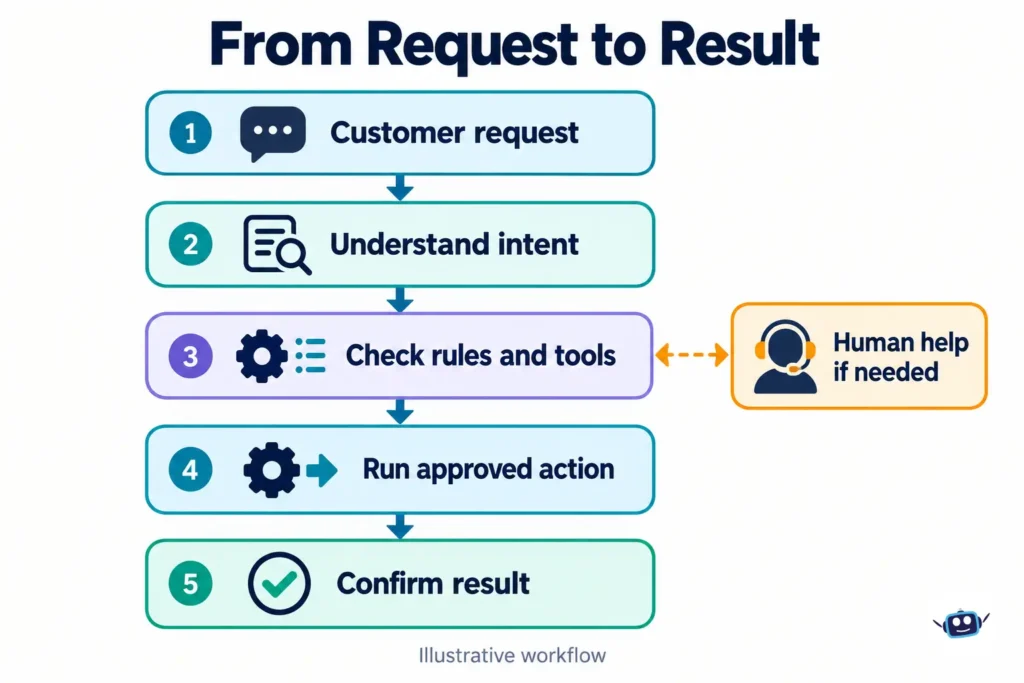
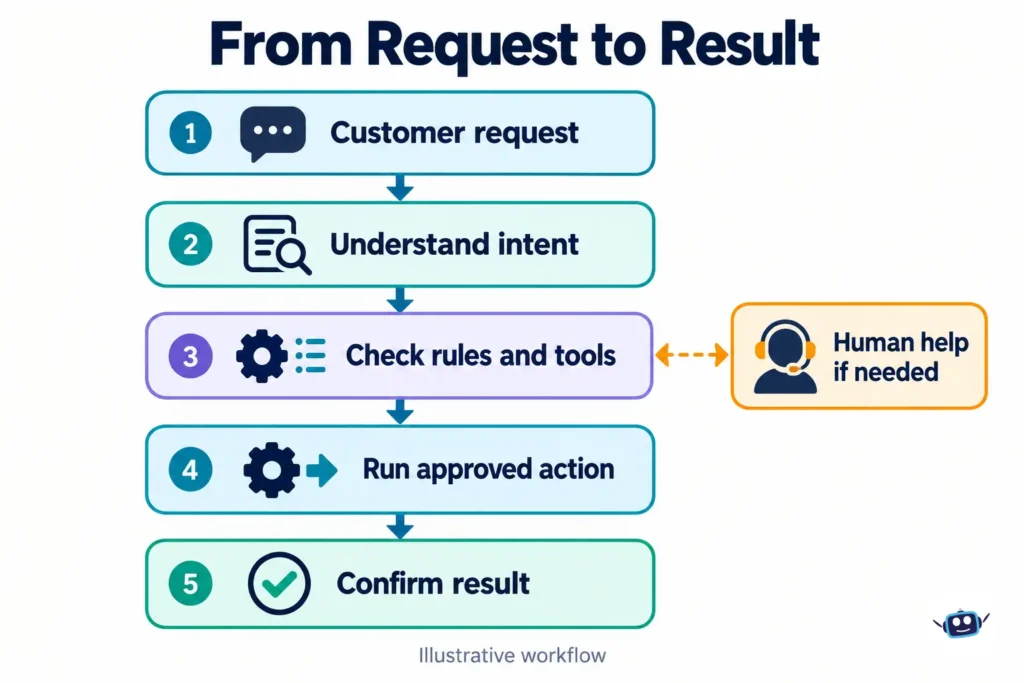
Consider an illustrative restaurant workflow. A caller requests pickup, changes the time and removes an item. A useful implementation would need to:
- Recognize the corrected request.
- Check the restaurant’s rules and connected ordering system.
- Confirm the final order with the caller.
- Submit the approved changes.
- Report whether the ordering system accepted them.
The acceptance criterion is a correct order in the destination system, not merely a plausible spoken confirmation.
This distinction also matters when comparing business agents. Our guide to the Google Cloud Gemini agent for enterprise work examines another approach to connecting AI with tools and company data.
Can SoundHound AI work offline?
Some tasks can run locally under the OASYS Edge architecture, according to SoundHound. Tasks requiring live online information or an external service still need connectivity.
As of October 2026, the announcement schedules OASYS Edge deployments for late 2026. It should not be treated as a feature already installed in every vehicle or device using SoundHound technology.
SoundHound’s technical explanation describes local agents working with supported device functions and context. For example, an appropriately integrated vehicle assistant could coordinate cabin settings locally. Making an online restaurant reservation would still require a connection to the booking service.
The useful distinction is between the part of a request handled on the device and the part that depends on a connected service.
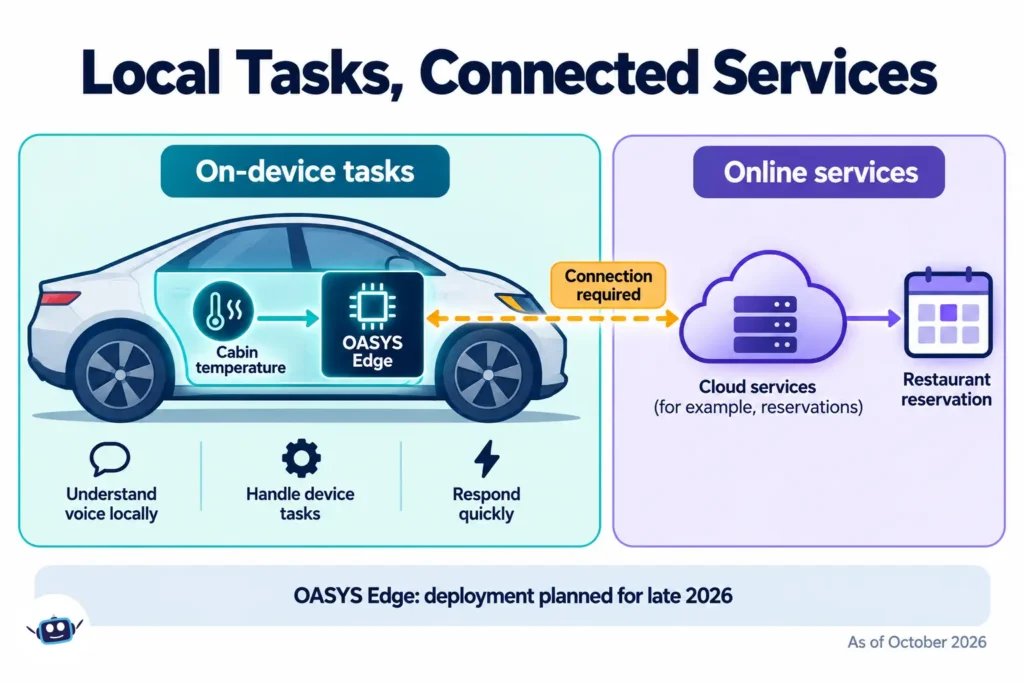
For procurement, ask for an offline demonstration of the exact actions your deployment must support. Also establish what happens when connectivity disappears halfway through a task: does it pause, fail clearly or retry without duplicating the action?
The same local-versus-connected distinction appears in our explanation of what Ghost Computer AI keeps local.
How much does SoundHound AI cost?
The music apps have public consumer pricing, while the current OASYS pages reviewed direct business customers to sales. We did not find a universal OASYS rate card on those pages.
The following reflects public pages checked on October 31, 2026:
| Product | Public pricing information | What the price does not establish |
|---|---|---|
| SoundHound Music, U.S. iOS listing | Free download; the App Store labels it as offering in-app purchases | Business automation pricing or access to paid music-streaming services |
| SoundHound∞, U.S. iOS listing | $6.99; SoundHound support describes Infinity as a one-time purchase | An enterprise license or a music-streaming subscription |
| OASYS and business deployments | Contact sales; no universal price verified on the reviewed product pages | Your implementation cost, usage allowance or support terms |
SoundHound’s music-app documentation explains that some connected music features require separate accounts or subscriptions. The music app’s download price should therefore be kept separate from any streaming service you connect.
For a business quote, make the billing unit explicit. A price per call, per minute or per location will produce different bills under the same workload.
| Quote item | Detail to get in writing |
|---|---|
| Usage | Billing unit, included volume, minimum commitment and overage treatment |
| Telephony | Whether numbers, forwarding, transfers and messaging are included |
| Models | Whether model usage is bundled or billed through another account |
| Human assistance | Who supplies staff, when they are available and how their work is charged |
| Implementation and exit | Integration work, ongoing changes, renewal, cancellation and data export |
These are quote questions, not a list of confirmed SoundHound surcharges. Their purpose is to make competing proposals comparable.
The overlooked metric: was the call resolved without staff?
A conversation can remain with the AI while a person helps behind the scenes. SoundHound explicitly documents this optional approach as Human Assisted Resolution, or HAR.
According to its product page, someone from your team or SoundHound’s team can provide direction or approval while the agent continues the conversation. The customer does not experience a conventional transfer.
The implication is that no transfer does not prove zero human involvement. When evaluating a containment or resolution percentage, establish what the metric includes.
A worked example: three costs from the same budget
Suppose an illustrative monthly deployment costs $600 in total, including the service and associated operating costs. It receives 1,000 calls, resolves 700 successfully and needs human assistance for 200 of those successful resolutions. That leaves 500 successful AI-only completions and 300 unresolved calls.
| Measure | Calculation | Result |
|---|---|---|
| Cost per received call | $600 ÷ 1,000 | $0.60 |
| Cost per successful resolution | $600 ÷ 700 | About $0.86 |
| Total spend per successful AI-only completion | $600 ÷ 500 | $1.20 |
This is an illustrative budgeting example, not SoundHound pricing or measured product performance. The arithmetic was checked with code; the same total spend is divided by three different outcome counts.
The last figure is not the marginal cost of an autonomous call. It shows how the apparent economics change when you define success more narrowly.
For a useful pilot, report successful AI-only completions, successful assisted completions, transfers, abandoned calls and unresolved requests separately. Also check whether customers call back because the first interaction failed to solve the problem.
SoundHound documents simulated conversations, repeated trials, transcript review and task-level evaluation. Use those capabilities as evidence sources, then verify important outcomes against the connected business system. A favorable automated evaluation should not be the only record of success.
What should you check before connecting customer data?
Start with the policy for the specific product and deployment. SoundHound’s consumer privacy policy and its role in a third party’s voice service are not interchangeable.
The company’s general privacy policy, updated in May 2026, covers its own apps and relevant websites. It says voice or audio interactions may be collected and may be shared with confidential contractors for quality control, with audio-morphing technology used in those cases.
For voice services embedded in a restaurant, vehicle or another company’s product, SoundHound says it generally processes end-user information on the provider’s instructions. Its partner policy directs users to that provider’s privacy documentation, or the SoundHound policy the provider adopts.
That means a restaurant customer needs the restaurant’s applicable notice, not just the privacy label attached to the music app.
Before a business rollout, settle four practical questions:
- Data: Which recordings, transcripts, identifiers and transaction details are retained, and for how long?
- Models: Which providers receive data, and what contractual terms govern training or improvement uses?
- People: Who can review conversations, provide human assistance or export records?
- Actions: Which operations require authentication, confirmation or approval, and how are failures recorded?
SoundHound describes controls for permitted functions, token usage, encryption and access. Those features still need to be configured around your actual workflow; a security feature list does not establish that every possible deployment is suitable for sensitive data.
An easily missed operational risk is outdated business information. SoundHound’s Smart Answering setup guide specifically warns that information imported from a website may be stale. Assign an owner to hours, prices, policies and service availability before the agent starts answering customers.
What do the latest numbers tell you about SOUN stock?
SoundHound’s latest published quarterly results as of October 31, 2026 show revenue growth alongside continuing losses. A functioning product and a growing business do not, on their own, establish an attractive stock valuation.
The August 5 earnings release and the SEC-filed second-quarter report support these figures:
| Metric | Period | Reported result |
|---|---|---|
| Revenue | Q2 2026 | $61.9 million |
| Revenue growth | Q2 2026 versus Q2 2025 | 45% |
| GAAP net loss | Q2 2026 | $42.8 million |
| Adjusted EBITDA loss | Q2 2026 | $9.6 million |
| Cash used in operating activities | First six months of 2026 | Approximately $60.0 million |
Keep the periods separate: the operating cash figure covers six months, while the revenue and loss figures cover one quarter. Adjusted EBITDA is also a company-defined non-GAAP measure, not a substitute for net income or operating cash flow.
The acquisition creates another comparison issue. Q2 ended on June 30, before LivePerson joined the company on September 4. Those quarterly results therefore cannot show the operating performance of the combined business after closing.
SoundHound has scheduled its Q3 release for November 5, 2026. As of this article’s verification date, those results have not been published.
For investors, the useful questions are specific:
- How much reported growth comes from existing operations versus acquisitions?
- Are losses and operating cash use improving together?
- How do new shares, acquisition obligations and funding needs affect existing shareholders?
- What future growth and profitability does the current valuation already assume?
These are analysis questions, not a prediction that SOUN will rise or fall. Our coverage of AI stocks, growth and cash-flow pressure explains why operating demand and investment returns can move differently.
Frequently asked questions about SoundHound AI
Can SoundHound identify a song you hum?
Yes. The official music-app listing describes identifying songs from singing or humming, as well as music playing nearby. That is a consumer-app feature, not an OASYS business workflow.
Is SoundHound AI free for businesses?
The free music app does not establish a free enterprise plan. As of October 2026, the OASYS pages reviewed direct business buyers to sales, so a deployment needs its own confirmed commercial terms.
Is SoundHound AI powered only by ChatGPT?
No. SoundHound documents its own speech and language components and integrations with external model providers, including OpenAI. The model configuration should be checked for the specific service being purchased.
Does SoundHound own LivePerson now?
Yes. Both companies’ official investor information confirms that the acquisition closed on September 4, 2026. Completion of the transaction should be distinguished from the continuing integration of products and services.
Can SoundHound replace every customer-service employee?
There is no verified basis for that blanket claim. SoundHound’s optional human-assisted mode explicitly retains a role for people, and staffing needs depend on the tasks, exceptions, service expectations and results of the deployment.
Is SoundHound AI profitable?
Its latest published quarter, Q2 2026, reported both a GAAP net loss and an adjusted EBITDA loss. Revenue growth or an acquisition announcement should not be described as proof of profitability.
What to do next
SoundHound AI is relevant when you need conversations to produce verifiable business outcomes. Its music app, enterprise platform and shares require different evaluations, and current product claims should be separated from deployment plans and financial results.
For a business rollout, the next step is a narrowly scoped pilot with one defined task, written pricing and separate reporting for AI-only and human-assisted completions. That gives you a concrete basis for deciding whether the service improves your operation.
Related: AI coding agents vs. chatbots: how actions change the risks.
Disclaimer
This article is for informational purposes only and is not investment or legal advice. AI LLM News is not affiliated with, sponsored by or endorsed by any brand mentioned. Prices, features and policies may change; information last verified on October 31, 2026. AI output can be inaccurate, and investing in stocks can result in losses.