

Muse Ember is what Meta calls its smallest, most efficient model, released November 9, 2026 for repetitive agent work: tool calls, coding subtasks, routing, extraction and long-document parsing. Meta lists it as muse-ember-1.0 on its Model API and in Muse Code at $0.10 per million input tokens and $0.50 per million output tokens, with a 1 million-token context.
An agent that fixes one bug can make hundreds of small model calls: read a file, run a test, patch a line, run the test again. At frontier prices, that volume is the bill. Ember is Meta’s answer to that problem.
This guide covers what Meta has confirmed, what only Meta or a single source claims, what the price list hides, and where the benchmarks show weaknesses.
What does Muse Ember do, at a glance?
Meta says Ember is built for high-volume, repeatable agent steps, not for hard one-off reasoning. The table separates what Meta states from what independent parties report.
| Item | What is published | Who says so |
|---|---|---|
| Release date | November 9, 2026 | Meta, TechCrunch |
| API model ID | muse-ember-1.0 | Meta |
| Input types | Text, images, audio, video | Meta (VentureBeat also lists PDFs) |
| Output type | Text | VentureBeat, reading Meta’s API docs |
| Context window | 1M tokens (1,048,576 per VentureBeat) | Meta |
| Max output | 512K tokens (524,288 per VentureBeat) | Meta |
| Reasoning effort | Minimal to max, max by default | VentureBeat, reading Meta’s API docs |
| Weights | Not released; parameter count private | Artificial Analysis, via VentureBeat |
| Best fit | Tool calls, coding subtasks, routing, extraction, long documents | Meta |
What is Muse Ember, and what is it not?
Muse Ember is a hosted, proprietary language model from Meta Superintelligence Labs. It is the first Meta model trained using Muse Wonder Full, according to Meta. It is not a chatbot app, a coding agent or an open-weights download.
The word “Ember” and the Muse family name cause some confusion:
| Name | What it actually is |
|---|---|
| Muse Ember | The small, low-cost model covered here |
| Muse Wonder / Wonder Full | Meta’s larger models for the hardest problems |
| Muse Spark | Mid-weight model for coding and agentic work |
| Muse Glimmer | Open-weights sibling of Spark |
| Muse Code | Meta’s terminal coding agent, where Ember is one selectable model |
| Muse (the agent app) | Meta’s consumer personal-agent product, unrelated to API pricing |
| Ember.js / Ember CLI | An unrelated JavaScript framework and its build tool |
Search results for “Ember” alone often return the JavaScript framework. Include “Muse” or “Meta” in your queries.
What changed recently around Ember?
Ember is the latest step in a fast-moving release run. Dates below come from Meta, TechCrunch, VentureBeat and the Meta Model API documentation.
| Date (2026) | Change |
|---|---|
| April | Muse Spark debuts |
| July 6 | Meta’s older Llama API preview is retired; the Meta Model API supersedes it |
| July | Muse Spark 1.1 opens a public API preview |
| August | Muse Code beta and Spark 1.2; Muse Glimmer follows |
| September | Spark 1.3; the Muse consumer agent launches |
| October | Muse Wonder and Wonder Full |
| November 9 | Muse Ember |
How much does Muse Ember cost?
For prompts up to 200,000 tokens, Meta lists $0.10 per million uncached input tokens, $0.004 per million cached input tokens and $0.50 per million output tokens. Above 200,000 tokens, the rates rise to $0.30, $0.012 and $1.50.
| Rate (per million tokens) | Up to 200K prompt | Over 200K prompt |
|---|---|---|
| Uncached input | $0.10 | $0.30 |
| Cached input | $0.004 | $0.012 |
| Output | $0.50 | $1.50 |
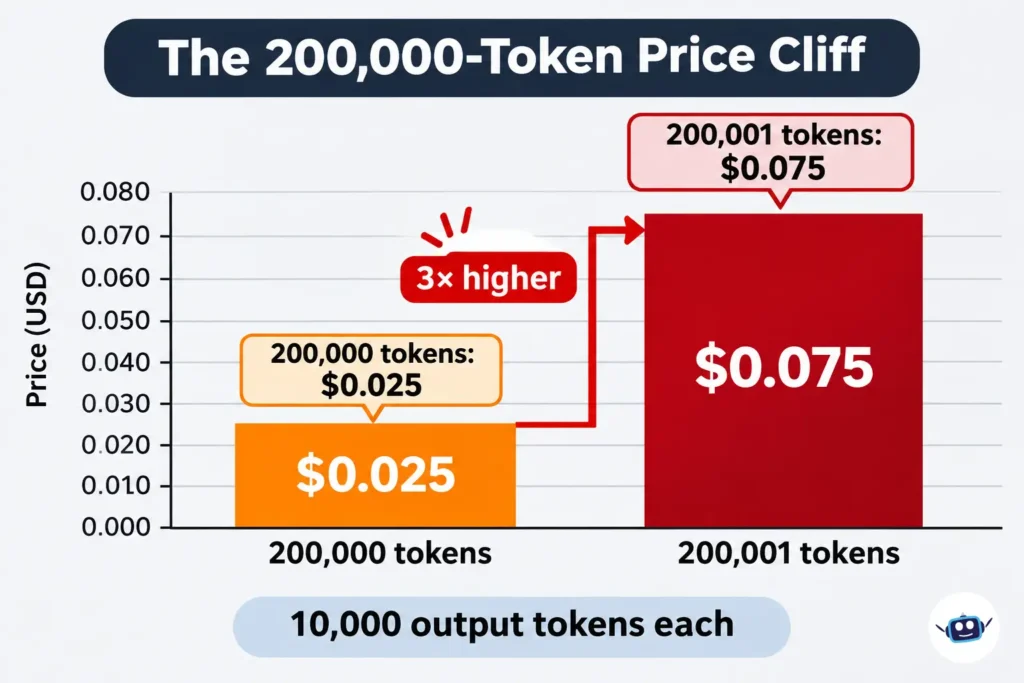
What most people miss: the 200K cliff. VentureBeat’s reading of Meta’s documentation says the higher rate applies to the entire request, including output. Cached tokens and conversation history carried forward count toward the cutoff.
In our calculation on November 10, 2026:
- A request with 200,000 uncached input tokens and 10,000 output tokens costs $0.025.
- Add one input token and the same request costs about $0.075, three times as much.
- A 300,000-token uncached prompt with 5,000 output tokens costs $0.0975. It would cost $0.0325 at the lower rates.
If your agent carries long histories, trim or restructure context so typical requests stay under 200,000 tokens.
Cost math for a repeating workload. These assumptions are illustrative, not measured: 10,000 requests, each with a 20,000-token prompt (16,000 cached, 4,000 new) and 1,500 output tokens.
| Model (list rates, short-prompt tier) | Cost per request | Cost for 10,000 requests |
|---|---|---|
| Muse Ember | $0.00121 | $12.14 |
| Claude Haiku 5.5 | $0.00131 | $13.10 |
| GPT-6 Luna | $0.00131 | $13.10 |
The cached rates used for Haiku and Luna ($0.01 per million) come from VentureBeat’s pricing comparison. The gap is about 7%. That is a second thing most coverage skips: Ember’s headline token prices match Haiku 5.5’s and Luna’s uncached short-prompt rates ($0.10 input, $0.50 output). Any large saving would have to come from cheaper cache reads and fewer tokens used per task, not from a lower sticker price.
Does Ember really deliver Haiku-level results at a third of the cost?
On one composite score, yes, according to Meta and an independent evaluator. Artificial Analysis reported that Ember at max reasoning scored 36 on its Intelligence Index, the same rounded score as Claude Haiku 5.5, at about $0.14 per benchmark task against about $0.41. Meta’s chart gives the unrounded scores as 35.8 for Ember and 36.2 for Haiku.
| Artificial Analysis, max effort | Ember | Haiku 5.5 | GPT-6 Luna |
|---|---|---|---|
| Intelligence Index | 36 | 36 | 28 |
| Cost per benchmark task | about $0.14 | about $0.41 | about $0.15 |
Artificial Analysis also reported Ember at xhigh effort scoring 34 at about $0.12 per task. Against Meta’s Spark 1.3, Meta’s own comparison shows 36 versus 37 on the index, at about $0.14 versus $2.39 per task.
The index is a composite. Your workload may not look like it, so treat it as a starting point for testing.
Where does Ember win, and where does it lose?
Meta’s results table shows Ember ahead on most listed tests and behind on one. These are Meta-published figures at max reasoning effort; several come from Artificial Analysis and others from Meta’s internal evaluations.
| Benchmark | Ember | Haiku 5.5 | GPT-6 Luna |
|---|---|---|---|
| AutomationBench-AA (business workflows, strict pass@1) | 37.8% | 13.9% | 20.2% |
| Agents’ Last Exam (Meta internal, Linux subset) | 61.6% | 57.0% | 57.1% |
| Terminal-Bench 4.0 (each model’s best published harness) | 40.9% | 39.2% | 16.4% |
| Coding Agent Index-AA | 46 | 37 | 31 |
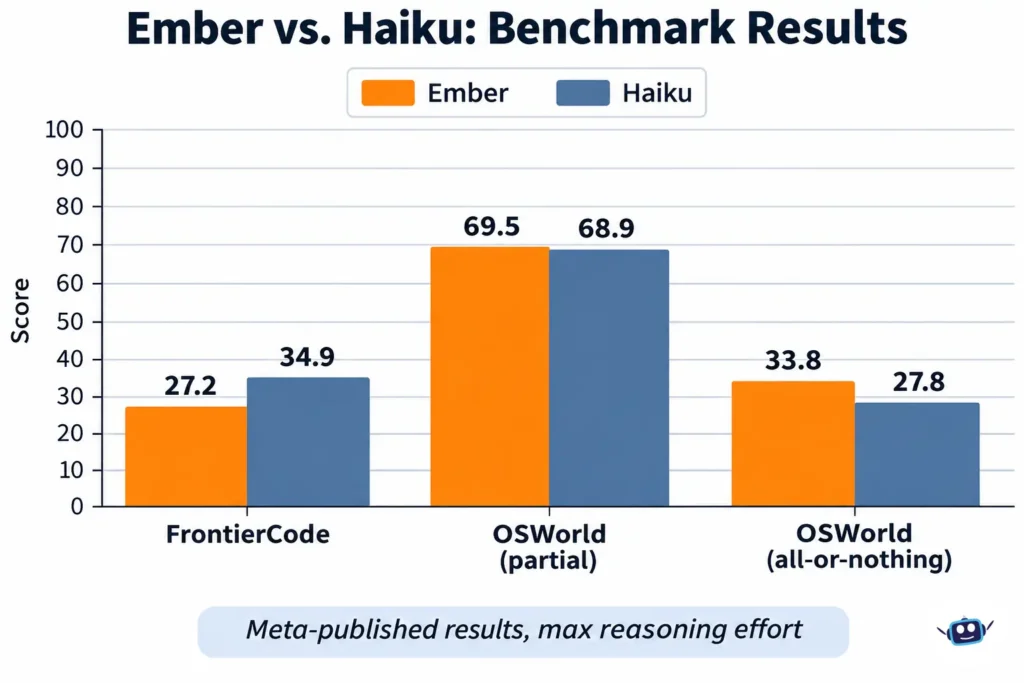
| FrontierCode 2.0-AA (mergeable engineering changes) | 27.2% | 34.9% | 25.2% |
| OSWorld 2.1 (Meta internal, partial credit) | 69.5% | 68.9% | 50.5% |
| PerceptionBench (Meta internal, with tools) | 80.6% | 78.6% | 62.8% |
Three caveats matter more than the headline:
- Haiku leads on mergeable code. On FrontierCode 2.0, Haiku scores 34.9% to Ember’s 27.2%.
- Partial credit flatters computer use. On OSWorld 2.1, Ember’s 69.5% partial-credit score falls to 33.8% when tasks are graded all-or-nothing. Haiku’s falls from 68.9% to 27.8%, and Luna’s from 50.5% to 17.0%. Ember still leads, but unattended desktop automation fails often.
- Harness choice moves coding scores. Meta ran each model in its own best published harness (mini-swe-agent for Ember, Claude Code for Haiku, Codex for Luna). Another published summary of Artificial Analysis’s results puts Haiku lower on Terminal-Bench 4.0 than Meta’s table does. Compare coding numbers only under the same setup.
Partner quotes in Meta’s launch post come from Box, Cline, Oracle, Cloudflare and You.com. They are early-access impressions selected by Meta. One example: Cloudflare says Ember ran up to 30% faster at the tail than the comparable model it tested. Treat these as vendor-supplied, not independent verification.
Where can you use Muse Ember?
Meta says Ember is available today on the Meta Model API and in Muse Code as muse-ember-1.0, and that Muse Ember, Spark and Wonder are available on Google Cloud and Oracle Cloud.
- Meta Model API: VentureBeat’s reading of Meta’s docs says it serves Ember through Responses, Chat Completions and Messages endpoints. Meta’s launch post confirms Responses API support.
- Muse Code: Meta’s terminal coding agent lists Ember as an available model.
- Google Cloud: VentureBeat reports that Google Cloud’s preview documents text and image input only. Meta’s post says Ember accepts audio and video, so confirm what your cloud route supports before designing around it.
- Model ID on cloud platforms: Meta publishes muse-ember-1.0 for its own API and Muse Code. The identifier on Google Cloud or Oracle Cloud was not confirmed.
Meta has not published, in anything we could read, whether third-party routers will carry Ember. Some gateways have started listing it, so check your provider’s own model page.
How should you pair Ember with a larger model?
Meta’s recommended pattern is a planner plus a worker: “Muse Wonder plans, Muse Ember handles the volume.” TechCrunch gives a support example: a heavier model writes the rules for one type of issue, then a lighter model applies them across tens of thousands of cases.
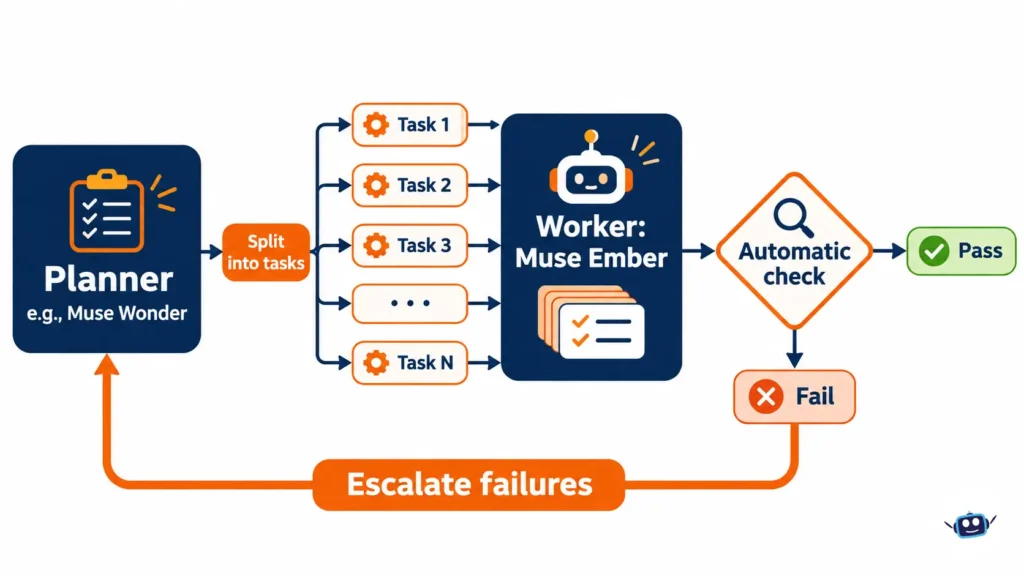
Use the Ember Fit Check below to decide which steps to hand to Ember. It is an original checklist built from the verified results above. The thresholds are illustrative, not Meta guidance.
| Question | If yes | If no |
|---|---|---|
| Can a cheap automatic check (tests, schema, field match) grade each result? | Good Ember candidate | Keep a stronger model or add review |
| Does the step repeat hundreds or thousands of times? | Savings add up | Savings may be too small to matter |
| Is the task a bounded subtask, not a whole engineering ticket? | Good fit | Escalate (Ember trails Haiku on mergeable code) |
| Do typical prompts stay under 200K tokens? | Short-tier rates apply | Cost can triple; restructure context |
| Does the step act on money, accounts or production? | Add human approval | Lower risk |
Is Muse Ember safe to use with sensitive data?
Meta says it evaluated Ember under its Meta Superintelligence Scaling Framework, covering chemical and biological, cybersecurity and loss-of-control risks. Per Meta, Ember stayed below the framework’s high-risk thresholds. Meta also says it tested whether Ember resists instructions hidden in web pages, documents or tool outputs. These are vendor-reported results, and the evaluation details were not independently confirmed.
On data use, VentureBeat reports that Meta says Standard-mode API content is excluded from model training, and that separate zero-data-retention terms exist for accounts with that setting. Separately, a third-party guide reports that Muse Code subscriptions default to a “Contributor” mode, a cheaper tier that permits training on prompts and responses, for Meta’s Spark models. We could not confirm whether any such tier applies to Ember. Before sending private code or contracts, read the data terms attached to your exact billing route.
Who should use Ember, and who should skip it?
Good fit:
- Teams running high-volume classification, routing, extraction or document triage with an existing success check.
- Coding agents that delegate small, testable subtasks (one failing test, one targeted fix).
- Pipelines that reuse a large shared prompt prefix, which benefits from the $0.004 cached rate.
Skip or test carefully:
- Work that must produce merge-ready code with little review.
- Unattended computer-use workflows where one failed step ruins the result.
- Workloads with prompts regularly above 200K tokens, unless the tripled rates still pencil out.
- Anyone who needs downloadable weights or on-premises hosting.
What mistakes do teams make with Ember?
- Comparing sticker prices only. Ember’s token rates equal Haiku 5.5’s and Luna’s short-prompt rates. The differences come from caching and token usage.
- Ignoring the default effort. Meta’s API defaults to max reasoning, and Meta’s scores come from max effort. Lower settings cost less and score lower (34 at xhigh, per Artificial Analysis).
- Trusting partial-credit scores. Check how a benchmark awards credit before assuming a workflow will complete.
- Skipping rate limits. We could not confirm Ember’s published rate limits. Check them before a production launch.
How can you check Ember yourself?
- Pick one repeating task with an automatic pass/fail check.
- Run 100 real samples through Ember, Haiku 5.5 and Luna at the same effort level.
- Record cost per accepted result, including retries and escalations, not cost per call.
- Log how many requests cross 200,000 tokens.
- Compare latency at the 95th percentile, not just the average.
FAQs
What is Muse Ember?
It is Meta’s smallest and most efficient Muse model, released November 9, 2026. Meta designed it for repetitive agent work such as tool calls, coding subtasks, routing, extraction and long-document parsing. It is a hosted proprietary model, not an app.
How much does Muse Ember cost?
For prompts up to 200,000 tokens, it costs $0.10 per million uncached input tokens, $0.004 per million cached input tokens and $0.50 per million output tokens. Above 200,000 tokens, the rates are $0.30, $0.012 and $1.50. As of November 2026, those are the figures Meta published.
Is Muse Ember open source?
No. Artificial Analysis says Meta has kept Ember’s weights and parameter count private. Meta’s open-weights option in the Muse family is Muse Glimmer.
Is Muse Ember better than Claude Haiku 5.5?
It depends on the task. Ember matches Haiku’s rounded Intelligence Index score of 36 at about a third of the cost per task and leads on agent benchmarks. Haiku scores higher on FrontierCode 2.0 (34.9% versus 27.2%).
Does Muse Ember handle images, audio and video?
Meta says it natively accepts text, images, audio and video and returns text. VentureBeat’s reading of Meta’s docs also lists PDFs. Google Cloud’s preview documents text and image input only.
What is Muse Ember’s context window?
Meta lists a 1 million-token context window and up to 512K output tokens. Prices rise above 200,000 prompt tokens.
Where can I use Muse Ember?
Meta says it is available on the Meta Model API and Muse Code as muse-ember-1.0, and on Google Cloud and Oracle Cloud. Check your cloud provider’s model page for the identifier and supported inputs.
Does Meta train on my Muse Ember data?
VentureBeat reports that Meta says Standard-mode API content is excluded from training. We could not confirm the terms for other billing routes, so read Meta’s data terms for yours.
Conclusion
Muse Ember is a credible low-cost worker model, but its advantage is cost per task, not a lower sticker price. The verified takeaways:
- It matches Haiku 5.5 on one composite score at about a third of the per-task cost, per Artificial Analysis.
- It trails Haiku on mergeable code and fails often on all-or-nothing desktop tasks.
- Crossing 200,000 prompt tokens triples the rates for the whole request.
Your next step: run the five-step check above on one repeating task and compare cost per accepted result.
Related: for more coverage of new models and pricing, see the latest updates on AI LLM News.
Disclaimer
This article is for informational purposes only and is not affiliated with, sponsored by or endorsed by Meta, Anthropic, OpenAI, Artificial Analysis or any brand mentioned. Prices, features and policies may change, and benchmark results depend on setup. Information last verified on November 10, 2026. AI output can be inaccurate, so test any model on your own data before relying on it.
“How this was made” note
AI assisted with research and drafting. The content was checked against Meta’s launch post and evaluation report, plus news and independent-evaluator coverage, and the cost math was run with code. No hands-on testing of Muse Ember was done, and the article says so by relying on published documentation. You should publish this note in the byline area (it is accurate and fits Google’s people-first guidance), but publish it only after you add more internal links; only your homepage could be verified (see the verification log).