

As of November 12, 2026, the AI trade is moving on three developments: CoreWeave’s strong quarter helped lift the Nasdaq Composite 1.6% on November 11; Nvidia then fell about 8.6% after hours on reports its board may remove CEO Jensen Huang; and Anthropic’s IPO, with a proposed $70-$78 range, is reported to start trading November 19.
Nvidia closed Wednesday at $173.73, up about 2.9%. Within hours, the same stock was trading near $158.78 after two newspaper reports landed back to back.
That swing is the whole story of this week in miniature. This article separates what is confirmed from what is only reported, explains why the percentages in headlines disagree, and lists the dates that decide what happens next.
What happened to the AI trade on November 11, in order?
Stocks rose all day, then Nvidia fell after the close. The sequence matters because the rebound and the sell-off had different causes.
| Time (U.S. Eastern) | Event | Status |
|---|---|---|
| Nov. 10, after close | CoreWeave reports third-quarter revenue of $3.66 billion and raises its 2026 revenue guidance to $13.0-$13.3 billion | Company-reported |
| Nov. 11, regular session | CoreWeave closes up 24.71% at $60.77; the Nasdaq Composite rises 1.60% to 25,466.19; the S&P 500 rises 1.31% to 7,619.38 | Market data |
| Nov. 11, regular session | Nvidia closes at $173.73, up about 2.9% | Market data |
| Nov. 11, after close | The New York Times reports Huang also had a relationship with an Nvidia executive who reports to him; the Wall Street Journal reports the board is preparing to oust him | Reported; Nvidia has not confirmed |
| Nov. 11, late evening | CNBC and CNN confirm the board is meeting to decide his future | Confirmed by outlets; no outcome announced |
| Nov. 11, after hours | Nvidia trades as low as about $158.78 (down 8.61%) | Extended-hours quote, fluctuates |
| Nov. 12, early | Nasdaq 100 futures are down about 1% | Futures, not a close |
The Nasdaq Composite had fallen 0.74% to 25,065.87 on November 10, so Wednesday’s gain of about 400 points recovered much of that day’s loss.
Why did AI stocks rebound before Nvidia fell?
CoreWeave, a cloud company that rents out AI computing capacity, reported results that eased fears about AI spending. Its revenue rose 168% from a year earlier, and its backlog stood at roughly $132.5 billion.
Oracle rose about 9% the same day, and CNBC and others described a broad lift in AI infrastructure names. The rebound was driven by earnings, not by Anthropic’s roadshow.
The rebound has real caveats:
- CoreWeave still posted a $709 million net loss in the quarter.
- Reports put its debt at about $46.9 billion.
- Several analysts cut price targets even as the stock jumped. Cantor Fitzgerald lowered its target from $176 to $100, and Stifel lowered its target from $120 to $60.
What most people miss: the market read CoreWeave’s quarter as proof that AI demand is intact, but CoreWeave’s own CFO said the company plans to lean less on unsecured bonds and more on loans backed by customer contracts. The relief was about financing as much as demand.
What is happening at Nvidia, and what is confirmed?
Confirmed: Huang acknowledged an extramarital affair in a staff memo on November 8, and Nvidia’s board hired the law firm Wachtell, Lipton, Rosen & Katz to investigate whether he was the target of a foreign intelligence effort.
The rest sits at different confidence levels. Treat each row separately.
| Claim | Status as of Nov. 12, 2026 |
|---|---|
| Huang admitted to an affair in a Nov. 8 staff memo | Confirmed (reported by CNBC and others quoting the memo) |
| The board hired Wachtell Lipton to investigate | Confirmed by a board statement |
| The board said it has no reason to believe national security or Nvidia secrets were compromised | Confirmed by a board statement (Nov. 8) |
| U.S. officials believe the woman, Alice Huang, was a Chinese intelligence asset | Reported (CBS, CNN); China’s foreign ministry called the allegations groundless |
| U.S. intelligence examined her role in shipments of Nvidia chips to Chinese firms | Reported by Reuters; not proven |
| A second relationship, with an Nvidia executive | Reported by The New York Times; not confirmed by Nvidia |
| The board is preparing to remove Huang | Reported by the Wall Street Journal and independently confirmed by Reuters |
| The board met Wednesday evening | Confirmed by CNBC and CNN sources; Nvidia has not commented |
| The board is working with an outside firm on replacements and weighing an interim CEO | Reported by Bloomberg |
| A board decision | None announced in the reports I could find as of Nov. 12 |
Two structural facts raise the stakes. Nvidia’s board has 11 directors, all but Huang considered independent, and no board chair. Under Nvidia’s bylaws, according to Reuters, a majority of the board can remove the CEO with or without cause.
Analysts have also pointed to the lack of a named successor. A proposed securities class action has also been filed against Nvidia and Huang, according to reports.
How far has Nvidia fallen, and why do the percentages differ?
It depends on the starting point and the price you use. Headlines cite roughly 25%, 29%, 31% and 35%, and each can be right for its baseline.
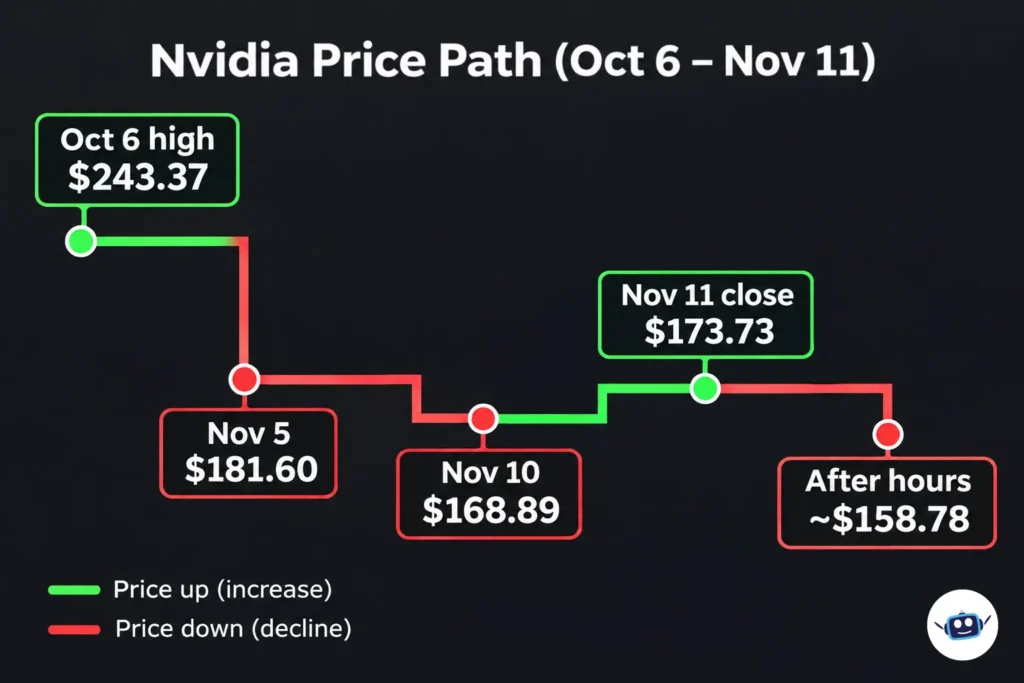
Nvidia’s intraday record was $243.37 on October 6, 2026, and its record close was $239.24 the same day.
| Price point | Price | Down from $243.37 intraday high | Down from $239.24 record close |
|---|---|---|---|
| Nov. 5 close | $181.60 | 25.4% | 24.1% |
| Nov. 10 close | $168.89 | 30.6% | 29.4% |
| Nov. 11 close | $173.73 | 28.6% | 27.4% |
| Nov. 11 after-hours low seen | $158.78 | 34.8% | 33.6% |
I calculated these figures from the published prices.
The after-hours row is a snapshot, not a close. Extended-hours quotes moved between about 7% and 9% below the regular-session close in different reports.
The “gain” on November 11 also varies: 2.87% against a $168.89 prior close, or 2.92% against $168.80. Check which prior close a source used before comparing.
What are Anthropic’s IPO terms?
Anthropic, PBC proposed selling 825 million Class A shares at $70-$78 each on the Nasdaq under the ticker ANT. The range comes from an amended S-1 registration filing dated November 10, 2026, as reported by CNBC, TechCrunch, Fortune and CNN.
The range is preliminary, and the final price can differ. CNBC, citing sources, reports pricing on November 18 and trading on November 19. The filing itself sets no date, and the IPO has not priced as of this writing.
| Item | At $70 | At $74 (midpoint) | At $78 |
|---|---|---|---|
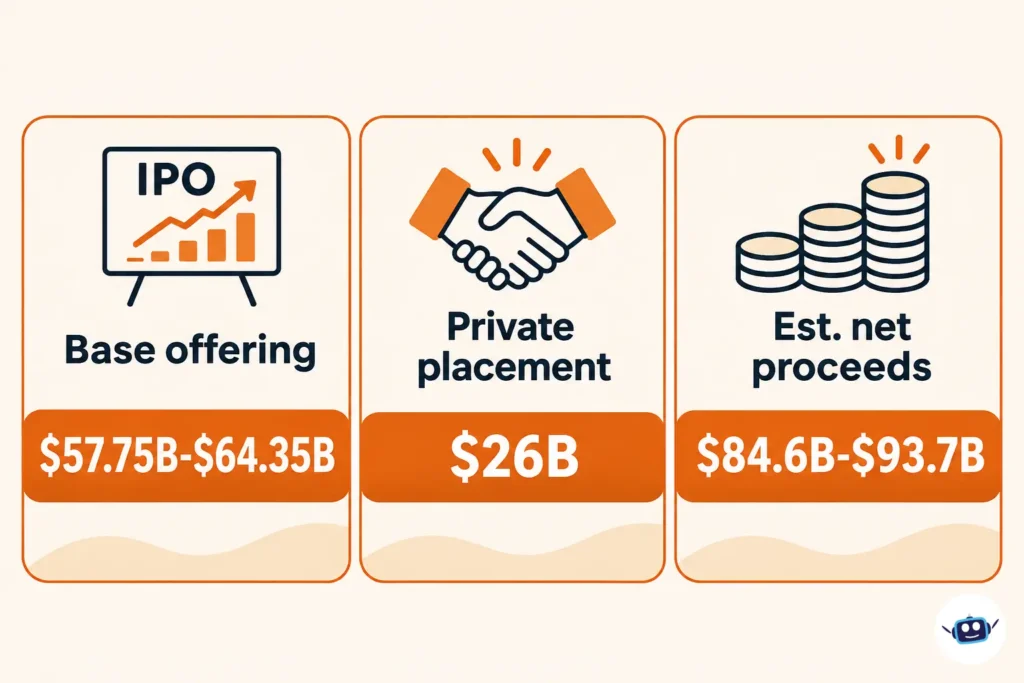
| Gross base offering (825M shares) | $57.75B | $61.05B | $64.35B |
Reports disagree on valuation because they count shares differently:
- Reuters, as relayed by one outlet, put the top of the range near $1.02 trillion on expected outstanding shares.
- The Financial Times put the range at roughly $1.26-$1.41 trillion fully diluted.
- TechCrunch reported $1.404 trillion fully diluted at $78, and CNN put the midpoint at $1.33 trillion.
Raise figures differ for a similar reason. Anthropic’s estimated net proceeds of $84.6-$93.7 billion, per TechCrunch, include a separate $26 billion private placement and, at the high end, the underwriters’ option to buy additional shares.
Reports name Google, Nvidia, AMD, Broadcom, Micron, Microsoft and TSMC as placement buyers. One report says Nvidia and Google would each buy $10 billion.
What most people miss: Nvidia is both a reported cornerstone buyer in Anthropic’s offering and the company whose leadership crisis is unsettling the AI trade. The two stories are linked by money, not only by sentiment.
Was $2 trillion ever Anthropic’s official target?
No official $2 trillion target appears in the sources I reviewed. Fortune described the $2 trillion figure as one that some news outlets had reported weeks earlier.
Calling the $1.4 trillion top of range a “reduced target” therefore compares an official range against unofficial press reports. The range is still well below those reports.
Did Anthropic’s safety disclosure matter to the IPO?
It matters as a risk disclosure, not as a stop sign. In the same filing that set the price range, Anthropic said a threshold in its Responsible Scaling Policy tied to AI accelerating its own research has now been crossed, according to Yahoo Finance.
Per that report, crossing the line means more safeguards, not a shutdown. The nonprofit METR estimated that Anthropic’s models have improved nearly twice as fast since October 2025.
The same filing reportedly flags nearly $900 billion in multi-year compute and infrastructure commitments. Those are obligations over several years, not money already spent. For background on the safety debate, see our explainer on why AI leaders are asking to pace the frontier.
How do inflation and the Federal Reserve fit in?
Hotter-than-expected inflation made a December rate hike the base case. The Bureau of Labor Statistics reported that October consumer prices rose 0.4% from September, against a 0.3% forecast, and core prices rose 0.3% for a third month.
The Federal Reserve held its target range at 3.75%-4.00% on October 28 and meets December 8-9. Using the CME FedWatch tool, outlets reported roughly an 85%-89% chance of a quarter-point hike and an 11%-15% chance of a half-point hike after the report, depending on the snapshot.
Those are market odds, not a Fed decision. CNBC also noted that no annual inflation rate was published for October because of last year’s government shutdown.
I found no verified evidence for the Overview’s claim of growing political scrutiny over U.S. data center power use, so it is left out.
Which dates matter next?
| Date | What happens | Status |
|---|---|---|
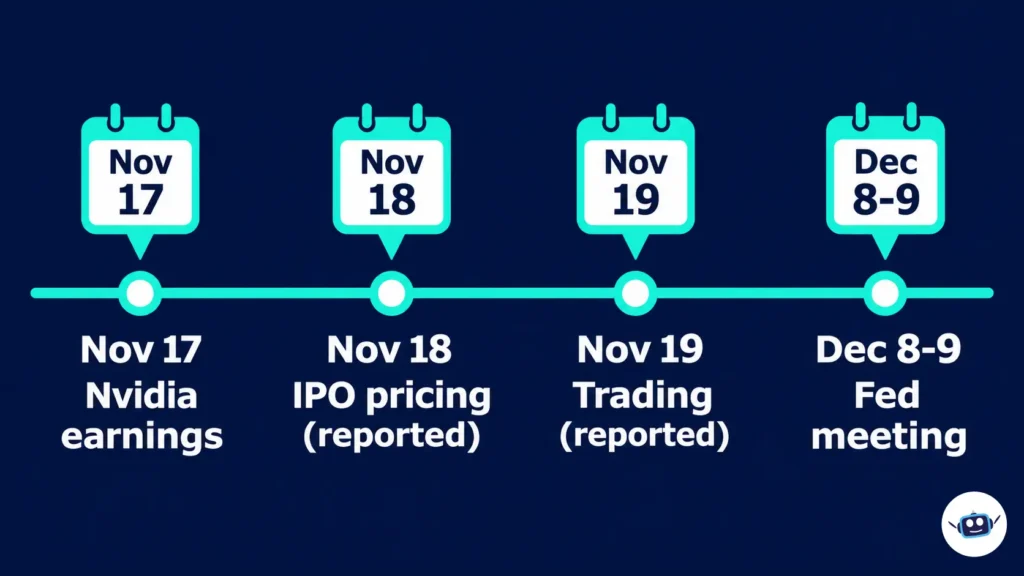
| Nov. 17 (Tue.) | Nvidia reports fiscal third-quarter results after the close; call at 2 p.m. PT | Announced by Nvidia on Oct. 28 |
| Nov. 18 | Anthropic IPO pricing | Reported by CNBC sources; not in filing |
| Nov. 19 | First Nasdaq trading of ANT | Reported by CNBC sources; not in filing |
| Dec. 8-9 | Federal Reserve meeting | Scheduled |
Some earnings calendars list November 18 or November 25 for Nvidia. Nvidia’s own announcement says November 17.
Nvidia’s “fiscal third quarter 2027” ended October 25, 2026, because its fiscal year ends in late January. It guided for $108 billion in revenue, plus or minus 2%, and MarketBeat’s consensus is about $108.8 billion.
How can you read an AI-trade day without overreacting?
Sort each headline into one of four signals. This is an illustrative framework built from this week’s verified facts, not a forecast.
| Signal | What it showed Nov. 11 | What would change the read |
|---|---|---|
| Demand | CoreWeave beat revenue estimates and raised guidance | Cuts to customer spending plans |
| Financing | CoreWeave said it would use less unsecured debt | Higher rates after a December Fed hike |
| Governance | Nvidia board reportedly weighing removing its CEO | A board decision or a named successor |
| New supply of shares | Anthropic offering 825M shares plus a $26B placement | Pricing outside the $70-$78 range |
A single day can send conflicting signals. Wednesday’s demand and financing signals were positive while the governance signal turned sharply negative.
Which names and numbers cause confusion?
| Term | What it actually is |
|---|---|
| Alice Huang | A Megaspeed executive; reported as having no relation to Jensen Huang |
| Fiscal Q3 2027 (Nvidia) | A quarter ending Oct. 25, 2026 |
| $2 trillion Anthropic valuation | A figure reported by some outlets, not an official target |
| $1.0 vs $1.4 trillion valuation | Basic vs fully diluted share counts |
| Gross vs net proceeds | Base offering vs total including the placement and fees |
Can you buy Anthropic shares in the IPO?
Possibly, but a request is not an allocation. Anthropic’s filing says retail investors may receive up to 20% of the Class A shares, depending on demand.
Brokers named in the filing include Charles Schwab, Fidelity, Robinhood, SoFi, TradePMR and E*TRADE from Morgan Stanley. Robinhood and SoFi use “IPO Access” requests, and neither guarantees shares.
Many retail investors will end up buying after trading begins, at whatever price the market sets.
What common mistakes should you avoid?
- Treating a quote as a close. After-hours and futures prices move and can reverse before the next open.
- Treating reports as decisions. No board action had been announced in the reports I could find.
- Mixing baselines. Compare drawdowns only from the same starting price.
- Reading the range as the price. The final IPO price can land outside it.
- Assuming the rebound was about Anthropic. The evidence points to CoreWeave’s earnings.
- Trusting one earnings calendar. Confirm dates with the company.
Frequently asked questions
When will Anthropic’s IPO start trading?
CNBC, citing sources, reports pricing on November 18 and Nasdaq trading on November 19 under the ticker ANT. Anthropic’s filing sets no date, so the timing could change.
What is Anthropic’s IPO price range?
The range is $70 to $78 per Class A share for 825 million shares, according to the amended S-1 filed November 10, 2026. Fully diluted valuation estimates reach about $1.4 trillion at the top.
Why did Nvidia stock fall after hours on November 11?
The Wall Street Journal reported that Nvidia’s board was preparing to remove CEO Jensen Huang, and The New York Times reported a second relationship. Shares fell as much as 8.6% in extended trading, a quote that moved during the session.
Has Jensen Huang been removed as Nvidia’s CEO?
As of the reports I reviewed on November 12, no board decision had been announced. CNBC and CNN confirmed the board met Wednesday evening, and Nvidia had not commented.
When does Nvidia report earnings?
Nvidia scheduled its fiscal third-quarter results for November 17, 2026, with the call at 2 p.m. Pacific. Some third-party calendars list other dates.
Why did AI stocks rebound on November 11?
CoreWeave’s stronger-than-expected quarter and higher guidance eased fears about AI spending and financing. Oracle, Nebius and other infrastructure names rose with it.
Will the Fed raise rates in December?
Markets priced a hike as the base case after the October inflation report. Fed policymakers meet December 8-9, and the odds change daily.
Does Anthropic’s safety alarm stop the IPO?
Anthropic said crossing the threshold means more safeguards, not a shutdown, and the filing is the same one that set the price range. Anthropic said it is still weighing what the crossing means.
Conclusion
The AI trade on November 11 was two stories. Earnings drove a rebound, and a leadership crisis at Nvidia drove the reversal. Anthropic’s IPO sits behind both.
Key takeaways:
- CoreWeave’s earnings, not Anthropic’s roadshow, drove the November 11 rebound.
- Nvidia’s board decision is unconfirmed and could change this picture within hours.
- Anthropic’s $70-$78 range is preliminary and its valuation depends on the share count used.
- November 17 (Nvidia earnings), November 18-19 (reported IPO dates) and December 8-9 (Fed) are the next checkpoints.
Your next step: before acting on any headline, check whether it describes a close, an after-hours quote or a report, and confirm dates with the company itself.
Related: GPU rental prices in 2026, the cost side of the AI buildout
For related coverage, see how Anthropic prices its Claude Haiku 5.5 model and our report on Nvidia’s RTX Spark laptops.
Disclaimer: This article is for informational purposes only and is not financial, investment or legal advice. It is not affiliated with, sponsored by or endorsed by Anthropic, Nvidia, CoreWeave or any other company mentioned. Prices, dates, filings and policies may change, and some reports described here are unconfirmed. Information last verified on November 12, 2026. AI-assisted content can be inaccurate, so confirm facts with official filings before making decisions.