
Google announced Gemini 4 Hydrogen on November 12, 2026, as its new model for everyday coding and agentic workflows. It succeeds Gemini 3.8 Flash’s role, but Flash has no announced API shutdown date. Hydrogen’s standard Gemini API price is $1.50 per million input tokens and $7.50 per million output tokens.
A faster coding agent can still produce a higher bill. Hydrogen arrives at twice Flash’s current introductory input and output token rates, while Flash is scheduled to reach the same rates on January 1, 2027.
That makes this more than a model-name change. Here is what is confirmed as of November 2026, which performance claims come from Google, and how access, caching, and migration settings affect your decision.
Has Gemini 4 Hydrogen actually replaced Gemini 3.8 Flash?
Hydrogen is Google’s successor for everyday coding and agentic work, but that does not mean the Gemini 3.8 Flash API has closed. Google’s current deprecation schedule lists no shutdown date for gemini-3.8-flash.
An agentic workflow is a task in which an AI model uses tools and takes multiple steps, such as reading a repository, editing code, and running checks. Google positions Hydrogen for this execution work, while Carbon and Argon remain options for harder reasoning.
The distinction matters if you maintain an existing integration. A new default in a consumer product and the retirement of a named API endpoint are separate events. Do not assume your application has migrated because the Gemini app has changed.
For the other end of the model family, our guide to Gemini 4 Carbon access and pricing explains the available routes.
Where can you use Hydrogen, and is it free?
Google announced Hydrogen across the Gemini app, Search, AI Studio, the Gemini API, and its business offerings. Access rules differ by product; a free route does not mean unlimited use or manual model selection everywhere.
| Product or route | Access as of November 2026 | Important distinction |
|---|---|---|
| Gemini app without a paid plan | Hydrogen can be selected automatically for suitable prompts | Most prompts use Flash-Lite; disabling Auto leaves free users on Flash-Lite |
| Gemini app with a paid plan | Google’s help page lists Hydrogen for AI Plus, Pro, and Ultra | Usage allowances and available controls depend on the plan |
| Google Search | Google says Hydrogen is available globally for all users | Search access is separate from an API account |
| Google AI Studio and Gemini API | Google lists free-tier access and paid usage | Free access has limits; paid API work is metered |
| Google Antigravity | The launch announcement specifies paid Google AI Pro and Ultra subscribers | Do not assume Gemini app access grants the same developer-tool entitlement |
If you want to identify what answered a Gemini chat, open the response’s menu and choose See response details, according to Gemini Apps Help. Auto access means Hydrogen may answer an eligible prompt; it does not mean every response uses Hydrogen.
How much does the Gemini 4 Hydrogen API cost?
Hydrogen’s standard paid Gemini API rate is $1.50 per million uncached input tokens and $7.50 per million output tokens, including thinking tokens. Its listed cached-input rate is $0.075 per million tokens, and standard token prices are flat across its context window.
A token is a unit of content processed by a model. Thinking tokens are part of its reasoning work, so your visible answer is only part of the billable output.
| Model and pricing period | Standard input per million tokens | Standard output per million tokens |
|---|---|---|
| Gemini 4 Hydrogen, current listed rate | $1.50 | $7.50 |
| Gemini 3.8 Flash, through December 31, 2026 | $0.75 | $3.75 |
| Gemini 3.8 Flash, scheduled from January 1, 2027 | $1.50 | $7.50 |
The dated comparison matters: Hydrogen costs twice Flash’s introductory rates today, but matches Flash’s scheduled January rates for uncached input and output. These are API charges, separate from Gemini app subscriptions.
What would a typical request cost?
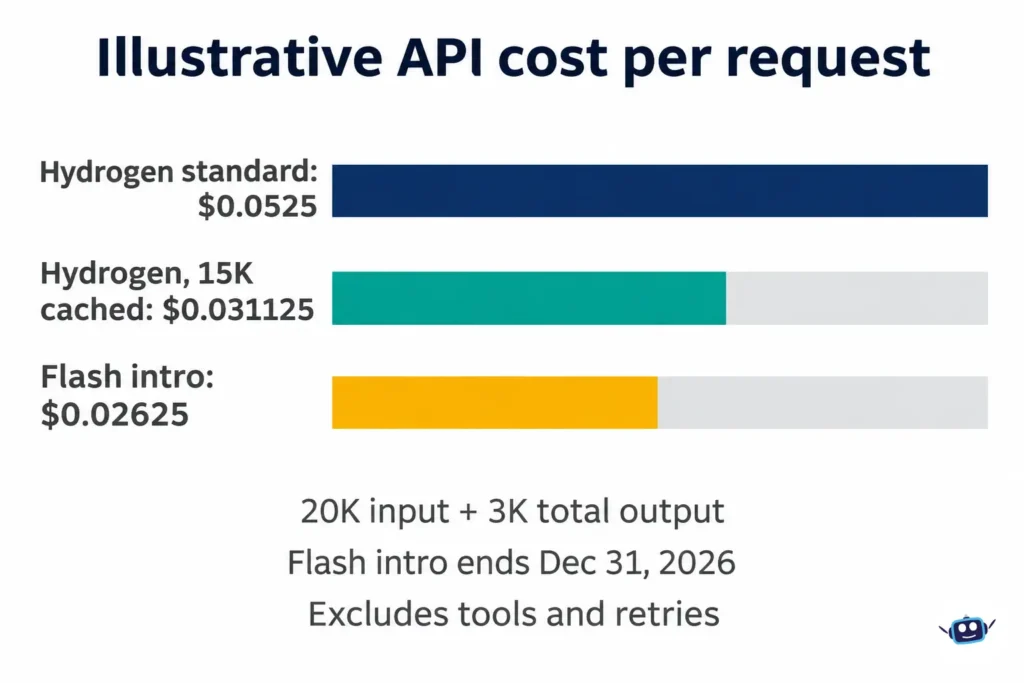
For an illustrative request with 20,000 input tokens and 3,000 total billable output tokens, Hydrogen’s standard cost is $0.0525. The calculation is 0.02 × $1.50 + 0.003 × $7.50.
The following examples hold token counts constant. They are calculated scenarios, not measured application results.
| Scenario | Cost per request | Cost for 10,000 requests |
|---|---|---|
| Hydrogen, standard, all input uncached | $0.0525 | $525.00 |
| Hydrogen, Batch, all input uncached | $0.02625 | $262.50 |
| Hydrogen, standard, 15,000 input tokens receive the cached rate | $0.031125 | $311.25 |
| Flash, standard introductory rate through December 31 | $0.02625 | $262.50 |
| Flash, standard rate scheduled from January 1 | $0.0525 | $525.00 |
These figures exclude tool charges and retries. The cached example assumes an actual cache hit; repeating a long prompt does not by itself guarantee that discount.
Can Batch, Flex, or Contributor reduce the bill?
Google lists Hydrogen Batch and Flex input/output rates at half the standard rate. Batch processes non-urgent jobs asynchronously with a target turnaround of 24 hours; Flex is a preview tier that trades lower prices for variable latency and best-effort availability.
Contributor also lists half-price Hydrogen token rates, but it is an invite-only private preview with a data-sharing condition. Google can use participating data to improve its products and machine learning technologies. Treat eligibility, data handling, and response-time needs as part of the price comparison.
What most people miss is that identical token rates do not imply identical bills. Even after January, thinking-token usage, cache hits, repeated context, tool queries, failed attempts, and completed-task quality can change the cost of the same workflow.
What data and extra charges should you check?
Google’s pricing table marks free-tier Hydrogen content as used to improve its products and ordinary paid-tier content as not used for that purpose. Contributor is a separate opt-in data-sharing arrangement; a discounted paid route should not be assumed to have the same data conditions as standard paid usage.
Before submitting company documents or customer information, review the terms for your actual service tier. A consumer Gemini subscription and a developer API project are different access routes.
Grounding—connecting an answer to external information—can also add charges. Google bills Search grounding per query after the applicable shared allowance, and one submitted prompt can trigger multiple queries. Token-only estimates therefore understate some research-agent workloads.
What do the speed and accuracy claims actually mean?
Google reports that Hydrogen finishes tasks 2.5 times faster than Gemini 3.8 Flash at Hydrogen’s default high thinking setting. Google also reports more than a fivefold reduction in fabricated claims; neither claim guarantees the same result on your workload.
In Google’s Terminal-Bench 4.1 comparison, Hydrogen scored 57%, versus Flash’s 18.2%. That is a result on a specific terminal-task evaluation, not a general accuracy percentage for every answer.
Independent evaluator Artificial Analysis lists Intelligence Index scores of 27 at low, 41 at medium, 51 at high, and 54 at xhigh. These independently published results support a capability difference between settings, but they do not independently establish Google’s exact fabricated-claim reduction.
Keep the evidence categories separate:
- Documented product details: Prices, supported settings, and published API behavior.
- Vendor measurements: Google’s speed, safety, and fabricated-claim comparisons.
- Independent evaluations: Results published by an evaluator using its own benchmark suite.
None is a universal pass rate for your application.
“Faster” also needs a metric. Time until an answer starts, output generation speed, and time to finish a multi-step task describe different experiences. For a coding agent, the useful measure is often time to a correct, checked change.
Which thinking level should you choose?
Hydrogen offers low, medium, high, and xhigh through its API, with high as the default. Google recommends choosing the lowest setting that meets your quality needs rather than using the deepest setting for every prompt.
| API thinking level | Starting use case from Google’s guidance | Tradeoff to evaluate |
|---|---|---|
| low | Fast chat and high-volume processing | Whether reduced reasoning still passes your checks |
| medium | Interactive coding and UI iteration | Responsiveness versus harder-task reliability |
| high | Complex coding, tool use, and knowledge work | Default balance of quality and execution time |
| xhigh | Difficult multi-step problems where high falls short | Additional latency and token use |
These API options should not be confused with the Gemini app’s controls. Gemini Apps Help currently lists Low, Medium, and High for its consumer interface.
For a useful comparison, keep the task, tools, and acceptance criteria constant. Record whether each setting finishes correctly, how long it takes, and its total billable usage. The highest benchmark score is not automatically the best operating choice.
What can break when you migrate from Flash?
Changing the model name is only the first step. Google’s migration documentation identifies changes to reasoning controls, caching, and the way context capacity is shared.
| Migration issue | Verified behavior | What to change |
|---|---|---|
| Old model identifier | Hydrogen uses gemini-4-hydrogen | Update the selected model explicitly |
| Old reasoning controls | thinking_budget and MINIMAL return HTTP 400 errors | Use a supported thinking level |
| Changed default | Hydrogen defaults to high; Flash defaulted to medium | Set the intended level explicitly before comparing results |
| Explicit context caching | Hydrogen does not support explicit cached-content requests | Remove those fields; implicit caching starts at a 4,096-token prompt threshold, subject to cache hits |
| Sampling controls appear ineffective | Custom temperature, top_p, and top_k values are ignored | Remove them and specify required behavior in the prompt or schema |
| Tool calls or later turns fail | Tool declarations and conversation state have stricter requirements | Declare tools natively and preserve prior thought signatures correctly |
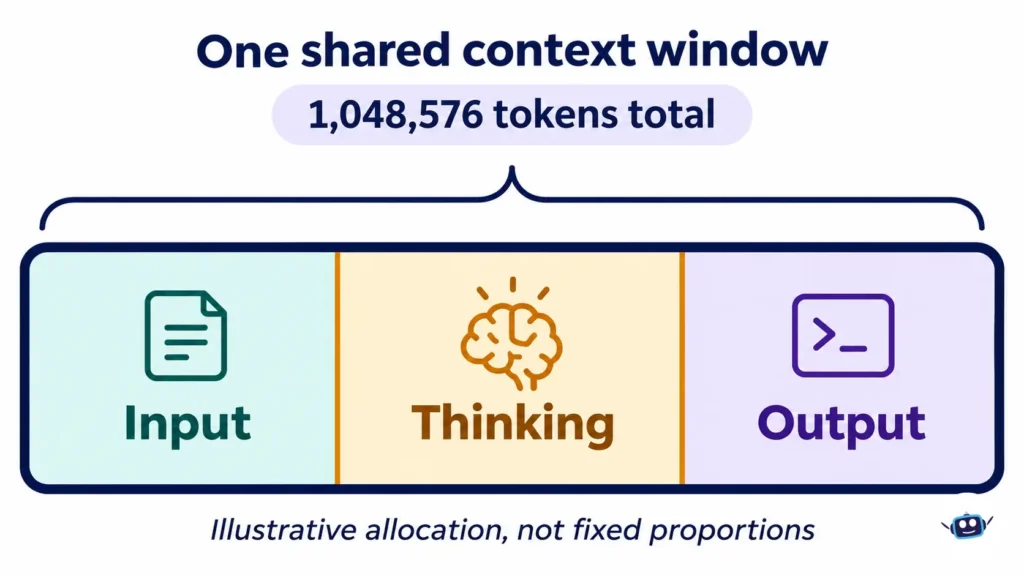
| Context assumptions | Input, thinking, and output share 1,048,576 tokens | Leave room for reasoning and the response |
Update your SDK for the API features you use, especially automatic continuation. Google documents different minimum SDK versions for the Interactions API and GenerateContent, so a single version recommendation does not cover every integration.
The context window is the model’s working capacity. It is not a promise that you can send a full million-token input and then receive another million tokens in the same interaction.
Google Cloud documents a 65,536-token foreground output segment, with longer generation available through supported continuation or background mechanisms. Check the API path you use before treating maximum generation capacity as a single-response limit.
Hydrogen accepts multimodal inputs, including text, images, audio, and video. Google Cloud also documents direct Office and OpenDocument file inputs. Our multimodal foundation models explainer covers why input support and output capabilities need to be checked separately.
How does Hydrogen fit alongside Carbon and Argon?
Google positions Hydrogen for rapid execution and Carbon and Argon for deep, long-horizon reasoning. Those roles are more useful than treating the elemental names as a simple ranking.
For development work, that can mean using a frontier model to plan a difficult architectural change, then Hydrogen to edit files and run checks. Whether that split helps depends on the task and the integration.
Google’s Antigravity Orchestrator can switch between Carbon and Hydrogen in one session. Google reports near-Carbon success rates on Terminal-Bench 4.0 with 24% less quota and 19% faster completion. Those are results for the combined setup on that benchmark; they are not standalone Hydrogen savings or a promise about your bill.
What changes in Google Search?
Google says Hydrogen improves Search’s handling of detailed, multi-part questions and produces more visual, structured answers. Its announcement describes improved query fan-out: running related searches across parts of a question to find relevant material.
For example, you can frame a question around several constraints rather than stripping it into disconnected keywords. Google says the update can return comparison tables, images, and a broader range of helpful links.
Those are product claims, not proof that every answer will be correct. When an answer affects a purchase or an important decision, open the underlying pages and check whether they support the specific claim.
Frequently asked questions
When was Gemini 4 Hydrogen released?
Google announced Gemini 4 Hydrogen on November 12, 2026. Artificial Analysis also lists that release date for its Hydrogen high entry.
Can you use Gemini 4 Hydrogen without paying?
Yes, Google documents free access routes, including automatic selection for suitable prompts in the Gemini app. That access is subject to usage limits and does not mean every free chat runs on Hydrogen.
Is Gemini 3.8 Flash shutting down?
Google’s API deprecation schedule lists no shutdown date for Gemini 3.8 Flash as of November 2026. Do not treat Hydrogen’s launch as an announced retirement deadline.
Does Hydrogen have a million-token context window?
Yes, Google documents a shared 1,048,576-token window. Input, thinking, and output draw from that same capacity, so large inputs reduce the space available for generation.
Is Hydrogen’s cached price automatic for every repeated prompt?
No. Hydrogen uses implicit caching, and the discounted rate applies to tokens that actually receive a cache hit. Review usage metadata rather than assuming every repeated token was discounted.
Do matching January prices mean Hydrogen and Flash cost the same?
Only if the relevant billable usage is also the same. Different reasoning-token volumes, caching behavior, tool calls, and retries can produce different total bills at identical headline input and output rates.
Does xhigh guarantee a better answer?
No setting guarantees correctness. Google advises reserving xhigh for difficult tasks where high falls short, because deeper reasoning adds latency and token use and can overthink simpler prompts.
Should you switch now or keep Flash?
Evaluate Hydrogen now if coding, tool use, or document workflows are limited by Flash’s reliability or completion time. Keep a working Flash integration available while you resolve migration issues and establish whether the newer model improves your actual results.
For simple classification or extraction, first check whether your existing model already meets your quality target. Paying for deeper reasoning adds little value if it does not change the outcome.
Use this practical comparison method; it is an editorial checklist, not an official Google benchmark:
- Choose representative tasks and define success. For code, require the intended change and relevant checks to pass. For document extraction, specify which fields and values must be correct.
- Run a controlled comparison. Keep tools and task instructions consistent. Test Hydrogen at medium and high, with Flash configured explicitly rather than relying on different defaults.
- Track the whole attempt. Record completion time, all billable tokens, cache usage, tool charges, retries, and whether the task passed.
- Calculate cost per accepted result. Divide total evaluation spend, including unsuccessful attempts, by the number of accepted results.
- Review failures before switching. Inspect malformed calls, missing context, incorrect answers, and permission-sensitive actions. Keep a rollback route for production traffic.
This comparison can guide your deployment; it cannot reproduce Google’s broad fabricated-claim claim without a matching evaluation method and dataset.
Hydrogen is a successor worth evaluating, while Flash’s API retirement remains unannounced. Your next step is to compare one workflow at explicit reasoning settings and decide from its correctness, completion time, and full cost.
Related: Our Meta Muse Ember pricing and benchmarks guide covers another model to consider when evaluating everyday AI workloads.
Disclaimer
This article is for informational purposes only and is not affiliated with, sponsored by, or endorsed by Google or any other brand mentioned. Prices, features, availability, and policies may change; information last verified on November 13, 2026. AI output can be inaccurate, so verify important claims and review generated code before using it.