

Introduction
Most defense-tech funding stories are about things that fly, float, or explode. This one is about spreadsheets, clipboards, and getting fuel to the right place before it’s too late.
On October 8, 2026, Gallatin AI announced a $50 million Series A to scale Navigator, its decision-support platform for U.S. military logistics. The headline numbers are easy to find. What’s harder to find is the context: how the company got here, what the round does and doesn’t tell us, and where the public numbers don’t quite add up.
I spent time reading the company’s official announcement, the Axios exclusive, the company’s earlier contract releases, and a pile of secondary coverage. This article separates what’s confirmed from what’s repeated, and points out a few things most write-ups skipped.
Quick Answer: What Happened?
Gallatin AI raised a $50 million Series A on October 8, 2026. The El Segundo, California company builds AI software for military logistics and sustainment. The round was backed by new and existing investors, including 8VC and Silent Ventures, and brings Gallatin’s stated total funding to $70 million. The money will go toward engineering hires, product development, and a broader set of AI-enabled sustainment tools for the Joint Logistics Enterprise.
Gallatin AI Series A: The Verified Facts
| Detail | What’s confirmed |
|---|---|
| Company | Gallatin AI, Inc. (founded 2024) |
| Round | $50M Series A, announced Oct 8, 2026 |
| Named investors | 8VC, Silent Ventures, “and others” |
| Lead investor | Not publicly disclosed |
| Total raised (company-stated) | $70M |
| Flagship product | Navigator |
| Headquarters | El Segundo, CA (offices in Washington, D.C. and Austin, TX) |
| Stated use of funds | Engineering, product development, expanded AI sustainment capabilities |
One correction to the coverage first. Several aggregator sites describe 8VC and Silent Ventures as “leading” the round. The company’s own release says only that the round was “backed by” them, and Axios says they participated. Until Gallatin names a lead, “no disclosed lead” is the accurate phrasing.
Who Is Gallatin AI?
Gallatin was founded in 2024 by Woody Glier, Daniel Buchmueller, and Brian Ballard, and incubated in 8VC’s Build program, which also produced defense companies like Epirus and Saronic. According to FreightWaves, the company emerged from stealth in April 2025 with a $15 million seed round led by 8VC. Silent Ventures, Moonshots Capital, Timeless Partners, and Banter Capital also participated.
The founding team’s background matters here. Glier is a Palantir and Scale AI alum, and the founders collectively have experience across the Department of Defense, Amazon, and commercial logistics. Ballard, now Chief Product Officer, says many people on the team have “lived these sustainment challenges firsthand in uniform.” That’s the kind of claim you’d want to verify through hiring pages and conference appearances, and Gallatin’s job postings do lean heavily on military-service backgrounds.
The company also lists other products, including Burrow, which it describes as a third-party logistics offering. This article focuses on Navigator because that’s what the funding announcement centers on.
What Navigator Actually Does
“AI logistics platform” is vague, so here’s the plain version. According to Defence Blog’s report on the III Corps contract, Navigator combines four capabilities:
- A logistics common operating picture: one live view of where supplies are, where they’re going, and where the gaps are.
- Predictive consumption algorithms: demand forecasting across all classes of supply, from fuel and ammunition to food, water, and medical items.
- AI-assisted planning for the Military Decision Making Process: the structured method Army staffs use to build and compare courses of action.
- Integration with Army simulation platforms: so staffs can rehearse plans before executing them.
Navigator also runs natively inside Maven Smart System and pulls data from existing Army systems of record through secure APIs. That design choice matters more than it sounds, because it means units don’t have to abandon the tools they already use.
A practical example (illustrative)
Imagine a sustainment planner supporting an exercise in Europe. A brigade reports its fuel consumption late and in a different format than the last unit did. Historically, someone reconciles that by hand, builds a convoy plan in a spreadsheet, and hopes nothing changes. A decision-support platform is meant to ingest the messy reports, forecast the next 72 hours of demand, and propose two or three supportable plans that the planner can adjust.
That’s the pitch. CEO Glier described the starting point bluntly to Axios, saying much of today’s logistics data is “very manual,” literally clipboard and paper. The company’s bet is that software can help even when the underlying data is inconsistent.
The Contract Ladder: How Gallatin Got to a $50M Round
Most coverage treats the Series A as a standalone event. It makes more sense as the latest step in a sequence. Here is the public record, in order:
- April 2025: Emerges from stealth with a $15M seed round.
- September 2025: Wins an Air Force Materiel Command Digital Transformation Office SBIR Phase I contract to study generative AI for humanitarian assistance and disaster relief logistics, according to PR Newswire.
- February 2026: Opens an Austin, Texas engineering office, positioned near Fort Hood and Army sustainment commands.
- March 2026: Awarded an Army Applications Laboratory PORTAL Direct to Phase II SBIR for predictive logistics in contested environments, per the company’s press release.
- June 2026: Wins an 18-month contract from III Armored Corps, awarded through an Other Transaction Agreement. Financial terms weren’t disclosed.
- July 2026: Awarded a Defense Innovation Unit Joint Sustainment Decision Tool contract for U.S. Army Europe and Africa, with Scale AI as a named teammate for course-of-action validation, per DIU’s JSDT announcement.
- October 2026: Announces the $50M Series A.
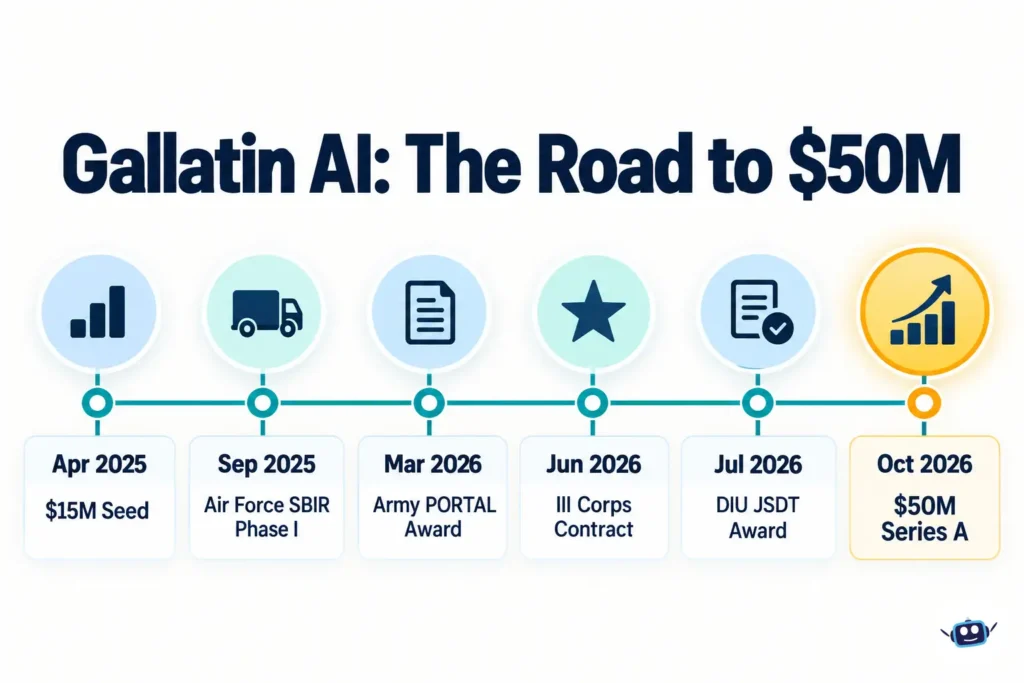
Read in order, the pattern is clear. Small government awards came first, then corps-level and theater-level work, then the larger raise. Investors weren’t funding a slide deck. They were funding a company with a visible trail of Army and DIU engagements. Defense-tech founders often describe this as using venture capital to build to commercial software standards before the government buys at scale, and Gallatin’s own releases make a similar argument.
The Funding Math Nobody Is Showing You
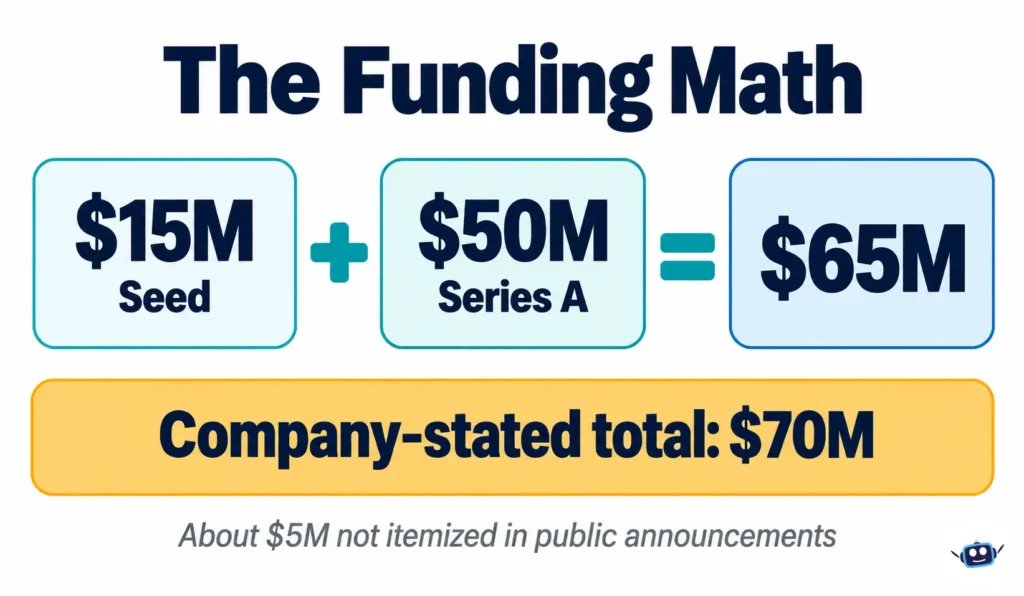
Here is something I haven’t seen in other coverage. The seed round was $15 million. The Series A is $50 million. That’s $65 million. Gallatin states its total funding is $70 million.
The roughly $5 million difference isn’t itemized in any announcement I could find. It could be an extension, a venture debt facility, grant-style funding, or simply rounding. I’m not claiming anything is wrong. But if you’re writing about this round or evaluating the company, “total raised: $70M” is the company’s figure, not one you can reconstruct from the announced rounds.
The release also says the Series A “follows a successful seed financing in 2024,” while contemporaneous reporting dates the seed announcement to April 2025. The company was founded in 2024, so that’s probably a loose reference to the seed period, but it’s another small inconsistency worth knowing about.
Why Military Logistics Is Suddenly Venture-Backable
According to Axios, the Pentagon treats contested logistics as a critical technology area: getting fuel, food, ammunition, and blood to their destinations, especially under fire. The Defence Blog report ties this to the risk of a high-intensity conflict in a theater like the Indo-Pacific, where supply lines would stretch across thousands of miles of ocean.
That gives venture investors something they like: a problem the customer has publicly named a priority, plus contracting vehicles (SBIRs, Other Transaction Agreements, DIU prototypes) that let startups get paid without waiting years for a traditional program.
There’s also a quieter reason. Drone and autonomy companies get the headlines, but autonomous systems still need someone to decide what cargo they carry, where they go, and how they’re loaded. Gallatin has shown this connection directly. In a field event described by Kodiak AI, Navigator completed load plans and Kodiak’s autonomous driver executed missions in unstructured terrain.
Competition: Not a Solo Race
It would be a mistake to read this round as proof that Gallatin owns the category. The Joint Sustainment Decision Tool program is multi-vendor. ExecutiveGov reported that DIU awarded prototype contracts to Air Space Intelligence and Watchtower Labs under the same program. Gallatin’s award is specific to U.S. Army Europe and Africa.
So the real competitive picture includes other startups, large integrators, and the Army’s own internal tools. Gallatin has partnered with Booz Allen Hamilton on contested logistics and announced interoperability with Palantir environments, which suggests a strategy of fitting into existing ecosystems rather than replacing them.
Potential Benefits If Navigator Delivers
If the platform performs as described in the Army and DIU announcements, the practical upside includes:
- Earlier warning on shortfalls, so planners act before a constraint becomes a mission problem.
- Faster course-of-action comparison, because staffs can test several supportable plans instead of building one by hand.
- Less manual reconciliation, since data from different units and systems lands in one view.
- Better rehearsal, through integration with simulation platforms used before live exercises.
Note the conditional. These are the stated capabilities, not independently audited results.
Risks and Open Questions
A balanced read needs these on the table:
- Measured results aren’t public. Contract values for the III Corps award weren’t disclosed, and I found no published performance metrics such as planning time saved or forecast accuracy.
- Data quality limits everything. Forecasting is only as good as the reports feeding it, and Gallatin’s own CEO describes those reports as messy.
- Pilot to program is the hard step. SBIRs and OTAs are real money, but moving from prototype awards to sustained funding is where many defense startups stall.
- Dependence on government timelines. Budget cycles and priority shifts affect revenue in ways commercial software companies rarely face.
Tips: How to Read a Defense-Tech Funding Announcement
Check the lead. “Backed by” and “led by” are different statements. If the lead isn’t named, say so.
Reconcile the totals. Add up the announced rounds. If they don’t match the stated total, note the gap rather than guessing.
Separate “deployed” from “contracted” from “scaled.” Navigator being used in exercises is different from being a program of record.
Look for measurable claims. Hours saved, forecast accuracy, and time-to-plan are evidence. “Order of magnitude improvement” is a company claim until someone publishes the test.
Trust primary sources first. Company releases, Axios, and trade outlets with named reporters beat anonymous aggregators.
Common mistakes
- Repeating “led by” without checking the release.
- Treating unverified statistics as fact. Some aggregators attached market forecasts or regional expansion claims to this story that don’t appear in the company’s announcement, so I left them out.
- Confusing the Series A with a contract value. The $50M is investor capital, not a government award.
Personal Experience: What I Learned Verifying This Story
I’ll be direct about what “experience” means here: I’m not a soldier or a logistician, and I won’t pretend to be. What I can offer is what happened when I tried to verify this story the way an editor should.
The first surprise was how much repetition there was. Within hours of the announcement, nearly a dozen pages said almost the same thing in almost the same words. Many traced back to a single press release. Reading them side by side taught me to find the original and work outward, instead of counting how many sites said something.
The second was the “led by” problem. I caught myself about to write that 8VC led the round because three separate pages said so. Then I reread the company’s release. It says “backed by.” Sticking with the primary source changed one sentence, but it’s exactly the sort of small error that spreads.
The third was the arithmetic. I added the seed and the Series A out of habit and got $65M, not $70M. I looked for an explanation and didn’t find one. The lesson I took away: when a number doesn’t reconcile, report the gap instead of smoothing it over.
The fourth was a few unsupported claims. I came across a market forecast and a regional-expansion claim attached to this story. Neither appeared in the company’s release or the Axios piece, so I dropped them. If you can’t find the original source, the claim doesn’t go in.
If you’re writing about any funding round, my practical advice is to keep a two-column note while you research: “confirmed by primary source” and “repeated by others.” Only the first column goes in the article.
Frequently Asked Questions
How much did Gallatin AI raise in its Series A?
Gallatin AI raised $50 million in Series A financing, announced on October 8, 2026. The company states its total funding is now $70 million.
Who invested in Gallatin AI’s Series A?
The company named 8VC and Silent Ventures, along with other new and existing investors. A lead investor hasn’t been publicly identified.
What does Gallatin AI do?
Gallatin AI builds AI-native software for military logistics and sustainment. Its flagship platform, Navigator, forecasts demand, flags shortfalls, and helps planners build and compare supply and movement plans.
What is Navigator?
Navigator is Gallatin’s decision-support platform. It provides a unified readiness view and supports vehicle readiness, supply, medical, and other mission-support functions. It runs inside Maven Smart System and integrates with existing Army systems.
Who uses Navigator?
Gallatin says Army and Air Force customers use it across tactical, operational, and strategic planning, including exercises in Japan, Alaska, and Europe. It has also won contracts from III Armored Corps and, through DIU, for U.S. Army Europe and Africa.
Is Gallatin AI a drone company?
No. As Axios put it, this isn’t another drone builder. Gallatin focuses on the software layer for planning, forecasting, and tracking supply movements.
What will Gallatin do with the $50 million?
According to the company, it will expand its engineering team, accelerate product development, and broaden its AI-enabled sustainment capabilities across the Joint Logistics Enterprise. It also says it’s accelerating a permanent presence on four continents.
How does this compare with other military logistics AI companies?
Gallatin isn’t alone. DIU’s Joint Sustainment Decision Tool program has also funded Air Space Intelligence and Watchtower Labs, so buyers have multiple options.
Conclusion: What This Round Really Signals
The Gallatin AI Series A matters less as a big number and more as evidence of where defense-tech money is moving: from hardware spectacle toward the software that decides what moves, when, and where. The company earned this round through a sequence of Army, Air Force, and DIU engagements, not a single splashy win.
At the same time, the public record has gaps: no disclosed lead investor, no published performance metrics, and a small funding-math mismatch. Those aren’t red flags. They’re the things worth watching as Navigator moves from exercises toward broader adoption.
Actionable takeaways
- If you’re reporting on this round, say “backed by,” not “led by,” and cite the company’s total as company-stated.
- If you’re an investor or analyst, watch for published results from the III Corps and USAREUR-AF work, since those will tell you more than the round size.
- If you work in logistics or defense procurement, note the design choice to layer onto existing Army systems rather than replace them.
- If you follow funding news in general, our Startups & Industry coverage applies the same fact-check approach to other rounds, such as our breakdown of the doxx.net $38M a16z-led round. You can also see how we handle verification in our editorial process.
Disclaimer: This article is for general information only and is not investment, financial, legal, or procurement advice. It reflects publicly available reports as of October 9, 2026. Claims about Navigator’s capabilities come from Gallatin AI’s statements and press coverage and have not been independently tested by AI LLM News. Funding figures, contract details, and company information may change. Verify details with official sources before making decisions.