
InferKit, the web and API text generator built by developer Adam King, is discontinued. Its website says the app became outdated as AI advanced, and that paid subscriptions were cancelled and refunded. You can no longer sign up or generate text with it. If you need what it did, which was continuing a passage you started, general assistants such as ChatGPT, Claude and Gemini now do that job. Sudowrite is aimed at fiction, and developers can move to OpenAI-compatible APIs or local model runners.
What InferKit Was
InferKit grew out of Talk to Transformer, a simple site Adam King launched in early May 2019. It let anyone try OpenAI’s GPT-2 language model, which OpenAI had announced in February 2019. You typed a few words and the model predicted what came next.
King later turned the idea into InferKit, a commercial product with a web editor and an API. A 2020 writing-technology blog reports that its API ran on a larger model called Megatron.
The core idea was text continuation. You supplied a prompt and InferKit extended it, with controls for output length, keywords to steer the topic, and sampling temperature (higher values give more random, varied text). Its audience was split between novelists looking for ideas and app developers who wanted generated text inside their products.
What Happened to InferKit
The InferKit site now carries a discontinuation notice. According to Autoblogging.ai, which checked on October 4, 2026, the pricing, docs and blog pages all redirect to that notice.
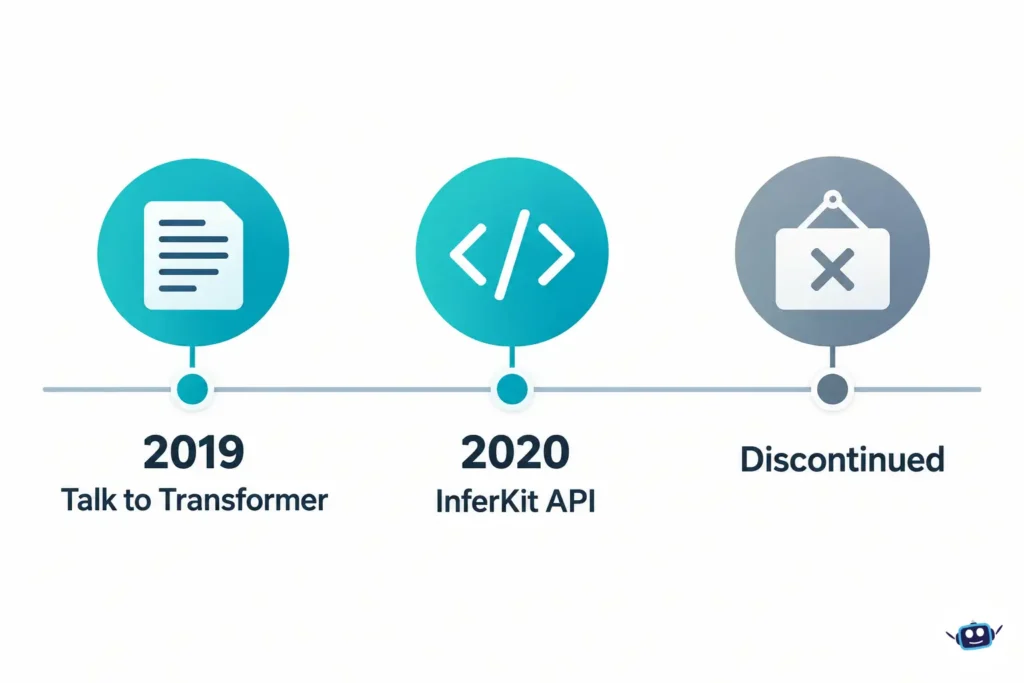
The exact shutdown date is unclear. Secondary sources disagree: one directory says April 2024, another says on or before July 31, 2024, and a third says 2025. AlternativeTo already listed the product as discontinued when its page was last updated on September 29, 2024. I found no dated official announcement, so treat any single month as unconfirmed.
What InferKit Cost (For the Record)
Two software directories, SpotSaaS and SaaSworthy, report the same pricing from when the service was live:
| Plan | Monthly price | Monthly characters |
|---|---|---|
| Basic | $20 | 600,000 |
| Premium | $60 | 2,500,000 |
At typical English averages, 600,000 characters is roughly 100,000 words. These plans are no longer sold. If you were a paying customer, the notice says you were refunded, so a quick look at your card statement is the only follow-up needed.
Why It Became Obsolete
InferKit was built for the GPT-2 and early GPT-3 era. SpotSaaS lists its main weakness: output could lose coherence over longer passages and sometimes drifted into odd or unsettling themes, so everything needed human review. Modern assistants follow instructions, hold context across long documents and can be told to match a tone or format. A tool that only continued raw text had little left to offer once those became common and cheap.
What to Use Instead
The right replacement depends on what you used InferKit for.
| If you used InferKit for… | Consider |
|---|---|
| Continuing or brainstorming text | A general assistant such as ChatGPT, Claude or Gemini |
| Fiction and story continuation | Sudowrite, which is built for novelists |
| Short marketing copy | A short-form tool such as Rytr |
| Team marketing content in one brand voice | A team platform such as Jasper |
| Whole SEO articles, researched and published | A dedicated article writer such as Autoblogging.ai (a vendor in this category, so weigh its claims as you would any seller’s) |
| API calls in your own app | An OpenAI-compatible chat API, or a local runner such as Ollama or LM Studio |
Prices and plan names for these tools change often, so check each vendor’s pricing page before you subscribe. For independent reviews of current tools, see the AI Tools and Reviews section of AI LLM News.
How to Migrate Your Workflow
If you used the web editor
- Paste your existing draft into an assistant.
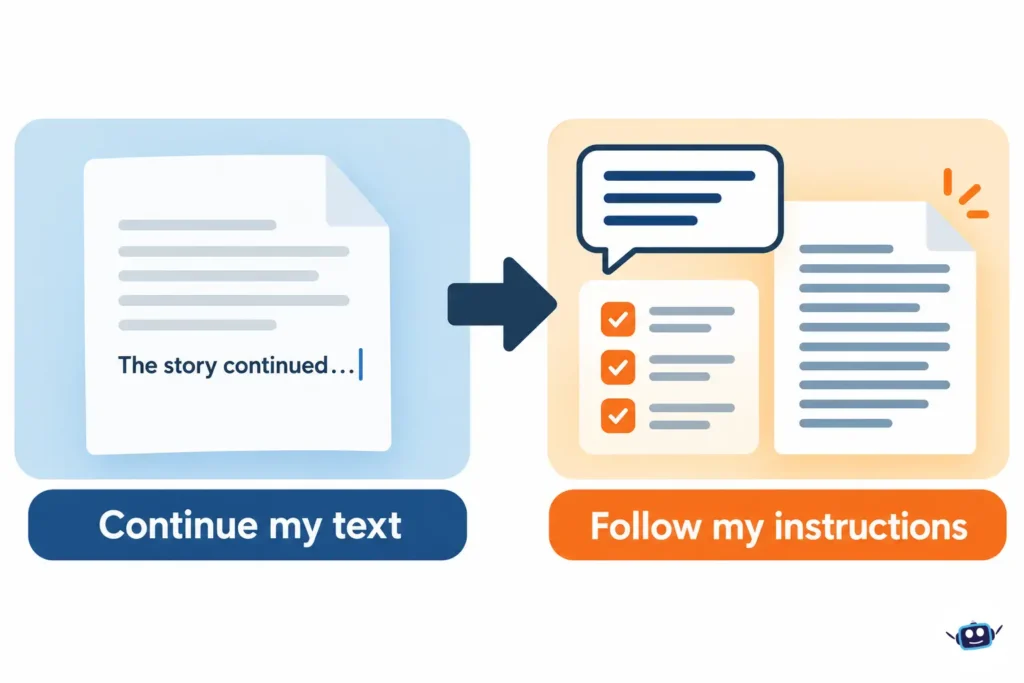
- Tell it what to do: “Continue this passage in the same voice and tense. Do not summarize or repeat it.”
- Set the length by asking for a word count, such as “about 300 words.”
- Edit the result by hand. Treat it as a first draft.
If you used the API
- Replace the single “prompt in, continuation out” call with a chat-style request. Put your old prompt in the user message and your instructions in a system message.
- Map your old settings. Output length becomes a maximum-token limit, and temperature carries over. The old keyword feature becomes a plain sentence in the prompt, such as “Stay focused on these topics: …”.
- Test on a sample of your real prompts before switching production traffic.
- Compare cost per request. Newer small models can be far cheaper than older paid plans, and the Claude Haiku 5.5 pricing breakdown shows how to read a vendor’s headline savings claim against your own usage.
For a wider view of how chat-style tools differ from agent-style ones, see this explainer on AI coding agents versus chatbots.
Practical Insights
Several unrelated projects share the name. Searching “InferKit” also turns up a Python package that deploys AI functions as web services, a Dart client for OpenAI-compatible servers, and an Objective-C inference toolkit for Apple platforms on GitHub. Their own documentation describes different projects and does not present them as the original text generator. Check the publisher before you install anything.
Directory listings go stale. Some review sites still describe InferKit as a live paid tool. Toolradar’s own pages disagree with each other: one says a free plan exists, another says there is none. The company’s site notice and the refund statement are more reliable than any aggregator listing.
The prompt style matters more than the tool. A completion model continues whatever you give it. A chat model does what you ask. Moving from one to the other works best when you spell out voice, length and what not to do.
Check how Google treats AI-assisted text. Google Search Central says generative AI can help with research and with structuring original content. It also warns that using AI to produce many pages without adding value can violate its spam policy on scaled content abuse. It suggests telling readers how content was made. If you publish AI-assisted text, add facts, examples and review of your own, and say how the piece was produced. For an example of agent-era data and permission questions, see AI LLM News’s guide to Muse AI.
Common Mistakes When Replacing InferKit
- Looking for an exact clone. No current mainstream tool copies its raw continuation style, and you will get better results from instruction-based prompts.
- Trusting old pricing or feature lists from directories.
- Publishing generated text without fact-checking or editing.
- Switching an API integration without testing output length, formatting and cost on real prompts.
- Installing a package called “inferkit” without checking that it is the project you want.
Frequently Asked Questions
Is InferKit still available?
No. The InferKit site says the service is discontinued and paid subscriptions were cancelled and refunded. Its pricing, docs and blog pages redirect to that notice.
Why was InferKit discontinued?
The site’s notice says the AI-based writing app became outdated as AI advanced over the past few years. No further explanation appears in the sources I found.
When did InferKit shut down?
The exact date is unconfirmed. Secondary sources point to some point between April 2024 and 2025, and AlternativeTo listed it as discontinued by late September 2024.
Who created InferKit?
Developer Adam Daniel King created it. He also built Talk to Transformer, the 2019 demo of OpenAI’s GPT-2.
Was InferKit free?
It had a limited free tier and two paid plans, according to directory listings of the live service. Basic was $20 a month for 600,000 characters and Premium was $60 for 2.5 million characters. None of that can be purchased now.
What is the best InferKit alternative?
It depends on the job. General assistants like ChatGPT, Claude and Gemini cover text continuation, Sudowrite suits fiction, and OpenAI-compatible APIs suit developers. Compare current pricing on each vendor’s own site.
Is the InferKit on GitHub or PyPI the same product?
No. The open-source packages that carry the name describe themselves as different projects, such as an Objective-C inference toolkit, a Dart client and a Python deployment library. Read the package documentation to confirm what each one does.
Do I need to do anything about my old subscription?
The notice says subscriptions were cancelled and refunded, so no action should be needed. Check your card statement to confirm no charges remain.
Conclusion
InferKit was an early, simple way to use large language models, and it has been retired. If you are replacing it, start with the task rather than the brand:
- For text continuation, use a general assistant and give it clear instructions.
- For fiction, try a writing tool built for stories.
- For API work, move to a chat-style API and re-test your length, temperature and cost settings.
- Ignore stale directory listings and check the publisher before installing anything named “inferkit.”
- Edit and fact-check generated text before you publish it.
Disclaimer
This article is for general information only. InferKit is discontinued, and the prices, features and availability of the alternatives mentioned can change, so confirm details with each provider before you buy or switch. Information is current as of October 2026.