
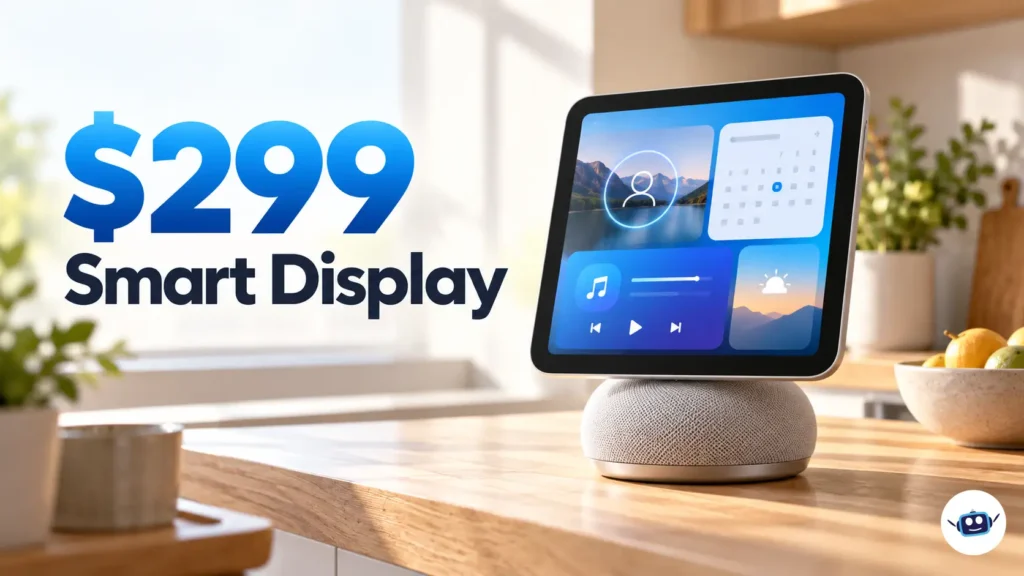
Apple HomeView is the company’s first smart display for the home. It costs $299 in the U.S., is open for pre-order now and arrives November 13. It has a 7-inch screen, recognizes up to six people by face, and runs Siri AI, a rebuilt version of Siri that is still in beta. The catch is that its most personal features need a recent iPhone or iPad. The accessories that make it a full smart home cost extra, and most arrive in December or later.
What Apple announced on October 13
Apple introduced HomeView alongside a new Apple TV 4K, a second-generation HomePod mini and a line of smart home accessories called Apple Home Collection. HomeView is the centerpiece. It is Apple’s answer to Amazon’s Echo Show and Google’s Nest Hub, and the most direct response yet to the criticism that Apple’s smart home pieces never felt like a system.
Here is what Apple confirmed in its newsroom release:
| Detail | What Apple says |
|---|---|
| Price | $299 for the tabletop model and $299 for the wall-mounted model |
| Display | 7-inch Liquid Retina, True Tone, brightness from 500 nits down to 0.3 nits |
| Chip | A18 |
| Colors | Silver, starlight, rose pink, space gray (wall-mounted: silver, space gray) |
| Audio | Two full-range drivers in the display, plus a down-firing woofer and two passive radiators in the base (tabletop) |
| Users | Face recognition for up to six people, each with their own Home Screen |
| Pre-order | Open now in the U.S. through Apple’s online store and the Apple Store app |
| Availability | November 13 |
| Not sold in | The European Union, because Siri AI is currently unavailable on iOS there |
Bloomberg reported that the device has no physical buttons and relies mainly on voice, with a touch grid of apps that will feel familiar to iPhone and iPad owners.
How HomeView’s face recognition works
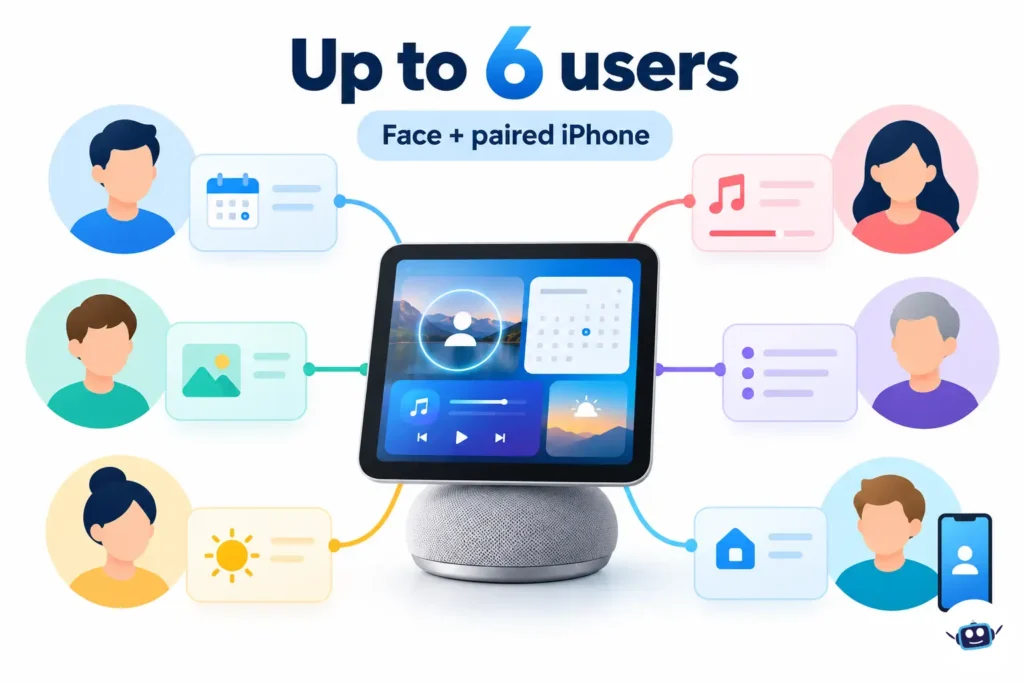
HomeView recognizes enrolled users by their faces and switches from a shared household screen to that person’s own Home Screen, with their apps and widgets. Personal content in Messages, FaceTime, Calendar, Reminders and Find My appears for the recognized person. Shared photo albums and music stay open to everyone in the home, including guests.
Two details matter more than the headline:
- Face alone is not enough for private content. Apple says Messages and Calendar content appears only when the enrolled user is recognized by face and their paired iPhone or iPad is present and recently unlocked. That is a second check, not a single camera match.
- There is an edge case. According to Apple’s footnote, if the paired device drops off Wi-Fi, personal information can remain accessible when the person is recognized by face and the device was recently on the same Wi-Fi network, has an active cellular connection, is in the same location and was recently unlocked.
Apple says camera and microphone data is processed in Secure Exclaves on the A18 chip, which are isolated runtimes. It states that this data can’t be accessed by HomeView’s software, apps, the user or Apple. That is Apple’s claim about its own design. Independent security researchers have not yet had the device.
Apple’s materials describe this as face recognition and don’t call it Face ID. Don’t assume it works like unlocking an iPhone.
Siri AI on HomeView: what works and what doesn’t yet
Siri AI is a rebuilt Siri that Apple says has broad world knowledge, more natural conversation and awareness of what’s on screen. On HomeView it is labeled beta, arrives in HomeView software version 27.2, and is available in English in the U.S., Australia, Canada, India, New Zealand, Singapore, South Africa and the UK. Reuters reported that Apple upgraded Siri this summer with help from Google, and that analysts remain unsure the assistant is strong enough to pull buyers into a crowded category.
What you get depends on the phone in your pocket:
| Feature | Needs an Apple Intelligence-enabled iPhone or iPad? |
|---|---|
| General-knowledge questions and natural conversation | No |
| Improved music discovery | No |
| Smart home control by voice or touch | No (accessories must be HomeKit or Matter compatible) |
| Requests that use your Calendar, Messages and personal context | Yes |
| Setup and multiuser support | Needs a compatible iPhone or iPad |
| Video summaries and natural-language search of camera footage | Yes, plus an eligible iCloud+ plan |
| Adjustable Siri voice expressiveness and pace | Yes, on specific newer hardware, English only |
Apple’s support page lists Siri AI as requiring an Apple Intelligence-capable device such as an iPhone 15 Pro or later, any iPhone 16 or later, or iPhone Air. An Apple Watch does not count as the personal device.
One line in Apple’s footnotes deserves attention. Certain Apple Intelligence features that rely on server-side models are subject to daily usage limits, and Apple says expanded access will be available for a fee in the future. Apple hasn’t published the limits or the price.
Smart home controls and the Apple Home Collection
HomeView controls lights, locks, thermostats and blinds by touch or by voice. The Home Camera face can show up to nine live camera feeds at once. With a supported iCloud+ plan and compatible cameras, it can recognize people, familiar faces, pets, packages and vehicles, and it can alert you when smoke or carbon monoxide alarms sound.
Apple also launched Home Collection, made with LG Electronics and Schneider Electric. Apple says these accessories set up with one tap from an iPhone, run through the Home app with no separate account, support Thread, and encrypt Home app data end to end. The locks and thermostats are Matter compatible, and the lock supports Aliro and works locally without internet.
| Accessory | Starting price (U.S.) |
|---|---|
| LG Indoor Cam Plug-In | $199.95 |
| LG Outdoor Cam Plug-In | $299.95 |
| LG Floodlight Cam | $399.95 |
| LG Video Doorbell Wired | $249.95 |
| LG Smart Deadbolt Lock | $349.95 |
| LG or Schneider Home Smart Thermostat | $199.95 |
| LG Temperature Sensor / Schneider Home Room Sensor | $39.95 |
Availability for Home Collection starts in December, with select accessories in early 2027. Apple says the cameras need no separate camera subscription, but footage history depends on iCloud+: the 50GB plan supports one camera, the 200GB plan up to five, and the 2TB plan an unlimited number. Event video history is kept for 10 days.
HomeView vs. Echo Show and Nest Hub
| Apple HomeView | Amazon Echo Show 8 | Amazon Echo Show 11 | |
|---|---|---|---|
| Price | $299 | $179.99 | $219.99 |
| Screen | 7-inch | 8.7-inch | 10.95-inch |
| Assistant | Siri AI (beta) | Alexa+ | Alexa+ |
The Amazon prices and screen sizes come from PhoneArena’s launch coverage, and Finchannel reported the same two prices. Google’s newest smart display is still the second-generation Nest Hub from 2021, according to PhoneArena and Technology.org.
HomeView costs more than both Echo models and has a smaller screen. What it offers instead is per-person recognition and tight integration with iPhone, FaceTime, Apple Music and the Home app.
Who should buy it, and who should wait
HomeView makes sense if:
- Your household already uses iPhones and iPads, and at least one is recent enough for Apple Intelligence.
- You want a shared kitchen or hallway screen that shows different people different things.
- You already use HomeKit or Matter accessories, or plan to buy Home Collection.
Waiting makes more sense if:
- Your phone is older or Android. You would get a smart display with general Siri AI, and you would lose the personal features.
- You want the lowest price. The Echo Show 8 costs $119.01 less at announced prices.
- You live in the EU, where it is not sold.
- You want to see how Siri AI performs after launch, since it ships as a beta.
What it really costs to build the full setup
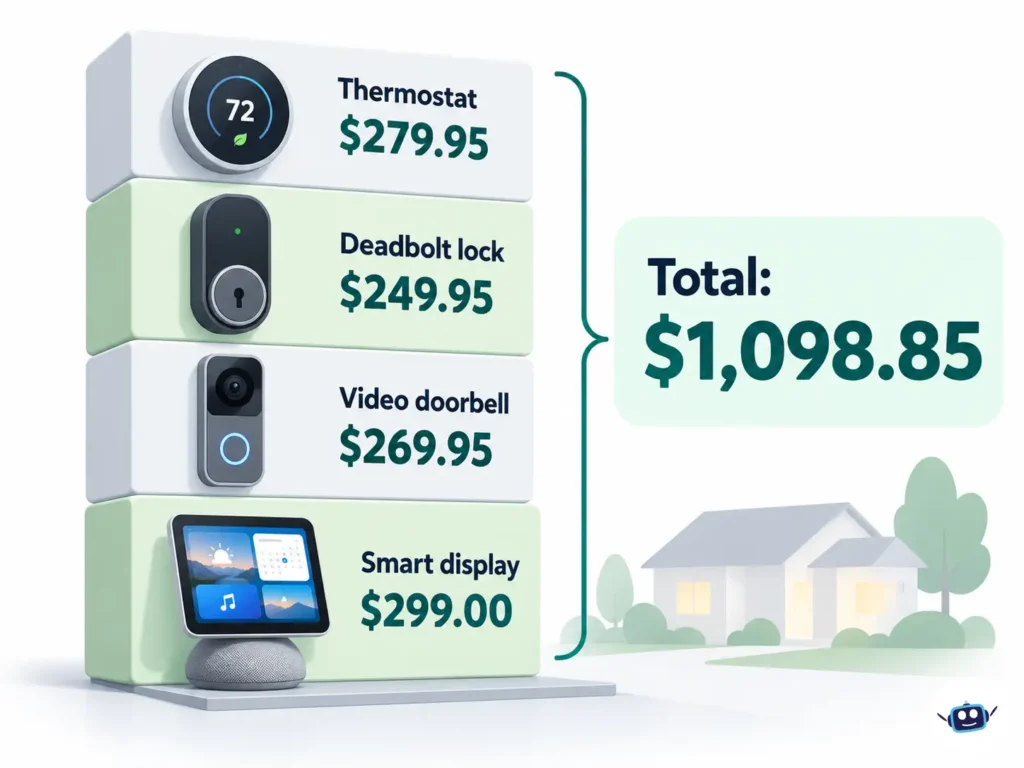
The $299 price covers the display only. Using Apple’s launch prices:
- Wall-mounted HomeView with the cheapest Schneider Home USB-C mount: $299 + $59.95 = $358.95.
- HomeView, LG doorbell and LG deadbolt lock: $299 + $249.95 + $349.95 = $898.90.
- Add one thermostat at $199.95 and the total is $1,098.85, before tax, installation or iCloud+ fees.
Apple Retail now offers professional installation from ADT for an extra charge, available in the U.S. this fall.
Practical Insights
Treat it as an iPhone accessory that happens to have a screen. Apple’s own footnotes say multiuser setup needs an iPhone or iPad, and personal content needs a paired Apple Intelligence-enabled device. A household with one recent iPhone and two older phones will get uneven results. Only the person with the compatible phone gets the full personal experience.
Check each phone before ordering. Compare every family member’s phone against Apple’s Siri AI requirements. The six-person limit is generous, but support is determined by the phone, not the display.
Buy in the order that you’ll use things. HomeView ships November 13, but Home Collection starts in December and some items arrive in early 2027. If you want the doorbell-and-lock front-door system, you won’t have it on day one. Existing Matter and “Works with Apple Home” accessories already work with HomeView, so you can start with what you own.
Budget for the cloud side. Camera history and the AI video summaries depend on iCloud+ tiers, and camera count is tied to storage plan. Apple also flagged possible future fees for heavier server-side AI use. A one-time $299 purchase may carry ongoing costs.
Place it with privacy in mind. Because a device with a camera and microphones is going into shared rooms, think about where it faces. Apple says the data is processed in an isolated runtime, but that is a claim to watch as independent reviews arrive. The same applies to nurseries and bedrooms, where the 0.3-nit night brightness makes a nightstand placement tempting.
Judge it after launch. Siri AI is in beta, and analysts quoted by Reuters said Apple still has to show benefits beyond basic voice commands. Apple’s materials are the primary source for features. Real-world performance data doesn’t exist yet. For a similar “preorder now, features later” situation in another category, see our look at what’s still coming soon on Surface Laptop Ultra, and for pricing context on another preorder-stage launch, read what Nvidia’s RTX Spark laptops really cost.
Common mistakes to avoid
- Assuming $299 is the whole cost. Mounts, cameras, locks, thermostats and iCloud+ add up quickly.
- Expecting Face ID-style behavior. Apple’s materials describe face recognition on a shared device, with a paired iPhone also needed for private content.
- Ignoring the language limit. Siri AI on HomeView is English-only at launch, with Canadian French promised later.
- Buying the wall-mounted model without a mount. It needs one of three Schneider Home mounts. The PoE version doesn’t arrive until early 2027.
- Counting on HomePod mini 2 or older speakers for everything. HomeView works with multiroom audio across HomePod, HomePod mini and AirPlay speakers, but Siri AI availability differs by device.
Frequently Asked Questions
How much does Apple HomeView cost?
It costs $299 in the U.S. for both the tabletop and the wall-mounted versions. The wall-mounted model needs a separate Schneider Home mount, starting at $59.95.
When can I get it?
Pre-orders are open now, and the HomeView ships to customers on November 13. Singapore pre-orders start October 15.
Does HomeView use Face ID?
Apple says HomeView recognizes users by their faces but doesn’t call it Face ID. Private content like Messages and Calendar also needs the user’s paired iPhone or iPad to be nearby and recently unlocked.
How many people can HomeView recognize?
Up to six. Each person gets their own Home Screen with apps and widgets, while shared photo albums and music stay available to everyone.
Do I need an iPhone to use it?
Setup and multiuser support require a compatible iPhone or iPad running the latest software. Without an Apple Intelligence-enabled one, you still get Siri AI’s general knowledge, conversation and music discovery, but not personal-context requests.
Is Siri AI finished?
No. It’s labeled beta on HomeView (software version 27.2) and is English-only for now. Apple also says some server-based AI features have daily limits and may cost money later.
Does HomeView work with non-Apple smart home devices?
Apple says it works with Matter and Works with Apple Home accessories, in addition to the new Home Collection.
Will it be sold in Europe?
Not at launch. Apple says HomeView isn’t available in the European Union because Siri AI isn’t currently available on iOS there, and it is working with the EU on a path forward.
Is HomeView better than an Echo Show?
It depends on your phone and priorities. HomeView costs more and has a smaller screen than the Echo Show 8 and 11, but it offers face-based personalization and deep iPhone integration that Echo does not. Reviews after launch will show how Siri AI performs.
Conclusion
HomeView is a well-specified, premium-priced display built for people already inside Apple’s ecosystem. Its strongest ideas are per-person home screens, a privacy design that requires both face and phone, and plug-in support for Matter devices. Its weaknesses are the $299 starting price, the iPhone dependency, the beta assistant, and a full smart home that won’t be available until December and beyond.
Before you pre-order:
- Check whether each household member’s phone supports Siri AI.
- Decide between tabletop and wall-mounted, and price the mount.
- List the accessories you need and note which are available in December or later.
- Add iCloud+ costs if you plan to use cameras.
- If you’re undecided, wait for independent reviews of Siri AI before the November 13 launch.
For more coverage of AI assistants and devices, browse our AI News section, our AI Tools & Reviews category, and our AI Policy & Ethics category for privacy and regulatory questions like the EU availability issue.
Disclaimer
This article is general information about a product announced on October 13, 2026, and is not a buying recommendation for your specific situation. Prices, features, languages, accessory release dates and regional availability can change, and Siri AI is still in beta, so confirm current details with Apple or the seller before you pre-order. Information is current as of October 2026.