
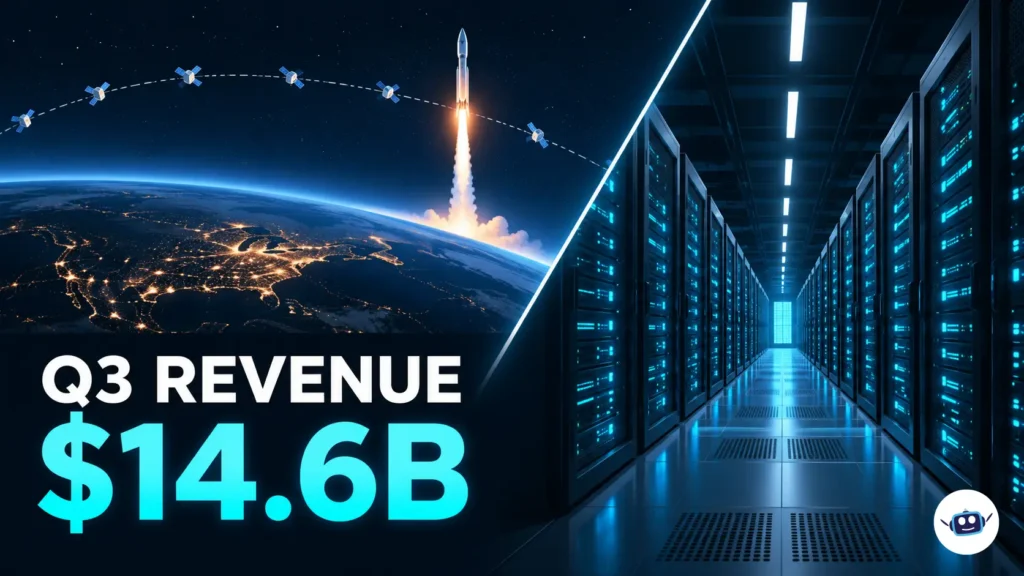
SpaceX reported third-quarter 2026 revenue of $14.6 billion on October 20, up 161% from $5.6 billion a year earlier. Its Super Intelligence (SI) segment, the unit formerly called AI, brought in $7.56 billion. That is the first time it has out-earned the Connectivity segment, which is mostly Starlink and generated $5.25 billion. Net income was $4.4 billion, but the company spent $19.6 billion on capital projects in the same quarter. That gap, plus how SI revenue is built, matters as much as the headline growth rate.
What SpaceX Reported for Q3 2026
The figures below come from SpaceX’s earnings release, filed with the U.S. Securities and Exchange Commission (SEC) as an 8-K for the quarter ended September 30, 2026.
| Metric | Q3 2026 | Q3 2025 | Change |
|---|---|---|---|
| Revenue | $14.6B | $5.6B | +161% |
| Income from operations | $2.8B | –$0.3B | swing to profit |
| Net income | $4.4B | –$1.1B | +$5.5B |
| Adjusted EBITDA (non-GAAP) | $8.8B | $2.2B | +306% |
| Diluted EPS | $0.35 | –$0.36 | — |
Revenue beat analyst expectations. Consensus sat around $12.7 to $12.9 billion, depending on the data provider (LSEG, Bloomberg and others). Sequentially, revenue rose 87% from $7.8 billion in the second quarter.
Which Segment Earned What
SpaceX now reports three segments: Space (launch and Starship), Connectivity (Starlink broadband, mobile and Starshield), and SI.
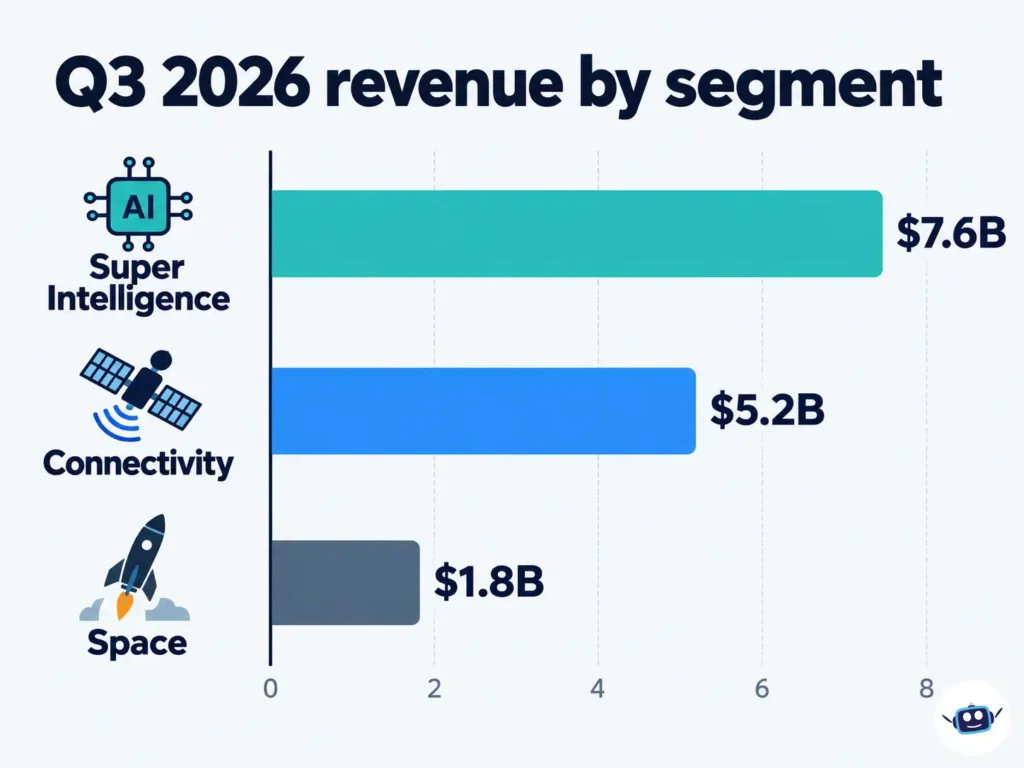
| Segment | Q3 2026 revenue | Share of total | Year over year | Quarter over quarter |
|---|---|---|---|---|
| Super Intelligence | $7.56B | 52% | +830% | +195% |
| Connectivity | $5.25B | 36% | +69% | +22% |
| Space | $1.77B | 12% | +6% | +84% |
Two details make the crossover bigger than it looks. SI revenue also exceeded Space and Connectivity combined ($7.02 billion). In August, Elon Musk had said AI revenue could pass the rest of the company as soon as September, so the quarter came in on that timetable.
What Is Inside the “AI” Number
Many summaries treat the $7.6 billion as chatbot revenue. The release says otherwise.
- Advertising: $538 million, up 19% year over year, from the X advertising business.
- SI solutions and infrastructure: $7.02 billion. This line covers cloud services agreements (renting compute to outside customers), Cursor, and Grok models and software, including the new Grok Bot.
- Cursor: SpaceX closed the roughly $60 billion acquisition of the AI coding tool on August 14. It contributed $608 million from closing through September 30.
SpaceX does not separate cloud rental revenue from Grok subscriptions or API revenue in the release. Removing Cursor entirely still leaves SI at about $6.95 billion (my calculation from the release), above Connectivity. The crossover is not just an acquisition effect. The CFO said SI solutions and infrastructure grew 192% sequentially even without Cursor, driven mainly by newly activated cloud agreements.
Starlink and Space Did Not Shrink
Connectivity revenue grew 69% year over year to $5.25 billion, and income from operations rose 99% to $2.4 billion. The numbers behind it:
- Consumer subscribers: 13.6 million, up 1.6 million in the quarter and up from 7.2 million a year earlier.
- Consumer ARPU: $69 a month, up 5% from the prior quarter but below $83 a year ago. Growth is coming from more customers, increasingly in lower-priced markets, rather than higher prices.
- Enterprise and government revenue: $2.13 billion, up 91% year over year, helped by Starshield and aviation. SpaceX reported more than 3,800 aircraft equipped with Starlink and said on the call that about 12,000 aircraft are under contract.
- Starship: Flight 14 was the first revenue-generating Starship mission and deployed 26 Starlink V3 satellites. SpaceX says that is about ten times the downlink capacity a Falcon 9 Starlink launch adds.
Space segment revenue was $1.77 billion, with 12 customer launches including NASA’s Nancy Grace Roman Space Telescope. The segment was roughly break-even at the operating line (a $7 million loss) as Starship development spending continued.
Profit Depends on How You Measure It
Headlines disagree on whether AI or Starlink is “the profit engine.” Both are right under different measures.
| Segment | Income from operations | Adjusted EBITDA | Capex |
|---|---|---|---|
| Space | –$7M | $357M | $1.61B |
| Connectivity | $2,367M | $3,499M | $1.54B |
| SI | $431M | $4,953M | $16.44B |
On adjusted EBITDA, SI leads. On GAAP operating income, Connectivity is more than five times larger. SI’s adjusted EBITDA excludes $2.47 billion of depreciation and $2.0 billion of stock compensation, including $1.2 billion tied to the Cursor deal. SpaceX’s CFO said that without the Cursor charge, SI’s operating profit would have been $1.6 billion.
Net Income Is Higher Than Operating Income
Operating income was $2.8 billion, yet net income was $4.4 billion. The release shows why. Interest income ($873 million) exceeded interest expense ($675 million), other income added $1.0 billion, and there was a $390 million tax benefit. Treat the $4.4 billion as the reported result, but the $2.8 billion operating figure better reflects the business before those items.
The Spending Side: $19.6 Billion in One Quarter
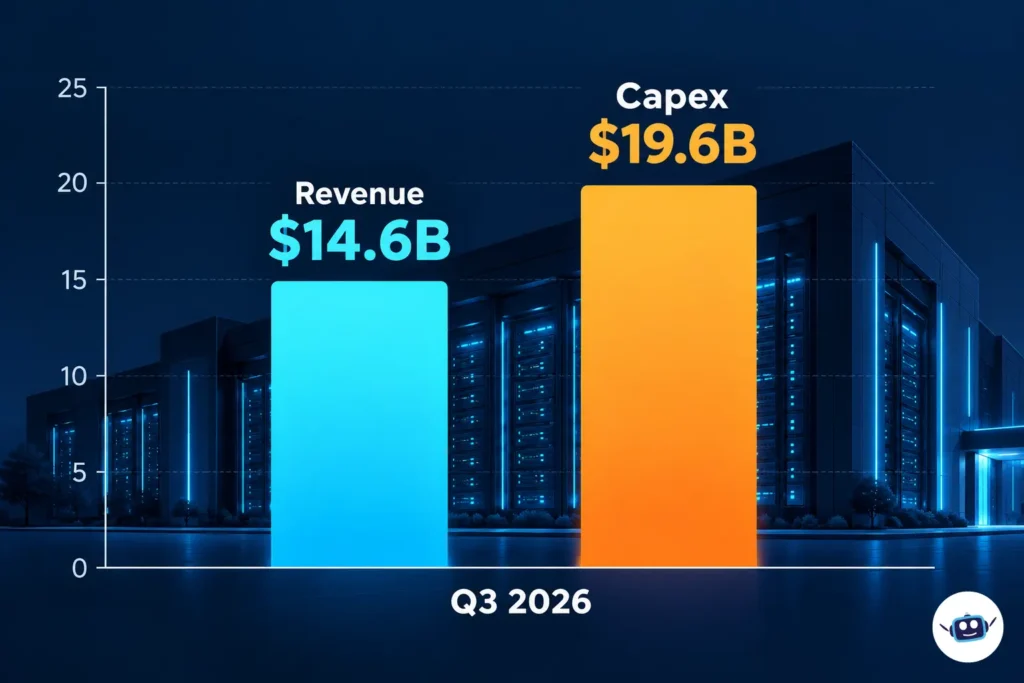
Capital expenditures were $19.6 billion, and $16.4 billion of it went to SI compute. Over nine months, capex was $48.1 billion against revenue of $27.1 billion and operating cash flow of $13.1 billion.
SpaceX funded the difference mostly from its June IPO (about $85.7 billion in net proceeds) and debt. It ended the quarter with $51.3 billion in cash and $38.6 billion in marketable securities, about $89.9 billion combined. Debt and finance leases totaled roughly $38.8 billion.
Management expects fourth-quarter capex of $35 billion to $40 billion. Nameplate compute reached 1.7 gigawatts at quarter-end, and the company expects 2.5 to 3 gigawatts by year-end.
What SpaceX Said About the Future
- Guidance: total revenue of $33 billion to $37 billion for Q1 2027.
- Annualized revenue: a target of $100 billion annualized by year-end, defined as December revenue multiplied by twelve. That implies roughly $8.3 billion in December alone.
- Backlog: $63 billion, of which about $42 billion is expected to be recognized within a year.
- Musk’s longer-range comments: annual recurring revenue of $500 billion to $1 trillion by the end of 2027, and 10 additional gigawatts of compute in 2027. These were remarks on the call, not formal guidance, and he described the harder targets as difficult.
- Starship: Flight 15 is expected in November, with an attempt to catch both the booster and the ship.
SpaceX’s own forward-looking statements warn that targets depend on power, chips, financing and regulatory approvals.
How the Market and Analysts Reacted
SPCX closed at $147.79 on October 20 and traded roughly 10% higher the next day. JPMorgan analyst Doug Anmuth raised his price target to $500 from $240 and kept an Overweight rating. The target rests on 20 times his estimated 2028 earnings per share of about $24. Per Yahoo Finance, the Street’s average target was about $223 before the post-earnings raises, so $500 is well above consensus. Targets are opinions, not forecasts anyone can verify.
Practical Insights
These points come from the filing and the call, not from any hands-on testing.
- Read the contract terms, not just the backlog. SpaceX’s S-1 says the Anthropic cloud agreements pay $1.25 billion a month through May 2029 but can be ended by either party on 90 days’ notice. Reporting on SpaceX’s filings describes a similar 90-day exit for a Google agreement after December 31, 2026. Musk said on the call that SpaceX prefers short-term contracts at close to spot rates. That keeps pricing flexible, but revenue is less locked in than a multi-year commitment.
- Separate demand from supply. SI growth currently depends on how fast SpaceX can switch on power, cooling and chips. Management itself calls power and cooling the limiting factor. Gigawatts online is a better leading indicator than any revenue forecast.
- Compare capex with operating cash flow every quarter. Payback under one year is management’s claim for new compute at current pricing. The next 10-Q and the Q4 report will show whether revenue and cash flow keep pace with $35 to $40 billion of quarterly spending.
- Watch quality of earnings. Connectivity’s 55% gross margin included a one-time benefit of about 3 points, mainly from tariff refunds. Management said Q4 gross margin should look more like Q2.
- Track the mix shift. If cloud rental dominates SI, the segment behaves like infrastructure. If Grok Bot and Cursor subscriptions grow, it behaves more like software. Grok Bot’s paid weekly users passed 800,000 in October, according to the COO. Our Grok AI usage guide covers the consumer product, and our agentic AI course guide explains the agent-style tools behind it.
Common Mistakes When Reading This Report
- Equating “AI revenue” with chatbot sales. About 93% of SI revenue is solutions and infrastructure, and advertising is the rest.
- Reading net income as operating profit. Interest, other income and a tax benefit contributed to the $4.4 billion.
- Assuming Starlink slowed. It grew 69%. SI simply grew faster from a small base.
- Treating annualized revenue as recognized revenue. The $100 billion figure is December revenue multiplied by twelve, not a trailing full-year number.
- Treating executive targets as guidance. The formal outlook in this report is $33 billion to $37 billion for Q1 2027.
Why It Matters for Businesses and Readers
SpaceX is now selling compute to other AI companies while building its own models. For readers tracking how AI is monetized, it shows that infrastructure, not only applications, can drive revenue. Our guide on what generative AI is actually good for and our analysis of why AI transformation fails cover the demand side. More coverage is in our artificial intelligence section.
Frequently Asked Questions
What was SpaceX’s revenue in Q3 2026?
SpaceX reported $14.6 billion ($14.575 billion exactly), up 161% from $5.576 billion a year earlier. It reported the figure on October 20, 2026, for the quarter ended September 30.
Did AI overtake Starlink?
Yes, by revenue. The SI segment earned $7.56 billion versus $5.25 billion for Connectivity, which is primarily Starlink. Starlink’s consumer revenue alone was $3.12 billion.
What does “Super Intelligence” mean in SpaceX’s reports?
SpaceX renamed its AI segment to Super Intelligence (SI) in this release. It covers Grok models, Grok Bot, the X advertising business, Cursor, and compute infrastructure rented to outside customers.
Is SpaceX profitable?
In Q3, yes: income from operations was $2.8 billion and net income was $4.4 billion. Over the first nine months of 2026, however, net income was still a loss of $413 million.
How many Starlink customers does SpaceX have?
It had 13.6 million consumer subscribers at September 30, up 1.6 million in the quarter. That figure excludes managed enterprise and government customers. SpaceX also said Starlink Mobile passed 22 million monthly users.
How much is SpaceX spending on AI infrastructure?
SI capex was $16.4 billion in Q3 and $40.0 billion over nine months. Management expects total company capex of $35 billion to $40 billion in Q4.
Are SpaceX’s AI cloud contracts guaranteed for years?
Not fully. The S-1 describes the Anthropic agreements as running to May 2029 but terminable on 90 days’ notice. Revenue visibility therefore depends on customers renewing, not only on contract length.
Where can I read the original documents?
SpaceX’s earnings release was filed as an 8-K on the SEC’s EDGAR database, and the company’s investor relations site hosts the call replay and transcript. The S-1 and 10-Q filings provide contract and accounting details.
Conclusion
The Q3 report shows a company that has changed shape: more than half of revenue now comes from a segment that barely registered a year ago, while Starlink and launch kept growing. The most useful takeaways:
- Check which profit measure a headline uses. SI leads on adjusted EBITDA, Connectivity on GAAP operating income.
- Look at what sits inside SI revenue before drawing conclusions about Grok’s popularity.
- Follow capex, gigawatts online and cash flow alongside revenue.
- Read cloud contract terms, since 90-day exits shape how durable the revenue is.
- Use the next checkpoints: the Q4 report, Flight 15, and the Q1 2027 guidance of $33 billion to $37 billion.
Disclaimer
This article is general information about a public company’s reported results. It is not financial, investment or tax advice, and it does not recommend buying or selling any security. Analyst price targets, company forecasts and management targets can be wrong, results vary, and a licensed financial professional should be consulted before any investment decision. Information is current as of October 2026; figures may be revised in later filings, so confirm details in SpaceX’s SEC filings.