
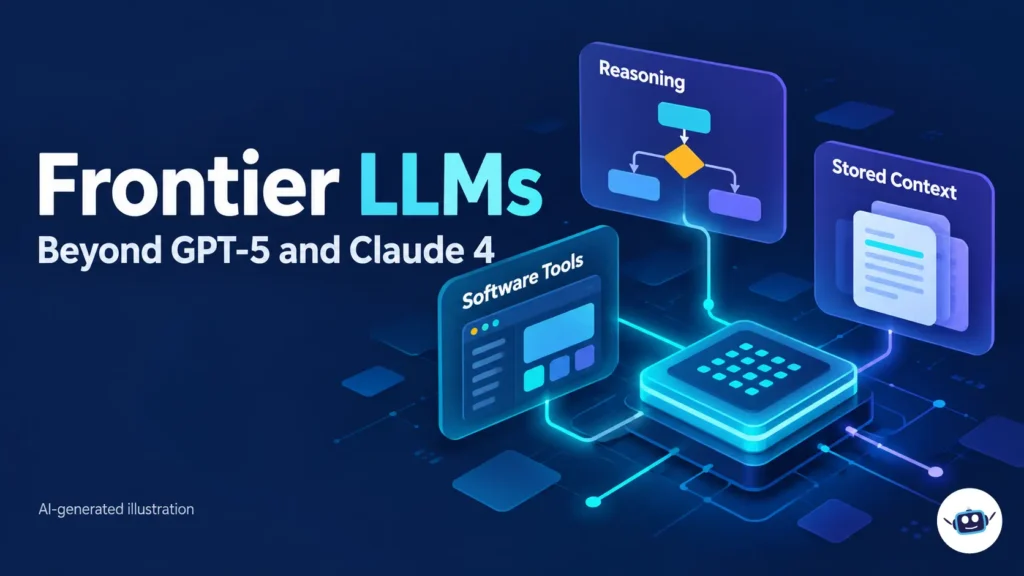
The next phase of frontier LLMs is already here. As of October 22, 2026, OpenAI’s GPT-6 models, Anthropic’s Claude Fable 5.1 and Claude 5.5 family, and Google’s Gemini 4 Argon have moved the discussion beyond the original GPT-5 and Claude 4 releases. The important shift is toward systems that can reason through difficult tasks, operate software, and carry work across multiple steps.
For developers, businesses, and AI users, the useful question is which system completes the work accurately, at an acceptable cost, with appropriate control over its actions.
What Are Frontier LLMs?
Frontier LLMs are large language models operating near the leading edge of general capabilities such as reasoning, coding, and understanding complex information. The boundary moves as models improve, and different systems can lead on different tasks.
Three terms help make comparisons clearer:
- Model: The underlying system that interprets inputs and generates responses.
- Product: The application through which people use models, such as ChatGPT or Claude.
- Agent: A system combining a model with tools, instructions, stored state, and a process for taking actions.
This distinction matters because a strong model alone does not provide a complete automation system. Available tools, permissions, and verification methods affect what an agent can accomplish.
What Changed After GPT-5 and Claude 4?
Anthropic introduced Claude Opus 4 and Sonnet 4 on May 22, 2025. OpenAI introduced GPT-5 on August 7, 2025. Those releases emphasized combinations of reasoning, coding, and tool use that later models have continued to develop.
The following snapshot covers selected current models and their providers’ stated positioning. Prices are standard API rates in US dollars per million text tokens, for uncached input and billable output.
| Model | Provider’s stated focus | Input | Output |
|---|---|---|---|
| GPT-6 Astra | Demanding reasoning, computer use, and professional work | $10 | $50 |
| GPT-6.1 Sol | Complex coding and professional work at a lower cost | $2 | $10 |
| Claude Fable 5.1 | Demanding reasoning and extended agent tasks | $10 | $50 |
| Claude Opus 5.5 | Complex coding and knowledge work requiring sustained judgment | $4 | $20 |
| Claude Sonnet 5.5 | Well-defined everyday coding and knowledge tasks | $2 | $10 |
| Gemini 4 Argon | Complex reasoning, software engineering, and knowledge work | $2 introductory | $10 introductory |
Cache operations, tools, processing modes, and long-context pricing can change the bill. These are API token prices; they do not describe the cost or limits of consumer subscriptions.
Two access and pricing details deserve attention. Google expanded Gemini 4 Argon access on October 13, including the Gemini API and eligible paid products. Earlier comparisons describing it as restricted to an initial security program are outdated. Google’s current developer documentation lists its introductory API rates through November 30, 2026, followed by $4 input and $20 output starting December 1.
Anthropic also distinguishes generally available Claude Fable 5.1 from Claude Mythos 5.1, which has restricted access. Similar underlying technology does not mean identical availability or safeguards.
Five Developments Shaping the Next Frontier
1. Reasoning becomes an adjustable resource
The direction of progress extends beyond training a larger model. OpenAI describes GPT-6 Astra as combining advances in pretraining, reinforcement learning, and alignment. Current models also offer ways to vary the computation spent solving a request.
Google documents low, medium, and high thinking levels for Gemini 4 Argon. Anthropic provides an adjustable effort setting for Haiku 5.5, extending this trade-off into its small-model tier.
The practical benefit is flexibility. A routine classification task and a difficult software investigation do not need the same reasoning budget. However, spending more computation is useful only when it improves the result enough to justify additional time and cost.
A reasonable expectation is more task-based allocation of reasoning: inexpensive processing for predictable steps and stronger models or higher effort for difficult decisions. This is an inference from current product designs, rather than a promised release roadmap.
2. Completed work matters more than impressive answers
An agent may need to inspect files, choose tools, interpret results, recover from errors, and check its final output. Each stage creates another opportunity for failure.
This makes benchmark interpretation important. METR’s task-completion “time horizon” measures task difficulty using the time a human expert would need, at a specified predicted success rate. A 50% time horizon means success on half of comparable benchmark tasks; it does not mean dependable autonomous operation for that many hours.
Code evaluation has another gap. A March 2026 METR research note found that some patches passing SWE-bench Verified tests would still be rejected by repository maintainers. The study covered earlier agents from 2024–2025, so its results should inform evaluation design rather than serve as a score for current models.
For a coding assistant, useful progress means producing changes that satisfy requirements and survive review. Our guide to AI coding agents versus chatbots explains how tool access changes the work a system can attempt.
3. Memory becomes a system design problem
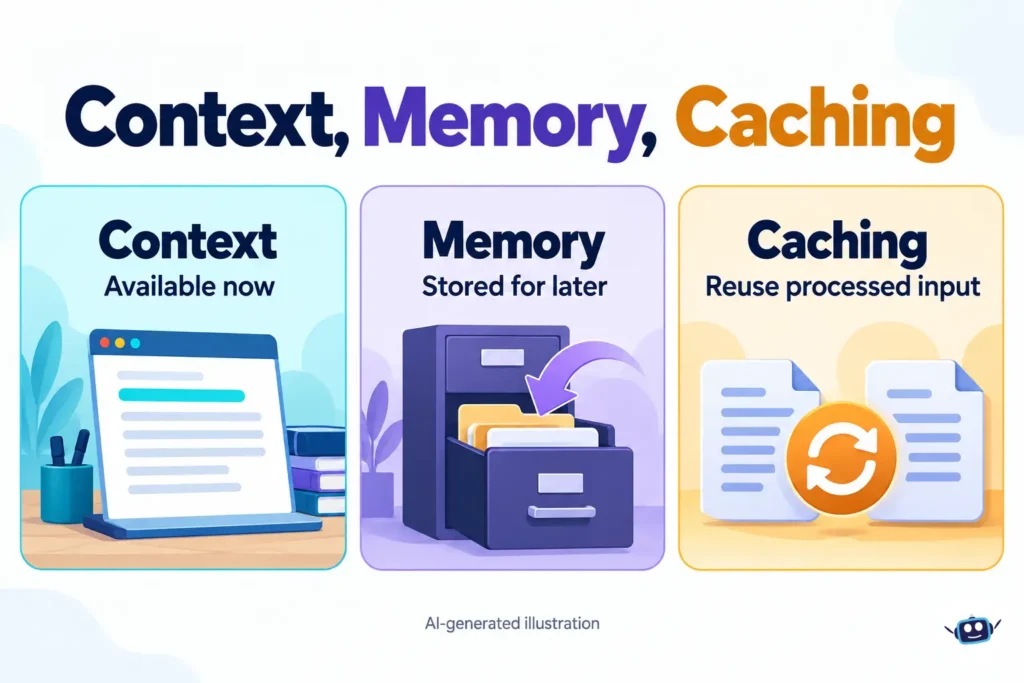
Longer context windows help models process more material, but several different mechanisms are often described loosely as “memory.”
| Mechanism | What it does | What to watch |
|---|---|---|
| Context window | Holds information available for the current model computation | Relevant details can compete with distracting material |
| Persistent memory | Stores information outside the active context for later retrieval | Saved information needs correction, updating, and deletion controls |
| Prompt caching | Reuses previously processed prompt content | Cache eligibility and pricing differ between providers |
Anthropic’s context-engineering guidance describes compaction and structured notes as ways to maintain continuity during extended work. It also cautions that aggressive summarization can discard details that become important later.
The next useful improvement is therefore better selection and retrieval of information, alongside larger capacity. An agent should retain the current goal and decisions, retrieve supporting evidence when needed, and avoid carrying obsolete instructions forward.
Our context engineering guide explores how to organize instructions, documents, tools, and conversation history.
4. Multimodal capability needs closer inspection
“Multimodal” does not mean a model accepts and produces every type of media. For example, OpenAI lists GPT-6.1 Sol as accepting text and images and producing text; its model page does not list native audio or video support.
A product may add separate image, speech, or video tools around that model. Comparing the underlying model with the entire application can therefore create misleading expectations.
Capacity also needs careful reading. Google documents Gemini 4 Argon’s approximately one-million-token window as a shared budget for input, thinking, and output. A large input leaves less room for reasoning and the final response.
For practical work, assess the exact media path: Can the system read the chart, inspect the spreadsheet behind it, calculate the result, and verify the saved file? Those are separate requirements.
5. Open weights expand the deployment choices
Progress is also happening outside closed hosted models. DeepSeek released V4.1-Flash-1017 on October 17, 2026, and its official model repository makes the weights available under the MIT License.
DeepSeek describes the update as using reinforcement learning with self-feedback to improve complete development tasks. That is a concrete example of progress through training methods and workflow performance, beyond simply advertising a larger parameter count.
Open weights offer another deployment route, including infrastructure controlled by the organization. They still require suitable hardware, serving software, security controls, and maintenance.
The decision should consider workload performance and operating requirements. A downloadable model is not automatically practical to run on a laptop, and access to its weights does not establish parity with every hosted flagship.
What Frontier Benchmarks Still Cannot Tell You
A headline score needs its testing conditions. Model version, reasoning effort, tool access, retry allowances, and the surrounding agent software all affect what was measured.
A useful comparison records those conditions before drawing a conclusion. Results from a model answering without tools cannot be treated as directly equivalent to results from an agent using search, code execution, and repeated attempts.
Release dates also differ from knowledge cutoffs. A recently launched model may still need current source material to answer questions about recent events.
The strongest evidence for adoption is a repeatable improvement on relevant work. A benchmark alone cannot establish that a system will handle every profession, remain reliable under changing conditions, or meet a particular definition of artificial general intelligence.
Practical Insights: How to Adopt Frontier LLMs
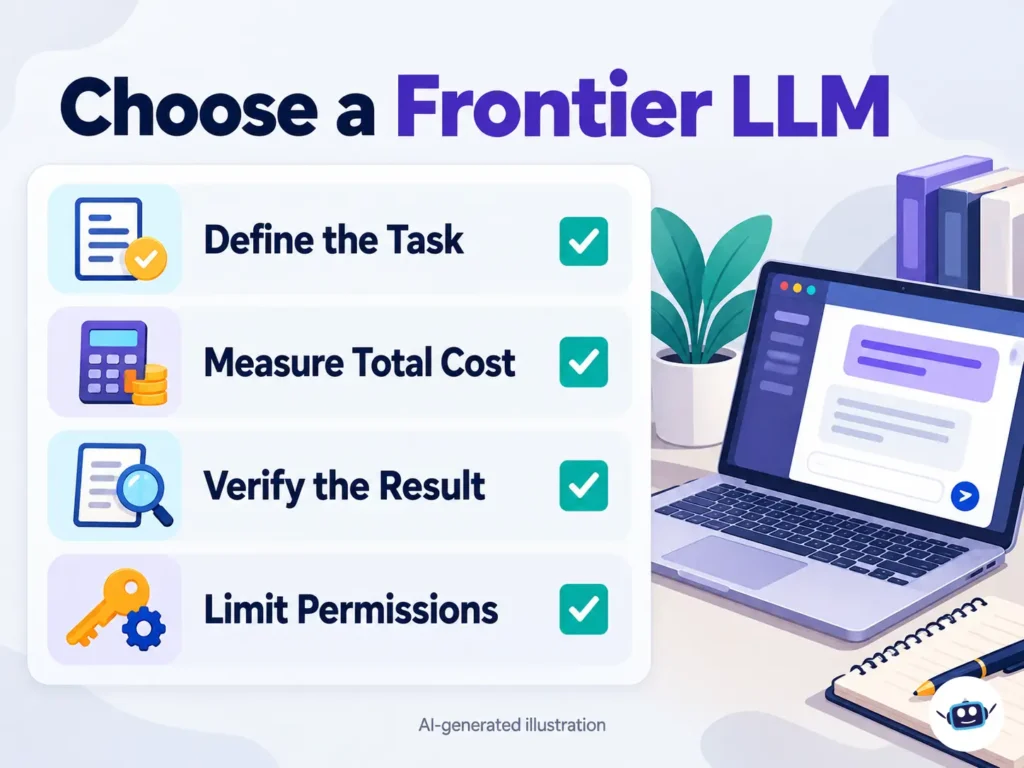
Define success before choosing a model
Start with a specific task and an observable completion condition.
For an AI news workflow, that might mean extracting claims from an announcement, checking each against the provider’s documentation, and producing a draft with correct dates and model names. For a coding workflow, it might mean fixing a defined bug while preserving existing behavior.
This makes it possible to distinguish fluent output from completed work.
Measure the cost of an accepted result
Token prices are only one part of the calculation. Include tool charges, repeated attempts, and the time spent reviewing or repairing the output.
Consider this illustrative calculation, not a performance test: one request uses 100,000 uncached input tokens and 10,000 billable output tokens, including any billed reasoning. Assume standard processing, no cache writes, and no tool charges.
| Model | Input cost | Output cost | Total |
|---|---|---|---|
| GPT-6.1 Sol | $0.20 | $0.10 | $0.30 |
| GPT-6 Astra | $1.00 | $0.50 | $1.50 |
The fivefold difference follows from the published token rates. It does not establish which model produces a better result or requires fewer attempts.
Long prompts can also change the rates: OpenAI documents higher full-request pricing for GPT-6.1 Sol above 272,000 input tokens. For another example of how workload shape affects spending, see our Claude Haiku 5.5 pricing analysis.
A useful internal measure is:
Cost per accepted result = total processing and review cost ÷ results meeting the acceptance criteria.
Match model capability to the task
A practical evaluation process is:
- Collect representative cases. Include ordinary work, ambiguous requests, and known failure cases.
- Set acceptance criteria. Define required facts, formatting, permitted actions, and evidence of completion.
- Compare realistic configurations. Record the model, effort setting, tools, and retry budget.
- Inspect failures. Separate incorrect answers, missing information, tool mistakes, and permission violations.
- Introduce limited deployment. Start with drafts or isolated work, then expand based on observed results.
- Recheck after material changes. Model updates, new tools, and different input data can change performance.
Routing simple tasks to a smaller model can reduce spending, but the routing decision itself needs evaluation. A system that sends difficult work to an unsuitable model may save tokens while creating expensive corrections.
Keep permissions separate from instructions
A request to “be careful” cannot replace an access control.
Anthropic’s computer-use documentation recommends isolated environments with minimal privileges and human confirmation for actions with meaningful consequences. It also warns that malicious instructions embedded in webpages or images can affect an agent.
For a publishing workflow, a sensible starting point is permission to research and prepare drafts, with publication controlled separately. For software development, use an isolated working environment and review changes before they reach production.
NIST’s Generative AI Profile provides a framework for evaluating risks including inaccurate output, privacy, and information security. The practical lesson is to assess the whole deployed system. Our coverage of the debate over pacing frontier AI provides broader context for these deployment questions.
Frequently Asked Questions
What comes after GPT-5 and Claude 4?
Released successors include OpenAI’s GPT-6 family and Anthropic’s Claude Fable 5.1 and Claude 5.5 models. Google’s Gemini 4 Argon is also part of the current frontier competition, so comparisons should extend beyond a two-company contest.
Which frontier LLM is best for coding?
The answer depends on the codebase, task, tools, and review requirements. Compare models on changes that matter to the project, including whether the resulting code meets requirements and remains maintainable.
Why can a cheaper model cost more overall?
A lower token rate can be offset by longer reasoning, more retries, extra tool calls, or additional human correction. Compare total cost for work that meets the same acceptance standard.
Does a million-token context window provide permanent memory?
No. Context capacity describes the information available within a model’s processing window, while persistent memory requires a separate storage and retrieval mechanism. Product memory settings and data-retention policies also need their own review.
Can open-weight frontier models run on a normal laptop?
Open weights do not imply low hardware requirements. Suitability depends on the particular model, precision, memory capacity, and serving setup; some deployments need substantial server infrastructure.
Will newer LLMs stop hallucinating?
There is no basis for assuming a newer generation will eliminate factual errors. NIST identifies confident but incorrect output as a generative AI risk, and important claims still need verification against reliable evidence.
Does the next generation mean AGI has arrived?
A higher benchmark score or new version number does not settle that question. Any AGI claim needs a clear definition and evidence covering broad capability, reliability, and performance outside selected tests.
Should businesses wait for the next major release?
A bounded pilot can establish whether current models already solve a useful problem. Keep the workflow adaptable so a later model can be evaluated without rebuilding permissions, data access, and acceptance checks.
Conclusion
The rise of frontier LLMs is increasingly about completing useful work with better reasoning, information handling, and tool use. Current releases also show that capability, price, and access can change independently.
Choose a clearly defined workflow, compare realistic configurations, and measure accepted results alongside total cost. Preserve control over consequential actions and keep the system easy to update. That approach provides a sound basis for benefiting from today’s models and evaluating whatever comes next.
Disclaimer
This article is for general information about AI models and software, with information current as of October 2026. Model features, API prices, availability, and access requirements can change, so confirm current details with the official provider before purchasing or deploying a system. Suitability depends on the task, data, and controls in place; important outputs and consequential actions require appropriate review.