
Over 21,000 people answered VRChat’s AI survey, 95% said they wanted some kind of label, and the platform decided not to build one. As of November 3, 2026, VRChat will not add an “AI-generated” label or an AI filter. It plans world ratings (thumbs-up and thumbs-down), larger image galleries and a stricter thumbnail rule. An optional “Human-authored” mark and a “Tools used” field are still undecided.
This guide covers what was decided, what the survey really measured, why VRChat said no, how bad the Steam backlash is, and what you can do in the meantime.
What did VRChat actually decide?
VRChat rejected the label and the filter, and it put other discovery features on a roadmap. The statuses below come from VRChat’s October 28 forum announcement as reported by Inven Global, MIXED and Road to VR. Timelines are VRChat’s own estimates.
| Item | Status (as of Nov 3, 2026) | Detail |
|---|---|---|
| “AI-generated” label | Rejected | VRChat says it is not adding one |
| AI filter | Rejected | VRChat says filters depend on accurate labels and get set once and forgotten |
| Ban on misleading world thumbnails | In force | Added to the Creator Guidelines in early October; an SDK reminder is planned |
| World likes/dislikes | Planned | Target is late 2026, or early 2027 if it slips |
| Multi-image world galleries | Planned | Target is the first half of 2027 |
| “Human-authored” mark | Under consideration | Optional, shown only on the world’s detail page, no effect on discovery ranking |
| “Tools used” field | Under consideration | No commitment or date |
| Videos, panoramas, world reviews, comments | On a future-consideration list | No date |
VRChat said it would share an update on the mark and the tools field by the end of the first quarter of 2027.
What most people miss: the early-October policy already allows several AI uses. According to Kotaku’s report, VRChat treated AI help with translation, code assistance, AI features inside tools like Blender or Unity, and personal-use building tools as acceptable. It called user-facing uses, such as AI-made assets or fully generated worlds, uncertain territory. VRChat has not banned AI.
What did the survey really say?
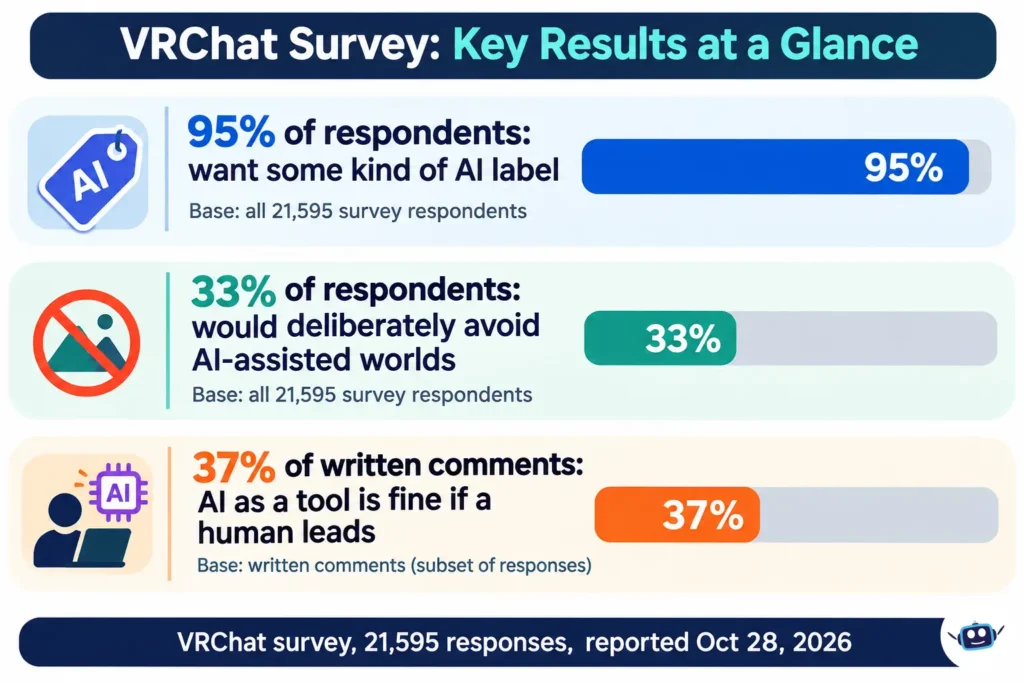
The survey showed strong demand for transparency. It did not show strong demand to avoid AI. VRChat reported 21,595 responses collected in about a week, and 95% wanted some kind of AI label.
The details sit underneath that headline, according to Inven Global’s reading of VRChat’s post:
- Asked which of eight example uses of AI should be labeled, respondents produced 3,141 different combinations. No single combination exceeded 10%.
- Only 33% said they would deliberately avoid “AI-assisted” worlds. By simple arithmetic, that is about 7,100 of 21,595 respondents, which is a large group but not the 95%.
- Among people who wrote comments, 37% said AI is fine as a tool if a human leads the creative work.
Some coverage turned 95% into roughly 20,500 people “asking to block” AI. VRChat’s published numbers don’t say that.
Treat the data with care. The respondents chose to take part, and MIXED reports that VRChat says it weighted the figures toward its player base. Road to VR notes the poll results are no longer viewable online, so you can’t recalculate anything.
Why did VRChat say no?
VRChat gave four reasons, and each has a counterpoint. The table is an original “label stress test” built from the verified reasoning. The counterpoints are illustrative analysis, not VRChat statements.
| Test | VRChat’s reasoning | Counterpoint critics raise | What would settle it |
|---|---|---|---|
| Definition | Respondents couldn’t agree on what counts as AI use | A “Tools used” field could break one label into parts, and VRChat is considering one | The definition VRChat picks for any mark |
| Honesty | Some creators would label honestly; others would pass off AI-assisted work as hand-made | Any self-reported system has cheaters, and Steam also relies on developer disclosure | Whether abuse proves common or rare |
| Harm | Hunting for AI use could become “sleuthing” that harasses creators who used no AI | Players who want information face a cost too | Real harassment data after any label ships |
| Staleness | Filters get set once, and the meaning of “AI” keeps shifting | Filters could be narrower or time-limited | Design choices VRChat hasn’t made |
VRChat’s most quotable line is that saying you used AI “can feel like a confession.” That explains why it leans toward a positive mark for human-made work over a warning for AI work.
The harassment worry has a real precedent. Vice reported that the indie RPG Shrine’s Legacy, launched in October 2025, drew “AI slop” reviews. The studio said it had not used generative AI, and the game’s reviews later recovered.
VRChat also already runs labels users can filter. Its content gating system, introduced in September 2023, has creators tag worlds and avatars for adult, violent or horror content. Flagged content is blocked by default for accounts under 18, and adults can adjust their filters. So the objection isn’t that labels never work. It is that this label is hard to define and hard to verify.
How did we get here?
The decision came out of three weeks of conflict. Dates below come from Kotaku, Mogura VR, IT Home, Road to VR and MIXED.
| Date | Event |
|---|---|
| Oct 4, 2026 | Community contributor Patroll announces stepping back from translations, wiki upkeep and community testing, calling AI a “rampant plague”; many popular worlds later display protest banners |
| Oct 7, 2026 | VRChat publishes its AI stance, updates the Creator Guidelines to ban misleading thumbnails and opens the survey |
| Oct 28, 2026 | VRChat posts survey results and the decision |
| Nov 2, 2026 | Road to VR and MIXED report the Steam backlash |
| Late 2026 to early 2027 | World likes/dislikes targeted |
| End of Q1 2027 | VRChat promises an update on the Human-authored mark and tools field |
| First half of 2027 | Galleries targeted |
Chinese-language outlet IT Home also reported that VRChat acknowledged accidentally publishing AI placeholder art on a live web page. That undercut its credibility in the debate.
How bad is the Steam backlash?
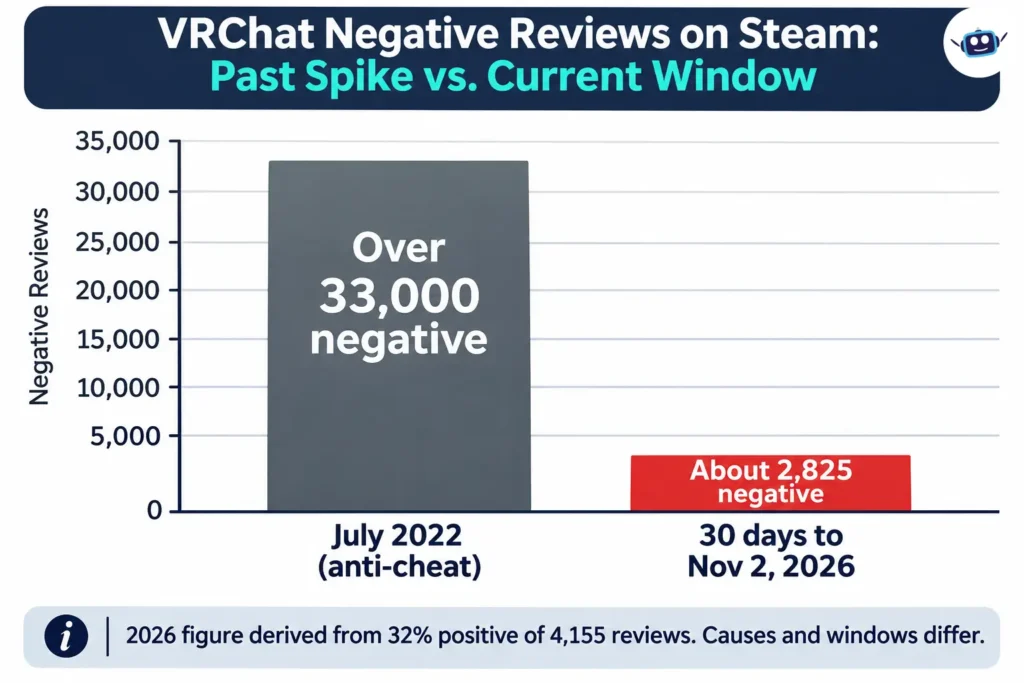
It is real, but the headline numbers overstate how much of it is about this one decision. MIXED checked VRChat’s Steam page at 16:07 UTC on November 2 and found 32% positive among 4,155 reviews from the past 30 days, labeled Mostly Negative. Road to VR reported about 33% and said the lifetime rating slipped from Mostly Positive to Mixed.
By our arithmetic, 32% of 4,155 leaves roughly 2,825 negative reviews in that window. MIXED cautions that the figure covers the whole 30 days and doesn’t show how many reviews were caused by the AI decision.
For scale, Road to VR cites SteamDB data showing over 33,000 negative reviews in July 2022, when VRChat added Easy Anti-Cheat. That is roughly 12 times the current 30-day negative count, though the windows and causes differ.
How does this compare with Steam’s AI disclosure?
Steam requires a disclosure, and VRChat won’t build one, but the two systems are different. Valve’s Steamworks documentation says the Content Survey has a Generative AI section covering content that ships with a game and is consumed by players, such as art, sound, narrative and localization. Valve says efficiency gains from AI-powered development tools are not the focus.
The survey splits AI content into two buckets:
- Pre-Generated: content made with AI during development and shipped to players.
- Live-Generated: content made by AI while the game runs. Developers must also describe the guardrails they use against illegal output.
Valve says its team compares the survey answers with the build and the store page. Steam has a gatekeeper step and one product per page. VRChat is a platform where people keep uploading worlds and avatars through the Unity SDK. Whether a Steam-style disclosure would work there is an open question.
Steam’s disclosure has its own critics. One analysis reported by PC Gamer found games with AI disclosures received about 53% fewer reviews after controlling for several factors. That is a third-party finding, and it shows correlation rather than proof of cause. It does show what VRChat creators fear.
What can players and creators do right now?
You can’t filter by AI yet, so work with the tools that exist.
For visitors:
- Judge a world by whether it matches its thumbnail. The Creator Guidelines now prohibit thumbnails that misrepresent a world, and you can use VRChat’s report tools if one does.
- Post feedback on VRChat’s public feedback board. MIXED notes a disclosure-and-filtering request there has over 1,000 votes.
- Use likes/dislikes once they ship, but remember they rate quality, not how a world was made.
For creators:
- Don’t use an AI thumbnail that shows things your world doesn’t contain. That is the one AI-related rule already in force.
- Decide in advance how you would describe your own AI use. VRChat’s own groupings (translation, code help, in-editor tools, assets, generated worlds) are a sensible starting list. This is our suggestion, not VRChat guidance.
- Keep simple process notes. If a Human-authored mark ships, VRChat hasn’t said whether it will require zero AI or only a human-led process.
- If you write code with AI help, AI coding agents differ from chatbots in how much they can change on their own, which matters for deciding what you disclose.
Check this yourself:
- Search VRChat’s forum for “Where we’re landing on AI in VRChat” and read the sections on labels and next steps.
- Open VRChat’s Steam page and compare the Recent and All review summaries.
- Re-read the Creator Guidelines thumbnail rule before uploading a world.
- Look for VRChat’s promised update after Q1 2027.
Myth vs fact
| Myth | Fact |
|---|---|
| VRChat ignored its survey | It published the result and explained why it didn’t build a label |
| VRChat banned AI | It banned misleading thumbnails, and several AI uses are explicitly acceptable |
| 95% of players want to avoid AI | 95% wanted some label; 33% would deliberately avoid AI-assisted worlds |
| This is VRChat’s worst review-bomb | 2022’s anti-cheat backlash produced over 33,000 negative reviews in a month |
| A Human-authored mark is coming | It is under consideration, with no commitment |
FAQs
Is VRChat adding an AI label? No. VRChat said it is not adding an “AI-generated” label or AI filters. It may add an optional Human-authored mark, but that is undecided.
When will world ratings arrive? VRChat targets late 2026, or early 2027 if it slips. These are estimates, and VRChat will collect feedback before deciding how to display ratings or use them in recommendations.
Does VRChat allow AI-generated worlds? The reporting describes no ban on them. In its early-October statement, VRChat called user-facing AI uses such as generated assets and worlds uncertain territory.
Why are Steam reviews so negative? Players are reacting to the label decision. Steam’s recent score covers a 30-day window, so it also includes unrelated reviews.
Can creators mark a world as human-made? Not yet. If the mark ships, VRChat says it would be optional, would appear on the detail page, wouldn’t affect discovery, and a missing mark would never count as an accusation.
What is the “Tools used” field? It is a proposed place for creators to list the software behind a world. VRChat is considering it and hasn’t committed to it.
Conclusion
VRChat chose quality signals over provenance labels: ratings and galleries are planned, a misleading-thumbnail ban is in force, and the Human-authored mark and tools field are still open. The survey proved demand for transparency, not agreement on what to disclose. Mark the end of Q1 2027 on your calendar, since that is when VRChat says it will report back on the mark and the tools field.
Related: The Nicolas Cage AI waiver story
Disclaimer: This article is for informational purposes only and is not affiliated with, sponsored by or endorsed by VRChat Inc., Valve or Steam. Features, timelines, review scores and policies may change at any time. Information last verified on November 3, 2026. Review figures are snapshots and AI output can be inaccurate, so confirm details on official pages.