
Quick answer: At New York Comic Con on October 10, 2026, Nicolas Cage said he didn’t sign an AI waiver for Amazon’s Spider-Noir and will “probably” not work with the studio again. He did not describe the waiver’s terms, and Amazon hasn’t publicly responded. Prime Video canceled the show in September without giving a reason, and Deadline’s reporting points to viewership versus production cost, not the waiver.
Introduction
When Nicolas Cage took the stage at New York Comic Con, he gave headline writers an easy storyline: an actor refuses AI, and a studio shuts his show down. The facts are less tidy.
The Nicolas Cage Amazon AI waiver story is real. Cage said it himself, on the record, in front of a crowd. But the waiver’s contents are unknown, and there is a more documented explanation for why Spider-Noir ended. This article lays out what is confirmed, what is speculation, and what it means for anyone who signs contracts touching AI. It also covers why a waiver request from Amazon would not be surprising, given how far the company has moved into AI.
What Nicolas Cage Actually Said
Per Deadline and TheWrap, Cage told the Saturday, October 10 audience that Amazon is “very AI-friendly,” pointing to $50 billion invested in OpenAI. He called himself “not an AI-friendly actor,” said he didn’t sign the waiver to let the company use AI on Spider-Noir, and added that he’s “probably” not going to work with that studio again.
Two details matter. “Probably” is a preference, not a ban or a legal dispute. And Cage didn’t accuse Amazon of anything improper. He framed it as a personal choice.
In the same panel, he said he would like to work with younger directors who make films by hand. Kotaku reported that he named Backrooms creator Kane Parsons, himself a vocal AI critic. He also said he will likely do a season of HBO’s True Detective. HBO declined to comment on the casting, and he is currently working on the film Perish.
Confirmed vs. Unconfirmed
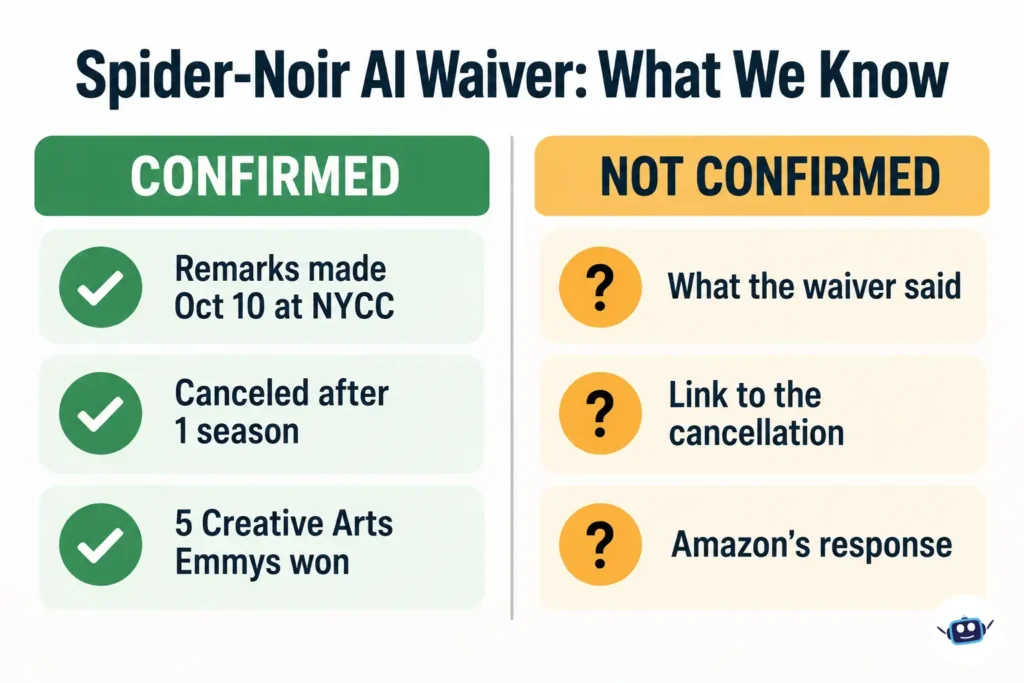
| Claim | Status |
|---|---|
| Cage made the remarks at NYCC on Oct. 10 | Confirmed by Deadline, TheWrap, Parade and others |
| Cage declined to sign an AI waiver | His own account; not independently confirmed |
| What the waiver said | Unknown; Cage didn’t detail it |
| The refusal caused the cancellation | Unsupported by any reporting |
| Amazon’s response | None public; Prime Video hadn’t replied to TheWrap’s request |
Why Was Spider-Noir Canceled?
This is the part most coverage skipped. Spider-Noir premiered May 25 on MGM+ and May 27 globally on Prime Video, running eight episodes. It was canceled around September 4. Prime Video has not given an official reason.
Deadline’s reporting offers a practical one. The show launched solidly at No. 2 on Nielsen’s U.S. original-series chart, with 851 million minutes viewed in week one and 2.6 billion across six weeks. But it fell out of Prime Video’s daily Top 10 faster than other recent hits. It was also filmed in both color and black-and-white versions, which made it costly. Deadline’s read was that the decision likely reflected viewing against cost.
Days later, the show won five Creative Arts Emmys from 11 nominations, the most of any Prime Video series this year. The wins were for cinematography, visual effects, stunt coordination, sound editing and title design. Cage’s own statement on the ending was calm: “one season is perfect.”
None of this proves the waiver played no role. It does mean that “refused AI, got canceled” is a theory, while “expensive show, fading audience” is the one with reporting behind it.
Is Cage Right About Amazon Being “AI-Friendly”?
On the numbers, yes. Amazon announced a $50 billion investment in OpenAI on February 27. PYMNTS reported that an SEC filing showed the commitment completed by the end of July, and another outlet put the stake at roughly five percent. Amazon has also put about $13 billion into Anthropic, with up to $20 billion more conditional on milestones, announced in April. (Anthropic is the maker of Claude.)
On the studio side, Amazon MGM Studios runs an AI Studio. TechCrunch reported its tools target things like character consistency across shots and pre- and post-production work. Amazon pointed to House of David, which used 350 AI-generated shots in season two. In May it launched the GenAI Creators’ Fund and an AI production platform called Project Nara. Executives describe the approach as human-centric.
Put together, a request asking talent to consent to AI use would fit the studio’s strategy. What remains unknown is how broad this one was.
The Union Angle Most Coverage Misses
Spider-Noir was shot in Los Angeles in 2024 and 2025, with set reports from January 2025. Production almost certainly fell under the 2023 SAG-AFTRA TV/Theatrical agreement, which came out of the actors’ strike and already requires consent and compensation for digital replicas. Neither Cage nor the studio has said so explicitly.
The newer 2026 agreement was ratified June 4 with 91.42% approval and runs through June 30, 2030. Per Variety, producers may use synthetic performers only if they bring “significant additional value” compared to a live actor or that actor’s digital avatar.
Union rules are a floor. Anything beyond them gets negotiated individually, and a star with Cage’s leverage can decline what a lesser-known actor might feel pressured to accept. That imbalance is the most useful takeaway from the story.
Why This Is Consistent for Cage
His position isn’t new. In a 2024 New Yorker interview, reported by Variety, he said he was terrified of AI and had undergone body scans for upcoming projects, including this one. He worried his likeness could be used after his death. The NYCC remarks fit that history.
Practical Guide: Reading an AI Clause Before You Sign
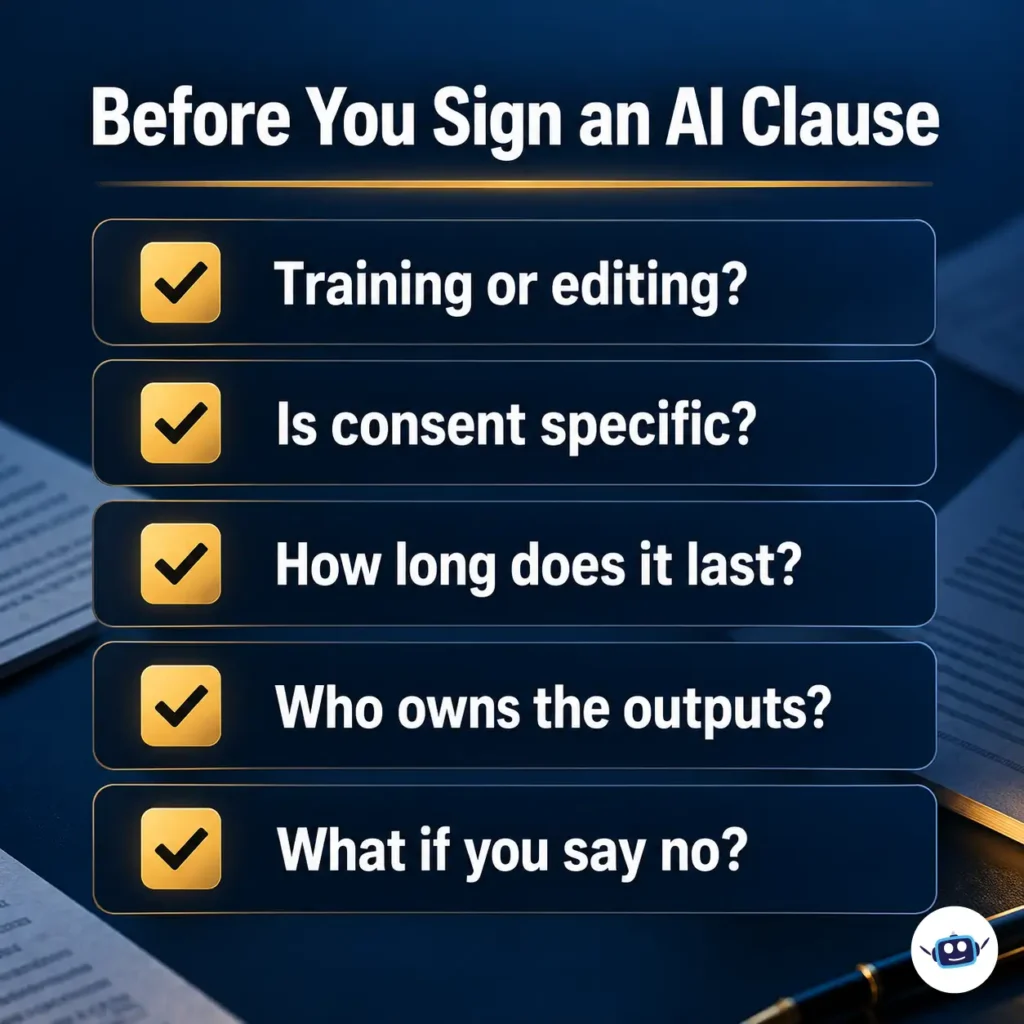
Five questions to ask
- Training or editing? Cleanup tools and model training are very different uses.
- Is the consent specific? SAG-AFTRA’s interactive media rules call for a reasonably specific description of use, not blanket language.
- How long does it last? Check whether it survives the project or your death.
- Who owns the outputs? And can they be reused elsewhere?
- What if you decline? Ask for the answer in writing.
Common mistakes
- Treating a waiver as routine paperwork.
- Assuming the union contract covers everything.
- Negotiating alone, without an agent, lawyer or union rep.
Best practices
Keep copies of every AI-related document. Ask for plain-language definitions of terms like “synthetic performer.” And separate the tool from the use, since many performers accept AI cleanup but refuse replacement.
Personal Experience: What Verifying This Story Taught Us
This section describes our actual research process on this article.
Most outlets quoted the same lines from the same panel. Repetition can look like corroboration when it is really one source echoed many times, so we treated Deadline, TheWrap and Variety’s reporting as the core record and checked everything else against them.
We hit three snags. Rotten Tomatoes scores appeared as both 92% and 96%, so we cited the 92% figure that Deadline-based reports used. Amazon’s Anthropic investment figure was circulating at an outdated $8 billion, when the current number is about $13 billion. And a claim that the waiver caused the cancellation appeared in social posts but nowhere in primary reporting, while the cost-and-viewership explanation had been largely overlooked.
The lesson is to separate the quote, the context and the inference every time. That is also how our editorial process works.
Why It Matters Beyond One Actor
For readers following AI policy and ethics, the story shows the AI debate moving from principle into contract language. For AI industry news, it shows the same companies funding frontier models also building production tools. And for startups and industry coverage, Amazon’s creators’ fund signals a bet that independent creators will adopt AI at scale.
FAQs
Did Nicolas Cage refuse to sign an AI waiver for Spider-Noir?
That is his account. He said so at New York Comic Con on October 10. Amazon hasn’t publicly confirmed or described the waiver.
Will Nicolas Cage never work with Amazon again?
No. He said “probably” not. It’s a stated preference, not a formal ban.
Why was Spider-Noir canceled?
Prime Video hasn’t given an official reason. Deadline’s reporting points to viewership declining faster than comparable shows, set against a costly production filmed in color and black-and-white.
Did the AI waiver cause the cancellation?
There is no reporting that supports that. It remains speculation.
How many Emmys did Spider-Noir win?
Five Creative Arts Emmys, from 11 nominations: cinematography, visual effects, stunt coordination, sound editing and title design.
Did Amazon invest $50 billion in OpenAI?
Yes. It announced the commitment in February, and an SEC filing reported in July showed it completed.
Does Amazon use AI in its productions?
Yes, in part. Amazon MGM Studios has an AI Studio, used 350 AI-generated shots in House of David season two, and launched a GenAI Creators’ Fund. Executives say the goal is to support human creators.
What do SAG-AFTRA contracts say about AI?
Digital replicas require consent and compensation. The 2026 agreement adds limits on synthetic performers through June 2030.
Conclusion
The Nicolas Cage Amazon AI waiver story is smaller than the headlines suggest and more useful than a celebrity spat. Cage says he declined a waiver, and Amazon is a heavy AI investor and tool-builder. But the waiver’s terms are unknown, and the best-documented reason for the show’s end is cost against viewership.
Takeaways:
- Treat “AI refusal caused the cancellation” as unproven.
- Read AI clauses for scope, duration, ownership and consequences of declining.
- Know which union agreement governs your work and what individual deals add on top.
- Check viral entertainment-AI claims against primary reporting.
Disclaimer: This article is general information, not legal, financial or professional advice. It reflects public reporting as of October 12, 2026 and may change. Cage’s statements are his own account, and Amazon had not publicly responded at the time of writing.