
Investors are selling bonds that finance AI data centers because they doubt AI revenue will grow fast enough to repay the debt. Prices on bonds tied to projects for Meta, Microsoft, Nvidia and Oracle have slipped below face value. CoreWeave’s 9.75% notes due 2031 traded around 82 cents on the dollar on October 16, yielding about 15%. Ludovic Subran, chief investment officer at Allianz, told the Financial Times that data centre bonds, as the paper spells it, are having their “Darwin moment.” In his view the weakest borrowers struggle to survive. This guide explains what happened, how to read the numbers, and what to watch next. Market data is as of October 16, 2026.
What happened: a stress build-up, not a one-day shock
The October headlines followed months of warning signs.
- Late April: The Wall Street Journal reported that OpenAI had missed internal user and sales targets. Data center–linked bonds fell, and CoreWeave’s 2031 bonds hit a then-record low of 98.63% of face value, according to Trace data.
- Mid-July: Bloomberg reported that nearly 80% of data-center securities sold since early 2025 were quoted at wider spreads than at issuance. Prime Data Centers paused a planned bond sale. Oaktree-backed Pure Data Centres scrapped a proposed €1 billion bond in favor of bank financing.
- September: The Financial Times, citing Morgan Stanley, reported that AI-related debt issuance worldwide fell to $23 billion. That was nearly half the previous month’s total. OpenAI’s chief executive also said the company would not go public in 2026.
- October 14–16: A hotter-than-expected U.S. inflation report hit tech stocks, and CoreWeave shares fell 15.5% in one session. Its five-year credit default swaps reached a record 1,194.5 basis points intraday on October 15, according to ICE Data Services as reported by Bloomberg. The Financial Times published its “Darwin moment” report the same day.
The numbers behind the sell-off
| Debt | What it finances | Reported level | Why it matters |
|---|---|---|---|
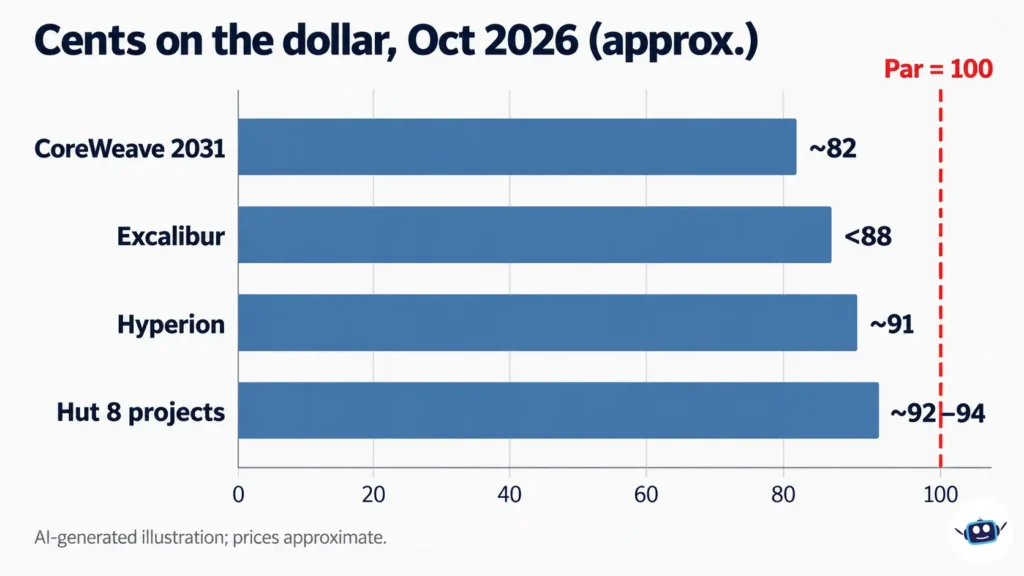
| CoreWeave 9.75% notes due 2031 | Neocloud (AI computing rental) borrowing | About 81.8 cents, yield about 15.1% (Oct 16) | Yield was about 12% two months earlier |
| QTS “Project Excalibur” | Blackstone-owned Georgia campus leased to Microsoft | Below 88 cents (FT) | Weakest of the large project bonds the FT named |
| Meta “Hyperion” (Beignet Investor) 2049 notes | $27.3 billion for Meta’s Louisiana campus | Below 92 cents (FT); about 91 in late September | Priced at par in October 2025 |
| Hut 8 Louisiana and Texas projects | Facilities for Google and Nvidia-linked tenants | About 94 and 92 cents (FT) | Shows the pressure reaches stronger tenants too |
Bond prices are quoted per 100 of face value, so “par” means 100. A bond trading at 82 has lost 18% of its face value on paper. Bondholders still receive the full amount if the borrower pays as promised. Prices below roughly 80 are conventionally treated as distressed territory, which is why the FT flagged CoreWeave’s drop.
Why investors are selling
Spending is outrunning proven revenue
The FT report links the sell-off to doubts about AI revenue and cites a Gartner forecast that AI spending will fall trillions of dollars short of what data center owners need. Bank of America consensus estimates show why lenders are uneasy. The five large AI “spenders” it tracks are expected to spend about $807 billion this year. Their combined free cash flow is forecast to swing from $191 billion in 2025 to minus $63 billion in 2026.
Revenue is still growing quickly, which is why this is a debate and not a verdict. Anthropic told prospective investors its third-quarter revenue reached $16.8 billion, as covered in our report on Anthropic’s Q3 revenue figures. Bond investors are asking whether growth like that is fast enough to cover debt that matures over decades.
Higher rates punish long-dated debt
On October 16 the 10-year Treasury yield was 5.12% and the 30-year was 5.45%. The Federal Reserve meets again on October 28, and the hot inflation data raised the odds of a rate increase. Long bonds fall hardest when yields rise, and many project bonds run to 2048 or 2049.
Hyperion shows how much of the damage can come from rates alone. The notes priced at about 2.25 percentage points over Treasuries in October 2025. In late September they yielded about 7.55%, roughly 2.3 points over Treasuries. The extra credit risk investors demanded barely changed, so most of that drop reflects the Treasury market. Excalibur and CoreWeave look different because their discounts reflect worries about the borrowers themselves.
Project bonds depend on lease terms
Hyperion’s bonds mature in 2049, but Meta’s leases start with a four-year term and renewal options. S&P rated the notes A+ at issuance, one notch below Meta’s AA-. Meta also provided a residual value guarantee, which is meant to repay bondholders if the leases are not renewed. Investors therefore own a claim on Meta’s willingness and ability to renew or pay. They have to price what AI computing demand looks like several renewal cycles from now.
CoreWeave: the pressure point
CoreWeave rents Nvidia-powered computing capacity to AI developers. It buys chips and builds capacity before customers pay, and it borrows to cover the gap. Its second-quarter filing, released August 11, shows the strain next to the growth:
- Revenue was $2.575 billion, up from $1.212 billion a year earlier, but net interest expense was $640 million and the net loss was $626 million.
- Operating income was a loss of $49 million. Adjusted EBITDA was $1.51 billion, which covers interest about 2.4 times.
- Operating cash flow was $679 million, while purchases of property and equipment were $6.42 billion. Net financing inflows of $10.07 billion filled the gap.
- Balance-sheet debt was about $35 billion, of which about $7.5 billion was current. Cash and equivalents were $5.5 billion, and stockholders’ equity was $5.0 billion.
- Revenue backlog was about $104 billion, not counting more than $25 billion of new commitments added in early Q3. Backlog is signed demand, not cash received.
The market read all this as a financing story. CoreWeave’s five-year credit default swaps (CDS, a contract that pays out if a borrower defaults) hit 1,194.5 basis points, or 11.945% of the insured amount per year. Using the standard shortcut, with an assumed 40% recovery rate, that works out to roughly a 63% chance of default over five years. Reuters put the figure at 64% at around 1,000 basis points, up from about 30% a year earlier. These numbers are market-implied prices, and CDS trading can be thin and volatile. They are not forecasts. Nvidia chief executive Jensen Huang said on October 15 that CoreWeave’s cost of capital is falling and that Nvidia does not need to backstop it.
Not all data center debt is the same
| Type | Example | What backs the bond | Main risk | Recent signal |
|---|---|---|---|---|
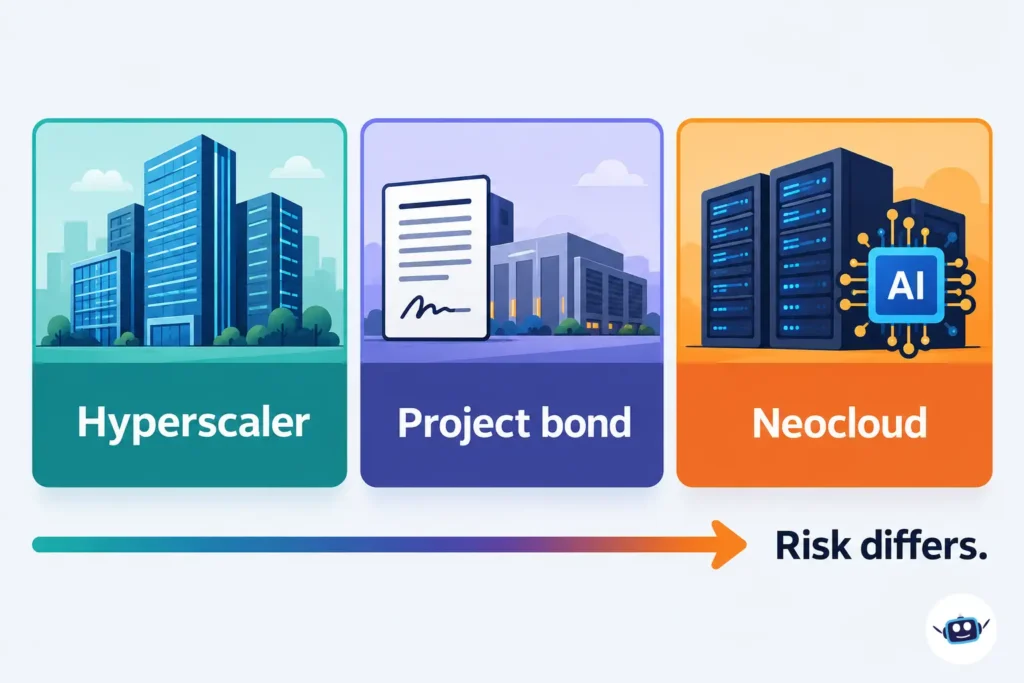
| Hyperscaler corporate bonds | Meta, Oracle, Amazon, Alphabet | The whole company’s cash flow | Heavy spending, rising leverage | Reuters reported record CDS levels for Amazon, Alphabet and Meta, far below CoreWeave’s |
| Project (SPV) bonds | Hyperion, Excalibur | Lease payments plus guarantees | Short lease terms, construction, residual value | Prices of 88–92 cents |
| Neocloud corporate debt | CoreWeave | The company’s own contracts and cash flow | Refinancing, capital spending, customer concentration | About 82 cents, yield about 15% |
“Data center bonds” is a broad label. The three groups carry different risks, and the sell-off is hitting them unevenly.
Common misconceptions
- “Below par means default.” A price below par means investors want more yield for the risk. A default is a missed payment. CoreWeave’s bonds can trade at 82 and still be paid in full.
- “Record CDS means distress everywhere.” Several megacaps set records, but their spreads remain a fraction of CoreWeave’s.
- “A huge backlog guarantees repayment.” Backlog is contracted future revenue. It does not pay interest until the capacity is built and delivered.
- “It is all about AI demand.” Rates, lease structure and refinancing timing explain a large share of the price moves.
- “Investors are leaving credit altogether.” Reporting on the September slowdown described investors as becoming more selective, not exiting the market.
Practical Insights
These points come from the verified figures above and standard credit analysis.
- Split the price move into rates and credit. Compare the bond’s spread over Treasuries now with its spread at issuance. If the spread barely moved, rates did the damage. If it widened a lot, the borrower is the problem.
- Check lease length against bond maturity. A tenant committed for four years backing a 23-year bond relies on renewals or guarantees. Read who provides the guarantee.
- Compare cash flow with spending. CoreWeave’s operating cash flow covered about a tenth of its equipment purchases last quarter. Borrowers in that position depend on markets staying open.
- Look at the refinancing calendar. With about $7.5 billion of CoreWeave’s debt current against $5.5 billion in cash, the terms it gets on new financing will be a live test.
- Watch the next catalysts. Those include the Fed’s October 28 decision, the November 3 midterm elections that Bank of America cited, new issuance volumes, and semiconductor prices. Bank of America’s Michael Hartnett said a rollover in chip prices would signal further tightening in AI credit.
- If you buy AI computing from a smaller provider, check its finances. Counterparty risk matters for buyers as well as bondholders. For a small-scale example of how a provider’s financial trouble reaches customers, see our guide on what users should do after the Character AI bankruptcy.
Frequently asked questions
What does “Darwin moment” mean for data center bonds?
Allianz’s Ludovic Subran used the phrase to say the market is now separating strong borrowers from weak ones. Well-backed projects should survive, while the weakest credits face real trouble.
Why are data center bonds falling now?
Several things landed together: doubts about AI revenue, a hotter inflation report, higher Treasury yields, and a slowdown in new issuance. Earlier warning signs included the OpenAI sales-target report in April and failed or paused deals in July.
Which data center bonds have fallen the most?
According to the FT, QTS’s Project Excalibur slipped below 88 cents and Hyperion below 92. CoreWeave’s notes were the hardest hit, at roughly 82 cents on October 16.
Does a bond price below par mean the company will default?
No. It means investors are demanding higher yields for the risk. Default only happens if the borrower misses a required payment.
What does a CoreWeave CDS spread of 1,194.5 basis points mean?
It means insuring $10 million of CoreWeave debt costs about $1.19 million per year. With an assumed 40% recovery, that implies roughly a 63% chance of default over five years. It is a market price that can swing quickly, not a prediction.
Are Microsoft, Meta and other big tech companies at risk?
Their credit default swaps hit record levels, but those levels are far below CoreWeave’s. Project bonds linked to their data centers also fell, mostly because of rates and the structure of the leases.
How do rising interest rates affect these bonds?
When yields rise, existing long-dated bonds lose value because new bonds pay more. Bonds maturing in 2048 or 2049 are the most sensitive.
Could ordinary investors own these bonds?
Yes, indirectly. Large fund managers, including Pimco and BlackRock, took part in the Hyperion deal, so bond funds can hold this debt. A fund’s published holdings show its exposure.
What to take from this
The sell-off is real, but it is selective. Debt backed by strong tenants and guarantees is falling mostly because of interest rates, while neocloud borrowers are being repriced on fundamentals. For any data center bond, compare spreads with issuance, check the lease term against the maturity, and look at cash flow rather than backlog. Over the next few weeks, the Fed decision, new deal volumes and CoreWeave’s refinancing terms will show whether the Darwin moment is a purge of the weakest or a wider retreat. For more coverage, follow our AI News reports and our Startups & Industry section.
Disclaimer
This article is general information about market events and is not financial, investment or tax advice. Bond prices, yields and credit spreads change daily, and results vary. Please consult a licensed financial professional before making any investment decision. The information is current as of October 2026.