

Introduction
You’ve probably seen the headline: three young founders, a $10 billion valuation, and an AI startup that many people had never heard of a year earlier. That startup is Mercor AI. Most coverage stops at the valuation. Fewer articles explain what Mercor does, why OpenAI-class labs pay for it, what experts earn, and why one poisoned open-source package made 2026 a stress test for the entire AI data supply chain.
This guide is built from primary sources wherever they exist: Mercor’s own pages, public dataset documentation, court-case summaries and reporting from TechCrunch, Forbes and Wired. Where something is reported but unconfirmed, I say so. Where sources disagree, I tell you which one I trust and why.
What Is Mercor AI?
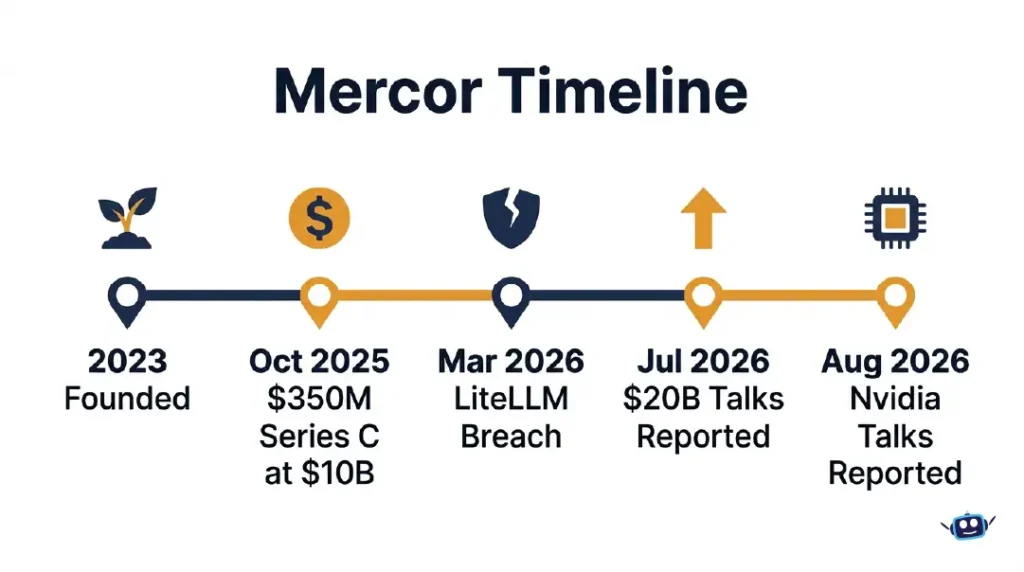
Mercor AI is a San Francisco company that recruits and vets professionals, such as lawyers, doctors, bankers and engineers, and places them on contract projects that train and evaluate artificial intelligence models. Brendan Foody, Adarsh Hiremath and Surya Midha founded it in 2023. According to Wikipedia’s company summary, they are high-school friends who later received Thiel Fellowships.
It began as a hiring marketplace linking freelance programmers in India with US companies. Then the founders noticed something bigger: AI labs badly needed qualified humans to write, grade and correct training data. The company pivoted, and today it describes itself as sitting where labour markets meet AI research.
Mercor at a glance
| Item | Detail |
|---|---|
| Founded | 2023 |
| Founders | Brendan Foody (CEO), Adarsh Hiremath, Surya Midha |
| Headquarters | San Francisco, California |
| Core business | Expert marketplace for AI training, evaluation and RLHF-style data |
| Reported clients | OpenAI, Anthropic, Meta, Nvidia and others |
| Last announced round | $350M Series C at $10B valuation (October 27, 2025) |
| Advertised pay | Average contracted rate around $108/hr; payouts weekly |
How Mercor Works
For AI labs and enterprises
A lab describes the expertise it needs, for example “senior M&A attorneys” or “board-certified physicians.” Mercor screens candidates, builds a team and manages delivery. The experts write prompts, grade model answers, create test cases and build scoring rubrics. This kind of work is broadly called human data or expert data.
Demand is growing because general internet text teaches frontier models less and less. Specialised domains like law, medicine and finance need judgement from people who actually practise them.
For experts
Candidates apply on the platform and complete an AI-led interview. If matched, they join project-based contracts as independent contractors. Mercor’s own job listings state that work is remote and that payment is weekly through Stripe or Wise. The same listings add that projects can be extended, shortened or concluded early, depending on needs and performance. Read that line before you plan your finances around any single project.
For employers hiring directly
Mercor still runs its original recruiting marketplace. Mercor does not publish what buyers pay, so any claim about its fee percentage is an outside estimate.
Funding and Valuation: Where Things Stand
Mercor’s official announcement says the $350 million Series C valued the company at $10 billion. Felicis led, with Benchmark, General Catalyst and Robinhood Ventures participating. Some outlets say the round came in September, but Mercor’s own post is dated October 27, 2025.
In July 2026, TechCrunch reported that Mercor was in talks at roughly $20 billion, citing Bloomberg. The same day, Foody said annualised revenue had passed $2 billion, and Mercor announced it was acquiring Deeptune, a company that helps train AI agents. Forbes added that the round could be about $500 million.
In August, PYMNTS reported that Nvidia had discussed joining the round, citing The Information. Nvidia is also a paying customer, reportedly spending tens of millions of dollars in a recent quarter on Mercor data for its Nemotron models. I found no official announcement that the round has closed, so treat the $20 billion figure as reported talks rather than a completed deal.
A detail most articles miss: “$2 billion” is billings, not take-home revenue
One report on the July talks noted that the $2 billion run-rate reflects total billed to clients, not Mercor’s net share. According to a person familiar with the situation, contractors receive 60 to 70% of that amount. That is a single anonymous source, so treat it as indicative, not definitive. It does mean the $2 billion headline should not be read as company profit.
The Unique Angle: Mercor Is Also the Exam-Setter
Most explainers treat Mercor as a staffing firm. But Mercor also publishes its own AI benchmarks, the APEX (AI Productivity Index) family. That gives it influence beyond its client list.
The best-known entry, APEX-Agents, tests whether AI agents can complete long, multi-step tasks in investment banking, consulting and corporate law. The research paper describes 480 tasks across 33 simulated work “worlds,” created by working professionals who estimated each task takes one to two hours.
The January 2026 finding was sobering. Frontier models completed fewer than 25% of tasks on the first attempt, and even with eight tries the best agents reached only about 40%. TechCrunch’s coverage noted that agents struggled most when they had to find information across several tools and files.
Why APEX-Agents 1.1 matters
Mercor later released APEX-Agents 1.1, which no longer rewards noncommittal answers. It also emphasises a gap that many readers overlook: the difference between solving a task at least once in four runs (Pass@4) and solving it every time (Pass^4). In real professional work, consistency is what counts. The public dataset card lists 240 tasks and 955 binary rubric criteria, so anyone can inspect how grading works.
One caution: top-of-leaderboard numbers differ between Mercor’s own pages and change with each benchmark version. Check the live APEX leaderboard before you quote a ranking.
What Does Mercor Pay?
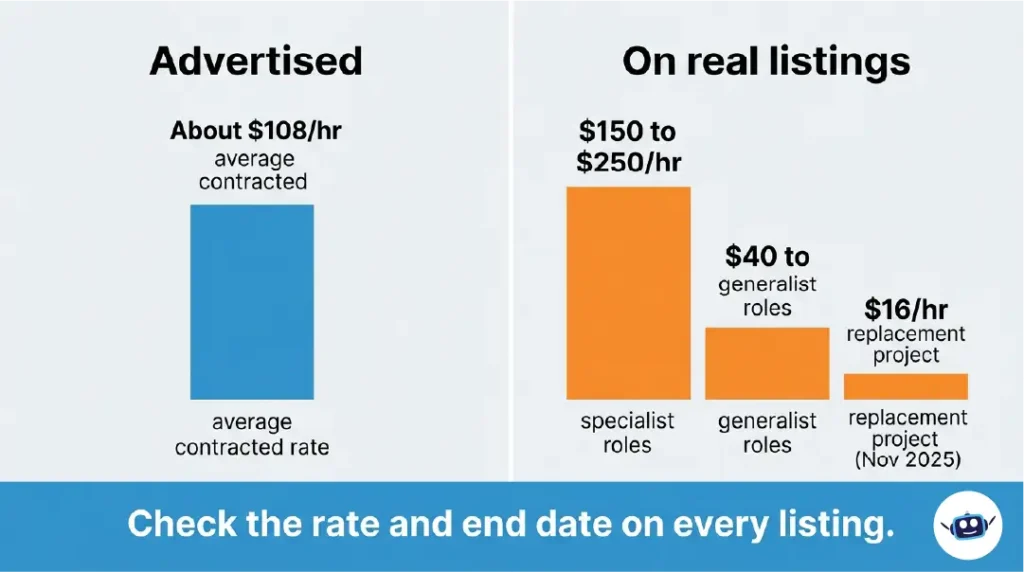
Mercor’s experts page currently advertises an average contracted rate around $108 per hour and daily payouts above $4 million. Its listings show wide spread: specialist roles such as elections forecasting list at $150 to $250 an hour, while a generalist expert listing says most contracts in that field have paid $40 to $70 an hour.
Treat the headline average as marketing. A third-party price tracker documented that Mercor relabelled the figure from “average pay” to “average contracted rate” on June 30, 2026, and that it swung between roughly $80 and $141 per hour in the following weeks. Mercor has not published a methodology for the number.
The sharpest example of variance came in November 2025. Forbes reported that a Meta-related review project was ended and some contractors were offered replacement work at $16 an hour, down from $21. Mercor disputed parts of the characterisation and said its role descriptions make clear that work is temporary.
The practical lesson: the rate and end date on the specific listing matter far more than the platform-wide average.
The 2026 Data Breach: What Actually Happened
On March 31, 2026, Mercor confirmed a security incident. In its statement, the company said it was one of thousands of companies affected by a supply-chain attack on LiteLLM, a widely used open-source AI gateway.
The chain, as described in public reporting:
- Attackers compromised publishing credentials for LiteLLM and pushed malicious versions to a public package index.
- Companies that installed the poisoned versions, Mercor among them, were exposed.
- The extortion group Lapsus$ claimed to hold about 4 terabytes of Mercor data, and complaints in court allege the data included identity documents, video interviews and biometric information for more than 40,000 contractors. These are allegations, not proven findings.
The fallout was fast. Wired reported that Meta paused all work with Mercor indefinitely. Multiple class actions followed, including Ananthula v. Mercor.io Corporation in the Northern District of California, summarised by Hausfeld. I found no public confirmation that Meta has resumed work.
What Mercor says now
In its official security update, Mercor said the forensic investigation is complete and that, of its nearly five million experts, only a very limited subset had sensitive information affected. It said it saw no evidence of fraudulent use. Trade press reported that new protections include an audit of third-party dependencies, tighter access policies, penetration testing and continuous monitoring.
A newer, unverified claim
On August 26, 2026, Cybernews reported that a seller on a cybercrime forum was advertising 4 TB of alleged Mercor databases and source code, with samples including logs, prompts and user roles. Cybernews said it was unknown whether this relates to the March incident and had asked Mercor for comment. I could not find a Mercor response, so treat this as an allegation only.
The bigger lesson isn’t about one company. An AI data vendor holds its customers’ most guarded assets, and its security is only as strong as its dependencies.
Personal Experience: What Stood Out While Researching Mercor
These observations come from reviewing primary documents and cross-checking reports, not from working as a Mercor contractor.
Definitions matter more than headline numbers. Mercor’s advertised “average” only made sense once I found the June 2026 relabelling. A rate without a stated method is a marketing line, not a salary.
Dataset cards beat press summaries. Reading the benchmark documentation showed details summaries skipped, such as 955 binary rubric criteria and how few tasks require file outputs. A checklist grader behaves very differently from a human reviewer.
Sources disagree, and that is normal. I found conflicts on the Series C month, on whether Meta’s pause was temporary, and on leaderboard scores. The fix was always the same: go back to the dated original.
“Gross” and “net” are easy to confuse. The $2 billion run-rate sounds like revenue in the normal sense. The reporting suggests it is closer to gross billings, which changes how you interpret the valuation.
The takeaway for experts: treat Mercor as a project marketplace, not a salaried job. People who do best diversify across platforms and read each listing’s end-date language.
Benefits of Mercor
- High pay ceiling for niche skills. Specialist listings reach $150 to $250 an hour.
- Rates shown on listings. Experts can see a rate before applying.
- Remote, flexible work with weekly payment.
- Exposure to frontier AI work that is hard to find elsewhere.
Common Mistakes to Avoid
- Assuming the headline rate applies to your role. Generalist listings run well below it.
- Treating a project as permanent income. Mercor’s own listings say projects can end early.
- Sharing more personal data than necessary. The breach shows why this matters.
- Skipping the contract. Reports say Mercor’s worker agreement routes disputes to individual arbitration, so read it first.
- Forgetting tax obligations. Independent contractors usually handle their own.
Best Practices for Experts
- Apply with a specific, tailored profile rather than a generic résumé.
- Screenshot each listing’s rate and terms before accepting.
- Use unique passwords and two-factor authentication on every account.
- Keep your own record of hours worked and approved.
- Maintain at least one other income source.
- Follow independent AI industry coverage, such as the news at AI LLM News, to catch platform changes early.
How Mercor Compares
Mercor competes with Scale AI, Surge AI and Turing in the expert-data market. Its pitch is neutrality: it supplies many labs rather than being tied to one, and Scale AI’s close relationship with Meta is often cited as the contrast. The 2026 breach tested that pitch. Rival valuations vary by source, so verify them before comparing.
Frequently Asked Questions
What is Mercor AI?
Mercor AI is a marketplace that vets professionals and places them on contract projects training and evaluating AI models. It also runs a hiring marketplace and publishes the APEX benchmarks.
Is Mercor legit?
Yes. It is a real, venture-backed company with named investors and a published funding announcement. Legitimacy isn’t the same as stability, though. Projects can end early, and the company faces data-breach litigation.
How much does Mercor pay?
Mercor advertises an average contracted rate around $108 per hour. Listings range widely: some specialist roles reach $250 an hour, while some generalist contracts have paid $40 to $70.
How does Mercor pay contractors?
Mercor’s job listings state weekly payments through Stripe or Wise. Payment terms are set per project.
How do you get hired on Mercor?
You apply on the platform, complete an AI-led interview and assessments, and are matched to relevant projects. Being matched isn’t guaranteed.
Was Mercor hacked?
Mercor confirmed on March 31, 2026 that it was affected by a supply-chain attack involving the LiteLLM library. Hackers claimed about 4 TB of data, and lawsuits followed. Mercor says only a very limited subset of its experts had sensitive information affected.
Who has invested in Mercor?
Mercor’s Series C was led by Felicis, with Benchmark, General Catalyst and Robinhood Ventures. Nvidia was reported in August 2026 to be discussing an investment, but I found no confirmation of a closed deal.
What is the APEX benchmark?
APEX is Mercor’s AI Productivity Index, a family of tests measuring whether AI models and agents can handle economically valuable professional work in fields such as law, finance, consulting and medicine.
Is Mercor worth it for freelancers?
It can be for specialists, if you treat it as one income stream among several and verify each project’s rate and end date.
Conclusion
Mercor AI sits at an unusual intersection: a staffing marketplace, an AI-data supplier and a benchmark publisher all at once. Its growth shows how much frontier AI now depends on human expertise. Its 2026 breach shows how fragile the supply chain behind that expertise can be.
Actionable takeaways
- Verify the rate and end date on every listing before accepting work.
- Share only the personal data a task truly requires.
- When you read APEX results, look at consistency scores as well as best-case scores.
- Treat valuation headlines as “reported” until a round is officially confirmed.
- Read “$2 billion” as billings, not profit.
- Recheck facts regularly. This story is still moving, and for more AI industry coverage you can follow AI LLM News.
Disclaimer: This article is for information only and is not legal, financial, tax or employment advice. Figures on funding, valuation, pay and litigation come from public reporting and company statements as of October 5, 2026, and may change. Lawsuit claims are allegations and have not been proven. Verify current terms directly with Mercor and consult a qualified professional before making decisions.