
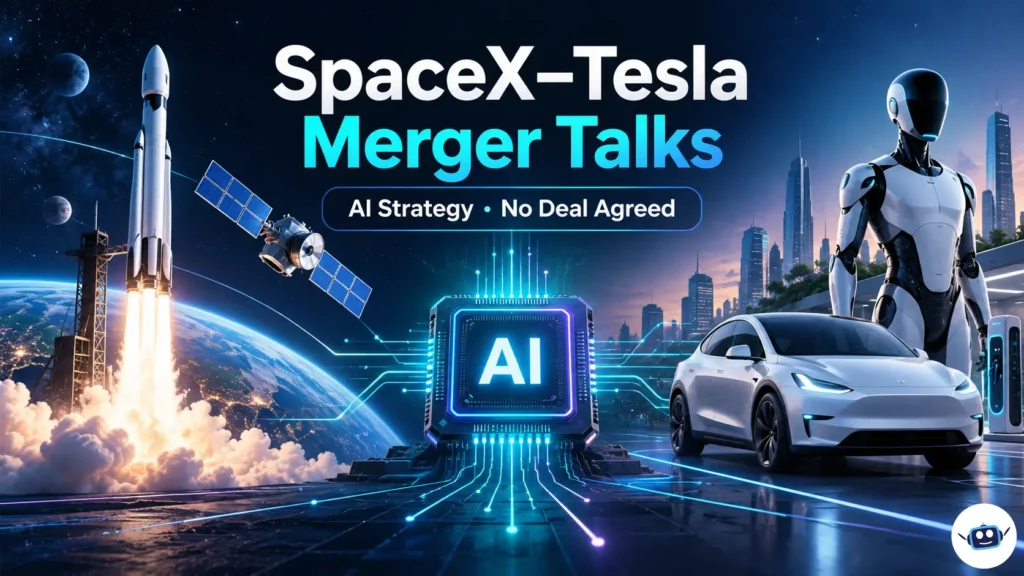
SpaceX and Tesla are exploring a potential merger through special committees of independent directors, according to Elon Musk’s remarks on SpaceX’s October 20, 2026 earnings call. Musk supports the idea, but the committees have not agreed on transaction terms. For the AI industry, the central question is whether combining software, chips, computing infrastructure and robotics would create benefits beyond the companies’ existing partnerships.
Musk’s reference to a “superintelligence singularity” explains his enthusiasm. It should be understood as his assessment of AI’s direction, rather than evidence that a defined technological milestone has occurred.
What has been announced about the SpaceX–Tesla merger?
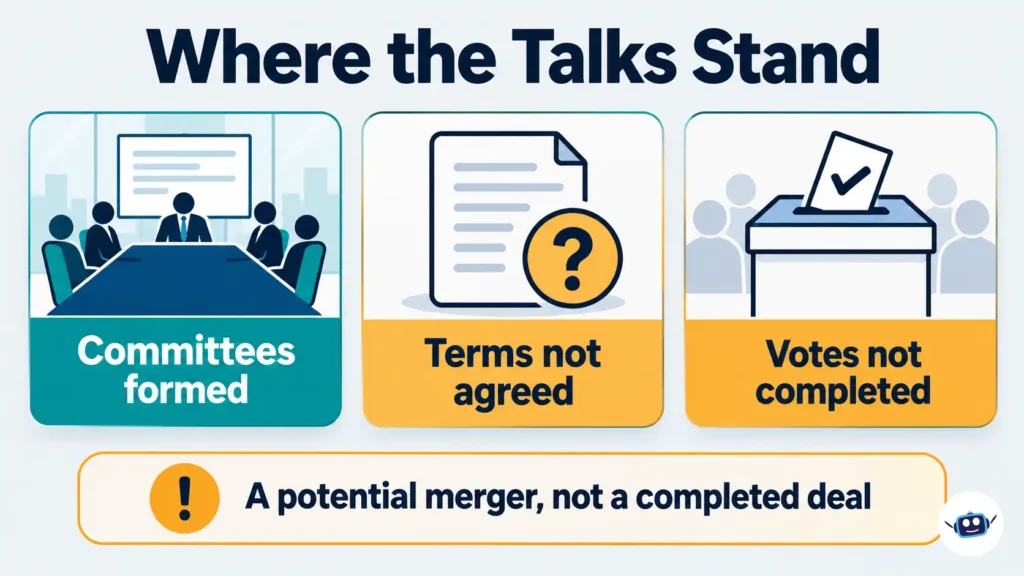
According to Musk’s account, both companies formed special committees at shareholders’ request. He said the committees consist of independent directors and that his position on both sides creates a conflict that excludes him from their discussions.
The Financial Times reported that the committees had not reached agreement on transaction terms. The Associated Press also reported Musk’s warning against assuming a merger was certain.
The distinction between reviewing a transaction and agreeing to one is essential.
| Question | Status |
|---|---|
| Are the companies exploring a combination? | Yes, according to Musk’s earnings-call remarks |
| Does Musk support the idea? | Yes |
| Have transaction terms been agreed? | Musk said they had not |
| Is a merger guaranteed? | No |
| Is a share-exchange ratio established? | No agreed ratio was identified |
| Is one company confirmed as the buyer? | No agreed transaction structure was identified |
The announcement is meaningful because it describes a board-level process. It does not establish a purchase price, ownership split or completion date.
Why AI is central to the potential combination
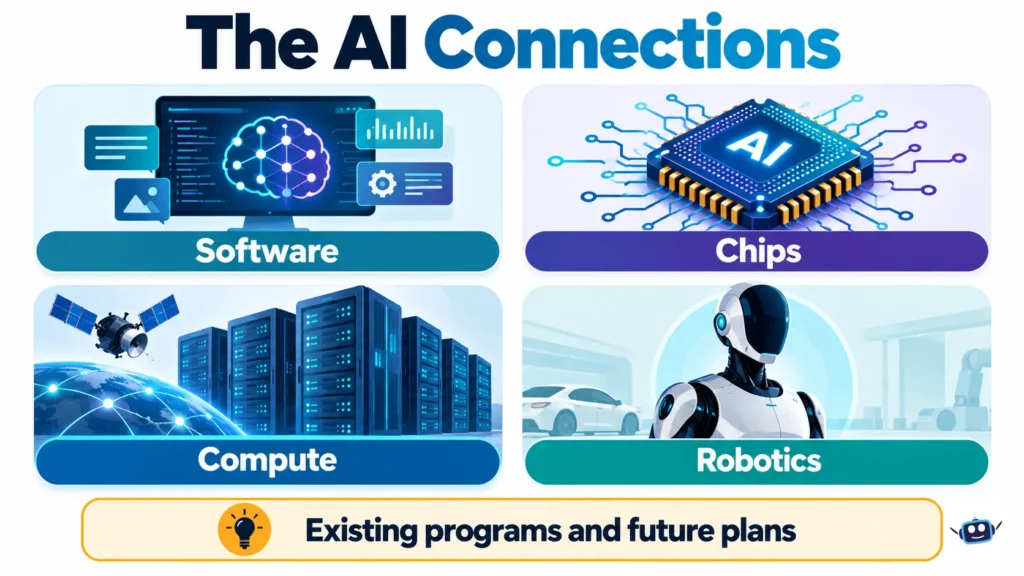
The strongest connection between these businesses is increasingly the infrastructure and engineering behind AI.
Tesla’s official AI materials describe work on neural networks, inference chips, autonomous systems and humanoid robotics. SpaceX’s public materials describe semiconductor development and orbital computing plans, while Tesla’s regulatory disclosures document SpaceX’s acquisition of xAI Holdings.
Together, these activities explain why a possible combination matters to readers following AI infrastructure and physical AI.
Tesla brings physical AI and inference engineering
Tesla’s AI and Robotics page describes systems for vision, planning and control. Its Optimus program requires capabilities including balance, navigation, perception and interaction with the physical world.
The same page describes engineering work on inference chips designed to run vehicle software efficiently. These are documented development priorities, not proof that every intended autonomous capability has been achieved.
For AI readers, the distinction matters. Developing a capable model, running it efficiently and deploying it reliably in a physical machine are separate engineering challenges.
A combined organization might coordinate those efforts more closely. Whether that coordination would improve products remains something to demonstrate.
SpaceX already contains an AI business
Tesla’s 2026 proxy statement records that xAI Holdings became a wholly owned SpaceX subsidiary on February 2, 2026.
The filing also explains an existing financial link. Tesla’s previously agreed investment in xAI Holdings converted into a right to acquire SpaceX shares following that transaction. Tesla completed its approximately $2 billion investment in SpaceX on March 12, 2026.
Tesla’s second-quarter Form 10-Q separately confirms the approximately $2 billion investment and describes the ownership interest as less than 1% at the time of investment.
This is an important addition to the merger story: the companies already have an ownership connection alongside their commercial relationships.
However, Tesla holding SpaceX shares does not make them a single company. Investment exposure and corporate control are different matters.
Terafab shows where their hardware plans overlap
SpaceX’s official Terafab materials describe a joint semiconductor initiative with Tesla. The intended applications include inference hardware for Tesla vehicles and Optimus robots, alongside chips designed for space-based computing.
SpaceX’s prospectus describes integrating chip design, fabrication and packaging. It also says the company expects to continue sourcing a significant portion of its computing hardware from outside suppliers.
The proposed advantage is greater coordination between the hardware being built and the applications that need it.
The practical limitation is execution. Announcing a semiconductor strategy, constructing facilities and producing dependable chips at scale are different milestones.
Does the “AI singularity” claim change the facts?
Musk used the singularity language while discussing cooperation in AI software, chip design, robotics, connectivity and SpaceX’s planned Starmind orbital computing constellation. Reuters reported those remarks in its explanation of the merger rationale.
Readers should separate that strategic argument from evidence of technical progress.
The merger discussions establish that directors are considering an ownership change. They do not establish that AI has reached superintelligence or that combining the companies would produce it.
More useful questions are measurable:
- Would shared development reduce computing costs?
- Would semiconductor projects deliver usable hardware on schedule?
- Would robots perform a broader range of tasks reliably?
- Would integration improve results beyond what existing agreements allow?
These questions make the AI argument easier to evaluate without relying on predictions about a singularity.
Why existing partnerships matter to the business case
A full merger is not the only way the companies can cooperate.
SpaceX’s prospectus describes a Terafab collaboration framework, with specific projects subject to separate negotiations and agreements. Tesla’s proxy also documents a framework for evaluating collaboration with xAI.
That creates a demanding test for any eventual proposal: what would common ownership achieve that those agreements cannot?
The following possibilities are analysis, rather than announced merger commitments.
Faster resource allocation
A combined business could potentially coordinate engineering teams, infrastructure spending and development priorities more easily.
However, shareholders would need visibility into which divisions generate cash and which consume it. Simpler internal approvals would not automatically mean better investment decisions.
Closer hardware and software development
Shared priorities could help engineers align processors with AI workloads and physical machines.
The benefit would depend on compatible requirements. Hardware optimized for a vehicle or robot may have different operating requirements from hardware intended for orbital computing.
More coordinated infrastructure planning
Computing projects require more than models. Hardware access, facilities, energy and financing all affect what can be deployed.
Our coverage of Alphabet’s Intersect acquisition and its data center power strategy explores another example of AI strategy extending into physical infrastructure.
Shareholder approval is a separate hurdle
Musk described Tesla approval as requiring support from 50% of all outstanding shares, rather than simply half of the shares participating in a vote. Business Insider and MarketWatch reported that description of the hurdle. The exact requirements for any eventual transaction should be checked against its formal shareholder materials.
The denominator matters. If approval is measured against outstanding shares, low participation makes reaching the threshold harder.
For a simple illustration, imagine a company with 100 voting shares outstanding. Support from 40 shares would not reach a 50-share threshold, even if only 60 shares participated.
That example explains the arithmetic; it is not a forecast of Tesla’s vote.
Independent committee review and shareholder approval also serve different purposes. A favorable recommendation would not itself complete every required approval.
What regulatory review could involve
The Federal Trade Commission explains that certain mergers require premerger notification under the Hart–Scott–Rodino Act. Applicable transactions must observe the required waiting period before closing.
The review can lead to additional information requests, negotiated remedies or a legal challenge. The requirements and outcome depend on the transaction’s structure and competitive effects.
It would therefore be premature to describe regulatory clearance as assured.
It would also be premature to assume that combining two large companies necessarily produces an antitrust violation. That assessment requires analysis of the relevant markets and the proposed transaction.
Practical Insights: How to assess what comes next
1. Separate existing facts from future plans
An investment completed in March is an existing fact. A planned chip facility describes future capacity. Claimed merger savings would be a projection.
Keeping those categories separate prevents ambitious plans from being mistaken for delivered results.
2. Look for benefits beyond cooperation
An eventual proposal should explain why a merger would improve on the companies’ existing relationships.
Useful detail would include the source of expected savings, the investment needed to obtain them and the timetable for measuring results.
3. Do not confuse market value with transaction value
Adding two companies’ stock-market values does not establish an agreed purchase price.
The terms would depend on the transaction structure and consideration. A share-based proposal would also require attention to dilution, voting rights and the resulting ownership split.
4. Follow spending alongside deployment
For AI infrastructure, assess operational capacity, customer demand and cash generation alongside construction announcements.
For robotics, follow demonstrated capabilities and deployment conditions. Our explanation of AI data center financing and debt risks provides related context on the funding questions.
5. Wait for product-specific announcements
Merger discussions do not establish lower AI prices, new vehicle features or wider robot availability.
Customers should evaluate actual product commitments and service terms.
6. Prioritize formal disclosures
If the committees reach an agreement, the most useful documents would explain the consideration, conditions, recommendations and applicable votes.
For related developments, follow our AI startups and industry coverage.
Frequently Asked Questions
Have SpaceX and Tesla agreed to merge?
No agreed transaction terms were identified in the reviewed reporting. Musk said independent committees were discussing the possibility and cautioned against assuming a deal would happen.
Why is Musk excluded from the committee discussions?
Musk said his roles and interests in both companies make him a conflicted party. Separate committees allow directors to evaluate the proposal from each company’s perspective.
Which company would buy the other?
An agreed buyer and transaction structure have not been established. Reports or analyst scenarios about an acquisition should be distinguished from a definitive agreement.
What vote would Tesla shareholders need to approve?
Musk described a threshold of 50% of all outstanding Tesla shares. The precise requirements would need to be confirmed in formal transaction materials if a proposal is announced.
Does Tesla already own SpaceX shares?
Yes. Tesla’s filings document an approximately $2 billion SpaceX investment completed in March 2026. That investment is separate from the potential merger.
Why does xAI matter to the story?
Tesla’s proxy records that xAI Holdings became a SpaceX subsidiary in February 2026. This helps explain why the potential combination is relevant to AI software and infrastructure as well as vehicles and rockets.
Would a merger prove that superintelligent AI has arrived?
No. Corporate ownership does not establish a technical capability. Musk’s singularity language should be treated as his view, separately from demonstrated performance.
What should readers watch next?
Look for a definitive agreement and shareholder documents explaining the terms, rationale and conditions. Engineering announcements will remain important, but they answer different questions from transaction disclosures.
Conclusion
The potential SpaceX–Tesla merger is an AI industry story because it could place more software, chips, computing infrastructure and robotics development under common ownership.
The strongest case for a transaction would explain what integration adds beyond existing partnerships. Until concrete terms emerge, focus on formal disclosures, shareholder protections and measurable engineering results. Treat a merger as a possibility and singularity claims as an assessment to examine.
Disclaimer
This article provides general information about reported merger discussions and AI industry strategy; it is not financial, investment, tax or legal advice. Information is current as of October 2026, and company plans and transaction proposals may change. Investment outcomes vary, so consult a licensed financial professional before making investment decisions.