
Researchers at the University of Washington’s Institute for Protein Design have used AI to create new proteases: enzymes that cut other proteins at selected sites. Two papers published in Nature on October 14, 2026, report complementary approaches using zinc-based chemistry and an activated cysteine amino acid. The work includes tests involving disease-related protein targets and, separately, an engineered reporter in cultured human cells. It does not demonstrate a treatment for Alzheimer’s disease, ALS or another condition.
For AI readers, the advance is the connection between computational design and measurable chemistry. Understanding that connection requires separating the two studies, their targets and their definitions of success.
What are AI-designed proteases?
Proteases are enzymes that break peptide bonds, the chemical links connecting amino acids in a protein chain. Natural proteases already carry out many biological functions; the new research develops additional protein structures capable of performing selected cutting reactions.
The National Institute of General Medical Sciences describes enzymes as biological catalysts that accelerate reactions. Their active sites hold the molecules they act on, called substrates. After a reaction, the products leave, potentially allowing the enzyme to act on another substrate.
Designing a protease therefore requires more than making a protein that binds something. It must position the target bond and catalytic components so that a chemical reaction occurs.
“Designed from scratch” also needs context. Researchers used established catalytic principles and geometries informed by natural enzymes. The newly designed part was the surrounding protein architecture and its interaction with a target—not a newly invented law of chemistry.
The two Nature studies at a glance
Both papers involve David Baker and colleagues, but they investigate different protease mechanisms.
| Feature | Zinc metalloproteases | Cysteine proteases |
|---|---|---|
| Paper | “Computational design of metalloproteases” | “De novo design of cysteine proteases” |
| Lead authors | Anqi Chen and Kejia Wu | Hojae Choi |
| Cutting mechanism | A zinc-containing active site activates water to attack a peptide bond | An activated cysteine participates in breaking the peptide bond |
| Designs tested experimentally | 135 | 69 |
| Reported initial hit rate | 36% | 13 of 69, approximately 19% |
| Important demonstrations | Cutting matching test substrates and selected disease-related targets | Cutting selected substrates, including an engineered reporter in cultured human cells |
The hit rates describe experimental screening outcomes. They are not measures of drug effectiveness or proof that the same percentage of arbitrary disease targets can be addressed.
These were also selected candidates that had passed computational development and filtering. The percentages should not be presented as the success rate of every structure initially generated by the models.
Why protein cutting is a demanding AI task
A protease must solve several linked problems: fold into a suitable structure, recognize a substrate, position the relevant bond, carry out the reaction and release its products.
Peptide bonds resist spontaneous hydrolysis under neutral aqueous conditions. This creates a demanding test for computational enzyme design: recognizing a molecule does not necessarily make the chemistry happen.
Consider a simplified design goal. An enzyme should cut one accessible segment of a protein while leaving other proteins alone. A design that grips the segment but cannot cut it fails the catalytic task. A design that cuts many unrelated sequences may fail the selectivity requirement.
This distinction explains why structure prediction cannot establish enzyme function by itself. A plausible arrangement provides a candidate for testing, while an experiment measures whether the intended behavior occurs.
How the AI protein-design pipeline works
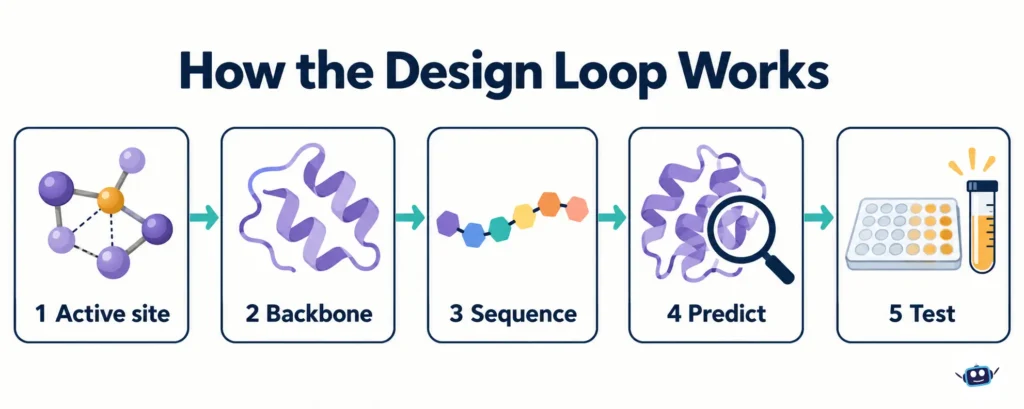
The research combined specialized models and laboratory validation. Each stage answered a different question.
1. Define the catalytic arrangement
Researchers began with the chemical components needed for the chosen reaction and a substrate arrangement near the active site.
For the zinc approach, this included the metal-centered chemistry and the water involved in cutting. For the cysteine approach, it included the reactive amino acid and neighboring catalytic groups.
These requirements constrained the design problem. The software was not simply asked to produce an interesting-looking protein.
2. Generate a surrounding protein structure
RFdiffusion-family methods generated candidate backbones around the required features. RFD2-MI, a version of RFdiffusion2 designed for molecular interfaces, helped address both catalytic-site construction and substrate interaction.
RFdiffusion2’s official documentation describes the ability to specify active-site features at the atomic level. That precision matters when small geometric differences can affect whether a reaction proceeds.
There is a useful parallel with our guide to context engineering: an AI system needs the right task-defining information. However, molecular constraints and language-model context remain different technical problems.
3. Choose amino acid sequences
Sequence-design methods proposed amino acids compatible with the candidate structures. The cysteine workflow used ProteinMPNN, while the zinc workflow used EnhancedMPNN, a refined version of LigandMPNN.
The initial design campaigns included jointly designed enzyme–substrate pairs. This made it possible to develop compatible molecular partners, but it also created an important limitation: success on a matching designed substrate does not automatically transfer to an existing human protein.
Designing against a fixed disease-related sequence is a separate test of the approach.
4. Predict and filter candidate structures
AlphaFold 3 helped assess whether proposed sequences were consistent with the intended structures and interactions.
Google DeepMind describes AlphaFold 3 as a molecular structure and interaction prediction system. A prediction can help eliminate implausible candidates, but it does not measure cutting activity, off-target effects or clinical benefit.
This is another example of the distinction between producing an output and validating its behavior, discussed in our comparison of AI coding agents and chatbots.
5. Build and test physical molecules
Researchers produced candidate proteins and measured their activity. Supporting methods included analyzing cleavage products, disabling catalytic components as controls and determining selected structures using X-ray crystallography.
These checks provide different kinds of evidence. Cleavage measurements test function; structural measurements test whether a molecule resembles its design.
The strongest conclusion comes from considering both.
What the experiments actually demonstrated
Zinc proteases: the target and assay matter
The initial metalloprotease screen used constructs in which the designed enzyme and its matching substrate were attached. The team also examined activity when enzyme and substrate were separate.
That distinction matters because attaching the partners brings them close together. A result from that arrangement does not fully describe how an independently moving enzyme encounters another molecule.
The research also showed why chemically relevant details belong in the model. Explicitly considering the catalytic water helped distinguish productive substrate arrangements from unproductive ones.
For AI developers, the broader inference is that the representation of a problem can matter as much as the model’s ability to generate a plausible structure.
Cysteine proteases: activity in cultured human cells
The cysteine study reported active designs and crystal structures close to their intended models. Its cell experiments used an engineered reporter in HeLa cells, a human cell line grown in laboratories.
The reporter’s fluorescence distribution changed in a way consistent with cleavage. Versions with a disabled catalytic cysteine served as controls.
This demonstrates a useful cellular capability. It does not show that the enzymes reached diseased brain tissue or treated a neurological condition.
Protein cutting can also activate a system
The metalloprotease work included engineered, masked biological molecules that became active after a designed protease removed the blocking component.
This illustrates a broader application than destroying a target. A selected cut can serve as a switch within an engineered biological system.
Such demonstrations are research tools and development concepts. They do not establish selective drug activation in patients.
Disease-related targets: what was cut, and where?
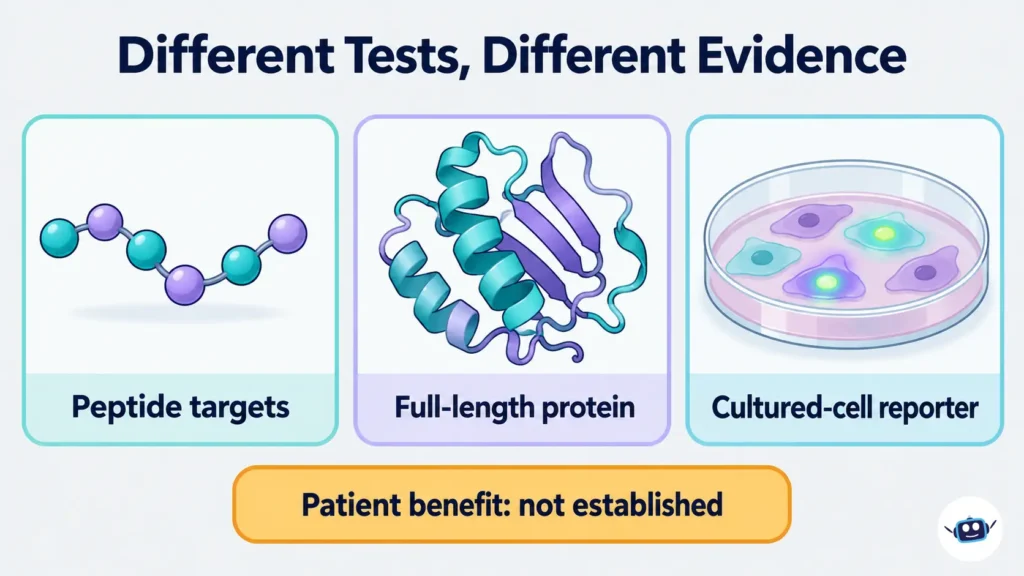
The phrase “cuts disease proteins” can hide important differences in the experimental material.
| Target or system | Demonstrated setting | What the result does not establish |
|---|---|---|
| TDP-43 | A designed zinc protease cut full-length protein in purified laboratory preparations, including monomeric and oligomeric forms | Safe removal of pathological TDP-43 in a person |
| Amyloid-beta | A zinc protease acted on a peptide sequence derived from amyloid-beta | Clearance of established Alzheimer’s plaques in a brain |
| Serum amyloid A | A zinc protease acted on a derived peptide substrate | Treatment of systemic amyloid disease |
| Engineered cellular reporter | Cysteine proteases showed activity in cultured human HeLa cells | Therapeutic delivery or benefit in patients |
A short peptide, a full-length protein and a reporter inside a cell pose different challenges. They should not be treated as interchangeable evidence.
Preserving normal protein function is another consideration. National Institute on Aging materials describe how TDP-43 can lose its normal nuclear function as well as accumulate abnormally. A useful intervention would therefore need a more specific objective than eliminating every copy.
Making a selected cut is an engineering result. Showing that the cut produces a beneficial biological outcome requires further evidence.
How fast are the AI-designed proteases?
The metalloprotease paper reports that its best initial design accelerated peptide-bond hydrolysis by more than 100 million-fold over the uncatalyzed reaction. Four substitutions increased that acceleration to more than 10 billion-fold.
The cysteine paper’s abstract reports rate enhancements of up to 30 million-fold over the background reaction for the designs summarized there. Later optimization experiments are additional results and should not be mixed into the initial hit-rate figures.
The essential question is: faster than what?
These large enhancements compare enzyme-assisted chemistry with a reaction proceeding without an enzyme. They do not mean the designs outperform natural proteases or existing medicines by those factors.
The cysteine authors identify a remaining gap relative to the most active native enzymes, involving active-site organization and substrate positioning.
The zinc study’s supplementary analysis also shows limits to computational scoring. AlphaFold 3 metrics helped screen out some damaging changes, but did not reliably rank the beneficial variants within the accepted range.
That is a useful AI finding in its own right: identifying a structurally plausible candidate and predicting the best catalyst remain different tasks.
What must happen before a medical application?
The studies do not establish a clinically effective treatment. A therapeutic development program would need to answer several additional questions.
Delivery: Can the active molecule reach the relevant tissue and cellular location? The National Institute of Biomedical Imaging and Bioengineering identifies transport through tissues and cells as a central drug-delivery challenge.
Selectivity: Does the protease spare unrelated proteins in a complex biological environment? Activity against the intended substrate is only one part of that assessment.
Immune response: Does the body recognize the protein in a way that changes its safety or effectiveness? FDA guidance specifically addresses evaluating immunogenicity during therapeutic protein development.
Control and exposure: How much activity occurs, where does it occur and how long does it last? These questions matter when the intended effect involves changing other proteins.
Biological benefit: Does the intervention improve a meaningful disease outcome while preserving useful functions?
The FDA describes preclinical research as a stage for investigating potential harm before testing a drug in people. A successful protein-design experiment does not replace that development process.
Practical Insights
A few checks make future protein-design announcements easier to assess.
Ask what counts as a successful design
Find the screening definition and denominator. Detectable activity in a selected set of laboratory candidates is different from reliable performance across new targets.
For example, “36% of selected designs cut their matching substrates” is a narrower and more useful statement than “AI can cut disease proteins with 36% success.”
Identify the comparison behind every speed claim
Separate acceleration over uncatalyzed chemistry from comparisons with natural enzymes.
Also distinguish reaction rate, substrate affinity and catalytic efficiency. A single impressive multiplier cannot summarize every property needed for an application.
Follow the evidence from target sequence to biological outcome
Check whether the work used a short peptide, full-length protein, engineered reporter, disease model or patients.
Each setting answers a different question. Evidence should support a claim at the level where the experiment was performed.
Look for controls and measured structures
Useful checks include confirming cleavage products, disabling catalytic residues and comparing experimentally determined structures with design models.
These controls help establish whether the observed activity depends on the intended machinery. A confidence score alone cannot provide the same evidence.
Plan around validated results
For research teams, the useful planning metric is the cost of obtaining candidates that meet defined experimental criteria.
Compute is one part of that process; protein production, testing and analysis also matter. Our guide to renting GPU compute provides background on evaluating the computing component.
Frequently asked questions
What is a protease?
A protease is an enzyme that cuts proteins by breaking peptide bonds. The new research uses computational design to create additional protein structures capable of carrying out selected cutting reactions.
Did AI design the proteins entirely on its own?
No. Researchers defined the chemistry, selected and filtered candidates, produced the molecules and tested their behavior. Several specialized models contributed to the design process.
Were Alzheimer’s or ALS patients treated?
These papers do not report patient treatment or clinical benefit. Their disease-related experiments establish laboratory activity against selected targets, which is an earlier stage of evidence.
Did the enzymes work in human cells?
The cysteine study demonstrated cleavage of an engineered reporter in cultured HeLa cells. That does not establish delivery to human tissues or treatment of disease.
Does the 36% hit rate apply to disease proteins?
No. It describes the metalloprotease study’s initial set of tested designs and their matching peptide substrates. Disease-related target experiments need to be evaluated separately.
Are the enzymes millions of times faster than natural proteases?
The large rate-enhancement figures compare the designed enzymes with uncatalyzed chemistry. They should not be presented as equivalent improvements over natural enzymes or medicines.
Are these protein scissors the same as CRISPR?
No. These proteases cut proteins, while commonly discussed CRISPR gene-editing systems act on genetic material. The scissors analogy does not make their molecular targets or applications equivalent.
When could the research lead to a treatment?
These studies do not establish a clinical timeline. Delivery, selectivity, immune response, safety and meaningful biological benefit remain essential development questions.
Conclusion
AI-designed proteases show that computational protein design can produce experimentally active molecular machinery. The progress is supported by measured cutting activity, structural characterization and, for the cysteine work, an engineered reporter tested in cultured human cells.
The most useful way to follow the field is to track three things: the actual target, the setting of the experiment and the baseline behind each performance claim. Future evidence about selectivity, delivery and disease outcomes will matter more for medical applications than a screening percentage alone.
Disclaimer
This article provides general information about published scientific research and is not medical advice or a replacement for a qualified healthcare professional. The protease studies discussed do not establish a treatment for Alzheimer’s disease, ALS or another condition; speak with your doctor about personal medical decisions and seek emergency care for urgent symptoms. Information current as of October 2026.