
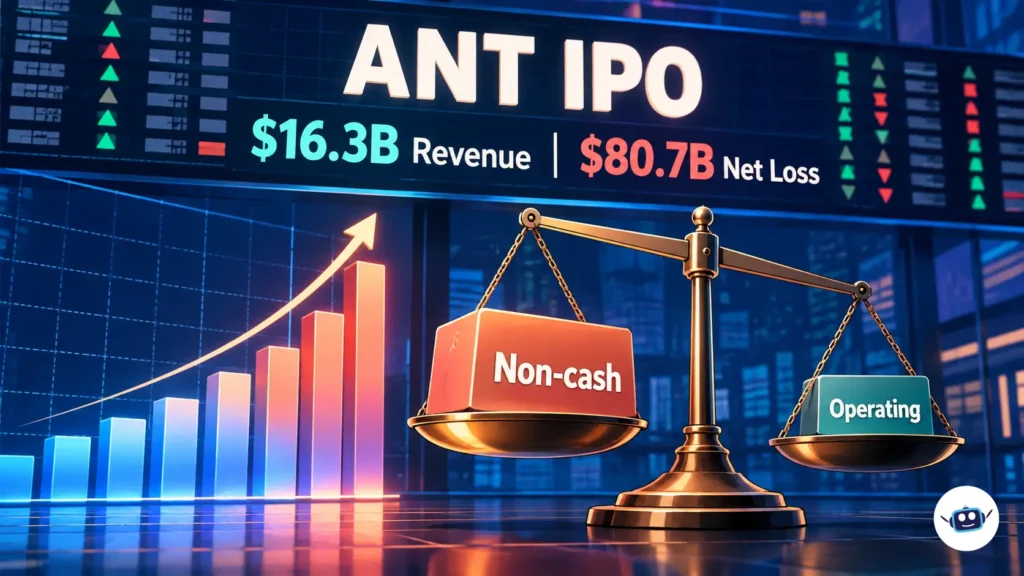
Anthropic, PBC filed its Form S-1 with the SEC on October 26, 2026, and intends to list Class A common stock on the Nasdaq Global Select Market under the symbol “ANT.” The filing shows $16,286 million of revenue for the six months ended June 30, 2026, against a net loss of $80,748 million. About 90% of that loss is a non-cash accounting charge tied to the rising value of Anthropic’s own convertible notes. The operating loss for the half was $693 million. The price range, share count and listing date are not set.
Anthropic IPO at a Glance
| Item | What the filing says |
|---|---|
| Company | Anthropic, PBC (Delaware public benefit corporation) |
| Proposed listing | Class A common stock, Nasdaq Global Select Market, symbol “ANT” |
| Public S-1 filed | October 26, 2026 |
| Confidential draft | Submitted June 1, 2026 |
| Price range and share count | Blank |
| Lead underwriters | Goldman Sachs and Morgan Stanley, among 22 banks on the cover |
| Status | Registration statement not yet effective |
Anthropic announced a confidential draft submission in June, which let it begin SEC review privately. The public version is the first time outsiders can read audited financials. The prospectus cover also states that the information is incomplete and may change, and the securities cannot be sold until the registration becomes effective.
Revenue: What $16.3 Billion in Six Months Means
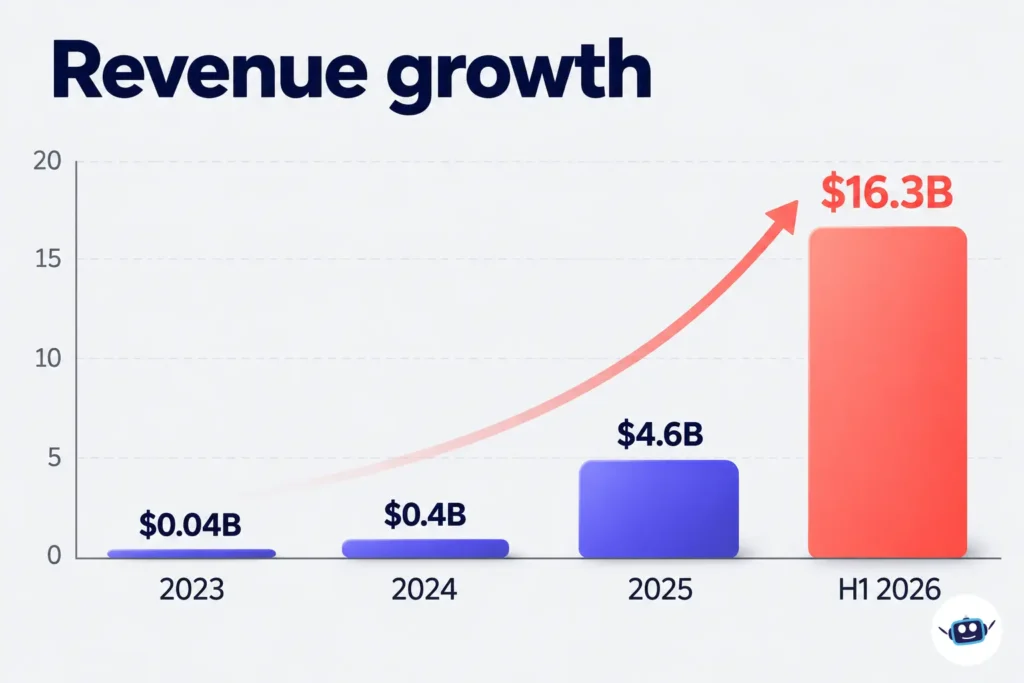
Revenue was $41 million in 2023, $386 million in 2024 and $4,585 million in 2025. It reached $16,286 million in the first half of 2026, compared with $1,163 million in the same period a year earlier. That is roughly 14 times the prior-year half, which matches the 1,300% growth figure in the headlines.
The quarterly split shows where the acceleration sits. Second-quarter revenue was $11.56 billion, per the S-1, which leaves about $4.7 billion for the first quarter. The second quarter alone exceeded everything Anthropic booked from 2023 through 2025 combined.
Other usage and customer figures from the prospectus:
- As of September 30, 2026, more than 11,900 customers each generated $100,000 or more of trailing-twelve-month revenue, more than 1,900 generated $1 million or more, and about 250 generated $10 million or more.
- Net Revenue Retention was approximately 900%. The metric divides current-quarter revenue from existing customers by their revenue a year earlier, and it excludes Claude Pro and Max subscribers.
- Anthropic reported that Q2 revenue grew 1,368% year over year while compute and infrastructure expenses grew 300%.
Anthropic ties the growth to Claude Code, its coding agent, and Claude Cowork, its knowledge-work agent. Those are the company’s own descriptions of what drives demand.
Why the Net Loss Is $80.7 Billion
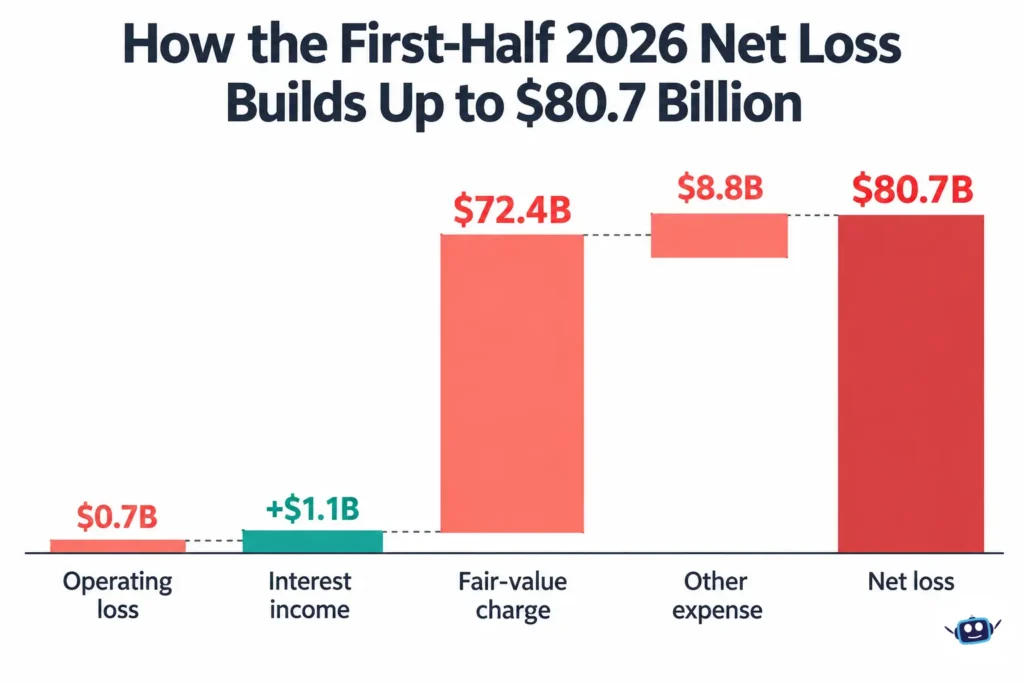
The headline loss is not a cash figure. Here is how the six-month result builds up, using the filing’s numbers:
| Line item (H1 2026) | Amount |
|---|---|
| Operating loss | –$693M |
| Interest income | +$1,111M |
| Change in fair value of convertible notes, derivatives and SAFEs | –$72,388M |
| Other expense, net | –$8,757M |
| Provision for income taxes | –$21M |
| Net loss | –$80,748M |
What “non-cash” means here
Anthropic says the $72.4 billion change came mainly from an increase in the fair value of its outstanding convertible promissory notes, which rose as its enterprise valuation rose. Under U.S. accounting rules, when a liability is carried at fair value, a higher value of the company makes the notes more costly to settle on paper, and the increase runs through the income statement. No cash left the building. The pattern also repeated in earlier years. The filing reports net losses of $1.5 billion, $8.3 billion and $42.0 billion for 2023, 2024 and 2025.
The part most coverage skips
Subtract the fair-value charge and about $8.4 billion of loss remains. Most of it is a separate $8.76 billion “other expense” line. Coverage disagrees on what that line is. One analysis says it came mainly from new note purchase agreements, while another calls it a non-cash financing charge. Either way, it sits outside the operating business. Treat the “90% non-cash” figure as accurate for the fair-value charge, and be cautious about claims that the entire gap is accounting noise.
Operating, GAAP and adjusted results
The GAAP operating loss narrowed to $693 million from $2,135 million a year earlier. The filing’s non-GAAP adjusted operating income was $1,618 million for the half, a 10% adjusted margin. Yahoo Finance reported that Anthropic earned $974 million in operating income in the second quarter, after a $1.7 billion operating loss in the first. Personnel costs include $2.2 billion of stock-based compensation for the half, which accounts for much of the gap between GAAP and adjusted figures.
Where the Money Goes: Compute, People and Sales
Compute and infrastructure cost $8,945 million in the first half, up from $2,334 million a year earlier. Personnel was $3,152 million, and sales, marketing and partnerships was $3,168 million, compared with $120 million. The sales line is the quiet outlier. It grew more than 25-fold, which suggests Anthropic is now paying heavily to expand distribution.
Compute is shrinking relative to revenue. It was about 160% of revenue in 2025 and about 55% in the first half of 2026, based on the figures above. That is the core of the efficiency argument in the filing.
Cash, Commitments and the Balance Sheet
As of June 30, 2026, Anthropic held $112.4 billion in cash and equivalents and $19.3 billion in short-term investments, and said it had raised $141.1 billion in total capital. The balance sheet also shows an accumulated deficit of $132.9 billion and a stockholders’ deficit of $127.6 billion. The deficit is largely a presentation effect, because $157.5 billion of redeemable convertible preferred stock sits outside equity until the IPO converts it.
The obligations are large and long. The prospectus says commitments are substantially all for compute and infrastructure, with most of the amount beyond 2030 expected to fall between 2031 and 2045. Press tallies of named contracts with Google, Amazon, Microsoft and others run to several hundred billion dollars, and the totals differ by report and draft. Compute is spread across AWS Trainium, Google TPUs, NVIDIA GPUs and AMD GPUs.
Who Controls Anthropic After the IPO
Buying Class A shares does not buy control. A single Class F share, held by an LLC of Anthropic’s seven co-founders, carries 50.1% of total voting power. The Long-Term Benefit Trust elects a majority of the board through Class T stock, and the company qualifies as a Nasdaq “controlled company.” Class N shares, held mostly by strategic partners, have no vote. Anthropic also says it does not expect to rely on the controlled-company exemption except for its nominating and governance committee.
The structure follows from Anthropic’s status as a public benefit corporation. Directors must balance shareholder returns against a stated public-benefit purpose, which can conflict with short-term financial interests. Readers who follow Claude and the wider model market can find ongoing coverage at AI LLM News.
Risks the Filing Flags
- Customer concentration. Reports on the filing say about one-fifth of first-half revenue came from two unnamed customers, and many large buyers lack long-term contracts.
- Channel dependence. Reuters, citing the earlier confidential draft, reported that 47% of 2025 sales ran through Amazon and Google, which are also investors, compute suppliers and AI competitors.
- Compute supply. The filing states that Anthropic has previously asked cloud partners for more compute than they were willing to provide.
- Growth durability. The summary of risk factors warns that historical growth rates are not indicative of future performance.
- Safety and regulation. The prospectus lists misuse, model misalignment, liability and an uncertain regulatory environment among its risks.
IPO Timing, Valuation and What Is Not Confirmed
Anthropic has set no date or price. The Wall Street Journal reported a target debut in the week of November 16, raising $100 billion or more at a valuation of $1.5 trillion to $2 trillion. Those are reported targets, not company statements. Some analysts expect a valuation near $1.5 trillion, and a few estimates run as low as $1.2 trillion. The last private round valued Anthropic at $965 billion after the money was raised.
For scale, SpaceX holds the IPO record, having raised nearly $86 billion including the underwriters’ option at a $1.77 trillion valuation. An amended S-1 with a price range is the next formal signal.
Practical Insights
Read the filing in this order. Start with operating income, then adjusted operating income, then net loss. The three tell different stories, and only the first is a plain GAAP measure of running the business.
Expect more non-cash noise around the IPO. The prospectus says the fair-value change on convertible notes will be eliminated pro forma when the notes convert at the offering. It also says Anthropic will begin recording stock-based compensation for certain RSUs in the quarter the IPO completes. The first full public quarter may therefore carry a large one-time expense unrelated to Claude’s performance.
Do not treat Net Revenue Retention as customer growth. It excludes subscribers and covers customers that already existed a year earlier, so 900% describes spending expansion among those accounts, not new-customer wins.
Separate three numbers that get blurred. Revenue is what customers paid. Operating result is what the business earned after costs. Net loss includes financing accounting. Mixing them produces headlines like “lost five times its revenue” that say little about the underlying business.
Common mistakes to avoid.
- Treating the $80.7 billion as cash burn.
- Treating reported valuations as confirmed IPO terms.
- Assuming Class A shareholders can influence board elections or a sale of the company.
- Comparing H1 2026 revenue with full-year 2025 without adjusting for the period length.
Frequently Asked Questions
When is the Anthropic IPO?
Anthropic has not announced a date. The Wall Street Journal reported a target of the week of November 16. The offering depends on SEC review and market conditions.
What is Anthropic’s stock ticker?
The proposed symbol is ANT, for Class A common stock on the Nasdaq Global Select Market. No public market exists until trading begins.
How much revenue did Anthropic report?
The S-1 reports $16,286 million for the six months ended June 30, 2026, versus $4,585 million for all of 2025.
Why is the net loss so much bigger than the operating loss?
A $72,388 million fair-value change on convertible notes, derivatives and SAFEs accounts for most of it. A further $8,757 million of other expense also sits below the operating line.
Is Anthropic profitable?
It depends on the measure. Operating income was positive in the second quarter. The first-half GAAP operating result was a $693 million loss, and the net loss was $80.7 billion.
What valuation is Anthropic targeting?
No valuation is confirmed. Reports cite $1.5 trillion to $2 trillion, while the last private round was $965 billion.
Can I buy Anthropic shares now?
No public market exists for Class A shares yet. Shares become tradable only after the offering is declared effective and trading starts. Retail access to IPO allocations varies by broker and is not guaranteed.
Who controls the company after the IPO?
Seven co-founders hold 50.1% of voting power through one Class F share, and the Long-Term Benefit Trust elects a board majority. Public Class A holders get one vote per share but cannot override those two blocs.
Conclusion
The filing shows two things at once. The business grew about 14-fold in a year and reached an operating profit in one quarter, while the net loss is dominated by accounting for notes that rise in value as Anthropic does. Neither fact cancels the other. Concentrated customers, partner dependence and commitments stretching to 2045 are real risks, and the governance structure gives public shareholders limited influence.
Takeaways:
- Judge the company on operating income and cash, not the $80.7 billion headline.
- Treat every valuation figure as reported until an amended S-1 shows a price range.
- Read the capital-structure section before anything else if you plan to own shares.
- Watch for the amended filing, the roadshow and the first public quarter’s results.
For continuing coverage, see the latest stories at AI LLM News.
Disclaimer
This article is general information about a publicly filed prospectus. It is not financial, investment or tax advice, and it is not an offer to sell or a solicitation to buy any security. Figures come from a preliminary filing that may change, results vary, and you should consult a licensed professional before making investment decisions. Information is current as of October 2026.