
Nvidia’s AI financing role is under scrutiny because it sells infrastructure while also helping customers fund and use it. October’s declines in CoreWeave, Nebius and IREN have sharpened questions about who carries the risk when AI expansion becomes harder to finance.
The concern reaches beyond chip sales. Nvidia holds investments, purchases computing capacity and guarantees selected obligations. These arrangements can support growth, but they also connect its finances more closely to customers’ performance.
For AI developers and businesses, the practical issue is whether computing providers can fund reliable capacity at sustainable prices. Falling stocks alone do not establish that services are failing.
Why Neocloud Stocks Matter to the AI Industry
Neoclouds are specialized cloud providers focused on accelerated computing, including the GPUs used to train and run AI models. CoreWeave and Nebius are prominent examples. IREN also operates AI cloud infrastructure.
Their business involves spending on equipment and facilities before collecting all the revenue those assets may eventually generate. That timing creates a financing requirement even when demand is growing.
Reuters reported further premarket declines in CoreWeave, Nebius and IREN on October 26. The market concern centers on the sustainability of debt-funded expansion and rising borrowing costs.
For a broader view of the companies affected, our coverage of the AI sell-off across data center stocks explains how cloud operators differ from suppliers of power, cooling and connectivity.
The distinction matters: a GPU supplier, a cloud operator and an AI model developer earn revenue at different points. A strong sales pipeline at one company does not automatically resolve another company’s funding needs.
How Nvidia’s AI Financing Works
Nvidia’s support takes several forms. Two documented CoreWeave arrangements illustrate why they need separate treatment.
In January 2026, Nvidia announced a $2 billion equity investment in CoreWeave. CoreWeave subsequently confirmed that the investment closed. That gives Nvidia exposure as a shareholder.
A separate agreement, signed in September 2025, had an initial value of $6.3 billion. CoreWeave’s filing says Nvidia must purchase residual unsold computing capacity covered by the agreement through April 13, 2032, subject to service requirements and termination provisions.
This makes Nvidia a supplier, investor and capacity customer within the same relationship. The capacity purchase arrangement does not guarantee every CoreWeave obligation.
The potential benefit is straightforward: financial support can help a provider build infrastructure and make more computing available. The risk is that the supplier becomes financially exposed to the same customers whose equipment purchases support its sales.
What Nvidia Has Actually Committed
Nvidia’s July 26, 2026 quarterly disclosures and its August Ohio agreement identify different types of commitments:
| Arrangement | Disclosed amount | What it represents |
|---|---|---|
| AI cloud agreements, as of July 26 | $36 billion | Cloud capacity commitments that decrease as capacity is consumed by third parties or Nvidia |
| Future data center leases intended for third parties, as of July 26 | $20 billion | Leases Nvidia expects to reassign |
| Other AI-cloud land, power and shell guarantees, as of July 26 | $3.5 billion maximum exposure | Support for specified lease obligations upon partner default |
| SB Energy/OpenAI Ohio guarantees, entered into in August | $105 billion aggregate cap | Conditional support for defined obligations associated with the initial project phases |
These figures are neither a single debt balance nor a forecast of losses. They have different payment conditions and schedules.
Nvidia also announced financing partnerships in August intended to mobilize more than $500 billion of third-party capital. The announcement described memorandums of understanding with six financial institutions. That target is distinct from money Nvidia itself has committed to pay.
A Capacity Purchase Has a Different Trigger From a Guarantee
Under the CoreWeave agreement, Nvidia can be required to buy covered capacity when other customers have not taken it. CoreWeave does not have to default first.
The Ohio guarantees, by contrast, respond to specified tenant defaults. Their operation depends on contractual conditions and remedies.
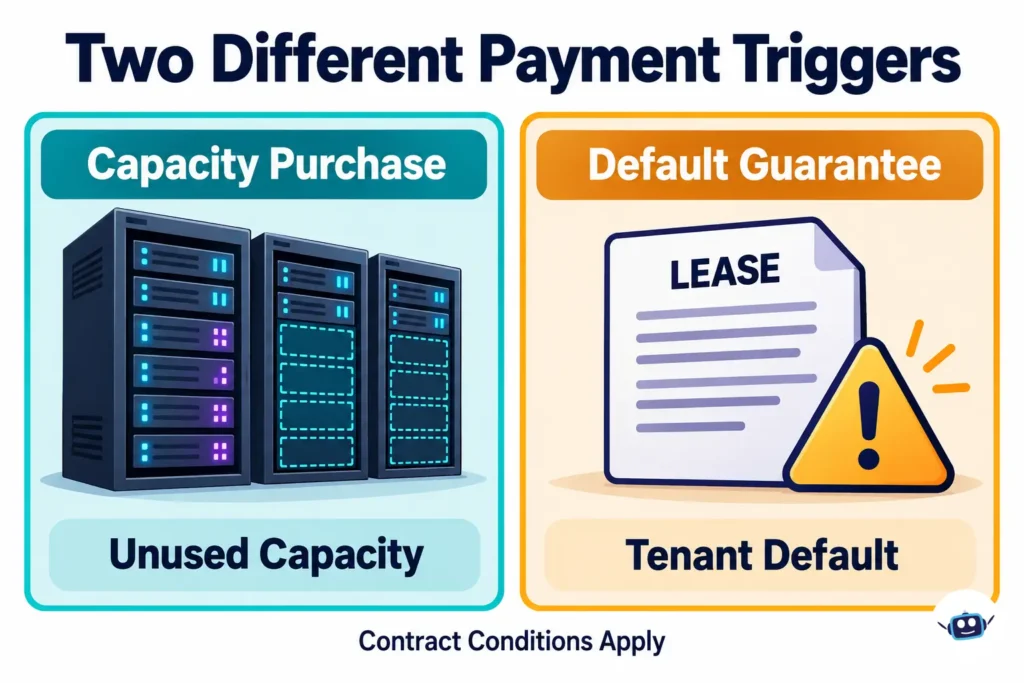
This distinction changes how readers should assess the risk. Lower utilization can activate a capacity purchase obligation while the provider continues operating normally. A default guarantee addresses a different event.
Neither arrangement, by itself, promises uninterrupted service to every customer using the infrastructure.
The Ohio Deal: Why the Capacity Figures Need Care
Nvidia’s August 17 filing and SB Energy’s registration disclosures describe the initial $105 billion guarantee as covering approximately 4.25 gigawatts of IT load. Additional capacity is subject to an option Nvidia can choose to exercise.
Nvidia’s project announcement separately describes at least 10 gigawatts of new energy generation supporting approximately 8 gigawatts of IT capacity across the broader campus.
Those measurements describe different things. Electricity generation, usable computing load and the portion covered by an initial guarantee should not be substituted for one another.
The guarantees become effective in phases, subject to conditions such as facilities being ready for service. If a qualifying default occurs, Nvidia has contractual choices involving taking over a lease, replacement tenancy or sale. Payment exposure depends on the applicable guaranteed value and recoveries.
The useful question is therefore which obligations become effective, when they start and what reduces the exposure.
CoreWeave’s Results Show the Financing Challenge
CoreWeave’s second-quarter earnings release and SEC filing provide a concrete example of growth alongside substantial funding needs.
| Metric | Quarter ended June 30, 2026 |
|---|---|
| Revenue | $2.575 billion |
| Net interest expense | $640 million |
| Operating cash flow | $679 million |
| Cash purchases of property and equipment, including capitalized internal-use software | $6.422 billion |
| Revenue backlog at quarter-end | Approximately $104 billion |
Subtracting operating cash flow from those equipment purchases gives $5.743 billion. That is a comparison of two reported cash-flow lines, not a forecast of insolvency or a complete measure of future financing needs.
CoreWeave’s backlog also has conditions. Its definition includes contracted amounts expected to become revenue subject to delivery and service availability. Backlog therefore cannot be treated as cash already available for interest payments or construction.
For balance, CoreWeave’s quarterly filing said management believed cash, investments and available borrowing capacity were sufficient for obligations anticipated within the following year. That assessment accompanied warnings about future capital requirements.
Our explanation of the data center bond sell-off and AI credit risks provides further context on the financing side.
What This Means for AI Models and Compute Buyers
The implications for AI teams are conditional, rather than automatic consequences of stock prices.
If a provider faces more expensive financing, it may need better margins, additional customer commitments or a slower expansion schedule. Which response it chooses depends on its contracts, liquidity and operating economics.
For an application developer, that could matter through the availability of new GPU instances, renewal terms or the timing of a planned deployment. It does not mean an existing inference endpoint has stopped working.
Consider a hypothetical team preparing to launch a document-analysis service. It should evaluate the capacity available for its launch date, its measured workload performance and its ability to recover data independently. The provider’s stock chart cannot answer those operational questions.
Our guide to GPU rental pricing and hidden compute costs explains why comparing hourly GPU prices alone gives an incomplete picture.
Practical Insights
The following steps are analytical recommendations based on the disclosed financing structures, not claims of firsthand testing.
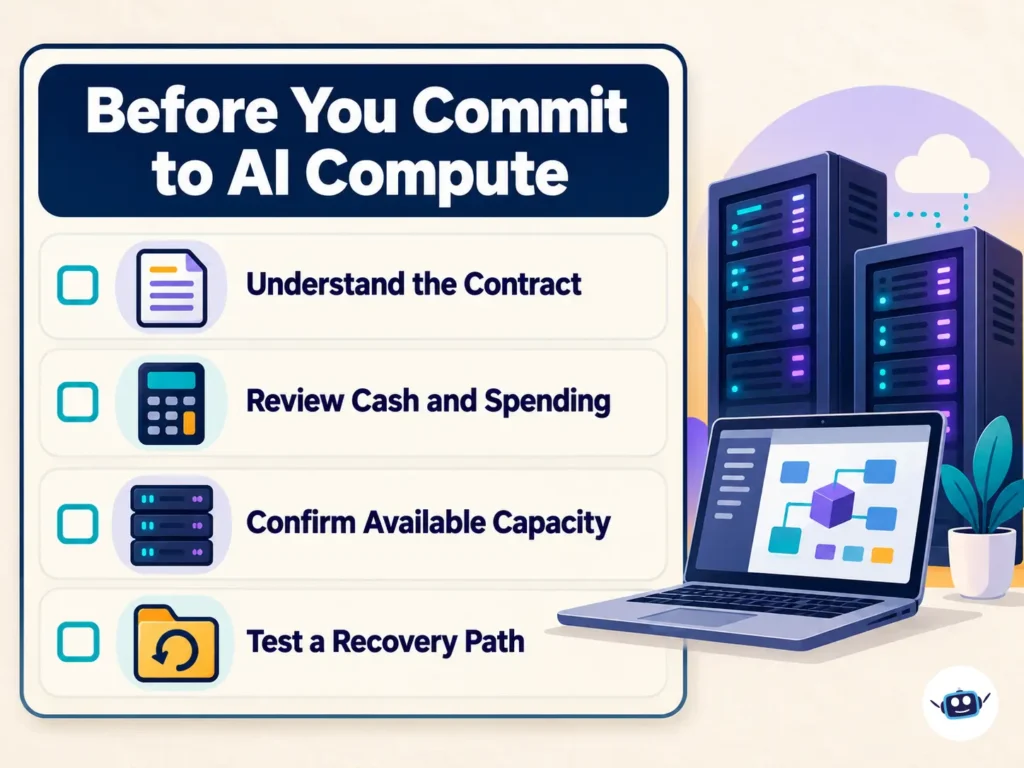
1. Identify the Contract Behind the Reassurance
A statement that a provider is “backed by Nvidia” leaves several questions unanswered. Establish whether that means an equity investment, a capacity purchase, a lease guarantee or another arrangement.
Then identify the beneficiary. Financial protection for a landlord does not automatically create refund rights or service guarantees for a cloud customer.
2. Match Financial Periods Before Comparing Numbers
Compare quarterly spending with quarterly cash flow, and distinguish cash from borrowing facilities. When reviewing backlog, identify delivery conditions and the period over which the revenue may arrive.
Avoid mixing a multiyear commitment with one quarter’s revenue and treating the resulting ratio as a solvency test.
3. Build a Workload-Level Cost Baseline
For an LLM application, record the cost of completing a representative task at the required quality and response time. Include storage, networking and idle capacity where applicable.
A cheaper GPU-hour can still produce a more expensive completed task if the deployment needs more runtime or resources. Use measured application costs when evaluating a new contract.
4. Prepare a Recovery Path Before Expanding
Maintain independent copies of data and deployment configuration where permissions and licenses allow. For self-hosted models, preserve the required model artifacts; for proprietary APIs, document the changes a substitute service would require.
Test a small representative workload on the recovery path. Record differences in output quality, latency and integration behavior before relying on it.
5. Watch Delivery and Funding Together
A financing announcement does not demonstrate that a cluster is available for production. An available cluster does not show that every future expansion phase is funded.
Track both sides: commissioned capacity and service performance, alongside cash generation, spending and access to capital.
Frequently Asked Questions
Why Is Nvidia Financing AI Cloud Companies?
Its investments and commitments help selected customers secure infrastructure and expand computing capacity. This can support sales of Nvidia systems and wider adoption of its platform, while increasing its exposure to those customers.
Does Nvidia Guarantee All CoreWeave Debt?
The documented capacity purchase agreement does not provide a blanket guarantee of CoreWeave’s debt. It covers specified residual computing capacity, subject to delivery, availability and termination provisions.
Does the $105 Billion Ohio Guarantee Mean Nvidia Has Paid That Amount?
No. It is an aggregate contractual cap on conditional exposure associated with the initial covered phases. Actual obligations depend on the agreement’s conditions, default triggers and remedies.
Are Falling Neocloud Stocks Proof That AI Demand Has Collapsed?
No. Share prices reflect expectations about profits, financing, risk and valuation as well as demand. A company can report growing revenue while investors become less comfortable with the cost of funding its expansion.
Is Revenue Backlog the Same as Cash?
No. CoreWeave’s definition includes future revenue expected under customer contracts, subject to service-related conditions. Cash collection and revenue recognition occur on their own schedules.
Will the Sell-Off Make GPU Rentals Cheaper?
There is no automatic link between a lower share price and a lower rental rate. Pricing depends on available capacity, demand, contract structure and the provider’s costs.
Should Businesses Stop Using Neocloud Providers?
A stock decline alone does not establish that a provider is unsuitable. Businesses should assess service performance, contractual protections, financial exposure and recovery options against their own workload requirements.
Conclusion
Nvidia’s financing role makes AI infrastructure risk more interconnected. Investors need to distinguish equity exposure, capacity purchases and conditional guarantees before judging the scale of that risk.
For AI teams, the useful response is concrete: understand the contract, compare spending with cash generation, verify available capacity and maintain a tested recovery path. The strongest evidence will come from delivered services and sustainable customer payments, alongside the funding needed to support them.
Disclaimer
This article provides general information about AI infrastructure financing and is not financial, investment or tax advice. Investment outcomes vary, and readers should consult a licensed financial professional before making decisions. Information is current as of October 2026; market conditions, financial disclosures and contractual arrangements can change.