
OpenAI plans to buy Google’s tensor processing units (TPUs), The Information reported on October 27, 2026, as the ChatGPT maker looks to spread its computing needs across more suppliers than Nvidia. The report cites a single person familiar with the matter. Neither company has confirmed it, and no price, chip count or delivery date has been made public. Reports describe the TPUs as an addition to OpenAI’s Nvidia hardware, not a replacement. This guide separates what is confirmed from what is still rumor, and explains why the move would matter.
What has been reported, and what hasn’t
According to Reuters, OpenAI declined to comment, and Google did not immediately respond to a request for comment. The report did not disclose financial terms or other details. Here is where each piece of the story stands.
| Claim | Status as of October 28, 2026 |
|---|---|
| OpenAI plans to buy Google TPUs | Reported by The Information from one anonymous source. Not confirmed by OpenAI or Google. |
| Price, volume, delivery timing | Not disclosed |
| Direct hardware purchase vs. capacity bought through Google Cloud | Not clear from the reports |
| Which TPU generation is involved | Not disclosed |
| OpenAI rented Google TPUs | Reported by Reuters in June 2025 |
| Google sells TPUs for customers’ own data centers | Announced by Alphabet on its April 29, 2026 earnings call |
| OpenAI models available on Google Cloud | Announced by OpenAI and Google Cloud on October 21, 2026 |
The “buy” wording deserves care. Some commentary has gone further and said OpenAI already owns Google chips. Nothing in the Reuters coverage supports that. It says OpenAI plans to buy them.
Why OpenAI would want Google’s chips
Supply and bargaining power
OpenAI is among the largest buyers of Nvidia GPUs, which it uses to train and run its models, according to Reuters. Amazon, Microsoft and Alphabet alone plan to spend as much as $600 billion combined on AI infrastructure this year. In a market that tight, a second source of chips reduces the risk of waiting on one supplier. It also gives OpenAI leverage in price talks. An analyst piece on Investing.com made the same point: a buyer doesn’t need to drop Nvidia to improve its terms. It only needs credible alternatives.
Inference costs
Inference is the work of running a trained model to answer requests, as opposed to training it. When Reuters reported in 2025 that OpenAI was renting TPUs, the stated aim was to hold down inference costs. Inference demand keeps growing as products such as coding agents handle longer tasks. Our piece on AI coding agents versus chatbots shows why that workload is so compute-hungry.
How OpenAI and Google got here
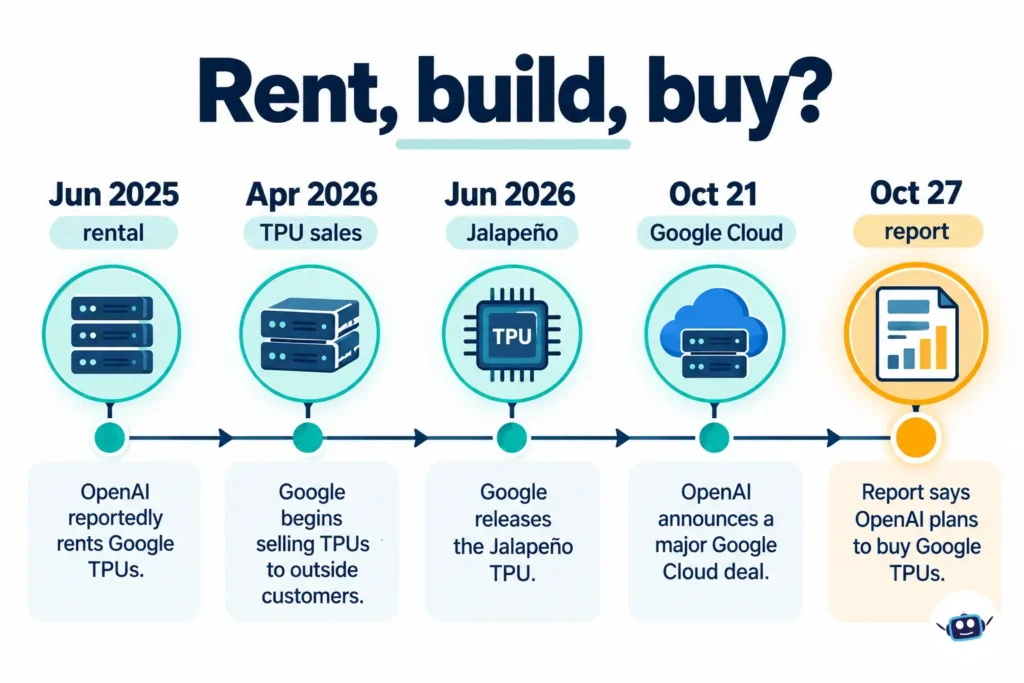
The relationship has moved in steps rather than one leap:
- June 2025: Reuters reported that OpenAI had begun renting Google’s chips. Soon after, OpenAI said it had no active plans to use them in its products. The Information also reported that Google was not renting its most powerful TPUs to OpenAI.
- October 2025: OpenAI and Broadcom announced a collaboration to deploy 10 gigawatts of OpenAI-designed accelerators.
- April 22, 2026: Google unveiled its eighth-generation TPUs, the TPU 8t for training and the TPU 8i for inference.
- April 29, 2026: Alphabet CEO Sundar Pichai said Google would begin delivering TPUs to a select group of customers for use in their own data centers.
- June 24, 2026: OpenAI and Broadcom unveiled Jalapeño, OpenAI’s first custom inference chip, with initial deployment planned by the end of 2026.
- October 21, 2026: OpenAI said its frontier models and Codex would come to Google Cloud’s Model Garden, with Microsoft remaining its main cloud partner.
- October 27, 2026: The Information reported OpenAI’s plan to buy TPUs. The same briefing said Google would also make TPUs available to Oracle Cloud customers.
TPUs and GPUs in plain terms
A GPU, such as Nvidia’s, is a flexible processor sold to a very wide range of customers. A TPU is a chip Google designed specifically for AI workloads. Until this year, the only way to use one was to rent it through Google Cloud.
Google’s own announcements give a sense of where the hardware is heading. According to Google, the TPU 8t delivers about three times the processing power of the previous-generation Ironwood and scales to 9,600 chips in one superpod. The TPU 8i links 1,152 chips per pod, carries three times more on-chip memory (SRAM), and delivers 80% better performance per dollar for inference than the prior generation. Those are Google’s figures and have not been verified independently.
The software question
Hardware is only half the story. Nvidia’s CUDA software ecosystem is its deepest advantage, and the Investing.com analysis describes the competitive challenge as taking on an ecosystem, not a chip. Google has been narrowing the gap. It open-sourced TorchTPU so developers can run PyTorch natively on TPUs, and it added TPU backends for the vLLM and SGLang serving engines. JAX remains the framework most closely tied to TPUs. Moving a large model family between chip types still takes engineering work, which is one reason a purchase like this would likely start with specific workloads.
OpenAI’s multi-chip strategy
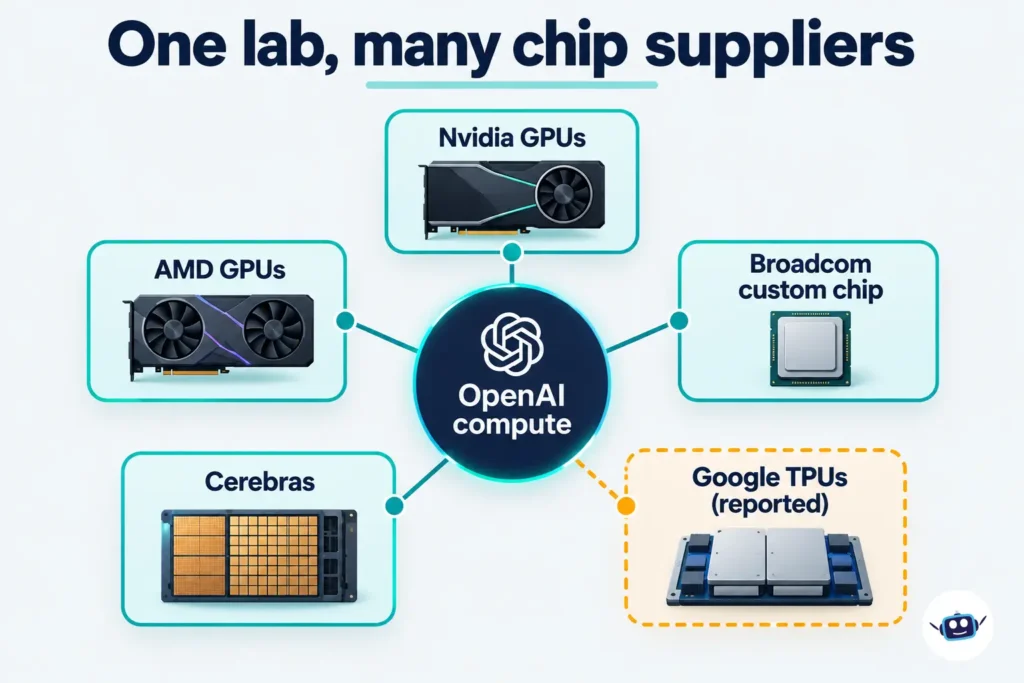
The TPU report fits a pattern. OpenAI has been signing with several chip suppliers at once.
| Supplier | What’s been announced | Notes |
|---|---|---|
| Nvidia | September 2025 letter of intent for at least 10 GW of systems | Letter of intent, not a definitive agreement. Reports say Nvidia invested $30 billion in an OpenAI funding round this year. |
| AMD | 6 GW deal announced October 2025 | Per reporting on the agreement |
| Broadcom | Custom Jalapeño inference chip; 10 GW collaboration | Initial deployment planned by end of 2026 |
| Cerebras | 750 MW of inference capacity | Disclosed in Cerebras’s SEC filings |
| Google TPU | Reported plan to buy; rented since 2025 | Unconfirmed; terms unknown |
Broadcom’s CEO told Bloomberg that early Jalapeño results showed roughly 50% cost savings against typical AI GPUs. That is a supplier’s claim from early testing, so treat it as a target rather than a measured result.
What it could mean for each side
For Google: a marquee outside customer. Alphabet’s CFO has said it expects to recognize a small share of TPU sales revenue by the end of 2026, with most arriving in 2027. Google’s TPU business already counts Anthropic as a customer, through a multiple-gigawatt agreement for next-generation chips expected to start coming online in 2027.
For Nvidia: the near-term revenue effect is unclear and likely small until volumes are known. The longer-term effect is on pricing power, because every credible alternative strengthens the buyer’s hand.
For OpenAI: more flexibility in where each workload runs, and less exposure to one supplier’s supply or pricing. The trade-off is added complexity. It would be running several chip architectures, each with its own software and operational needs. For background on the capital behind this, see Nvidia’s role in financing AI customers and why investors worry about AI data center debt.
For everyday users: probably nothing visible soon. A chip purchase affects cost and capacity behind the scenes, and the effect on products such as OpenAI’s GPT-6 models and other frontier LLMs would show up gradually, if at all.
Common misconceptions
- “OpenAI is switching from Nvidia to Google.” No source says this. Reports describe TPUs alongside Nvidia hardware.
- “The deal is done.” It is a single-source report with no disclosed terms.
- “Peak chip specs decide the winner.” Buyers care about cost per token, latency, power draw and software fit, not headline numbers alone.
- “OpenAI and Google are no longer rivals.” They still compete in AI products and search. Reuters notes they have increasingly struck commercial deals anyway.
- “Stock moves confirm the story.” Alphabet shares rose more than 1% in premarket trading on October 28, according to Investing.com, but a price move is not confirmation of a deal.
Practical Insights
These points come from the verified facts above and reasoning about them, not from any testing.
- Check whether “buy” means hardware or capacity. Google’s April plan was to deliver TPUs for customers to run in their own data centers. If OpenAI takes hardware, it also needs the power, cooling and networking to run it. If it buys capacity through Google Cloud, the arrangement looks more like its 2025 rental. The reports don’t say which.
- Watch the TPU generation. In 2025, Google was reportedly holding back its most powerful TPUs from OpenAI. Whether the same limit applies to a purchase is unknown, and it would shape how useful the chips are.
- Expect a slow timeline. Alphabet’s CFO has said most TPU revenue will land in 2027. That suggests large deliveries to buyers are more likely to ramp next year than this quarter.
- Judge the deal by workloads, not headlines. Inference-heavy use, such as serving ChatGPT and Codex, is where TPU economics are easiest to argue. Large-scale training on TPUs would be a bigger signal.
How to follow the story, step by step:
- Look for confirmation or comment from OpenAI or Google.
- Read Alphabet’s third-quarter results, due after the market close on October 28, for any mention of TPU customers or volumes.
- Look for hard numbers: units, gigawatts, contract value.
- Check which TPU generation and which workloads are involved.
- Note whether Nvidia or OpenAI describe any change to existing Nvidia commitments.
Frequently asked questions
Has OpenAI confirmed it is buying Google TPUs?
No. OpenAI declined to comment to Reuters, and Google had not responded when Reuters published. The claim rests on one anonymous source cited by The Information.
Is OpenAI leaving Nvidia?
There is no evidence of that. OpenAI remains among Nvidia’s largest customers, and reports frame the TPUs as an addition to its Nvidia hardware and its own custom chip.
What is a TPU?
A tensor processing unit is a chip Google designed for AI workloads. Google has used TPUs for years in its own services and rented them through Google Cloud. In 2026 it began selling them directly to select customers.
How is buying different from OpenAI’s 2025 rental?
Renting means using Google’s chips inside Google’s data centers. Buying could mean the chips run elsewhere, in OpenAI’s or a partner’s facilities, though the report doesn’t say. A purchase would imply a longer-term commitment.
Why would Google sell chips to a competitor?
Alphabet said demand for TPUs is growing among AI labs, capital markets firms and high-performance computing users, and that selling hardware expands its market. Reuters notes the two companies compete but increasingly do business together.
How does this relate to OpenAI’s own Jalapeño chip?
Jalapeño is an inference chip designed with Broadcom, due for initial deployment by the end of 2026. OpenAI appears to be pursuing its own silicon and outside options at once.
How did markets react?
Alphabet shares rose more than 1% in premarket trading on October 28, according to Investing.com. That reflects investor sentiment, not confirmation of any deal.
When could any purchase take effect?
Unknown. Alphabet has said most TPU sales revenue will be recognized in 2027, which points to a gradual ramp.
Conclusion
The report that OpenAI plans to buy Google TPUs is significant mainly for what it signals. The largest AI labs want several chip suppliers, and Google has turned an internal tool into a product it sells. The deal itself remains unconfirmed, and its size, hardware type and timing are unknown.
Actionable takeaways:
- Treat the story as a credible lead, not a finished deal.
- Look for confirmation, volumes and the TPU generation involved.
- Read Alphabet’s results for any TPU customer detail.
- Judge the shift by workloads and cost per token, not by headlines about Nvidia.
Disclaimer
This article is general information about reported developments in AI computing. It is not financial or investment advice, and it does not recommend buying or selling any company’s shares. The central report is unconfirmed, and details such as terms, products and prices can change, so check official company announcements before making decisions. Information is current as of October 2026.