
Alphabet’s Google Cloud revenue doubled last quarter, up 103% to $30.7 billion. The stock still fell almost 13% the next day, according to UBS’s Chief Investment Office.
That gap explains the current selloff. Investors no longer reward AI spending announcements. They want to see what the spending returns, how it is paid for, and what it does to the businesses that already make money. This guide covers the verified numbers, the four companies at the center, and the signals that would tell you whether the pressure is easing or getting worse. All figures are as of November 3, 2026.
Why are AI and tech stocks falling right now?
The short answer: spending is growing faster than cash flow, and the market has stopped giving that a pass. UBS says earnings expectations were broadly met last week, but investors are now weighing overinvestment, financing and cannibalization more heavily.
Here is what happened in the market:
- The Nasdaq Composite fell 2.9% on Friday, October 30, and 2.0% for the week, according to UBS. The S&P 500 fell 1.8% on Friday.
- Reports around the month-end described it as the Nasdaq’s worst month since March 2025.
- On Monday, November 2, the Nasdaq fell another 1.07%, according to Invezz.
- Intel dropped 28.6% on Friday, per UBS. AI is lifting server orders, but component scarcity left Intel unable to meet all data center demand and pushed up PC prices.
Not all of this is AI. UBS also pointed to Brent crude at $118 a barrel on Friday amid worries about renewed US strikes on Iran. The 10-year Treasury yield was 4.93%. Higher oil and yields hurt expensive stocks regardless of what happens in data centers.
What did each of the four hyperscalers actually report?
Three of the four reported negative free cash flow, and the fourth stayed positive. The table shows each company’s latest figures.
| Company | 2026 capex guidance | Cash-flow signal | Cloud growth, latest quarter |
|---|---|---|---|
| Alphabet | $195–205 billion (unchanged) | Q3 free cash flow of –$9.1 billion; second straight negative quarter | Google Cloud +103% to $30.7 billion |
| Meta | $135–145 billion (floor raised from $130 billion) | Q3 free cash flow of –$2.12 billion | No cloud business; revenue +26% to $64.6 billion |
| Amazon | About $220 billion | Trailing 12-month free cash flow of –$42.4 billion, versus +$14.8 billion a year earlier | AWS +39% to $46.0 billion |
| Microsoft | About $170 billion, reported as lowered from $175 billion | Stayed positive; CFO Amy Hood expects to remain free cash flow positive this fiscal year | Azure +48% |
Sources: company earnings releases and calls, and CNBC and UBS reporting, October 21–30, 2026. Reports describe the period for Microsoft’s $170 billion figure in different ways, so treat it as an approximate full-year number.
The arithmetic is simple. Alphabet spent $51.4 billion on capex against $42.3 billion of operating cash flow, a gap of about $9.1 billion. Meta spent $34.91 billion (including finance lease principal) against $32.79 billion, a gap of $2.12 billion. Amazon’s trailing 12-month property and equipment purchases of about $210.7 billion exceeded its $168.3 billion of operating cash flow by $42.4 billion. We ran these calculations ourselves on November 3, and they match the reported free cash flow figures.
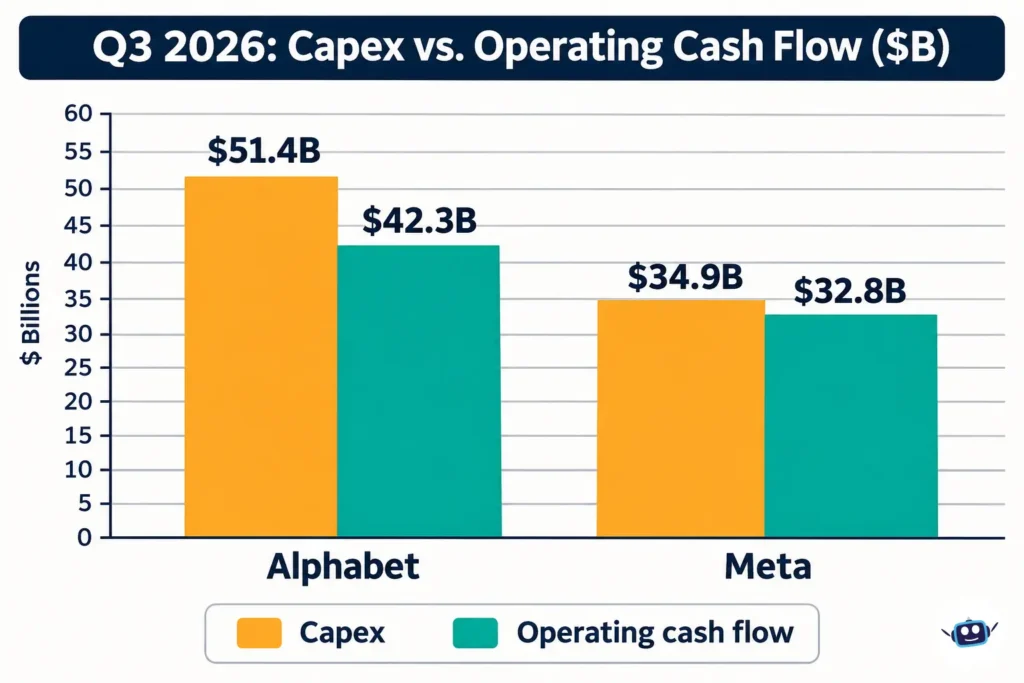
What most people miss: negative free cash flow does not mean these companies lose money. Alphabet reported $26.2 billion of net income available to common stockholders. Amazon’s operating income rose 61% to $28.1 billion. Meta’s Q3 operating income fell 37%, but that included a $9.89 billion legal charge unrelated to AI. The pressure comes from cash being spent ahead of the revenue it is meant to produce.
Is this a “nobody wants AI” problem?
No. By every figure the companies reported, demand is the strongest part of the story. UBS says accelerating cloud revenues and growing advance orders point to sustained demand for AI infrastructure.
- Alphabet said Gemini reached 1 billion users, and Google Cloud’s growth accelerated from 82% in the prior quarter.
- Microsoft’s Azure grew 48%, compared with 43% in the prior quarter. Hood said some third-party capacity deliveries slipped, and CNBC reported that chip providers’ delays will push some capacity into the first half of 2027.
- Amazon’s AWS grew at its fastest pace in nearly five years.
The real worry is the order of events. Spending arrives first, revenue arrives later, and the gap needs funding. There is also a cannibalization risk. Alphabet’s Search query growth hit a five-year high, but Search revenue growth slowed to 12%. UBS notes management indicated that AI Mode currently monetizes at a lower rate than traditional search. Alphabet is growing a new business while its old one earns less per query.
If you want the product side of this, our explainer on Google’s Gemini agent push for enterprise work covers what Google is selling to those enterprise buyers.
How are tech companies paying for all this?
Increasingly with new shares, not only cash and debt. This is the part of the story the headline capex totals hide.
- Alphabet raised $84.8 billion in equity in June, including $10 billion from Berkshire Hathaway, according to Fortune.
- Meta announced a new class of nonvoting Class C stock alongside its Q3 results, which it said would help it finance growth while preserving its founder-led structure. On October 26 it announced plans to raise up to $95 billion in stock: about $35 billion in underwritten offerings first, then about $60 billion through an at-the-market program, per CNBC. Nvidia, AMD and Broadcom signaled interest in buying up to $5 billion of shares collectively.
- Credit markets noticed. Meta’s five-year credit default swap spread hit an all-time high on October 22, CNBC reported.
- Blackstone President Jon Gray said on November 3 that more global equity fundraising is coming. He named “Meta and Google and Oracle raising equity,” plus SpaceX and Anthropic going public, according to Reuters. CNBC reported he also said debt investors face concentration risks as lenders pile into the same borrowers.
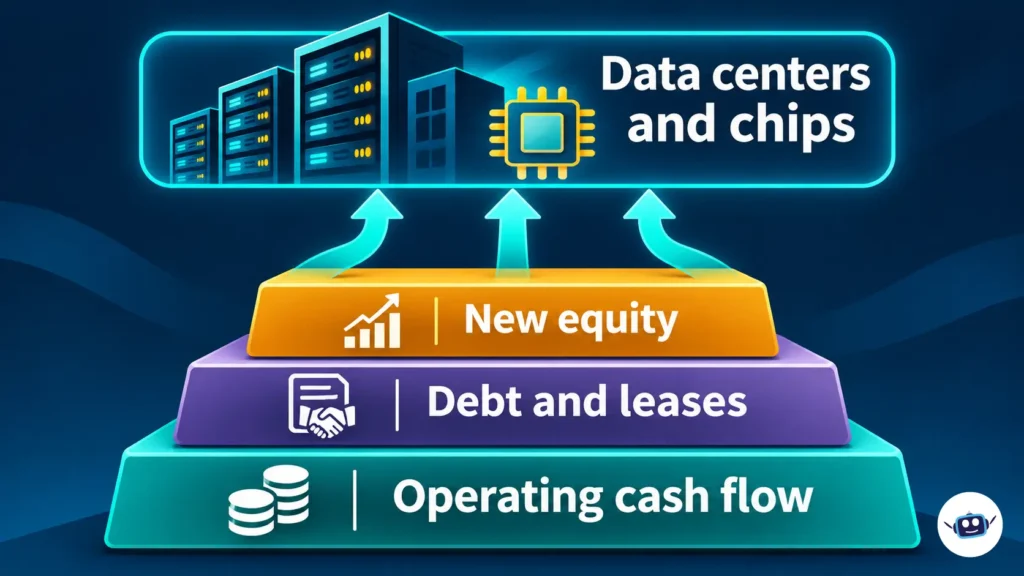
Smaller, more indebted players are under more strain. UBS says neocloud credit has sold off over a funding mismatch: large, debt-financed upfront investment against cash flows that arrive later. But UBS puts neoclouds at only about 8% of its capex estimate, versus about 80% for Alphabet, Amazon, Microsoft, Meta and SpaceX. Its conclusion is that select project delays, repricing and consolidation are more likely than a broad collapse in spending. That is a forecast, not a fact.
If you rent compute rather than build it, the squeeze reaches you indirectly. Our GPU rental pricing guide shows what providers charge today.
What changed in the last two weeks?
| Date (2026) | Event |
|---|---|
| October 21–22 | Meta reports Q3: free cash flow turns negative, capex floor rises to $135 billion, nonvoting stock announced. Shares fall nearly 7% the next day. |
| October 26 | Meta announces plan to raise up to $95 billion in equity. |
| October 28 | Alphabet reports Q3: Cloud +103%, negative free cash flow, 2027 capex to rise significantly. Microsoft reports: Azure +48%, capex below its own outlook. |
| October 29 | Amazon reports: AWS +39%, trailing free cash flow –$42.4 billion, 2027 spending “meaningfully more” than 2026, per CNBC-sourced reporting. Alphabet shares fall almost 13%. |
| October 30 | Nasdaq falls 2.9%; Intel drops 28.6%. |
| November 2 | Nasdaq falls 1.07% as AI spending concerns persist. |
| November 3 | Blackstone’s Gray says most major tech companies are expected to raise more capital. |
Why do the capex totals in headlines disagree?
Because they count different companies, different periods and different definitions. You will see figures from roughly $650 billion to over $800 billion for the same boom.
| Figure | What it covers |
|---|---|
| About $650 billion | Hyperscaler capex over the past year, per BlackRock citing Bloomberg data (trailing, not a 2026 forecast) |
| More than $740 billion | Alphabet, Amazon, Meta and Microsoft 2026 outlooks combined, per TechCrunch’s October 30 tally |
| Up to $828 billion | The same four plus SpaceX (including xAI), per Fortune |
| $1.0 trillion | UBS’s 2026 forecast for all AI capex, including neoclouds and others; it forecasts $1.4 trillion for 2027 and $1.5 trillion for 2028 |
Definitions matter too. Microsoft’s $45.2 billion quarterly capex includes finance leases. Cash paid for property and equipment was $39.4 billion, a $5.8 billion difference. Meta also counts finance lease principal. Amazon guides to cash capex. When you compare companies, check which number you are comparing.
Who is holding up, and where is money going?
According to Morningstar, Apple has benefited from an “anything but AI” trade because it has not spent heavily on AI buildout. BlackRock’s analysis found S&P 500 Q3 earnings growth excluding the largest companies at 29%, versus 18% for the “Magnificent Seven.” It also said incremental margins on hyperscaler spending have fallen to about 28% from 40%. UBS said quality bonds rallied last week as stocks fell.
This is rotation, not retreat. UBS’s base case still has AI investment as a positive driver of equity returns in 2027, but it says selectivity matters more as the market shifts from rewarding spending to judging returns.
What would signal a real turning point?
UBS names specific triggers that would worry it:
- AI lab revenue growth slowing meaningfully.
- Cloud utilization weakening.
- Falling AI costs failing to stimulate enough new usage to absorb the added capacity.
- Algorithmic efficiency gains sharply reducing compute needs.
- A significant deterioration in financial conditions limiting hyperscalers’ willingness to fund new investment.
Earlier this autumn, calls from frontier AI leaders to slow down also hit tech shares, according to CBS News. The risk the market is pricing is partly about pace, not only payback.
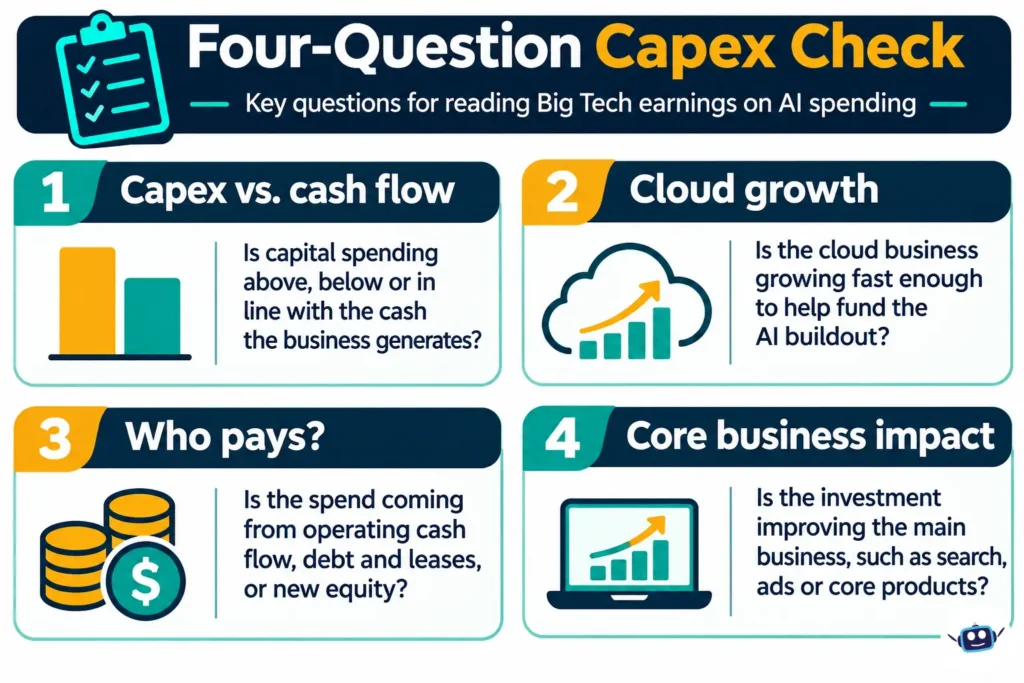
A four-question check for any earnings report
This is an original checklist built from the verified facts above. Use it on the next report.
| Question | What to look for | Example from this season |
|---|---|---|
| Is capex outrunning operating cash flow? | Free cash flow and the funding gap | Alphabet’s $51.4B capex vs. $42.3B cash flow |
| Is cloud growth keeping pace? | Cloud growth acceleration and backlog | Google Cloud +103%, Azure +48% |
| Who is paying? | Debt, equity, partners | Meta’s up-to-$95B equity plan |
| Is the core business being cannibalized? | Revenue per query or unit | Alphabet’s lower-monetizing AI Mode |
Myth vs. fact
| Myth | Fact |
|---|---|
| Negative free cash flow means these companies are losing money. | Alphabet earned $26.2 billion in net income last quarter. Free cash flow measures cash after spending, not profit. |
| The selloff means AI demand is collapsing. | Cloud growth accelerated at Google, Microsoft and Amazon. The doubt is about payback and funding. |
| All “tech” stocks fell for the same reason. | Intel’s drop was tied to component scarcity; Alphabet’s to cash flow and Search; oil and yields hit the whole market. |
| Everyone’s capex total is the same number. | Totals range from about $650 billion to over $800 billion depending on scope and definition. |
FAQs
Is the AI bubble bursting?
Nothing verified in this season’s earnings shows spending collapsing. All four hyperscalers guided to heavy 2026 spending, and Alphabet, Amazon and Meta signaled more in 2027. UBS expects delays and consolidation, not a broad collapse, but that is a forecast, and volatility is likely to stay high.
How much are Big Tech companies spending on AI in 2026?
Alphabet guides to $195–205 billion, Amazon to about $220 billion, Meta to $135–145 billion, and Microsoft to roughly $170 billion. Combined, that is above $740 billion by TechCrunch’s tally.
Why did Alphabet fall when Google Cloud revenue doubled?
Cash flow turned negative for a second straight quarter, 2027 capex is set to rise significantly, and Search revenue growth slowed. Investors weighed the cost of growth against its return.
Will more tech companies sell new shares?
Blackstone’s Gray says yes. He expects Meta, Google and Oracle to raise equity. New shares can dilute existing holders’ ownership, which is one reason equity raises can pressure a stock.
What is the difference between capex and capex including finance leases?
Finance leases let a company use data center or equipment capacity without paying cash upfront. Microsoft and Meta include them in headline capex. Cash paid for property and equipment is smaller, so check which one a figure uses.
Which stocks are less exposed to AI spending worries?
Morningstar says Apple has benefited because it has spent less on AI buildout. Lower exposure is not lower risk, and this is not a recommendation.
The bottom line
The selloff is about the price of AI growth, not a lack of demand. Alphabet, Meta and Amazon are spending more than their cash flow supports, the gap is increasingly funded with equity, and investors now want returns to show up faster.
Your next step: pick one company you follow and run the four-question check on its latest report before the next earnings date.
Related: How Claude Haiku 5.5 pricing works
Disclaimer
This article is for informational purposes only and is not financial or investment advice. It is not affiliated with, sponsored by or endorsed by any company mentioned. Stock prices, forecasts and company guidance change quickly, and past market moves do not predict future results. Information last verified on November 3, 2026. Consult a licensed financial advisor before making investment decisions.