

As of November 2026, Google says Gemini 4 Carbon is available to paying developers through the Gemini API in Google AI Studio, to enterprises through Gemini for business, and to Google AI Ultra subscribers in the Gemini app, AI Mode and Antigravity. API pricing is $2 input and $10 output per million tokens through November 30.
By the aillmnews editorial team. How this was made: AI assisted with research and drafting. Every fact was checked against Google, Google Cloud and Anthropic pages read on November 11, 2026. No hands-on testing was done.
If you plan to run a long agent job on Gemini 4 Carbon, timing matters. The per-token price doubles on December 1, 2026, and Carbon is designed to spend more tokens per task than its sibling model.
This guide covers who can use Carbon today, what it really costs, how it differs from Gemini 4 Argon, and where the headlines overreach.
Who can use Gemini 4 Carbon today?
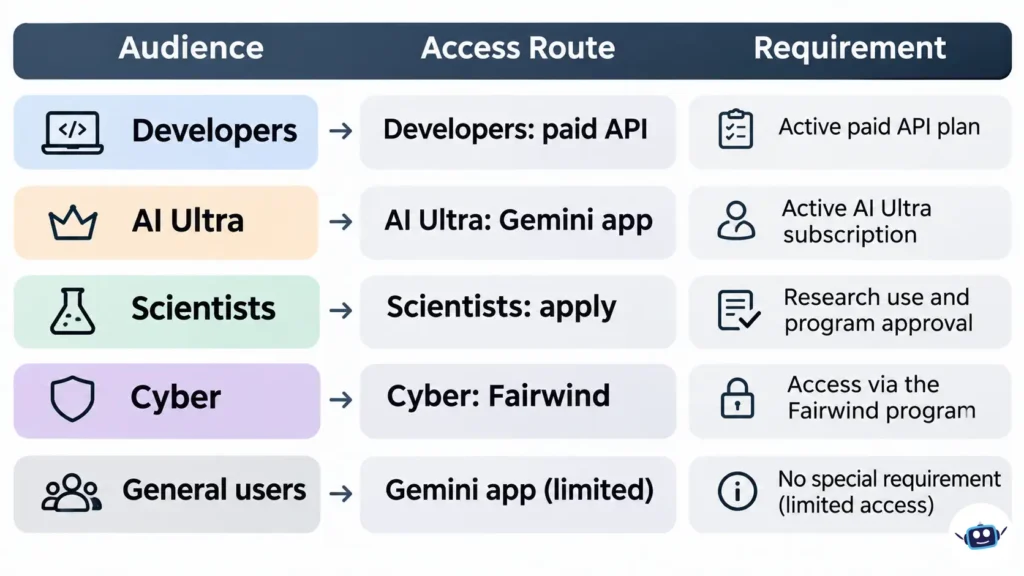
Five groups have an access route. Only one of them needs no payment, and it requires an application.
| Audience | Where | Requirement | Status (Nov 11, 2026) |
|---|---|---|---|
| Developers | Gemini API in Google AI Studio; Android Studio | Paid tier of the Gemini API | Available |
| Enterprises | Gemini for business (API or model drop-down); Antigravity; CodeMender | Paying enterprise customer | Available |
| Everyday users | Gemini app; AI Mode in Search | Google AI Ultra subscription | Rolling out |
| Scientists and researchers | Google Antigravity, highest usage tier | Application; six months free | Rolling weekly onboarding |
| Cybersecurity defenders | Fairwind Program | Application and approval | Rolling access |
Three details the short summaries skip:
- “Consumers” means Ultra only. According to Google, Carbon is not in the free or AI Pro tiers of the Gemini app. Argon stays available for AI Pro and above.
- The science program is not unlimited. Google says access is subject to eligibility, capacity and selection. The program began four weeks before Carbon’s launch with Argon, aimed at 10,000 scientists. Google says thousands are already onboarded.
- The cyber version is a separate model. Google Cloud’s documentation lists
gemini-4-carbon-cyber-permissivefor projects approved through the Fairwind Program. It is generally available there behind an allowlist.
Google Cloud’s documentation lists Carbon as generally available on its enterprise agent platform, with a release date of November 10, 2026. It adds that Carbon is a “Google Frontier Model” subject to abuse monitoring under the service terms. Enterprises should review that term with their legal team.
How much does Gemini 4 Carbon cost?
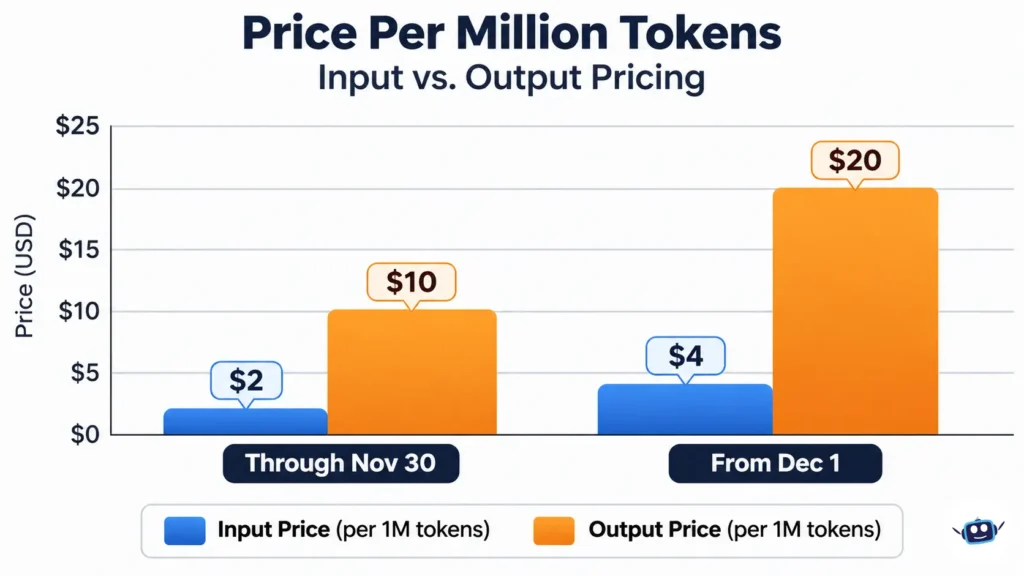
Through November 30, 2026, the Gemini API charges $2 per million input tokens and $10 per million output tokens. From December 1 it charges $4 and $20. Output tokens include thinking tokens. Carbon is not available on the free tier.
| Per 1M tokens | Through Nov 30, 2026 | From Dec 1, 2026 |
|---|---|---|
| Input | $2.00 | $4.00 |
| Cached input (implicit caching) | $0.10 | $0.20 |
| Output, including thinking | $10.00 | $20.00 |
According to Google’s developer documentation, implicit caching is on by default for prompts of at least 4,096 tokens and discounts cached input by 95% on cache hits. Explicit caching (cachedContents) is not supported on Carbon.
Here is a cost example. The numbers are illustrative; I ran the math in code on November 11, 2026.
| Illustrative job | Intro price | Post-Dec 1 price |
|---|---|---|
| 200,000 input + 60,000 output tokens, no caching | $1.00 | $2.00 |
| Same job, 150,000 input tokens served from cache | $0.715 | $1.43 |
| 10,000 such uncached jobs | $10,000 | $20,000 |
What most people miss: per-token price is not per-task price. Google’s own documentation says Carbon spends more thinking tokens per turn than Argon, which raises token use and latency. At the same per-token rate, a hard task can still cost more on Carbon. Test your own prompts at each thinking level before you budget. For the arithmetic of per-call costs on another model family, see our Claude Haiku 5.5 pricing explainer.
Gemini for business pricing for Carbon was not published in the sources I read, so I cannot state it.
Should you use Carbon or Argon?
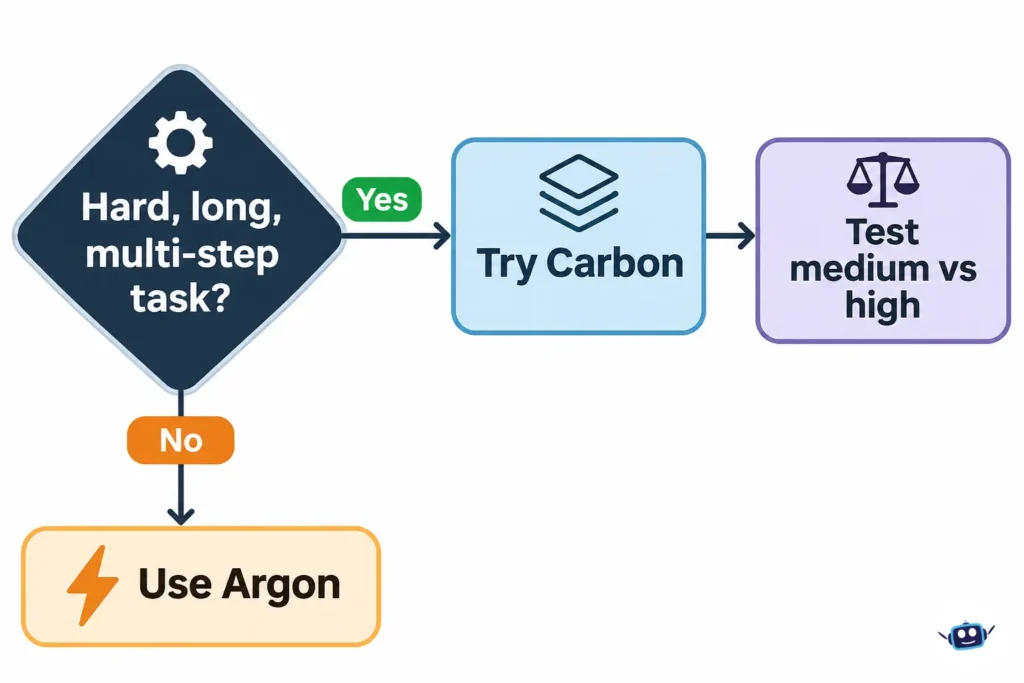
Use Argon by default and Carbon for the hardest jobs. Google’s launch post calls Argon “the ideal choice for the majority of software engineering and knowledge work.” Carbon is built for tasks that test the limits of a model’s intelligence, such as complex multi-step debugging and open-ended scientific research.
| Gemini 4 Argon | Gemini 4 Carbon | |
|---|---|---|
| Model ID | gemini-4-argon | gemini-4-carbon |
| Per-token price | Same as Carbon | Same as Argon |
| Thinking tokens per turn | Fewer | More (Google’s description) |
| Best for | Interactive coding, day-to-day features, fast production loops | Root-cause debugging, architecture, dense multimodal synthesis, proofs, security audits |
| Context window | 1,048,576 tokens, shared by input, thinking and output | Same |
| Gemini app | AI Pro and Ultra | AI Ultra |
Google’s documentation says that if you already run Argon, switching is a model-string change with no request schema changes.
How do you start with Gemini 4 Carbon?
The API route takes five steps, based on Google’s documentation.
- Use a Gemini API key on the paid tier. Carbon is not available on the free tier.
- Set the model to
gemini-4-carbon. The documentation’s quickstart uses the Interactions API. - Keep
thinking_levelatmedium, the default, and testlowandhighbefore choosing. Google advises picking the lowest level that meets your quality bar. - Raise
max_output_tokens. Standard synchronous responses stop at 65,536 tokens. For longer output, setbackground=Trueand a higher limit, up to 1,048,576 minus your input tokens. - Extend client timeouts. Google says hard prompts can take several minutes and recommends timeouts of at least 15 minutes, or background execution.
If you are moving from Gemini 3 or earlier, also remove temperature, top_p and top_k, which Google says are ignored. Replace explicit caching with prompts that put static content first. Good prompt structure matters more here, and our guide to context engineering covers it.
Everyday users on AI Ultra pick Carbon from the model menu in the Gemini app or AI Mode. Google AI Ultra starts at $100 a month in the US, according to Android Authority, with a higher tier at $200.
What changed in the last four weeks?
| Date | Event |
|---|---|
| Oct 13, 2026 | Gemini 4 Argon opens to developers and AI Pro and Ultra subscribers (per Google developer documentation and third-party reports) |
| Oct 28, 2026 | Google announces Carbon and limits it to a subset of cyber defenders via Fairwind |
| Nov 9, 2026 | Anthropic releases Claude Fable 5.2 at $8 input and $40 output per million tokens |
| Nov 10, 2026 | Carbon opens to paying developers, enterprises and AI Ultra; the science program expands to Carbon |
| Nov 30, 2026 | Carbon introductory pricing ends |
| Dec 1, 2026 | Carbon pricing rises to $4 input and $20 output |
Some pre-November-10 pages still say Carbon is cyber-defender-only or has no API model ID. Those pages are outdated.
Is Carbon better than rival models?
On some tests, yes. On others, no, and most head-to-head figures come from the vendors themselves.
Google reports that Carbon ranks first on CursorBench 4.0, Perplexity’s WANDR and Zapier’s AutomationBench. It says Carbon does so at more than 2X lower cost per task than the next best external model. These are vendor-reported results.
Anthropic’s Fable 5.2 announcement, also vendor-reported, shows a mixed picture:
| Benchmark (Anthropic’s table) | Fable 5.2 | Gemini 4 Carbon |
|---|---|---|
| AutomationBench | 51.4% | 53.9% |
| FrontierCode 2.0 | 49.1% (Xhigh effort) | 41.1% (Medium effort) |
| FrontierSWE v2 | 69.9% | 61.2% |
The table has caveats. Each lab chooses effort levels, and Anthropic ran its own comparisons. Third-party outlets citing Artificial Analysis report Fable 5.2 ahead of Carbon on its Intelligence Index, with Carbon cheaper per task. I did not read Artificial Analysis directly, so treat that as unconfirmed by me.
Google’s launch post also gives a Multimodal Knowledge Agent result of #2 at more than 6X lower average cost per task than the top model. Early coverage of the same benchmark quoted different figures, so check Google’s current page.
On price alone, Carbon’s intro list price is 75% below Fable 5.2’s ($2/$10 versus $8/$40). That falls to 50% on December 1. List price is not cost per task, because models use different numbers of tokens.
What are the limits and risks?
- Vendor benchmarks. Google’s cyber scores (88.2% on SEC-bench Pro, 54.8% on ExploitGym, 71.0% on CWE-bench) come from its October 28 post and were run without guardrails.
- Hallucinations. Google’s model card says Carbon may hallucinate and may occasionally be slow or time out.
- Knowledge cutoff. The model card gives March 2026.
- Prompt injection. Google reports a 0% attack success rate on one benchmark, but also says robustness “remains an area for continued improvement.”
- Preview feature.
/swarmin Antigravity is a preview, not a finished product. - Token appetite. Longer thinking raises latency and spend per turn.
Why can’t I see Carbon? A quick troubleshooting table
| Symptom | Likely cause | Fix |
|---|---|---|
| Not in the Gemini app model list | Plan below AI Ultra, or rollout not yet reached your account | Check your plan; Google says it is rolling out |
| API returns model not found | Free tier or wrong model string | Use a paid-tier key and gemini-4-carbon |
| Requests time out | Longer thinking on hard prompts | Raise timeouts to 15+ minutes or use background execution |
| Answers cut off | max_output_tokens too low for thinking plus output | Raise it to at least 32,768 |
| No cyber model access | Fairwind approval needed | Apply to the Fairwind Program |
| Cost higher than expected | More thinking tokens per task | Lower thinking_level or switch to Argon |
Who should use Carbon, and who should skip it?
Use it if you run long agentic coding or debugging jobs, dense multimodal document analysis, or scientific research. Google positions the model for these.
Skip it for now if you do interactive day-to-day coding where speed matters, you are on the free tier or AI Pro, or you cannot absorb the December 1 price doubling. Argon is the default Google recommends. For enterprise teams, our overview of Google Cloud’s Gemini agent for enterprise work gives context on where these models fit.
Myth vs fact
| Myth | Fact |
|---|---|
| Carbon is open to everyone | It requires a paid API tier, an AI Ultra plan, or an approved application |
| Carbon replaces Argon | Google says Argon remains the default for most work |
| Carbon is 75% cheaper than Fable 5.2 | Only on list price during the intro period; 50% from December 1 |
| The 95% cache discount applies automatically to anything | It applies to implicit caching on prompts of 4,096+ tokens |
| Free science access is guaranteed | It is subject to eligibility, capacity and selection |
FAQs
Is Gemini 4 Carbon free?
No for the API and the Gemini app. Google says it is not on the free tier. Scientists can apply for six months of free access through Antigravity.
Is Gemini 4 Carbon available in the Gemini app?
Yes, for Google AI Ultra subscribers, and it is rolling out. Argon remains available to AI Pro and above.
What is the Gemini 4 Carbon API model name?
It is gemini-4-carbon. The cyber version for approved Fairwind projects is gemini-4-carbon-cyber-permissive.
How big is the context window?
Google documents 1,048,576 tokens, shared across input, thinking and output. Default synchronous output is 65,536 tokens.
What does /swarm do?
Google describes it as turning a single prompt into a coordinated team of agents you can track in real time. It is a preview in Google Antigravity.
Can scientists get Carbon for free?
Eligible applicants can get six months free at Antigravity’s highest usage tier. Google says onboarding is weekly and subject to capacity and selection.
When does the price go up?
On December 1, 2026, from $2/$10 to $4/$20 per million input/output tokens.
Conclusion
Carbon is real, widely available to paying users, and priced at launch like Argon, but its best use is narrow. Use it for the hardest, longest tasks, and keep Argon for everyday work. Budget for the December 1 increase and for higher token use per task.
Next step: run one of your hardest real tasks on Carbon at medium and high thinking before November 30, record the token use, and price it at the December rates.
Related: AI coding agents vs chatbots
Disclaimer: This article is for informational purposes only. It is not affiliated with, sponsored by or endorsed by Google, Anthropic or any brand mentioned. Prices, features and policies may change, and AI output can be inaccurate. Information last verified on November 11, 2026.
“How this was made” note
Publish it, in the byline area, in the short form shown in the article. It is accurate: AI assisted with research and drafting, and facts were checked against official pages read on November 11, 2026. It makes no claim of hands-on testing, which would be false.