
By the AI LLM News editorial team. Last updated November 14, 2026. How this article was made: AI assisted with research and drafting. The facts were checked against Reuters reporting, Amazon and Google published materials, court records and earnings-call coverage. No hands-on product testing was involved.
World Product Graph is an internal Amazon plan, reported by Reuters on November 13, 2026, to collect data on virtually every product sold worldwide, including items Amazon doesn’t stock. The draft carries an aspirational October 1, 2027 date. Amazon says the brainstorming document doesn’t necessarily reflect its current plans, and Reuters could not determine whether it will launch.
Imagine asking a shopping assistant which vacuum fits your home, only to learn its answer missed a newer model sold elsewhere. A broader product database could close that gap, but only if the data is accurate and fresh.
This article covers what Reuters reported, what Amazon disputes and what nobody has confirmed. It also explains how the plan connects to Amazon’s fights with Meta’s Muse and Perplexity, and what shoppers and brands should check.
What is Amazon’s World Product Graph?
It is a reported internal initiative to gather data on virtually every item for sale on Earth, whether or not Amazon sells it. According to Reuters, the source is an internal document and people familiar with the matter.
The document is a “PR/FAQ,” a press-release-style memo Amazon uses to pitch new products. Reuters says these are typically six pages long. Reuters also says not all of them become products, and its sources said this one could be modified or aborted over financial or other concerns.
The effort sits in Amazon’s Selection & Catalog Systems unit, according to Reuters. It is organized under Robert Tekiela, a vice president in that division.
As of November 14, 2026, we found no Amazon announcement, product page or documentation for World Product Graph. Everything below about the plan comes from Reuters’ reporting and Amazon’s response to it.
| Claim | Status as of November 2026 | Basis |
|---|---|---|
| Amazon is planning a “World Product Graph” | Reported, not confirmed by Amazon | Reuters, citing an internal document and sources |
| Aspirational launch date of October 1, 2027 | Reported; Reuters could not say whether it is realistic | Reuters |
| Coca-Cola and Bayer signed up to contribute data | Stated in the document; the companies did not respond to Reuters | Reuters |
| Amazon would crawl other retailers’ websites | Reported; Reuters could not determine how, or whether permission would be sought | Reuters |
| Alexa for Shopping is roughly 97% accurate | Amazon’s own claim; method not published | Amazon statement to Reuters |
| The project will launch | Unknown | Reuters says it could change or be dropped |
That does not mean Amazon owns the world’s product data. The reported project describes an ambition to collect and organize information, nothing more.
Has Amazon confirmed the plan?
No. Amazon told Reuters that draft, outdated documents often paint an incomplete picture and that a brainstorming document like this one doesn’t necessarily reflect current plans. Amazon added that it is constantly working on ideas to make its catalog comprehensive, accurate and helpful.
That is neither a denial nor a confirmation. Amazon did not say the project doesn’t exist, and it did not say it does.
How would World Product Graph collect product data?
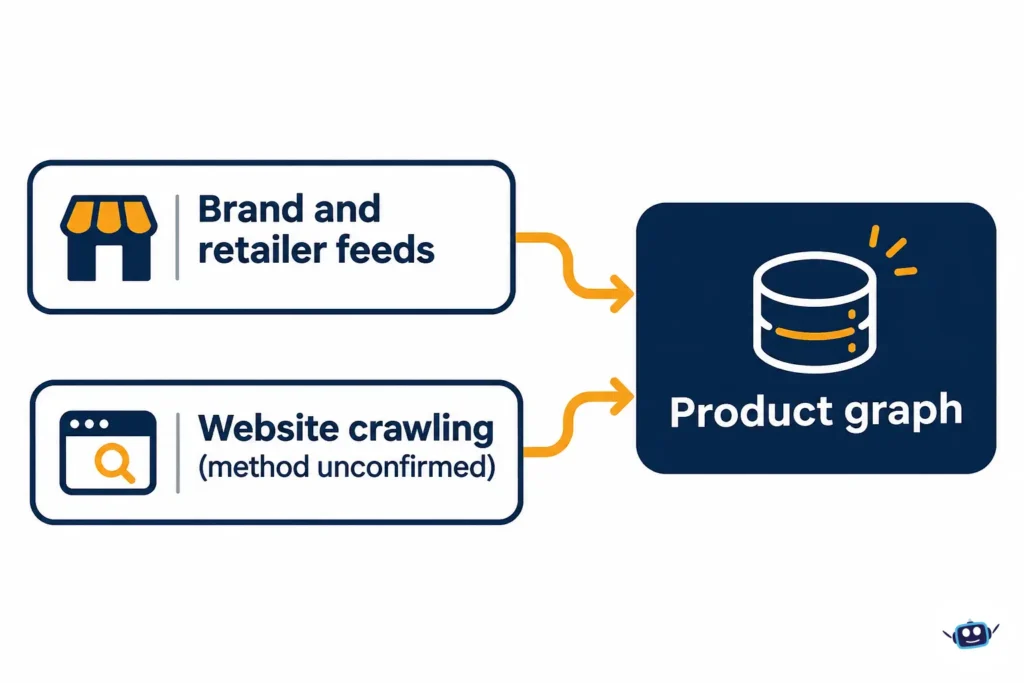
Through two streams, according to Reuters. Some brands and retailers would send product data to Amazon continuously, and Amazon would also crawl other retailers’ websites on its own.
The document says the plan depends on discovering how brands organize products on their own sites. Reuters could not determine how Amazon would crawl those sites or whether it would need permission in every case. That question is open.
Amazon has related experience. According to Business Insider, a late-2024 planning document for a project called Starfish expected to collect product information from 200,000 external brand websites in 2025. Reuters does not say World Product Graph is related to Starfish, and we found no source that connects them.
Why does Amazon want this data?
The reported answer is that shoppers often start product research elsewhere. Reuters cites a 2025 Morgan Stanley research report, which we did not review directly.
| Moment in the shopping journey | Amazon | Walmart | |
|---|---|---|---|
| Where product research begins | 57% | 16% | Not reported |
| Where search begins when the buyer knows the exact product | 23% | 41% | 18% |
Source: 2025 Morgan Stanley research report, as reported by Reuters.
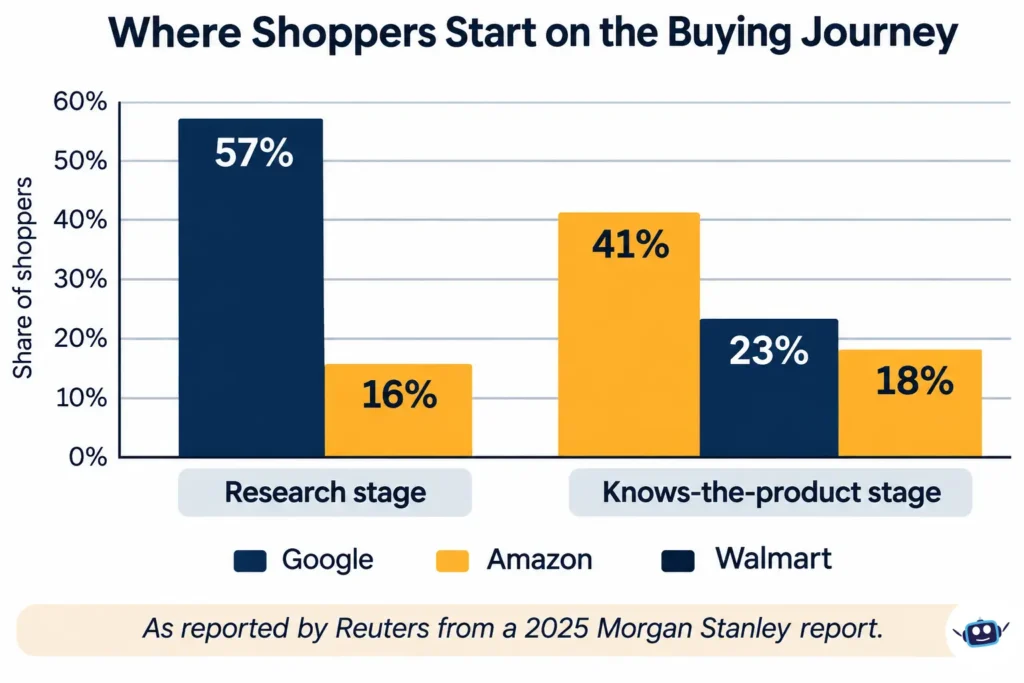
The 41-point gap between Google and Amazon at the research stage is the opening. The document argues Amazon can’t be the destination for every shopping mission if customers leave to research on Google, brand sites and review sites.
Reuters also reports the document wants to help shoppers see how products relate to each other. Examples include which model or colorway is the newest, and which option suits a particular shopper.
Cost is a second motive. According to Reuters, the document says Rufus handled about 83 million searches a week and that running them is expensive. Annualized, that is roughly 4.3 billion searches a year. More complete data would let Amazon use cheaper models more efficiently, the document says. For a primer on how per-call pricing adds up, see our explainer on Claude Haiku 5.5 pricing.
What can a product graph tell an AI assistant?
A product graph is an organized collection of product information and the relationships between items. Those relationships can include model versions, variants and accessories.
The difference between a product and an offer matters. A product record describes a model and its specifications. An offer describes one seller’s price, shipping, returns and availability. One product can have many offers.

A broad catalog helps an assistant find candidates. It does not tell you the final checkout price or the terms of the seller you would actually buy from. Amazon has not said how the reported project would resolve duplicates, separate versions or refresh changing data.
Does Amazon already show products from other stores?
Yes, through existing programs that are separate from World Product Graph. Shop Direct, Buy for Me and Alexa for Shopping are documented by Amazon. World Product Graph is not.
| Experience | What Amazon says happens |
|---|---|
| Shop Direct | You select a product and visit the merchant’s store to complete the purchase. |
| Buy for Me | For eligible products, you tap a button and Amazon makes the purchase from the merchant’s website on your behalf. |
| Alexa for Shopping | Amazon’s AI shopping assistant answers shopping questions in the Amazon Shopping app and on Amazon.com. |
For Buy for Me orders, Amazon says delivery, returns, exchanges and customer service are managed by the brand store. Check who the merchant is before you confirm.
Amazon says that as of March 2026, Shop Direct covered over 100 million products from more than 400,000 merchants. An Amazon spokesperson told EMARKETER that Shop Direct now includes about 250 million outside listings, roughly 2.5 times the March figure. The Information first reported that number on October 28, 2026. According to Reuters, employees describe World Product Graph as the beginnings of an expansion of these services.
Amazon also says merchants can sync catalogs with Shop Direct through feeds from providers including Feedonomics, Salsify, CEDCommerce and Versafeed. That documents a way to supply data to an existing program. It does not confirm participation in the reported graph.
Is Alexa for Shopping the same as Rufus?
Yes, in effect. According to Amazon’s Rufus page, Rufus was renamed Alexa for Shopping on May 13, 2026. Amazon’s help page says it is bringing Rufus and Alexa together as one assistant.
Reuters quotes the internal document as saying many Rufus answers are “factually wrong or incomplete,” and that customers lack the expertise to spot the errors. Amazon told Reuters the usage figures in the document are significantly outdated. It also said its own data shows Alexa for Shopping is roughly 97% accurate globally.
That 97% figure is Amazon’s claim. We found no published test, sample or definition of accuracy. Amazon’s own help page says the assistant may not always get things right.
Is Alexa for Shopping really 97% accurate?
Nobody outside Amazon can say. The claim comes from the vendor, and its method is unpublished. For a detail that decides a purchase, such as whether a part fits your model, check the manufacturer’s specifications and the actual listing.
How does Amazon’s plan compare with Google’s Shopping Graph?
Google’s Shopping Graph is an existing, documented product catalog. World Product Graph is a reported proposal.
Google first cited more than 60 billion product listings in May 2026 and repeated the figure in its October 15, 2026 Universal Cart announcement. That is Google’s count of listings, not a verified count of unique products. We found no confirmed catalog size for the Amazon project, so the two can’t be compared directly.
How does this fight AI shopping agents?
A shopping agent is software that completes shopping tasks for a user. It can search, compare and sometimes buy. If you want the broader context, see our guide to AI agents versus chatbots.
Reuters’ sources say that if Amazon holds the most complete product data, agents working for shoppers would be compelled to seek products on Amazon.com instead of rival sites. That is the sources’ view of a possible outcome, not a demonstrated one.
Reuters also says Amazon executives have grown wary of agents that might send traffic to sites with more complete data. Two disputes show the stakes.
Meta’s Muse. Meta launched Muse on September 8, 2026. Amazon blocked it from shopping on Amazon.com on September 20, according to GeekWire’s reporting as summarized by several outlets. Amazon says Meta did not tell it Muse would use the store, the agent doesn’t identify itself while browsing, and it appears to store customer credentials. Meta says Muse has no visibility into passwords or payment methods. Those are the companies’ competing claims, and we found no independent finding on either. Our Muse guide explains how the agent works.
Perplexity. In a November 2025 statement, Amazon said third-party apps that buy on customers’ behalf should operate openly and respect providers’ choices about participating. Amazon then sued Perplexity over its Comet browser’s shopping assistant. A district court granted Amazon a preliminary injunction in March 2026. On August 4, 2026, the Ninth Circuit vacated it, finding Amazon unlikely to succeed on its Computer Fraud and Abuse Act claim. The panel reasoned that the user, not Perplexity, accesses the site. The Ninth Circuit denied Amazon’s petition for rehearing on September 10, 2026, and the case returned to the district court.
Reuters calls the case ongoing, which is true of the underlying lawsuit. But the appeals ruling is narrow, covers only a preliminary injunction and is not a final judgment. It still weakens one legal route for keeping outside agents off a site.
What has changed recently?
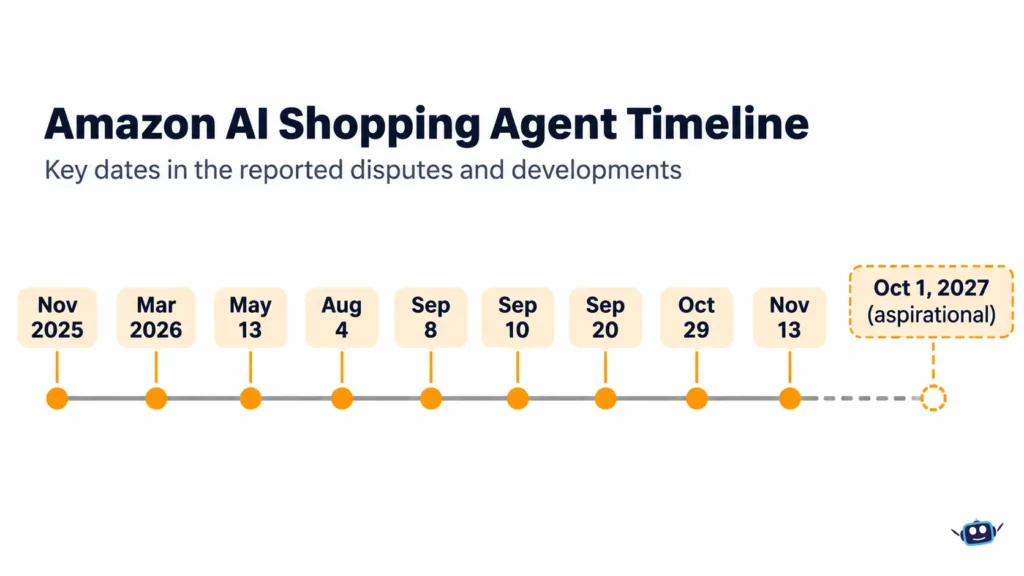
| Date | Event | Source type |
|---|---|---|
| November 2025 | Amazon publishes its Perplexity statement and sues | Amazon; court filing as reported |
| March 2026 | District court grants Amazon a preliminary injunction | Court ruling, as reported |
| May 13, 2026 | Amazon renames Rufus “Alexa for Shopping” | Amazon |
| August 4, 2026 | Ninth Circuit vacates the injunction | Court opinion, as reported |
| September 8, 2026 | Meta launches Muse | Meta, as reported |
| September 10, 2026 | Ninth Circuit denies Amazon’s rehearing petition | Court order |
| September 20, 2026 | Amazon blocks Muse from shopping on its store | Amazon statement to GeekWire |
| October 15, 2026 | Google repeats its 60 billion listings figure | Google, as reported |
| October 29, 2026 | Amazon’s Q3 earnings call | Earnings coverage |
| November 13, 2026 | Reuters reports World Product Graph | Reuters |
| October 1, 2027 | Aspirational date in the draft | Reuters; unconfirmed |
What did Amazon’s CEO say about AI shopping agents?
On the October 29, 2026 call, Andy Jassy said few customers shop through outside agents because the experience is “still not great,” per Fortune. He also said outside agents did not cause weaker-than-expected advertising growth.
On the same call, Jassy said more than 400 million customers used Alexa for Shopping in the past 12 months and that interactions rose 570% year over year. He said US customers who use it spend 50% more per order than those who don’t. Coverage of the call left two points open. It did not say whether the 400 million figure includes pre-merger Rufus users. It also did not say whether the 50% covers only orders placed through the assistant.
Jassy also said Amazon anticipates working with horizontal agents while expecting Alexa for Shopping to be the primary agent used to shop Amazon. Reuters notes that Jassy publicly downplayed agent impact while sources describe executives as more wary. Both can be true.
What most people miss
Amazon is already doing a version of this. Shop Direct and Buy for Me list outside products inside Amazon, as covered above.
The permission question is unresolved. In 2025, Amazon added AI crawlers to its robots.txt blocklist, per Modern Retail citing The Information. Reuters says it could not determine whether Amazon would seek permission to crawl others. A plan built partly on crawling, from a company that restricts crawling of its own site, will draw scrutiny.
Some claims have a single source. Muse’s reported 10 million US and Canadian users since September comes from Reuters alone. The Morgan Stanley percentages are as reported by Reuters.
A bigger database isn’t a better answer. An assistant still depends on data quality and freshness, a point our context engineering guide covers in depth.
What should shoppers check before relying on an AI recommendation?
Use an assistant to narrow choices, then verify the details that affect your purchase.
- Match the exact model. Check the manufacturer’s model number, version, size and compatibility.
- Identify the seller. Confirm whether Amazon or another merchant sells the item.
- Review the full cost. Check the checkout total, including shipping, taxes and recurring charges.
- Read return and warranty terms. For Buy for Me orders, Amazon says the brand store manages returns and exchanges.
- Review permissions. Understand what account information an agent can access and what you authorize.
Amazon says you can review and manage Alexa interactions, including shopping conversations, on its Review Alexa History page.
What should brands and merchants watch?
| Reader | What’s at stake | Practical step |
|---|---|---|
| Brands | Your product data may be supplied to, or crawled by, Amazon | Keep specs, identifiers and variants consistent across your site and feeds |
| Marketplace sellers | AI answers draw on listing details, reviews and Q&A | Audit listings for accuracy |
| Competing retailers | Agents may route traffic toward the most complete data | Publish clean, structured product data |
| Shoppers | AI answers can be wrong, including Amazon’s own | Verify specs on the manufacturer’s page |
| Investors | Reuters ties the plan to advertising and AI costs | Treat it as an unconfirmed draft |
Amazon’s Shop Direct merchant page describes how to sign up and how to opt out. One report says merchants are included automatically and must opt out, and that comes from a single source. Reuters says it could not determine how crawling would work or how brands could correct errors. Amazon has not published operating rules for the reported project.
Myth vs fact
| Myth | Fact |
|---|---|
| Amazon has launched World Product Graph | No launch has been announced. Reuters reports a draft with an aspirational October 1, 2027 date. |
| Amazon denied the report | Amazon called the document a brainstorming draft that may not reflect current plans. It did not deny the project. |
| Alexa for Shopping is proven 97% accurate | That is Amazon’s claim, and the method is unpublished. |
| Amazon won the Perplexity fight | The Ninth Circuit vacated Amazon’s injunction and denied rehearing. The case continues in district court. |
| Amazon would own all product data | Reuters reports an ambition to collect data. Ownership has not been established. |
How can you check this yourself?
- Search Amazon’s official news pages for “World Product Graph.” A launch would appear there first.
- Read Amazon’s investor relations materials after the next earnings call.
- Check the Ninth Circuit docket for Amazon.com Services LLC v. Perplexity AI for new filings.
- Compare any AI shopping answer with the manufacturer’s specification page and the checkout total.
Frequently asked questions
What is Amazon’s World Product Graph?
It is a reported internal Amazon plan to gather data on virtually every product sold worldwide, including items Amazon doesn’t stock. Reuters reported it on November 13, 2026, citing an internal document. Amazon has not announced it.
When will World Product Graph launch?
Unknown. The draft carries an aspirational date of October 1, 2027, but Reuters could not determine whether that is realistic. Sources told Reuters the plan could be modified or aborted.
Is Amazon crawling other retailers’ websites for this project?
The document describes crawling as one data source. Reuters could not determine how it would work or whether Amazon would need permission. We found no Amazon confirmation that this crawling has started.
Which brands are involved?
According to the document, Coca-Cola and Bayer have signed up to contribute data, and Amazon held a CEO-level summit for a trial with Procter & Gamble. The companies did not respond to Reuters.
Is World Product Graph the same as Shop Direct or Google’s Shopping Graph?
No. Shop Direct is an existing Amazon program, and Google’s Shopping Graph is an existing Google catalog. World Product Graph is a reported proposal, though employees describe it as an extension of Shop Direct and Buy for Me.
Why did Amazon block Meta’s Muse?
Amazon says Meta did not notify it, Muse doesn’t identify itself and it appears to store customer credentials. Meta says Muse can’t see passwords or payment methods. Amazon told GeekWire it is talking directly with Meta.
Did Amazon win its lawsuit against Perplexity?
Not so far. The Ninth Circuit vacated Amazon’s preliminary injunction on August 4, 2026, and denied rehearing on September 10, 2026. The underlying case returned to the district court.
Is Alexa for Shopping always accurate?
No. Amazon’s help page says it may not always get things right. Amazon told Reuters its data shows roughly 97% global accuracy, but the method is unpublished.
Conclusion
The key takeaways are these:
- World Product Graph is a reported draft, not a launched product.
- Amazon disputes the document’s relevance and its usage figures, not its broader data ambitions, which Shop Direct and Buy for Me already reflect.
- The Perplexity ruling and the Muse block show the fight over outside agents is still being decided.
Your next step: before your next AI-assisted purchase, confirm the exact model, the seller, the total price and the return terms on the actual listing.
Related: Meta’s Muse personal agent, explained
Disclaimer
This article is for informational purposes only and is not affiliated with, sponsored by or endorsed by Amazon, Google, Meta, Perplexity, Reuters or any brand mentioned. It is not financial, investment or legal advice. Plans, prices, features and policies may change, and several matters described are unconfirmed or under dispute. AI output can be inaccurate, so verify product details and purchase terms before relying on a recommendation. Information last verified on November 14, 2026.