
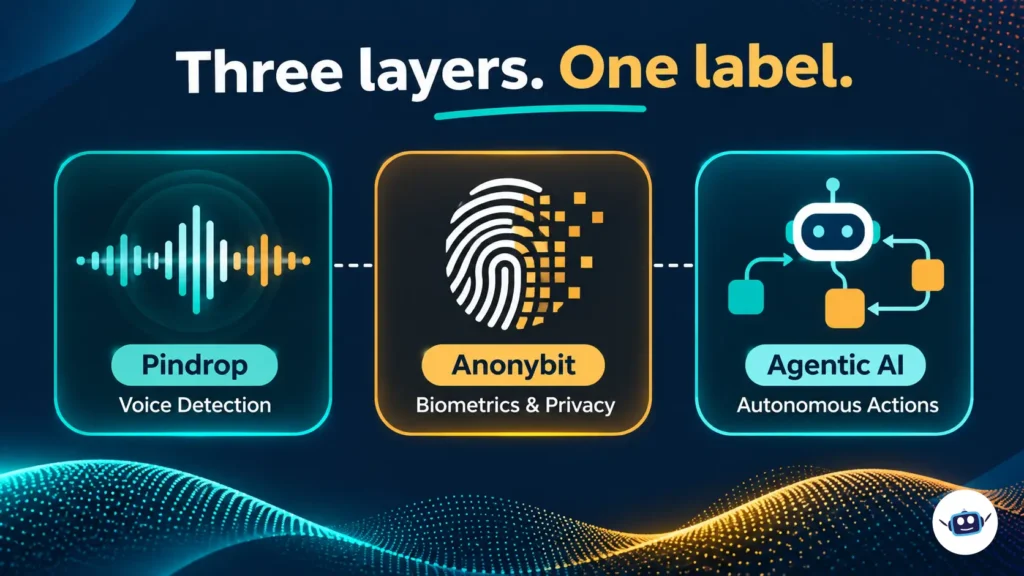
“Agentic AI Pindrop Anonybit” is a label, not a product either company has announced. It describes pairing AI agents, Pindrop’s voice deepfake detection, and Anonybit’s decentralized biometrics. As of November 2026, we found no joint offering from the two firms, and Anonybit’s founder and former CEO now works at Prove.
Search the phrase and you will find guides describing a “three-layer defense” that blocks deepfake calls in milliseconds. Look for the product page and there isn’t one. This article separates what each company verifiably sells, what changed in 2025 and 2026, and which popular claims have no public proof.
Is “agentic AI Pindrop Anonybit” a real product?
No joint product from Pindrop and Anonybit turned up in our research. The phrase is a way of describing how three separate capabilities could be combined.
In our check on November 10, 2026, Pindrop’s partner page listed integrations including NiCE, Zoom, Webex, Microsoft Teams, Five9, Genesys, Verizon, Google Cloud and Amazon Connect. Anonybit was not among them. That is not proof that no one has ever connected the two, but it is not what a shipped partnership looks like. We could not open Anonybit’s own website in this check, so Anonybit details here come from press releases and trade coverage. One of the top-ranking guides on this keyword also calls it a conceptual framework rather than something you buy.
What most people miss: guides written in 2026 often present integration details, such as bidirectional APIs and sub-200-millisecond cycles, as fact. We found no vendor documentation for any of them.
Where did the phrase come from?
The earliest source we found that puts the three names together is a June 5, 2025 Biometric Update roundup titled “Trust in the age of agentic AI: insights from Pindrop, Anonybit, Validsoft.” It is a roundup, not a partnership announcement.
It covered three separate views of the same problem. Pindrop’s webinar was the first of a four-part series on its 2025 Voice Intelligence & Security Report. It featured Amit Gupta, VP of Deepfake Detection, and Mo Merchant, Director of Research and Development. Validsoft published a post on why the voice channel matters. Anonybit’s CEO, Frances Zelazny, wrote about binding AI agents to human identity.
Pindrop’s webinar page cited an expected 162% increase in deepfake fraud in 2025. The webinar also gave a figure of one fraudulent call in every 599, as reported by Biometric Update. These are Pindrop’s own figures and projections.
Later content sites fused the three names into one keyword. That is our reading of how the phrase spread, not something any source states.
What does “agentic” mean here? Three different things
The keyword mixes three separate ideas, and most guides cover only the first.
| Meaning of “agentic” | What it is | Verified evidence (as of November 2026) |
|---|---|---|
| Agent as investigator | AI that helps fraud analysts work cases | Pindrop Fraud Assist: call summaries, evidence compiled in one place, multilingual-to-English summaries, auto-generated case notes. Pindrop’s September 2026 release says enterprise policies and human judgment stay in control. |
| Agent as caller | AI voice agents phoning your contact center, some malicious | Pindrop BotStopper, launched September 16, 2026. Pindrop says it detects machine callers in about two seconds, backed by a registry of more than 5,000 AI voices. |
| Agent as identity-bound actor | An AI agent tied to a verified human who authorized it | Anonybit and SmartUp announced identity-bound agents in May 2025. NIST published design tenets for agent identity in late October 2026. |

The most popular claim, an AI that autonomously decides to pass or block a caller in milliseconds, is not what Pindrop’s agentic products are described as doing. Pindrop’s agents assist human fraud and risk teams.
What does Pindrop actually do?
Pindrop is a voice and video security company. As of November 2026, its site groups products into three engines.
| Engine | Products | What Pindrop says it does |
|---|---|---|
| Synthetic | Pulse for Contact Centers, Pulse for Meetings, BotStopper | Detects synthetic voices, deepfakes in meetings, and AI agent callers |
| Risk | Protect, plus optional Fraud Assist | Assesses fraud risk during live interactions; Fraud Assist adds AI-assisted investigation |
| Authentication | Passport, plus VeriCall technology | Authenticates known callers with less friction; VeriCall adds caller ID validation and spoof detection |
Pindrop’s homepage cites more than 2,300 detection signals, a database of 2.7 million known bad actors, and 8 billion or more interactions analyzed. These are vendor figures. Many guides still quote “1,300+ features,” which looks like an older number.
Pindrop does not publish a price list that we could find. Its site directs buyers to a demo request.
How accurate is it?
Three figures circulate, and they come from different tests.
| Figure | Where it comes from | Caveat |
|---|---|---|
| 99% | Pindrop’s homepage description, “independently validated” | The page we read did not say which test |
| 96.4% (81 of 84 clips) | Pindrop’s account of an NPR study | Short clips of five to eight seconds; small sample |
| Above 95% | Pindrop’s September 2026 release, citing a June 2026 Podonos benchmark | Pindrop says only four systems cleared 95%; we did not review the benchmark itself |
Pindrop says Pulse flagged every deepfake sample in the NPR study. If so, the arithmetic implies the three errors were real human clips flagged as synthetic. That is a false-positive risk worth testing on your own call audio.
What does Anonybit do, and is it still the same company?
Anonybit built decentralized biometric infrastructure. It splits biometric data across separate environments so no single database holds a full record. Its founder and former CEO, Frances Zelazny, joined Prove on June 2, 2026. We could not confirm Anonybit’s current corporate status or product roadmap.
Anonybit’s agent-related claims date from May 2025. It announced, with the no-code platform SmartUp, what it called the first privacy-preserving identity solution for AI agents. Its decentralized biometric cloud supports face, voice, fingerprint, iris and palm. The “first” label is a vendor claim. Anonybit also received a US patent for decentralized biometric authentication in early 2025.
On August 12, 2026, Biometric Update reported that Prove is building privacy-preserving biometrics with new cryptographic technology. Zelazny described it as built from scratch, including multi-party computation. Prove has filed for patent protection and expects to launch toward the end of 2026. Other people have joined Prove from Anonybit.
Practical consequence: if you want “Anonybit-style” biometrics, ask who sells, supports and updates the product today.
What changed recently?
| Date | Event | Source type |
|---|---|---|
| Early 2025 | Anonybit awarded US patent for decentralized biometric authentication | Trade press |
| May 12, 2025 | Pindrop webinar on agentic AI and voice fraud | Pindrop |
| May 28, 2025 | Anonybit and SmartUp announce identity-bound AI agents | Press release |
| June 5, 2025 | Biometric Update roundup naming Pindrop, Anonybit and Validsoft | Trade press |
| June 2, 2026 | Prove appoints Zelazny to lead privacy-preserving biometrics | Prove release |
| August 12, 2026 | Prove outlines new biometric technology, expected late 2026 | Trade press |
| September 16, 2026 | Pindrop launches BotStopper; shows Fraud Investigation Agent | Pindrop release |
| Late October 2026 | NIST publishes design tenets for AI agent identity and authorization | NIST |
How could the three layers fit together?
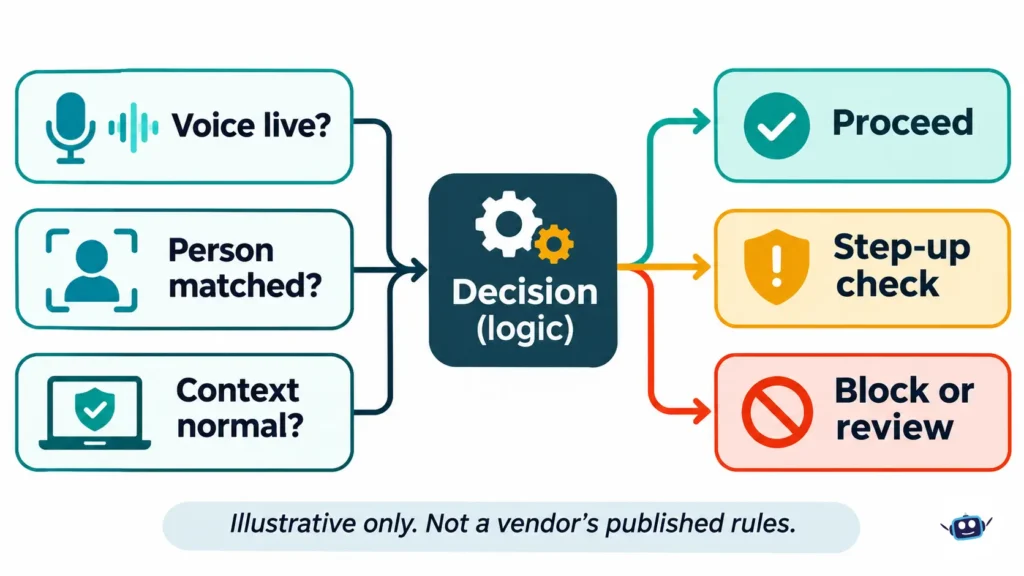
If an organization built its own stack, the logic would likely weigh three questions: is the voice live, is this the enrolled person, and does the context fit? The table below is an illustrative framework built from general design logic. It is not any vendor’s published rules, and the thresholds are assumptions.
| Voice liveness | Identity match | Context | Illustrative response |
|---|---|---|---|
| Passes | Confirmed | Normal | Proceed |
| Passes | Confirmed | Unusual device or request | Step-up check, such as a push notification |
| Passes | Not enrolled or no match | High-value action | Step-up, then human review if it fails |
| Fails | Any | Any | Block or route to fraud team; do not trust a match on a suspect voice |
The NIST tenets add a design principle: agents should have unique, cryptographically verifiable identities and short-lived, revocable access. They should also leave a tamper-evident record. NIST describes the tenets as an initial set of design guidance, not a standard or mandate. Whatever you automate, keep a human path for irreversible actions.
Which popular claims hold up?
| Claim in circulation | Status |
|---|---|
| Agentic AI decides in milliseconds; full cycle under 200 ms | Unpublished. Pindrop describes about two seconds for Pulse detection, a vendor figure. No vendor source for a three-layer cycle time. |
| Pindrop and Anonybit exchange data through APIs | Not found. No announcement; Anonybit absent from Pindrop’s partner page in our check. |
| Pindrop analyzes breathing patterns | Unverified. Pindrop’s pages describe frequency changes and spectral distortions. Breathing appears only on third-party sites. |
| The stack cut fraud by 90%+ | Mislabeled. Pindrop’s HealthEquity case study is titled as a 90% fraud drop, a Pindrop-only, vendor-reported result. |
| Anonybit is GDPR- and HIPAA-compliant by design | Vendor-claimed design goal. Compliance depends on how you deploy and govern it. |
| Autonomous AI replaces human analysts | Contradicted. Pindrop says human judgment stays in control of its agents. |
What are the risks and limits?
False positives. No detector is perfect, and the small NPR sample above is the clearest public example of how errors would show up.
Biometric privacy law. Some US states, including Illinois, regulate biometric data. Pindrop’s newsroom reports an August 19, 2026 Third Circuit ruling that it qualifies as a financial institution under Illinois’s biometric privacy act. We did not review the ruling, and whether any exemption applies to you depends on your facts.
Vendor change. Anonybit’s leadership moved to Prove, so confirm product continuity before you depend on it.
Over-automation. Letting software block customers without human review can lock out legitimate callers.
Agent permissions. An agent that can approve transactions needs the narrow, revocable access NIST describes. Our explainer on how coding agents differ from chatbots covers the same idea of who holds the keys. As AI agents place calls for people, Pindrop’s homepage is also promoting an analysis of Meta’s Muse calling contact centers. Our guide to Meta’s Muse personal agent covers that agent from the user side.
Who should consider this approach, and who should skip it?
Consider it if you run fraud, authentication or contact-center security at a bank, insurer, healthcare provider or large call operation. Pindrop’s customer base and pricing model are built for those buyers. Evaluate each component separately and design the orchestration yourself.
Skip it, or treat it as background reading, if you are an individual or a small business. Pindrop is an enterprise platform. For personal protection, agree on a verification phrase with family members and call people back on numbers you already have.
How can you check a vendor claim yourself?
- Ask which test produced the accuracy figure, how large it was, and whether it used your channel and audio quality.
- Ask for false-positive rates on genuine callers, not only detection rates on fakes.
- Ask whether the two vendors have a documented, supported integration, and who is accountable if it fails.
- Ask what a human can override, and how fast.
- Ask where biometric data lives, who can reconstruct it, and which laws apply to your callers.
- Run a pilot on your own recorded calls before committing.
FAQs
What is agentic AI Pindrop Anonybit?
It is a label for combining AI agents, Pindrop’s voice deepfake and fraud detection, and Anonybit’s decentralized biometrics. As of November 2026, we found no joint product announced by either company.
Are Pindrop and Anonybit partners?
We found no announced partnership. Pindrop’s partner page, read on November 10, 2026, did not list Anonybit. Confirm directly with both companies if it matters to your project.
Does Pindrop use agentic AI?
Yes, in investigation and bot detection. Fraud Assist is described as an AI agent for phone-fraud investigations, and Pindrop’s September 2026 release introduced a Fraud Investigation Agent and an Enrollment Agent. Pindrop says human judgment remains in control.
What happened to Anonybit’s founder?
Frances Zelazny, Anonybit’s founder and former CEO, was appointed General Manager of New Market Innovations at Prove on June 2, 2026. We could not confirm Anonybit’s current corporate status.
How accurate is Pindrop’s deepfake detection?
Pindrop reports figures from roughly 95% to 99% depending on the test. One reported NPR study scored 81 of 84 clips correctly. These are vendor-reported figures from different tests, so validate them on your own audio.
How much does Pindrop cost?
We found no public price list. Pindrop’s site routes buyers to a demo request, so expect a quote shaped by your volume and deployment.
Does decentralized biometric storage make data safe?
It is designed to remove a single database that exposes everyone in one breach. That is the vendor’s design claim, and we did not review independent evidence of its effectiveness. It also does not remove the need for consent practices and legal review.
Can this kind of stack stop AI agents calling your contact center?
Pindrop says BotStopper detects machine callers in about two seconds. It also says legitimate agents should be welcomed, and the goal is knowing which agent is calling and what it may do. That is a vendor claim, and agent identity standards are still being drafted.
Conclusion
Agentic AI Pindrop Anonybit is a useful shorthand for layered identity defense, but it is not a product. Pindrop’s verified offering is voice and video deepfake detection, risk scoring, authentication and AI-assisted investigation. Anonybit’s decentralized biometrics have unclear continuity now that its founder works at Prove. The autonomous, millisecond decision layer remains unpublished.
Key takeaways: treat the phrase as a concept, not a product. Verify accuracy on your own data. Keep humans in control of high-value decisions.
Next step: if you run a contact center, write down the three questions in the illustrative table above. Then ask each vendor for evidence on its piece, rather than for a bundle that does not exist.
Related: Google Cloud’s Gemini agent for enterprise work
Disclaimer
This article is for informational purposes only and is not affiliated with, sponsored by or endorsed by Pindrop, Anonybit, Prove or any other company mentioned. Products, features, prices and policies may change. Information last verified on November 10, 2026. This is not security, legal or compliance advice, and AI output can be inaccurate, so confirm critical details with the vendors and qualified professionals.