

Labelbox, the San Francisco AI infrastructure company, announced on October 14, 2026 that it raised more than $100 million in Series E financing at a $1.25 billion pre-money valuation. The round combines equity with a credit facility. Infinitum Partners led it, with Wipro Ventures, Andreessen Horowitz (a16z), B Capital, Tau Ventures and Snowpoint Ventures taking part. The money goes to two products: Horizon, which builds reinforcement learning environments for frontier AI labs, and Recursion Managed Agents, which runs business agents for enterprises.
Below is what the round includes, what the headline number leaves out, and how it compares with other AI data companies’ recent raises.
The deal at a glance
| Item | What Labelbox reported |
|---|---|
| Announcement date | October 14, 2026 |
| Amount | More than $100 million, equity plus a credit facility |
| Valuation | $1.25 billion pre-money |
| Lead investor | Infinitum Partners |
| Other named investors | Wipro Ventures, a16z, B Capital, Tau Ventures, Snowpoint Ventures, and others |
| Customers | 400+, from frontier labs and hyperscalers to startups and Fortune 500 companies |
| Financial claims | Profitable in 2026; revenue growth above 5x year over year |
| Products funded | Horizon and Recursion Managed Agents |
These figures come from Labelbox’s own blog post by CEO and co-founder Manu Sharma and its PR Newswire release. They are company claims. Labelbox did not publish revenue, profit or customer-level numbers.
What “$100M+” does and does not tell you
Three details change how the headline should be read.
It is not all equity. Labelbox says the financing includes “equity and a credit facility.” It did not say how the total splits between them. A credit facility is borrowed money that must be repaid, while equity is ownership sold to investors. Calling the whole amount a “$100 million investment” overstates what investors put in.
The valuation is pre-money. A pre-money valuation is the company’s value before the new money comes in. The post-money figure is usually pre-money plus new equity. Because the equity portion is undisclosed, nobody outside the company can work out a reliable post-money number.
Some pages online get the basics wrong. One aggregator page says Labelbox did not disclose a valuation. That is incorrect, because the company’s own post states $1.25 billion pre-money. Other data pages describe Labelbox’s earlier $110 million round as a Series E at a $1 billion valuation dated 2025. That round was the Series D, announced in January 2022 and led by SoftBank Vision Fund 2, and it made Labelbox a unicorn. The Series E is the October 2026 round described here.
One more wrinkle is in the customer claim. The press release says Labelbox works with “over 90% of leading U.S. AI labs.” Sharma’s blog post separately says it works with 90% of the leading frontier AI labs and hyperscalers. Those are two different groups, and neither comes with a published customer list.
Who is backing Labelbox
Infinitum Partners leads. Sharma’s post says Infinitum’s John Yetimoglu was an early investor in Groq and is now involved in building large-scale compute infrastructure at GroqCloud. Sharma wrote that access to compute “will be central” to Labelbox’s next chapter, so the investor choice appears tied to that need. The post does not say Infinitum will supply compute.
Andreessen Horowitz and B Capital are repeat names. Both appeared in the Series D coverage in 2022. Snowpoint Ventures also took part in that round, according to Forbes Japan’s report. Wipro Ventures and Tau Ventures are named participants in the new round.
What Labelbox plans to do with the money
The company says the financing will fund research and engineering across Horizon and Recursion Managed Agents, plus more people to bring both products to customers.
Horizon: reinforcement learning for frontier labs
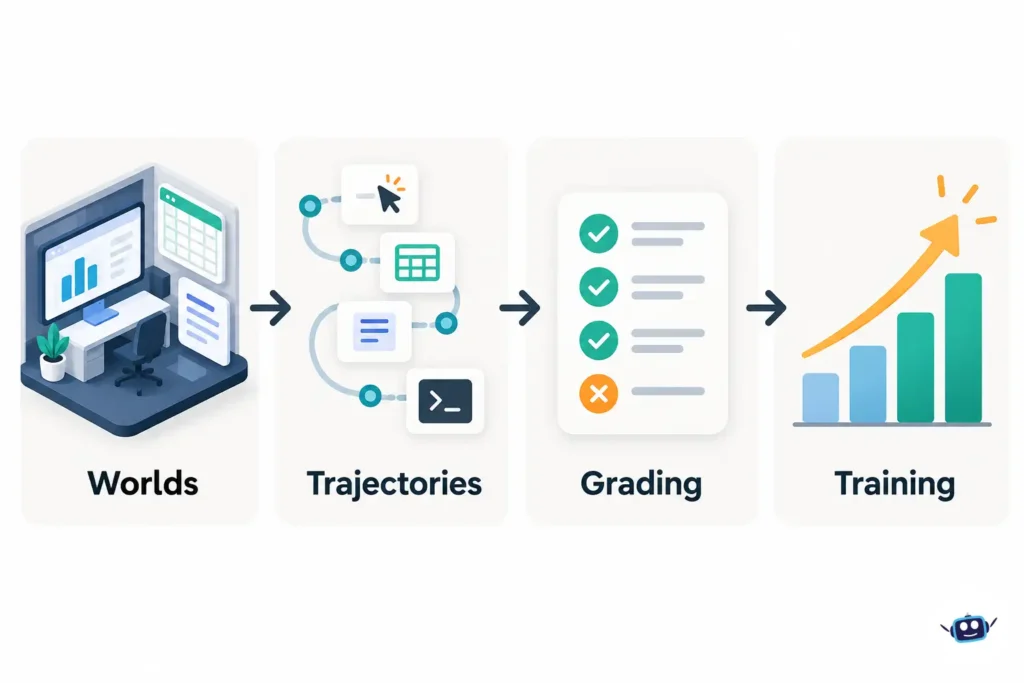
Horizon is aimed at organizations that train large AI models. Labelbox describes a system called WorldSim that builds simulated companies, complete with code, dashboards, spreadsheets, slide decks and documents filled with realistic business data. A model works a hard task from start to finish inside one of these worlds, and every step is recorded as a trajectory.
Grading happens in two layers:
- Deterministic verifiers score each trajectory the same way every run, which settles correctness.
- When two trajectories are both correct, an expert’s preference decides which is better. Sharma calls this teaching the model “taste.”
Labelbox says it operates at the scale of thousands of worlds and millions of graded trajectories, tuned to a customer’s pass@k targets. Pass@k is a common evaluation measure that asks whether at least one of k attempts solves a task. The company lists coding, computer use, research, multimodal and voice work among the covered domains.
Recursion Managed Agents: agents that start on their own
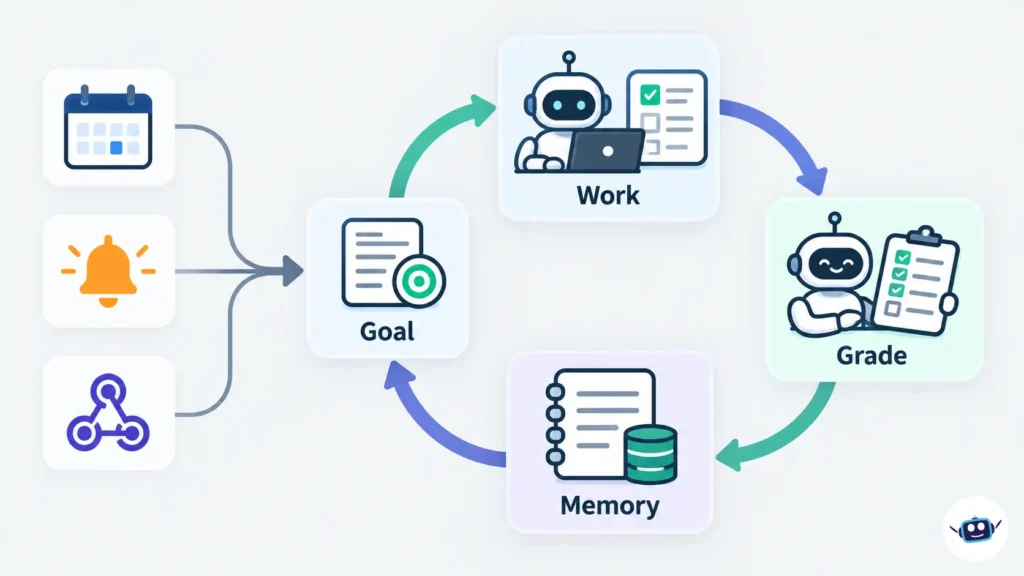
Recursion Managed Agents opened to enterprise customers on October 8, 2026. Each agent is set up with three inputs:
- A goal.
- A trigger, such as a schedule, an alert, a Slack message, a webhook or an API call.
- A rubric, a plain-language checklist of what good work looks like.
A separate grader agent scores each run against the rubric and cites evidence for each judgment. If the work misses, the agent revises it. Agents can work in three modes: multi-agent (a coordinator chains specialists), team (copies of an agent split work on a shared board), and auto, the default, where the agent decides which it needs.
Labelbox says agents connect to more than 100 business applications and any MCP server. Each tool is tagged read-only, changes data, or destructive, and credentials sit in a vault the model cannot see. Sessions run in isolated sandboxes, sensitive actions can wait for a person’s approval, and spend, token and time limits can pause a run. The company lists SOC 2 Type II, GDPR, CCPA, NIST 800-171 and PCI DSS as part of its security and compliance program, and says the product runs with zero data retention at every LLM provider.
How Labelbox got here
Sharma, Brian Rieger and Dan founded Labelbox in 2018. Its first product was software for labeling and managing training data. The company raised a $40 million Series C led by B Capital in early 2021, according to VentureBeat, and the $110 million Series D in January 2022.
Sharma describes three chapters: data tooling, then reinforcement learning environments after what he calls the ChatGPT moment, then agents. The agents were built for internal use first. Labelbox says it runs 51 agents across 11 teams, covering engineering, security, ML research, finance, sales and procurement.
That path matches a wider shift. Labeling-tool companies are moving toward finished datasets, simulated environments and evaluation work for AI labs.
How the round compares with a close peer
Snorkel AI is the closest recent comparison, since it also moved from labeling software into datasets and reinforcement learning environments.
| Labelbox | Snorkel AI | |
|---|---|---|
| Announced | October 14, 2026 | September 22, 2026 |
| Round | Series E, $100M+ (equity plus credit facility) | Series E, $350M |
| Valuation | $1.25B pre-money | $3.5B |
| Led by | Infinitum Partners | Insight Partners and S32 |
| Revenue disclosure | None; says growth above 5x and profitable | Run-rate of $375M per TechCrunch (Reuters reported “crossed $350M”) |
Do not read this as a ranking. Valuation type differs (pre-money versus the figure Snorkel reported), Labelbox published no revenue, and Snorkel’s run-rate is annualized, not booked revenue. Another reference point is Meta’s $14.3 billion deal for a 49 percent stake in Scale AI in June 2025, which sits in a different size class from either round.
What the 32% cost claim shows, and what it doesn’t
Labelbox’s launch post offers one concrete result. Its pull-request review agent ran 39 graded reviews between September 19 and 21, 2026, on a single agent version and a single model. Across the 33 reviews that passed the grader, the median cost fell from $13.15 for the first 11 to $8.90 for the last 11, a 32% drop. The agent’s memory was updated 15 times, and time per review stayed near 27 minutes.
This is useful as a mechanism: the same model got cheaper because memory reduced wasted searches and repeated mistakes. It is a thin basis for forecasting savings elsewhere. It is one agent, one task type, under two days, measured by the company that sells the product. Labelbox itself says that because every pull request is different, “this isn’t a lab test.”
Practical Insights
These points come from the verified facts above plus reasoning about them. They are not claims of hands-on testing.
Read the funding mix before the headline. When a round says “$100M+” and “including a credit facility,” ask how much is equity. Equity dilutes owners and signals investor conviction in the business. Debt is cheaper in ownership terms but has to be repaid.
Pre-money and post-money are not interchangeable. Quote the figure the company actually stated, and label it. Writing “$1.25 billion valuation” without “pre-money” is a small but real inaccuracy.
Profitability claims need context. Labelbox says it reached profitability in 2026 and grew more than 5x. Without a revenue base, 5x could describe very different businesses. Treat it as a direction, not a scale.
If you are evaluating Recursion, start with the company’s own examples. Its launch post suggests recurring, describable work: flaky-test fixes, vendor risk reviews, weekly forecast refreshes, pre-call account briefs. The common thread is a job that returns every week and has a checkable definition of done. A vague job with no rubric gives the grader nothing to score.
Write the rubric first. The product’s central mechanism is grading against a team-written standard. Labelbox says that without a rubric you can begin with a plain definition of done and tighten it as you review early runs. Weak rubrics will produce confident-looking scores on weak work.
Check what “zero data retention” covers. The claim concerns LLM providers not keeping prompts and outputs. The launch post also says session transcripts and agent memory are stored in the customer’s workspace, with memory browsable and deletable. Those are different layers, and a security review should ask about both.
Budget by session hour. Pricing is per agent session hour, with compute and model spend combined into one estimate shown before launch, and no seats or subscriptions. Labelbox says existing enterprise customers get a one-time $100 credit and new teams get $20 in free credits for a limited time. Compare that against current seat-based tools using your own expected hours, and confirm current terms with Labelbox.
Common mistakes when reading this news
- Treating $100 million as new equity. Part of it is a credit facility.
- Calling the round a $110 million Series E. That figure belongs to the 2022 Series D.
- Assuming a post-money valuation. It was not disclosed.
- Repeating customer-share claims without noting that they are company-reported and the denominators differ.
- Generalizing the 32% cost result from one internal agent to every deployment.
- Comparing Labelbox’s valuation directly with Snorkel’s without noting the pre-money label and the missing Labelbox revenue.
FAQs
How much did Labelbox raise in its Series E?
Labelbox announced more than $100 million in Series E financing on October 14, 2026. The total includes both equity and a credit facility, and the company has not published the split.
What is Labelbox’s valuation after the Series E?
Labelbox stated a $1.25 billion pre-money valuation. It has not published a post-money figure, and it cannot be calculated without knowing how much of the round is equity.
Who led the round?
Infinitum Partners led it. Wipro Ventures, Andreessen Horowitz, B Capital, Tau Ventures and Snowpoint Ventures also participated, along with other investors the company did not name.
What does Labelbox sell now?
It sells two products. Horizon provides reinforcement learning environments and evaluation infrastructure for frontier AI labs. Recursion Managed Agents lets enterprises run graded, self-improving agents inside the business applications they already use.
Is Labelbox profitable?
The company says it reached profitability in 2026 while growing revenue more than 5x year over year. It did not publish revenue or profit figures, so the claim cannot be checked independently.
How is the Series E different from the earlier $110 million round?
The $110 million round was the Series D, announced in January 2022 and led by SoftBank Vision Fund 2. The Series E is the October 2026 round led by Infinitum Partners.
How much does Recursion Managed Agents cost?
Labelbox prices it per agent session hour, with compute and model spend combined in one estimate shown before launch. Existing enterprise customers get a one-time $100 credit, and the company has offered new teams $20 in free credits for a limited time. Confirm current terms with Labelbox.
How does this compare with Snorkel AI’s raise?
Snorkel AI raised $350 million at a $3.5 billion valuation on September 22, 2026, led by Insight Partners and S32. The two rounds are not directly comparable, because of differences in valuation type, round structure and revenue disclosure.
Conclusion
Labelbox’s Series E is a real, company-confirmed round, but the headline needs careful reading. It is more than $100 million in equity and credit combined, at a $1.25 billion pre-money valuation, led by Infinitum Partners. The company says it is profitable, growing over 5x, and serving 400-plus customers, and it has not published numbers that let outsiders test those claims.
Actionable takeaways:
- Quote the round precisely: “$100M+ including a credit facility, at a $1.25B pre-money valuation.”
- Do not confuse this round with the 2022 Series D.
- If you are considering Recursion, pick one recurring job, write a rubric, and test it on a small number of session hours before committing.
- Ask vendors separately about provider-side data retention and about stored transcripts and memory.
- Treat the 32% cost drop as one internal case, not a benchmark.
For related reading, see our coverage of Gallatin AI’s $50M Series A, Doxx.net’s $38M a16z-led round, our explainer on AI coding agents versus chatbots, the wider startups and industry coverage, and our report on the data center bond selloff and AI debt.
Disclaimer
This article is general information about a funding announcement. It is not financial, investment or tax advice, and company-reported figures such as profitability, growth and customer share have not been independently audited. Product details, pricing and credits can change, so confirm them with Labelbox before making a purchasing or investment decision, and consult a licensed professional where appropriate. Information current as of October 2026.