

Venice AI is a private, uncensored AI platform for chat, images, video, audio and code. It was founded in 2024 by Erik Voorhees. Venice says it does not store or log your prompts and replies. Your chat history lives in your browser, not on its servers. It has a free plan with daily limits, and paid plans run from $18 to $200 a month. The privacy claim is real but depends on which model you pick. Some models only hide your identity from an outside provider. Others run in hardware-isolated or end-to-end encrypted modes.
This guide covers what Venice AI is, how each privacy mode works, what it costs, and where it falls short.
What Venice AI is (and what it is not)
Venice is a model router with a privacy-focused front end. It does not build one flagship model. It gives you access to many models from different makers and applies its own privacy rules on top. Venice’s documentation advertises more than 380 models across text, image, audio and video.
Many older articles call Venice an “open-source models only” service. That is out of date. Venice’s current API price list includes models from Anthropic, OpenAI, Google and xAI alongside open-weight options such as DeepSeek, Qwen, GLM and Venice’s own Venice Uncensored. Each model carries a privacy label, which matters more than the brand name.
Some background facts:
- Venice is described as Las Vegas-based and founded in 2024 by Erik Voorhees.
- On July 1, 2026, Unite.AI reported a $65 million Series A led by Dragonfly Capital at a $1 billion valuation. It was Venice’s first outside raise.
- Venice reported more than 3.4 million users and over $70 million in annualized revenue at that time. Treat these as company figures.
How Venice AI privacy works: four modes
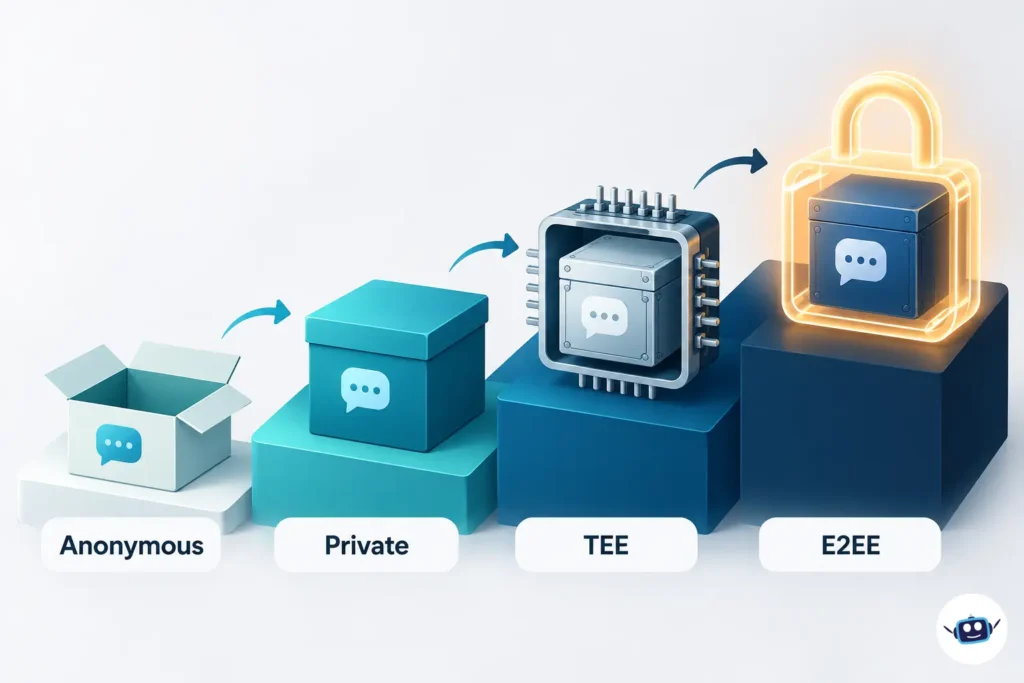
Venice’s documentation describes a shared foundation. Requests pass through a Venice proxy over encrypted HTTPS and are relayed without Venice storing the prompt or response content. On top of that, each model runs in one of four privacy modes.
| Mode | What it means | What you still have to trust |
|---|---|---|
| Anonymous | Venice proxies your request without sending your Venice identity to the model provider. | The provider can still see your prompt. |
| Private | Zero data retention, enforced by contract. Content is processed for the request and not kept. | Venice and its infrastructure partners keeping their agreements. |
| TEE | The model runs inside a Trusted Execution Environment, a hardware-isolated enclave with remote attestation. | The hardware and attestation process. |
| E2EE | Your client encrypts the prompt before sending it. Only a verified enclave can decrypt it. | The verified enclave. |
The first two modes depend on policy and contracts. TEE and E2EE add technical controls you can check. If you need strong guarantees, that difference matters.
Two details most guides skip:
- TEE and E2EE are currently available for text models only. Venice’s docs say so directly.
- E2EE switches off features that need plaintext outside the enclave. That includes web search, memory, summaries and some tool flows.
So there is a trade-off between maximum privacy and convenience. Venice’s own docs say it plainly.
What stays on your device
According to Venice’s help center, your conversation history is encrypted and stored in your browser’s local storage. Venice keeps no copy. That cuts both ways. Clearing your browser cache deletes your Venice history, and chats do not follow you between devices. You can export a conversation from the history drawer. Plan listings also mention encrypted backups on paid tiers, so check that feature before relying on it.
What Venice still collects
Venice does not claim to collect nothing. Its documentation says it may process operational metadata for authentication, billing, abuse prevention, reliability and support. Depending on how you use the product, that can include:
- account or wallet identifiers
- request timestamps and the model you selected
- token counts and billing amounts
- IP address and browser or device information
- product event logs
Venice says this is separate from prompt and response content. A VPN or a disposable email will not remove all of it, but it can reduce what links back to you.
Models: where the “private” label changes
On Venice, the model decides your privacy level. In Venice’s pricing documentation, many open-weight models such as DeepSeek, GLM, Qwen, Kimi and Venice’s own models are listed as Private. Models from Anthropic, OpenAI and Google are listed as Anonymized. That means your identity is hidden from the provider, but the provider can see your prompt.
The practical rule is simple: use a Private, TEE or E2EE model for sensitive text. Use an Anonymized model when capability matters more than provider-level secrecy.
Developers can use the API’s models listing to see each model’s privacy level and whether it supports TEE or E2EE. The API is OpenAI-compatible, so many existing tools work after you change the base URL and key. If you are weighing chat tools against automated coding tools, our comparison of AI coding agents versus chatbots covers that trade-off.
Venice AI pricing in 2026
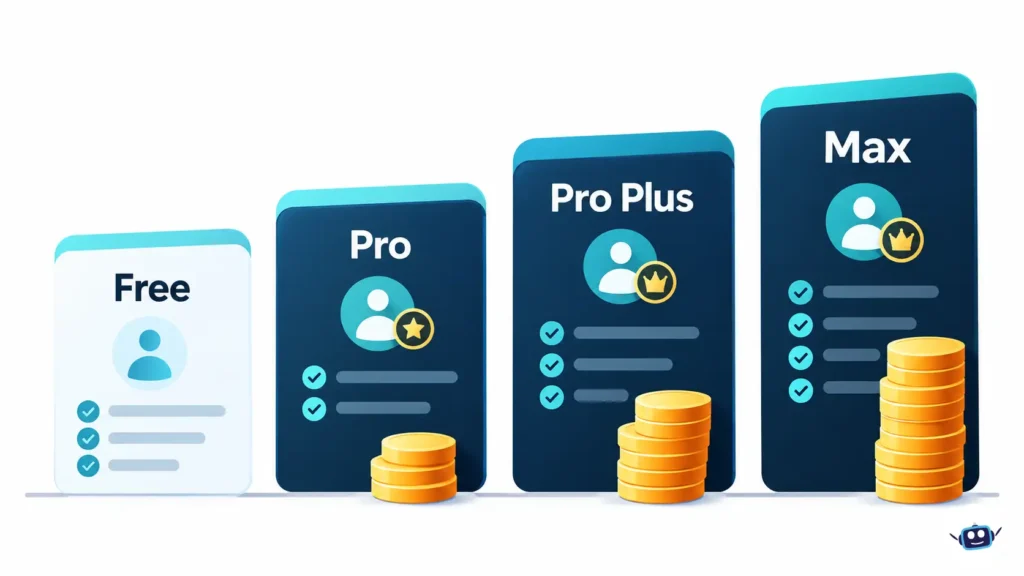
Venice lists four plans. Prices and limits below were confirmed across Venice’s own blog and several independent pricing listings as of autumn 2026.
| Plan | Price per month | Main limits and extras |
|---|---|---|
| Free | $0 | Base models, 10 text prompts and 15 image prompts a day, API access |
| Pro | $18 | All Pro models, unlimited text, up to 1,000 images a day, 100 credits a month |
| Pro Plus | $68 | 7,500 credits a month, higher image limits, credits roll over for two months |
| Max | $200 | 22,500 credits a month, highest limits, credits roll over for three months |
Credits are the catch
Venice equates 100 credits to $1. Pro’s 100 monthly credits are therefore worth about one dollar. Video, music and some premium or frontier models use credits. Reviewers estimate that Pro’s allowance covers roughly one short video clip a month. If video or premium models are your reason for subscribing, compare Pro Plus (about $75 in credits) with Pro before you pay.
Venice also lists annual billing discounts. Confirm the current figure on its pricing page.
API and token pricing
Developers pay per token. According to Venice’s API price list, Venice Uncensored 1.2 costs $0.20 per million input tokens and $0.90 per million output tokens. Claude Opus 5.5 is listed at $4.00 input and $20.00 output. Web search and scraping are $10 per 1,000 requests.
Venice also has two crypto tokens, VVV and DIEM, on the Base network. One staked DIEM gives $1 of Venice credit per day. Unused daily credit does not roll over, and the allowance refreshes at 00:00 UTC. VVV is Venice’s main token. You can stake it to mint DIEM. Unstaking DIEM has a one-day cooldown. Unlocking the staked VVV behind minted DIEM has a seven-day cooldown. You do not need crypto to use the consumer app. These tokens are mainly relevant to API users and token holders, and token values can swing sharply.
What “uncensored” actually means on Venice
Venice markets “no content filtering.” In the API documentation, uncensored is a model trait. A model category such as text:uncensored is labeled separately from others. That suggests “uncensored” describes particular models and settings rather than every model in the catalog. Third-party models keep their own behavior.
Fewer filters does not mean fewer responsibilities. Laws still apply to what you generate and share. Venice’s approach also draws scrutiny. Unite.AI noted that its unrestricted stance sits in the middle of a broader debate about safety and moderation. For wider context, see our AI policy and ethics coverage.
How to start with Venice AI
- Open the official site. Use venice.ai and docs.venice.ai. Independent, unofficial intro pages exist on GitHub Pages, and at least one says its links are referral links.
- Try the free tier first. Guest access exists with tighter limits, and a free account raises them.
- Choose the model by privacy label, then by task.
- Export important chats, since history lives in your browser.
- Upgrade only after you hit a limit you can name, such as images per day or credits for video.
Common mistakes
- Assuming every model is equally private. Anonymous models expose your prompt to the provider.
- Treating “unlimited” as unlimited everything. Unlimited text applies to Pro models. Credits cover video, music and premium models.
- Clearing the browser cache without exporting chats. Venice keeps no copy.
- Using E2EE and expecting web search. E2EE disables it.
- Buying Pro for video. One short clip a month is a thin allowance.
- Copying stale numbers. Free-tier limits have changed over time, and older guides quote 25 daily messages.
Practical Insights
These points come from Venice’s own documentation, not from hands-on testing.
Match the mode to the task. A recipe or a brainstorm needs no special mode. A draft contract, medical question or unreleased business plan deserves a Private, TEE or E2EE model.
Private is a promise, TEE is a proof. Private mode is enforced by contract. TEE and E2EE add hardware attestation and client-side encryption. Venice also states that Private mode does not make you anonymous at the account level. Billing and abuse-prevention metadata still exist.
Local storage is both feature and risk. No server copy means nothing to leak from Venice’s side, but also nothing to recover if your browser data disappears. Back up what matters.
Compare the total cost, not the headline. The $18 plan suits private chat and images. Heavy video or premium-model use makes the $68 plan closer to a credit bundle with a subscription attached.
Cross-check before you commit. Venice’s pricing and model catalog change often. The API price list shows models added and retired within months.
If you are comparing creative or role-play tools, our DreamGen AI review covers another option. Our guide on what to use when an AI tool shuts down is a reminder to keep exports of your work. More comparisons are in our AI tools and reviews section.
FAQs
Is Venice AI free?
Yes. The free plan covers base models with 10 text prompts and 15 image prompts a day, plus API access. Paid plans start at $18 a month.
Does Venice AI store my conversations?
Venice says it does not store your prompts, uploads or replies on its servers. Your history is kept in your browser. It may still process operational metadata such as IP address, timestamps and billing data.
Do I need an account?
No. Guest access exists with tighter limits. An account raises the limits and is required for paid plans.
Can I use Claude or GPT models on Venice?
Venice’s API list includes Anthropic and OpenAI models, labeled Anonymized. The provider can see your prompt, but your Venice identity is hidden. Premium models use credits.
What happens if I clear my browser cache?
Your Venice chat history is deleted, because Venice keeps no copy. Export important conversations first.
Do I need crypto to use Venice AI?
No. VVV and DIEM are optional and mainly useful for API access. Standard subscriptions work without them.
Is Venice AI really uncensored?
Venice’s own models and some others are labeled uncensored. Models from other providers keep their own behavior. Laws on what you create and share still apply.
How much does Venice AI cost?
Pro costs $18 a month, Pro Plus $68 and Max $200. Credits for video, music and premium models are priced at 100 credits per dollar.
Conclusion
Venice AI is worth considering if you want chat history out of a company’s database, wider model choice, and fewer filters. Its strength is a layered privacy design. Its weak points are the credit system, locally stored history, and the fact that only some modes are provable.
Action steps:
- Start on the free tier and test two or three models.
- Check each model’s privacy label before sending anything sensitive.
- Use TEE or E2EE models for your most private text, and accept that E2EE turns off web search.
- Export chats you need to keep.
- Upgrade only when a specific limit blocks you, and confirm prices on the official site.
Disclaimer
This article is for general information only. Venice AI’s prices, plan limits, model lists and privacy features change often, so please confirm the details with Venice before you subscribe or share sensitive data. Privacy modes reduce data exposure but cannot guarantee anonymity, and you remain responsible for how you use any AI tool and for following the laws that apply to you. Information current as of October 2026.