
Disney is not buying Character.AI. It has hired most of the company’s people and is the opening bidder, at $20 million, for a non-exclusive, perpetual license to some of its code and patents. The consumer app, the brand, the user data and the finished models stay in the bankruptcy estate. They will go to a rival bidder or be shut down. Character Technologies filed for Chapter 11 in Delaware on October 12, 2026, and the court-supervised sale is expected to close in late November or early December.
What happened, in order
Disney sent Character.AI a cease-and-desist letter in September 2025 over user-made bots based on its characters. Character.AI said it removed them, and the dispute never became a lawsuit.
A year later, on September 18, 2026, Disney announced that Character.AI’s then-CEO, Karandeep Anand, would become its first company-wide chief technology officer. He began on October 2 and reports to Disney CEO Josh D’Amaro. The same day, according to a summary of the court papers by the bankruptcy research site Bondoro, Disney and Character.AI signed an exclusivity and prepayment agreement with a binding term sheet and a transition services agreement.
On October 12, Character Technologies filed for Chapter 11 in the U.S. Bankruptcy Court for the District of Delaware. It listed between $50 million and $100 million in assets and the same range in liabilities. Reuters reported the $20 million Disney agreement the same day. TechCrunch’s October 18 report, citing a filing spotted by Bloomberg, added that Disney would make offers to at least 60 employees at about $60 million a year in compensation.
Is Disney buying Character.AI?
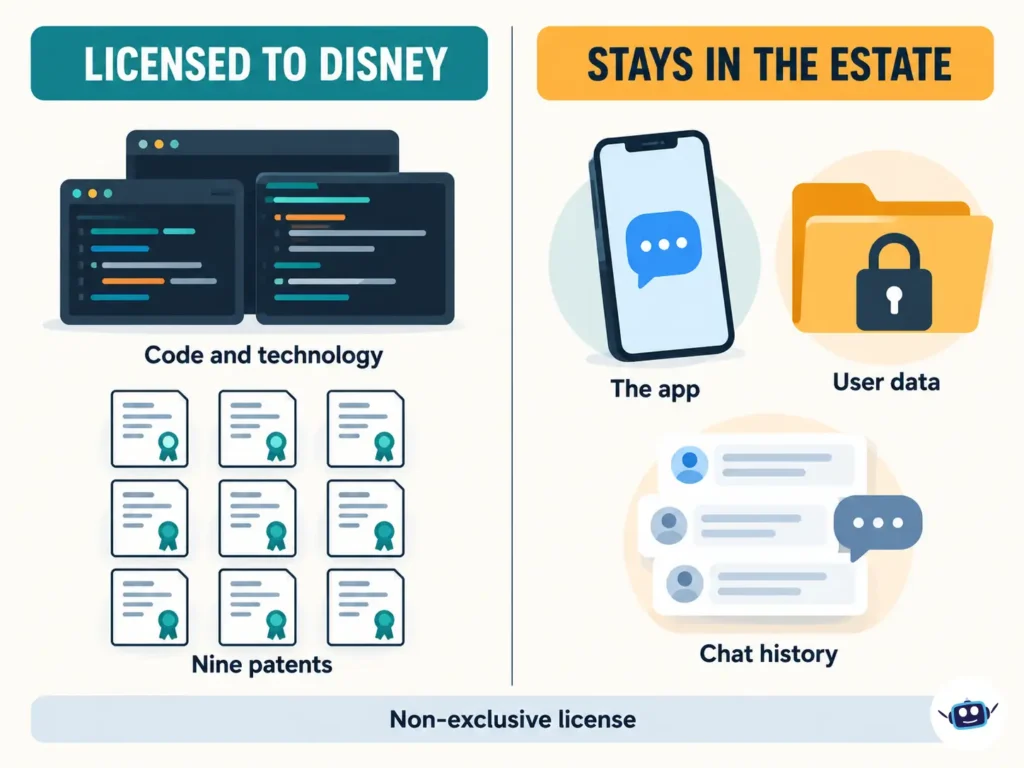
No. The headline “Disney acquires Character.AI assets” compresses a split deal. According to PPC Land’s reading of the bidding procedures motion, the license covers the engineering and leaves out the audience.
| Item | Disney’s license | Stays with the bankruptcy estate |
|---|---|---|
| Code for training, safety, serving, age prediction | Yes (a copy; 25 listed technology areas) | Original retained |
| Nine listed patents and applications | Licensed | Still owned by Character Technologies |
| Consumer app and website | No | Yes |
| Brand, trademarks, domains | No | Yes |
| User data, chats, user inputs and outputs | No | Yes |
| Training data and finished models | No | Yes |
| Most of the workforce | Hired by Disney | 18 active employees at filing |
Because the license is non-exclusive, Character.AI keeps ownership of the technology. The term sheet lets it license or sell the same code to others, subject to Disney’s permanent rights. A buyer of the app could therefore get the same engineering Disney has.
The people deal: how many, and at what cost
Of 86 full-time employees at the end of September, 66 accepted Disney offers. Business Insider reported that 56 had formally resigned at the time of the filing and 10 were waiting on work-visa updates. The company had 18 active employees on the petition date, and eight were expected to stay through key parts of the case.
The term sheet describes the structure this way, as summarized by Bondoro and PPC Land:
- Disney would require no more than six “key employees,” including the CEO, to accept offers.
- It would offer jobs to at least 60 others at pay set by Disney’s own practices, including bonus and stock-based compensation.
- Disney estimates about $60 million a year in run-rate compensation for roughly 65 offered employees.
- It adds a $30 million retention pool, paid on the first and second anniversaries and conditional on staying.
- It estimates total compensation and retention over three years at about $180 million.
Reading the numbers correctly
Some outlets reported “$60 million for 66 employees.” The filing’s own figure is an estimate for about 65 people. Spread evenly, that is roughly $920,000 per head per year, but this is only an average. It includes the CEO’s package and every junior engineer’s, so it says little about any one salary.
The term sheet also says employee pay “will not constitute consideration payable to the Company.” Creditors have a claim on the $20 million, not on the $180 million. Disney paid $7.5 million before the bankruptcy: $5.5 million was non-refundable and $2 million was a deposit.
Character.AI also agreed not to enforce non-compete, non-solicit, confidentiality or invention-assignment covenants against the people who left. It released them from claims, including fiduciary-duty claims for the CEO, and agreed not to recruit them back for three years.
The $20 million license: how it’s paid and what it covers
The $20 million comes in three parts. Disney paid $5.5 million up front and a $2 million deposit on September 18. The remaining $12.5 million is due at closing. If another bidder wins, Disney gets its deposit back plus up to $700,000 in bid protections, but the $5.5 million stays with Character.AI.
Schedule A of the stalking-horse agreement lists technology that reads like the build sheet of a consumer chatbot at scale:
- post-training recipes and evaluation frameworks;
- a safety stack and a long-horizon safety monitor called Guardian;
- an age-prediction model;
- inference, model routing and GPU cluster management;
- a system for managing character context and prompts;
- image and video generation tools.
Of the nine patents, four are issued US patents, including one on optimizing key-value cache for model inference. That addresses the cost of answering each message, which is a large expense for a free chat app.
The license is perpetual, worldwide, irrevocable and royalty-free. It covers products under Disney-owned or Disney-controlled branding. Disney cannot license the technology on a standalone basis to unrelated third parties. It is delivered “as is,” and Disney gets 30 days of access to the code repositories.
Why Character.AI ended up here
The company’s own filings show a business with real usage that did not cover its costs. Bondoro’s summary of the court papers gives these figures:
- About 12 million monthly active users, spending around 120 minutes a day on average.
- Fiscal 2025 revenue of about $23.6 million.
- August 2026 monthly revenue of about $5.3 million: roughly $2.8 million from subscriptions and $2.5 million from advertising.
- Monthly operating expenses, excluding legal fees, of about $13.3 million in August 2026, down from about $21.9 million in the second half of 2024.
- Net cash burn of about $8.2 million a month.
Reuters reported that compute spending reached $56.1 million between January and August 2026. The company stopped building its own large models after Google’s August 2024 deal, which paid about $2.7 billion for a non-exclusive license and brought back the founders. Disney’s $20 million is about 135 times less. Readers following how AI infrastructure is financed may want our coverage of data center bonds and AI debt, where compute costs and revenue expectations also collide.
Legal pressure compounded the cost problem:
- Private lawsuits. In January 2026, Character.AI and Google agreed to settle several family lawsuits over harm to minors. The debtor says one case, filed in August 2026, is the only personal-injury suit still pending.
- State actions. Kentucky sued in January 2026 and Pennsylvania in May 2026. A 46-member multistate group of attorneys general is negotiating a consent order.
- Teen restrictions. Open-ended chat for under-18 users ended on November 25, 2025.
- Failed sale attempt. A prior banker approached about 28 potential buyers or investors, who cited the litigation and regulatory overhang, and the outreach produced one proposal that did not proceed.
What a rival bidder faces
Disney is a stalking horse, meaning the opening bid that others must beat. Under the proposed procedures:
- A competing bid for the assets Disney is licensing must exceed $20 million plus the $700,000 break-up fee plus $1 million, so $21.7 million is the floor.
- Bids must be all cash, with a 10% deposit and no financing conditions.
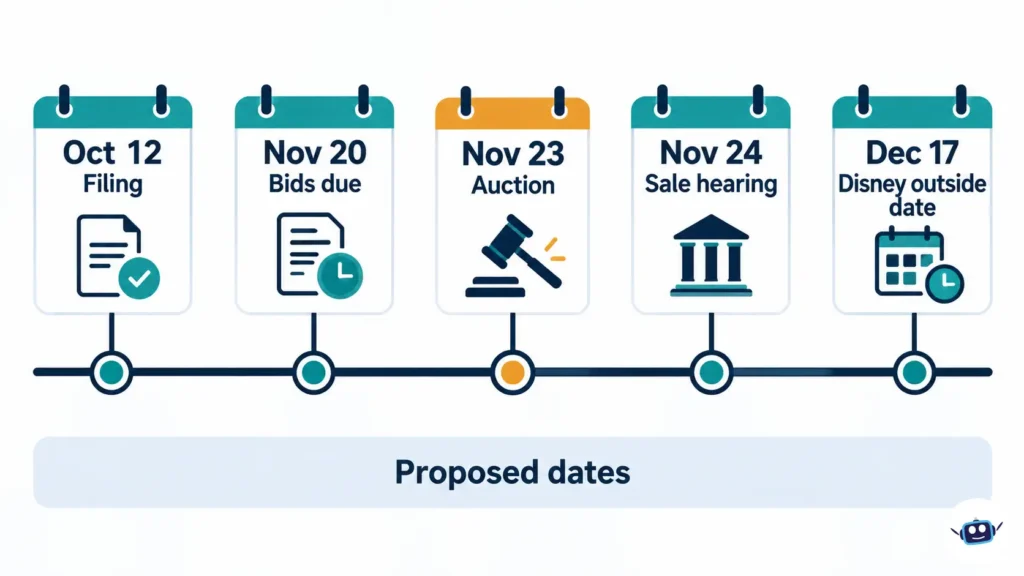
- Bids are due November 20 at 5:00 p.m. Eastern. An auction, if needed, is set for November 23, and the sale hearing for November 24.
- A rival winner must close by November 30. Disney’s own outside date is December 17.
- A winner could interview and make offers to the former Character.AI staff, though Disney may exclude up to 20% of them.
- Disney would provide transition services to a winner for the lesser of 60 days after closing or 75 days after the auction. The winner would pay Disney’s cost plus a 10% margin.
In practice, a rival could try to buy the app and hire back the team. But those people now draw Disney salaries and sit inside a retention pool that pays only if they stay.
What the states want from any buyer
On October 14, attorneys general from 39 states and the District of Columbia filed a 28-page notice of interest. Colorado’s attorney general led the group. The notice sets out nine conditions it expects any buyer of the business or its data to meet. According to reports on the filing, they cover age assurance, crisis safeguards, limits on chatbots impersonating licensed professionals, use of chats for model training, and advertising choices. One condition would give users a meaningful chance to access and delete their data before any transfer.
At the hearing, Character.AI’s attorney told the court that no buyer had yet made an offer for the user data or the operating chatbot business. Disney’s license excludes both.
What this means for people who use Character.AI
The app is still running and paid subscriptions remain active. Character.AI has said the platform will be wound down if no bid keeps it operating.
- Export your data now. Character.AI’s help page says the export takes three to four weeks, according to Notebookcheck’s report. In the web app, go to Profile Settings, then Account, then Manage Account & Data, then Export Data. In the mobile app, use the settings gear, then Legal & Privacy.
- Export before you delete. Deleting an account first can leave you without a copy.
- Save the characters you made. Copy each character’s description and sample dialogue separately, because an export may not preserve them in a reusable form.
- Treat the sale dates as proposed. The court must still approve the bidding procedures, and the company can move the dates.
What this means for AI companies and for Disney
This is an acqui-hire, a structure where a buyer takes the team and licenses the technology instead of buying the company. Character.AI has been on both sides of it. Google did a version in 2024, and Bondoro’s summary lists earlier examples such as Microsoft with Inflection and Amazon with Adept. Where this one differs is the bankruptcy. The value sits in the people and the code, while the audience, the liabilities and the consumer product are left for the estate.
For Disney, the deal buys engineering that includes safety and age-assurance tooling. The filings do not say what Disney plans to build. Analysts at eMarketer pointed toward in-house talent, parks and gaming rather than a standalone chatbot app, but that is interpretation, not a stated plan. Disney’s pay budget also arrives weeks after it laid off several hundred workers, including some in technology roles.
For other companion-chat products, the lesson is about exposure. Character.AI’s trouble came from child-safety cases and regulator attention more than from a lack of users. Readers comparing alternatives can see how privacy and pricing differ in our guide to DreamGen AI and in our explainer on Flipped AI’s character chat app. If you rely on an AI tool that might disappear, our piece on the discontinued InferKit and its alternatives covers what to look for before a service closes.
Dates to watch
| Date (2026) | Event | Status |
|---|---|---|
| October 12 | Chapter 11 filing, Delaware | Done |
| October 14 | State attorneys general file notice of interest | Done |
| November 17 | Final hearing on cash management | Scheduled |
| November 19 | Creditors’ meeting under oath, 1:00 p.m. ET | Scheduled |
| November 20 | Bid deadline, 5:00 p.m. ET | Proposed |
| November 23 | Auction, if needed | Proposed |
| November 24 | Sale hearing | Proposed |
| December 17 | Disney’s outside closing date | Proposed |
| February 18, 2027 | Latest end of Disney’s transition services | Per agreement |
Practical Insights
Separate the three things being sold. The workforce, the technology license and the consumer business are different assets with different buyers. Most confusion in headlines comes from merging them.
Follow the cash, not the headline. Disney’s roughly $180 million staff budget is about nine times its $20 million license price, and none of the staff money reaches creditors. The price of the license says little about what the people are worth to Disney.
The audience may be the hardest asset to move. The states’ conditions and the earlier failed outreach to 28 parties suggest that user data and a legal overhang reduce what a buyer will pay. That is reasoning from the filings, and the auction will show whether a bidder values the app differently.
Watch for a topping bid. The first sign of a rival will likely be a designated additional stalking horse by November 9 or a qualified bid by November 20. Silence until then points toward Disney’s license closing and the app shutting down.
Expect timeline slippage. The filings contain inconsistencies, such as a closing target of November 16 that the bidding calendar has already passed. PPC Land noted several of these. They do not change the economics, but they show the papers were assembled quickly.
FAQs
Did Disney buy Character.AI?
No. Disney is the opening bidder for a non-exclusive license to certain code, nine patents and claims against former employees. The app, brand, user data and finished models are excluded.
How many Character.AI employees is Disney hiring?
Of 86 full-time employees at the end of September, 66 accepted Disney offers. The term sheet describes at least 60 offers plus up to six key employees, including the CEO.
How much is Disney paying the employees?
Disney estimates about $60 million a year in run-rate compensation for roughly 65 people, plus a $30 million retention pool. Total compensation and retention over three years is estimated at about $180 million.
Is Character.AI shutting down?
Not yet. The app remains online during the sale. The company has said it will wind down the platform if no bid lets it continue operating.
Who is the CEO of Character.AI now?
Colin Adams is quoted as the company’s chief executive in the October 12 announcement. Karandeep Anand left to become Disney’s first chief technology officer.
Can another company outbid Disney?
Yes. A rival must top $20 million plus the $700,000 break-up fee plus $1 million, a floor of $21.7 million, with cash and no contingencies. Bids are due November 20 under the proposed schedule.
What happens to my Character.AI chats?
User chats and data are excluded from Disney’s license and remain with the estate. State attorneys general want any buyer to give users a chance to access and delete data before a transfer. Exporting your own copy now is the safest step.
Why did Character.AI go bankrupt?
The company cited high costs, potential litigation liabilities and regulatory engagement. Filings show August 2026 net cash burn of about $8.2 million a month against roughly $5.3 million in monthly revenue.
Conclusion
Disney’s deal moves the people and part of the engineering to a company with deep resources and leaves the consumer product, its data and its legal history in the estate. The next signals are the court’s approval of bidding procedures and whether any rival bids by November 20. The takeaways:
- Read “Disney bought Character.AI” as shorthand for a hiring deal plus a license.
- Treat the November dates as proposed until the court rules.
- If you use the app, request your data export now, since it can take weeks.
- If you build or buy AI companion products, weigh safety and data-handling exposure alongside usage numbers.
For more on funding and deals in the sector, see our Startups & Industry coverage.
Disclaimer
This article is general information about a developing news story and legal process, not legal advice. Court schedules, bid terms and app features such as data export times can change, so confirm current details with the court docket and Character.AI before acting. Information is current as of October 2026.