
Alphabet agreed on December 22, 2025, to buy Intersect, an existing Google partner that develops power and data center infrastructure, for $4.75 billion in cash plus assumed debt. The deal closed on March 10, 2026. Alphabet’s SEC filings put the total purchase price at about $5.9 billion after adjustments. Intersect keeps its own brand under founder Sheldon Kimber, but its operating assets in Texas and its California assets were left out of the sale. The aim is to build power plants next to new Google data centers instead of waiting for the grid.
Alphabet–Intersect deal at a glance
| Item | Detail |
|---|---|
| Announced | December 22, 2025 |
| Headline price | $4.75 billion in cash, plus assumed debt |
| Closed | March 10, 2026 |
| Purchase price in Alphabet’s 10-Q | About $5.9 billion after purchase price adjustments |
| Structure | Intersect stays separate from Alphabet and Google, under the Intersect brand, led by Sheldon Kimber |
| Not included | Operating assets in Texas; operating and in-development assets in California |
| First joint project | Quantum Clean Energy Project, Haskell County, Texas |
| Second joint project | Meitner Energy Center, Gray and Roberts Counties, Texas |
Timeline: from partnership to ownership
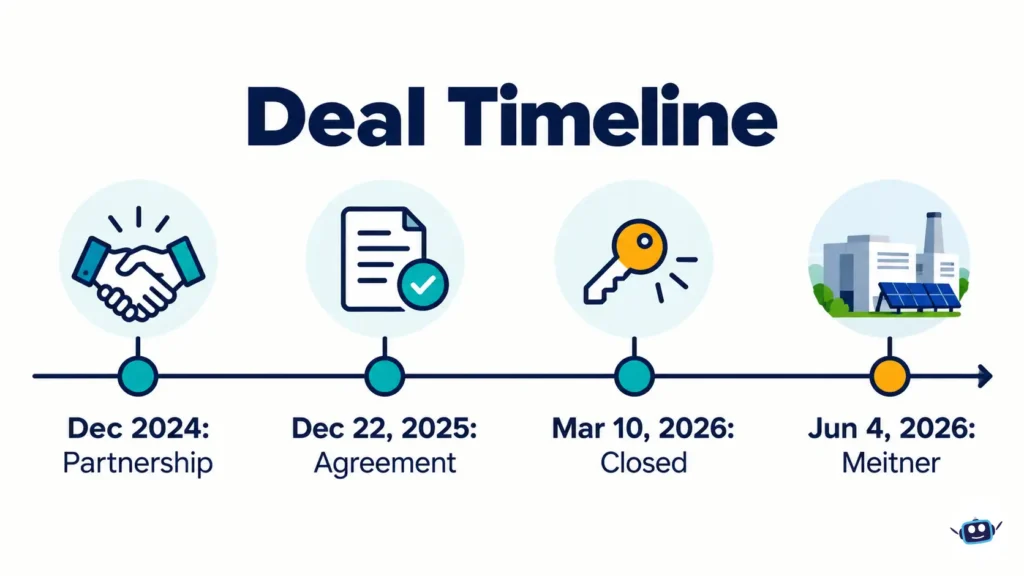
- December 2024: Intersect announced a strategic partnership with Google and TPG Rise Climate. It came with a funding round of more than $800 million and a target of $20 billion of renewable power infrastructure by 2030, according to POWER magazine and TechCrunch. Google became a minority owner.
- November 2025: Google announced a $40 billion Texas investment through 2027, including a data center campus in Haskell County.
- December 22, 2025: Alphabet announced the definitive agreement to acquire Intersect.
- March 10, 2026: The acquisition closed, inside the first-half-2026 window Alphabet had given.
- April 29, 2026: Alphabet raised its 2026 capital expenditure guidance to $180–190 billion. It said the range now included investment related to Intersect.
- June 4, 2026: Google and Intersect started construction on the Meitner Energy Center.
- July 22, 2026: Alphabet raised 2026 capex guidance again, to $195–205 billion.
What Alphabet bought, and what it did not
Alphabet’s announcement says the transaction includes Intersect’s team and “multiple gigawatts” of energy and data center projects that were in development or under construction through the existing Google partnership. Intersect will also explore emerging technologies to increase and diversify energy supply.
Several parts of the business stayed outside the deal. CNBC and PV Tech reported that Intersect’s existing operating assets in Texas, and its operating and in-development assets in California, were excluded. Those assets remain with existing investors, including TPG Rise Climate, Climate Adaptive Infrastructure and Greenbelt Capital Partners. Intersect said customers of those assets should expect uninterrupted service.
So Alphabet did not buy the whole company as it stood in 2025. It bought the development platform, the people and the pipeline tied to Google’s data center plans.
One more detail matters here. Intersect describes its business as co-locating energy-hungry industrial users with dedicated gas and renewable generation. It is a power developer that builds next to data centers, not a general-purpose renewable portfolio.
Why Alphabet bought Intersect
Power has become one of the hardest inputs to secure for AI data centers. Pichai tied the deal to building new generation “in lockstep with new data center load,” which means timing power plants and data centers together instead of connecting a finished data center to a grid that may not have spare capacity.
The demand side is documented. In Alphabet’s June 30, 2026 10-Q, Google Cloud revenue was $24.8 billion for the quarter, up from $13.6 billion a year earlier. Remaining performance obligations, meaning contracted revenue not yet recognized, were $519.5 billion, of which $513.9 billion related to Google Cloud. On the first-quarter call, Pichai told analysts Google was “compute constrained in the near term,” according to CNBC. Compute demand is not unique to Google. Our report on Anthropic’s reported third-quarter revenue shows how quickly AI customers are scaling.
Alphabet also said it is deploying AI to speed up grid connections for new power plants and supporting energy efficiency and affordability programs in data center communities.
How the co-located model works
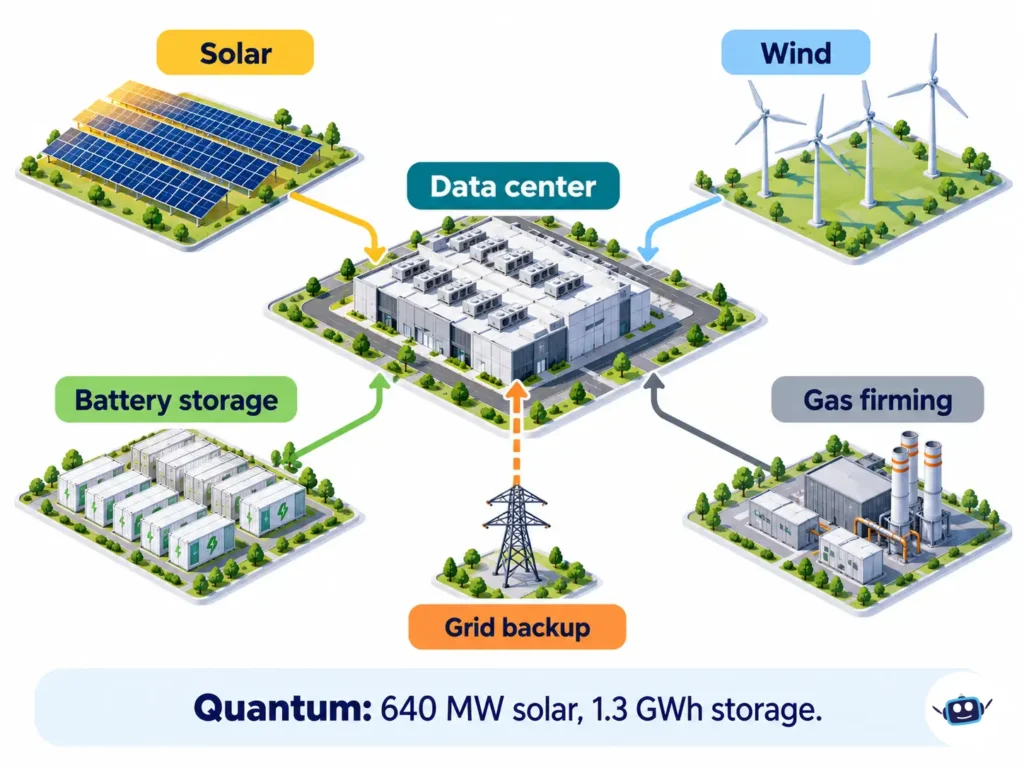
A conventional data center asks a utility for power and waits for generation and transmission to catch up. In the co-located model, a developer builds generation and storage on or next to the same site. The data center draws from that dedicated supply, with the grid as a backstop. pv magazine USA described this as a “behind-the-meter” approach that can ease congestion and interconnection delays.
Quantum: Haskell County, Texas
Quantum is the first joint co-located site. POWER and Data Center Dynamics report it as two solar-and-storage facilities with a combined 640 MW of solar and 1.3 GWh of battery storage, built beside a Google data center campus. Quantum was scheduled to start operating in June 2026, and the adjacent Google data center broke ground around the same time.
Meitner: Gray and Roberts Counties, Texas
Meitner is the second site. Google says it will pair a data center with more than 1 GW of wind, solar and battery storage, plus on-site gas-fired generation for firming. In Google’s words, most of the site’s power will be clean from day one, with a minority share from gas to keep operations reliable. The data center will use air cooling instead of evaporative cooling, which Google says avoids the water withdrawals of cooling towers. Google did not disclose the data center’s compute load, its power usage effectiveness targets or a commercial operation date.
The price tag: $4.75 billion, $5.9 billion, and the capex picture
Most coverage repeats the $4.75 billion headline. Alphabet’s own filings give the fuller number. The 10-Q says Alphabet completed the acquisition on March 10, 2026, “for $5.9 billion, after purchase price adjustments.” The purchase accounting table lists about $1.2 billion of debt, which matches the “plus assumption of debt” wording in the December announcement.
For scale, Alphabet’s cash flow statement shows $80.6 billion of purchases of property and equipment in the first half of 2026 alone. Against 2026 capex guidance of $195–205 billion, the roughly $5.9 billion purchase price is about 3% of the midpoint. That is simple arithmetic, not an Alphabet statement. Intersect is small next to the overall buildout, but it targets one of the scarcest inputs.
Financing is a live question across the sector. For the debt side, see our report on how investors are repricing AI data center debt.
What it means for electricity customers and communities
Alphabet framed the deal as expanding reliable, affordable power for data center growth while avoiding added costs for grid customers. POWER reported that in March 2026 Google signed the White House Ratepayer Protection Pledge, committing to pay for all of its power and for infrastructure costs driven by its growth.
Co-location lowers dependence on local utilities, but it does not remove community questions. Meitner uses gas for firming. Large construction projects bring workforce housing and road demands. POWER reported that Google is building an 800-acre workforce hub in Wheeler County for up to 3,500 construction workers. Readers following the policy side can find related coverage in our AI Policy & Ethics section.
Common misconceptions
- “Alphabet bought all of Intersect.” It did not. Operating assets in Texas and operating and in-development assets in California stayed with existing investors.
- “The deal is still pending.” It closed on March 10, 2026.
- “It cost exactly $4.75 billion.” That is the announced cash price. The 10-Q reports a total purchase price of about $5.9 billion after adjustments.
- “Intersect is purely renewable.” Its own description includes dedicated gas generation, and Meitner includes on-site gas for reliability.
- “Intersect is now part of Google’s operations.” Alphabet said it will remain separate under the Intersect brand, working closely with Google’s technical infrastructure team.
- “Quantum’s megawatts equal data center capacity.” Quantum’s 640 MW and 1.3 GWh describe the solar and battery plant, not the data center’s computing load.
Practical Insights
These points come from the verified figures above and standard reasoning about how these deals are reported.
- Read the filing, not just the headline. The $4.75 billion in the press release and the $5.9 billion in the 10-Q describe the same transaction at different stages of accounting. Quote both, with dates.
- Keep energy capacity and data center load separate. MW and GWh at Quantum tell you about generation and storage. They do not say how many servers the campus will run. Google has not published that figure for Meitner.
- Check which basis a source uses. Earlier coverage of portfolio documents cited 840 MW for Quantum’s solar, while 2026 announcements cite 640 MW. Figures like these often differ by what is counted, so confirm the basis before comparing projects.
- Wait for commissioning evidence. As of mid-October 2026, the sources reviewed confirm Quantum’s scheduled June start and the data center’s groundbreaking. They do not include a dated notice that the data center itself is operating.
- Use capex guidance as the scoreboard. Alphabet moved 2026 guidance from $175–185 billion in February to $180–190 billion in April to $195–205 billion in July. The next filing shows how much Intersect-related spending is flowing through.
- Judge the clean-power claim by site. Alphabet says most of Meitner’s power is clean from day one. The minority gas share and its emissions treatment are the details to track.
What to watch next
- Whether Google or Intersect confirms the Quantum data center is energized.
- A commercial operation date or capacity figure for Meitner.
- Further co-located sites. Intersect’s own website, cited by ESG Dive, points to 10.8 GW of clean energy capacity expected to be operating or under construction by late 2028. That is Intersect’s target, not an Alphabet commitment.
- Alphabet’s next quarterly filing for updated Intersect and capex figures.
- Whether other hyperscalers copy the model. More on industry deals is in our Startups & Industry section and our AI News coverage.
Frequently Asked Questions
How much did Alphabet pay for Intersect?
Alphabet announced $4.75 billion in cash plus the assumption of debt. Its 10-Q reports a total purchase price of about $5.9 billion after purchase price adjustments, which includes assumed debt of roughly $1.2 billion.
Has the Alphabet–Intersect deal closed?
Yes. Alphabet’s 10-Q states the acquisition was completed on March 10, 2026. The original guidance was a first-half 2026 close.
Did Alphabet already own part of Intersect?
Yes. Google took a minority stake in Intersect’s funding round of more than $800 million in December 2024, led with TPG Rise Climate. The 2025 deal moved Alphabet from minority investor to owner of the acquired business.
What was left out of the acquisition?
Intersect’s existing operating assets in Texas, and its operating and in-development assets in California, were not included. They stay with existing investors, including TPG Rise Climate, Climate Adaptive Infrastructure and Greenbelt Capital Partners.
Will Intersect keep operating under its own name?
Yes. Alphabet said Intersect remains separate from Alphabet and Google under the Intersect brand, led by Sheldon Kimber. It works closely with Google’s technical infrastructure team on joint projects.
Is Intersect’s power all renewable?
No. Intersect describes pairing industrial demand with dedicated gas and renewable generation. At Meitner, Google says most power will be clean from day one, with a minority share from on-site gas for firming.
Where are the first Google–Intersect projects?
Quantum is in Haskell County, Texas, with 640 MW of solar and 1.3 GWh of storage. Meitner is in Gray and Roberts Counties, Texas, with more than 1 GW of wind, solar and storage plus gas firming.
Does the deal change anything for Google Cloud customers?
Alphabet has not announced product or pricing changes. The stated purpose is to bring more data center and generation capacity online faster to meet Cloud customer and user demand.
Key takeaways
Alphabet’s purchase of Intersect closed on March 10, 2026, and it is best understood as a power supply move. Alphabet bought the team and development pipeline tied to Google’s data center plans, not the entire company. Use the filing’s $5.9 billion total alongside the $4.75 billion headline, keep generation capacity separate from data center load, and treat Intersect’s 2028 capacity target as a company goal. For updates, watch Alphabet’s next filing, commissioning notices for Quantum and any capacity disclosure for Meitner.
Disclaimer
This article gives general information about a corporate transaction and is not financial, investment or tax advice. Figures come from company statements and public filings, may be revised, and results of any investment decision can vary, so please consult a licensed professional before acting. The information is current as of October 2026.