
The AI sell-off is hitting companies that supply the power, cooling, construction and connections behind data centers. The immediate concern is whether future profits and cash generation can justify expectations for the AI build-out. Strong sales alone do not settle that question.
On October 23, 2026, Bloom Energy, Comfort Systems USA and Credo were among the infrastructure stocks under pressure. Yet recent company disclosures show substantial business growth. Understanding this split requires looking at three separate things: demand for AI computing, suppliers’ financial performance and the valuations investors assign to that performance.
What Happened to AI Data Center Stocks?
Yahoo Finance’s October 23 coverage identified a broad retreat across the companies building and equipping AI data centers. Its report highlighted Bloom Energy’s on-site electricity systems, Comfort Systems’ mechanical and electrical contracting, and Credo’s connectivity products.
The timing matters. Bloom and Comfort Systems released their third-quarter results on October 22. Selling continued the following day despite strong revenue figures.
That establishes a gap between reported business activity and market pricing. It does not establish that AI demand has collapsed, or that every company’s shares fell for the same reason.
The useful question is: How much durable, profitable growth is already reflected in each stock’s price?
Which Companies Supply the AI Build-Out?
“AI infrastructure” covers several businesses with different customers, costs and risks.
| Company | Role in the build-out | What deserves attention |
|---|---|---|
| Bloom Energy (BE) | Fuel-cell systems that generate electricity on-site | Cash collection, manufacturing investment and margins |
| Comfort Systems USA (FIX) | Mechanical, HVAC and electrical contracting | Project execution, backlog conversion and cash flow |
| Vertiv (VRT) | Power, cooling and other critical infrastructure | Orders, delivery schedules and profitability |
| Credo (CRDO) | Connectivity solutions using copper and optical technologies | Customer demand, product adoption and margins |
A construction contractor earns money differently from a component supplier. A data center landlord also has a different business model from either.
Grouping them together can reveal shared exposure to AI investment, but it can hide important differences in financial resilience.
What the Latest Results Actually Show
Bloom Energy: Growth With a Cash-Flow Question
Bloom’s October 22 release reported third-quarter revenue of approximately $1.236 billion, up 138.1% from a year earlier. It raised full-year revenue guidance to $4.4 billion–$4.6 billion.
Its GAAP gross margin improved to 33.8%, compared with 29.2% a year earlier and 33.4% in the preceding quarter. Describing those figures as a gross-margin decline would be inaccurate.
The cash statement presents a different concern. Bloom used approximately $27.1 million in operating cash and spent $153.5 million buying property, plant and equipment. Operating cash flow minus those purchases was therefore approximately negative $180.6 million, a simple free-cash-flow calculation.
Interpretation: Sales growth and improved margins can coexist with cash outflows. The next question is whether investment and working-capital requirements eventually produce stronger cash generation.
Comfort Systems: Backlog and Cash Both Increased
Comfort Systems’ October 22 release reported quarterly revenue of $3.77 billion and operating cash flow of $1.01 billion.
Its backlog reached $17.81 billion at September 30, compared with $9.38 billion a year earlier. The company’s quarterly filing also reported substantial growth on a same-store basis, showing that acquisitions alone did not explain the increase.
There is an important qualification. Comfort Systems says its backlog covers contracted or committed installation and replacement work, while service work and some short projects do not pass through that measure. It describes backlog as an indicator of near-term revenue direction with limited predictive value.
Interpretation: A larger backlog supports visibility into work ahead. Assessing its value still requires examining timing, execution costs and the cash ultimately collected.
Why Strong Earnings Can Accompany Falling Stocks
Expectations Can Change Faster Than Results
Share prices reflect expectations about future performance. A company can report rising earnings while investors become less willing to pay a high price for those earnings.
The SEC’s Investor.gov explains that the price-to-earnings ratio compares a stock’s price with earnings per share. If the valuation multiple falls enough, a stock can decline even when earnings rise.
For AI suppliers, this means impressive historical growth does not automatically answer questions about spending several years ahead.
Revenue, Profit and Cash Measure Different Things
Revenue records sales under accounting rules. Profit deducts expenses. Operating cash flow tracks cash generated or used by operating activities.
Free cash flow commonly subtracts capital expenditure from operating cash flow, although company definitions can vary.
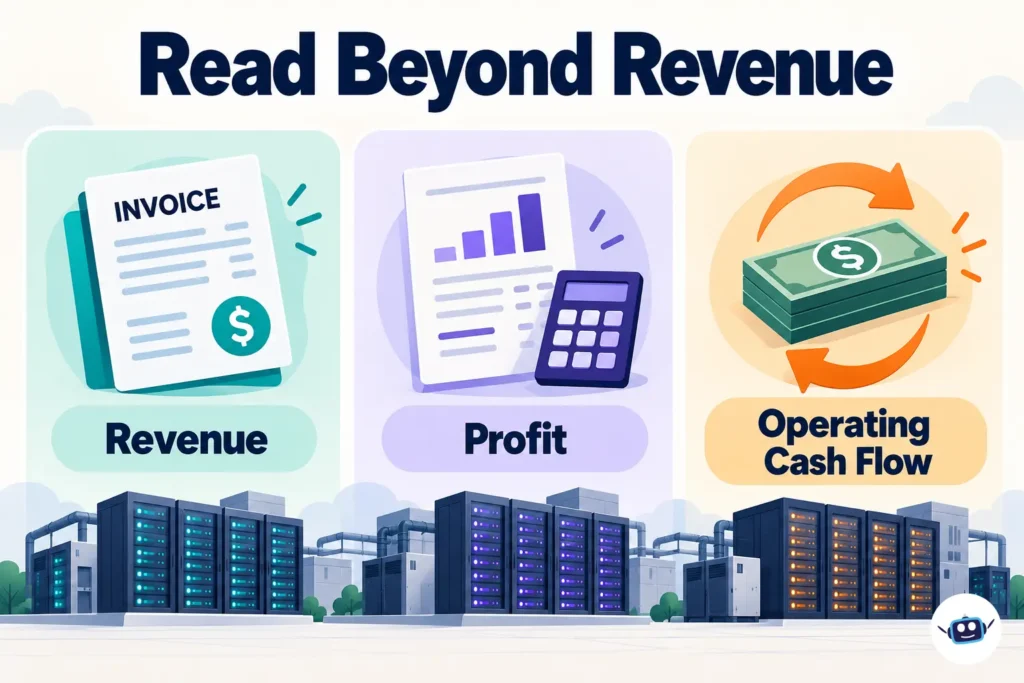
These distinctions matter during rapid expansion. Building capacity and funding inventory can consume cash before customer receipts arrive. A profitable quarter therefore does not guarantee that a supplier can fund its next stage of growth without additional financing.
Our coverage of AI data center financing and debt risks examines the funding side of the same infrastructure expansion.
Power Shortages Create Opportunity and Execution Risk
Limited power availability can increase the importance of on-site generation, electrical equipment and cooling systems. It can also delay the facilities those suppliers expect to serve.
The International Energy Agency’s 2026 analysis identifies constraints involving electricity connections, energy equipment, chips and project approvals.
The commercial implications depend on a company’s position. An operating facility with secured power faces different risks from a development still waiting for an interconnection. An equipment supplier may have demand but still need to manufacture, deliver and receive payment.
Our explainer on Alphabet’s Intersect acquisition and data center power strategy provides related context on coordinating energy supply with computing projects.
Does the Sell-Off Mean AI Computing Demand Is Falling?
A stock-market decline cannot answer that on its own.
The IEA’s 2026 central projection puts global data center electricity consumption at approximately 950 terawatt-hours in 2030, compared with 485 TWh in 2025. These figures cover data centers overall; they are not a measurement of AI alone.
The agency also expects electricity consumption from AI-focused facilities to triple over that period. These are projections, subject to technology, financing and infrastructure constraints.
Efficiency adds another complication. The IEA reports that energy use per AI task is declining, while broader adoption and more demanding applications can increase total consumption.
For LLM developers and businesses, the relevant measures include the cost of completing a useful task, service reliability and the computing capacity available. Cheaper inference can change demand patterns without eliminating the need for infrastructure.
Our GPU compute rental pricing guide explores the customer-facing side of computing costs.
Practical Insights: How to Read the Next Earnings Report
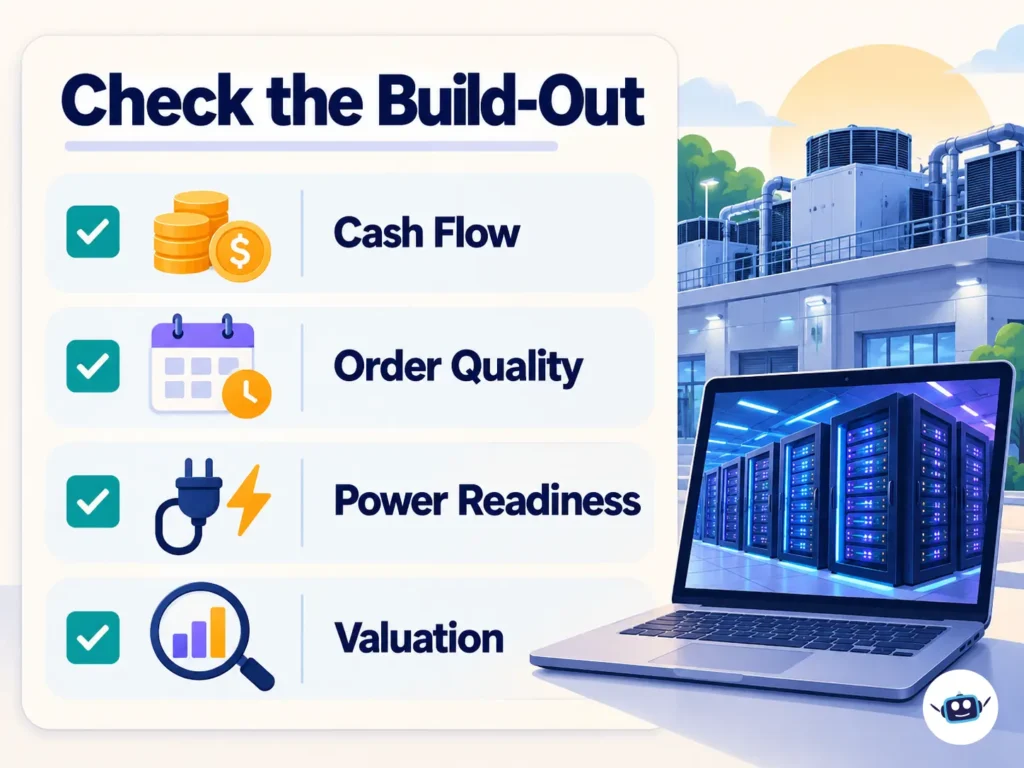
A consistent review process helps distinguish a valuation correction from deteriorating business conditions.
- Identify the business model. Establish whether the company sells equipment, performs construction, rents computing capacity or leases facilities. Each model has a different path from investment to cash receipts.
- Compare equivalent periods. Keep quarterly and year-to-date figures separate. Check both sequential and year-over-year changes before describing margins as improving or weakening.
- Read the cash statement. Examine operating cash flow alongside capital expenditure. Investigate receivables, inventory and customer deposits when cash generation moves sharply.
- Inspect the order measure. Determine what the company includes in backlog or contracted revenue. Look for delivery timing, cancellation provisions and customer concentration.
- Separate actual results from guidance. A completed quarter is historical evidence. Management’s outlook is an estimate.
- Connect spending to deployment. Follow power availability, completed installations, utilization and customer payments alongside announced construction budgets.
A common mistake is treating every decline as evidence of a failed AI project. Another is assuming a large backlog makes valuation irrelevant.
For businesses buying AI services, these checks also support supplier assessment. Reliable capacity, contract flexibility and a provider’s ability to keep funding operations can matter as much as an attractive headline price.
What to Watch After October 24
Several scheduled releases provide near-term checkpoints:
| Company | Announced reporting date | Questions to examine |
|---|---|---|
| Vertiv | October 28, 2026 | Are orders converting into deliveries, margins and cash? |
| Microsoft | October 28, 2026 | How does cloud demand compare with infrastructure spending? |
| Alphabet | October 28, 2026 | What changes in capital expenditure and capacity commentary? |
| Amazon | October 29, 2026 | What do AWS results and investment plans indicate? |
These dates come from company announcements. The results were still pending as of October 24.
More spending would support evidence of continued investment, but the quality of that spending also matters. Watch whether deployment, customer demand and cash generation develop together.
FAQs
Why are AI data center stocks falling despite strong results?
Strong results can arrive alongside lower expectations for future returns or lower valuation multiples. Cash requirements, financing conditions and delivery risks can also affect how investors assess a growing business.
Which companies are involved in the data center build-out?
Bloom Energy, Comfort Systems USA, Vertiv and Credo represent different parts of the supply chain. Their activities include on-site power, construction, cooling, electrical infrastructure and connectivity.
Did Bloom Energy’s gross margin decline?
Its reported third-quarter 2026 GAAP gross margin increased both year over year and sequentially. Its quarterly cash outflow is a separate financial issue and should be evaluated separately.
Does a record backlog guarantee future profits?
No. Backlog measures work or commitments under a company’s definition, rather than guaranteed profit. Delivery schedules, costs, contract terms and execution affect the eventual financial outcome.
Are all data centers used for artificial intelligence?
No. Data centers also support conventional cloud services, storage and other digital workloads. Industry-wide electricity figures should therefore be distinguished from estimates specifically covering AI facilities.
Will more efficient AI models reduce infrastructure demand?
Efficiency can reduce the resources needed for an individual task. Total demand also depends on how many tasks users perform and how demanding those tasks become, so efficiency alone does not determine infrastructure needs.
Does the sell-off mean AI services will become cheaper?
A falling supplier stock price does not directly set cloud or API prices. Customers should compare actual provider pricing, availability, usage limits and contract terms rather than assume a market decline will reduce their bills.
Does a lower share price make an AI stock a bargain?
A lower price alone does not establish value. The assessment also depends on earnings prospects, cash generation, financing needs and the expectations still embedded in the valuation.
Conclusion
The AI sell-off highlights the need to evaluate infrastructure demand and investment returns separately. Recent disclosures show substantial activity, while cash requirements and future expectations remain central to the financial assessment.
Follow cash flow, margins, order quality and deployment progress together. For AI businesses, also track the capacity and service terms available to customers. Those measures provide a firmer basis for decisions than either a construction announcement or a falling stock chart alone.
Disclaimer
This article provides general information only and is not financial, investment or tax advice. Information is current as of October 2026; market prices, company guidance and reporting schedules can change. Investment outcomes vary, and you can lose money, so consult a qualified, appropriately licensed financial professional before making investment decisions.