
Steam AI clone problems are cases where someone uses AI tools to copy a game’s look, mechanics or code and release the copy on Steam before, or alongside, the original. Since mid-October 2026, indie developers have reported copies appearing within days, plus emails threatening a clone unless they pay. Valve responded on October 27. It announced no new clone checks, said it won’t police which tools developers use, and advised studios to build a community and keep updating their games.
Before you act on any rule below, check Valve’s current Steamworks documentation. Steam’s policies and events change faster than any article can.
One context note first. Reports differ on small details. Most outlets place Valve’s Q&A in Busan, South Korea, though one said Seoul. Next Fest was reported as having 7,240, 8,011 or 8,202 games depending on when and how it was counted. This article explains those differences where they matter.
What changed in the last six weeks
| Date | What happened |
|---|---|
| August 2026 | A viral post boosts the unreleased Needle In A Haystack Simulator; a handmade copy and then more clones follow (Aftermath) |
| Late Sept to early Oct | Developers of Iron Pilgrim and Circusar report emails threatening an AI clone unless they pay |
| Oct 16 | NoGlyph publicly alleges another studio copied its code |
| Oct 17 | Studio Athome’s Takashi Mochibe shares a similar $200 demand on X |
| Oct 19 to 26 | Steam Next Fest runs with a record number of demos |
| Week of Oct 19 | Alliance Arts cancels a public demo; Digital Sun delays a public ReVamp playtest |
| Oct 27 | Valve’s Steam business team answers developers at Steam Indie Connect |
What did Valve say about AI clones on October 27?
Tom Giardino and Marc Wilkinson spoke at Steam Indie Connect, co-hosted by Valve, the Busan Indie Connect Festival Organizing Committee and the Korea Creative Content Agency. Inven Global’s report was translated from Korean. Game Developer said it had the translation verified by a native speaker. Treat the wording as close paraphrase, not a transcript.
| Topic | Valve’s position |
|---|---|
| Policing tools | Valve doesn’t want to act as a gatekeeper on which tools developers use, AI included |
| Clones | They predate AI; AI has sped them up |
| Recommended defense | Build a community and identity, then keep adding features and personality a single mechanic can’t capture |
| Extortion emails | First time Giardino had heard of it; a law-enforcement matter, but Valve wants reports |
| Next Fest slop | The first two days are near-random by design; Valve admits “some low-quality games get exposed” and is discussing responses |
| Wishlists | They don’t affect store visibility; people buying and playing does |
| New solutions | None announced, per Inven Global’s summary |
Game Developer added background. Valve has kept a largely hands-off approach to curation since 2018, when it said it would allow nearly everything apart from content it judges illegal or trolling.
Is it a clone, slop, or an AI-disclosed game?
Headlines blur three separate things. Separating them changes how worried you should be.
| Type | What it is | Example evidence |
|---|---|---|
| Clone | Copies another game’s idea, look or code | NoGlyph alleges 13 identical class names and leftover error messages in another game (as reported by PC Gamer) |
| Slop | Low-effort content, not necessarily copied from anything | Players’ complaints about thousands of Next Fest demos |
| AI-disclosed game | The developer reported generative AI in content that ships to players | 2,502 of 7,240 Next Fest games in one scrape |
The NoGlyph claims are the developer’s own, as relayed by PC Gamer. I found no response from the accused studio.
What do Steam’s AI rules actually cover?
Valve’s Steamworks documentation says every developer completes a Content Survey before a store page and build go to review. Its generative AI section covers content that ships with the game and is consumed by players: art, sound, narrative, localization and similar. Valve says efficiency gains from AI features built into development tools are “not the focus.”
| Pre-generated | Live-generated | |
|---|---|---|
| Meaning | AI-assisted content created during development that ships with the game | AI content created while the game is running |
| Valve’s check | Reviewed like non-AI content, including the Distribution Agreement promise of no illegal or infringing content and consistency with marketing | Same rules, plus a description of the guardrails against illegal output |
| Special limit | None listed | Valve won’t ship live-generated, adult-only sexual content |
Two points readers often miss. First, finishing the survey doesn’t clear a game. Valve’s FAQ says products must follow the content rules whether or not they disclose. Second, nothing in these rules targets a game for resembling another game. Copyright holders are pointed to Steam’s DMCA form, and trademark owners to a separate trademark complaint form.
How big is the Next Fest flood, and why do the numbers disagree?
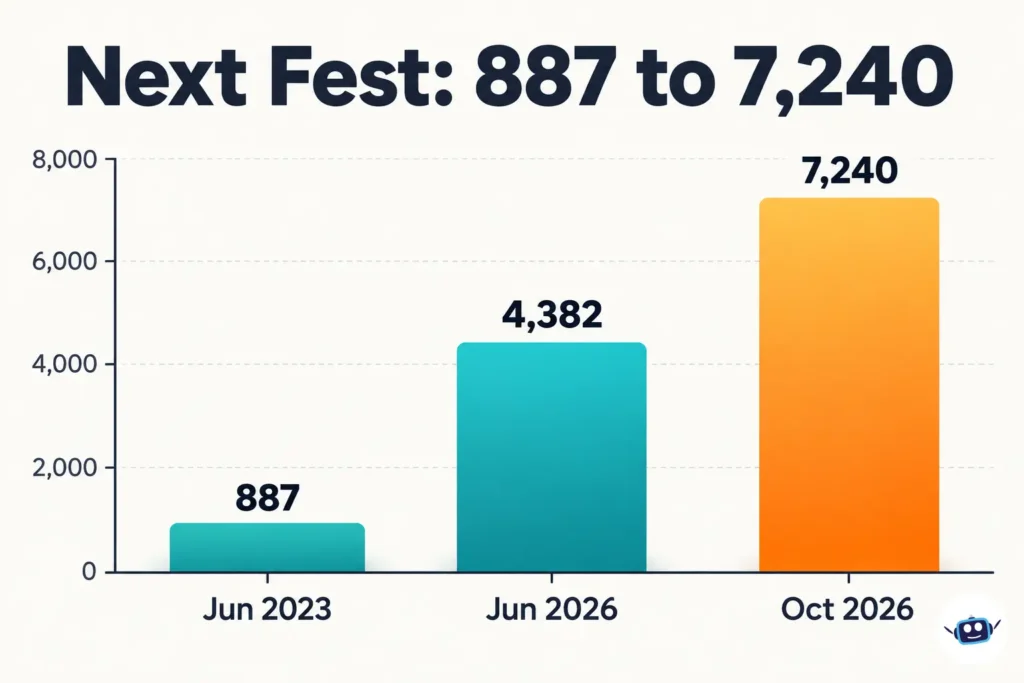
| Edition | Games participating |
|---|---|
| June 2023 | 887 |
| June 2026 | 4,382 |
| October 2026 | 7,240 |
Source: GameDiscoverCo for earlier editions, and Chris Zukowski’s scrape of the live October page.
Many articles said 8,000 or more because the press preview page listed 8,011 at one point (PC Gamer). Zukowski explains that developers withdraw games after the preview, so a live-page count runs lower. AI-disclosure totals vary for the same reason, since outlets drew on different SteamDB listing sets. Estimates run from roughly 15% to over 36%. Zukowski’s own figure is 34.6%. Treat every percentage as an estimate, because Valve itself hasn’t published one.
His data also adds nuance:
- Only 2 of the 25 most-played demos carried an AI disclosure.
- Of the games with a disclosure, 75.7% mentioned art or visuals, and only 3.0% mentioned runtime generation.
- Valve doesn’t require disclosing code assistants, so the code figure is low by design.
- He argues that stolen-game stories reaching the top of the charts are rare. He also notes his figures rely on honest disclosure.
Is cloning a game illegal in the US?
It depends on what was copied. The US Copyright Office says copyright doesn’t protect ideas, procedures, processes, systems or methods of operation, though it can protect how they are expressed.
| What was copied | Generally covered by US copyright? | Practical route |
|---|---|---|
| Core idea, rules, mechanics | Usually not | Compete on quality and community; ask a lawyer about unusual cases |
| Source code | Can be | DMCA notice through Steam’s copyright form |
| Art, music, text | Can be | DMCA notice |
| Name or logo | Not copyright; trademark may apply | Steam’s trademark complaint form |
| Overall look (palette, fonts, style) | Unclear | A lawyer can assess it |
Legal scholars debate how far video game rules should be protected, and AI doesn’t change the statute. The point holds regardless: a copied idea and copied code are different claims.
What should developers do about AI clones?
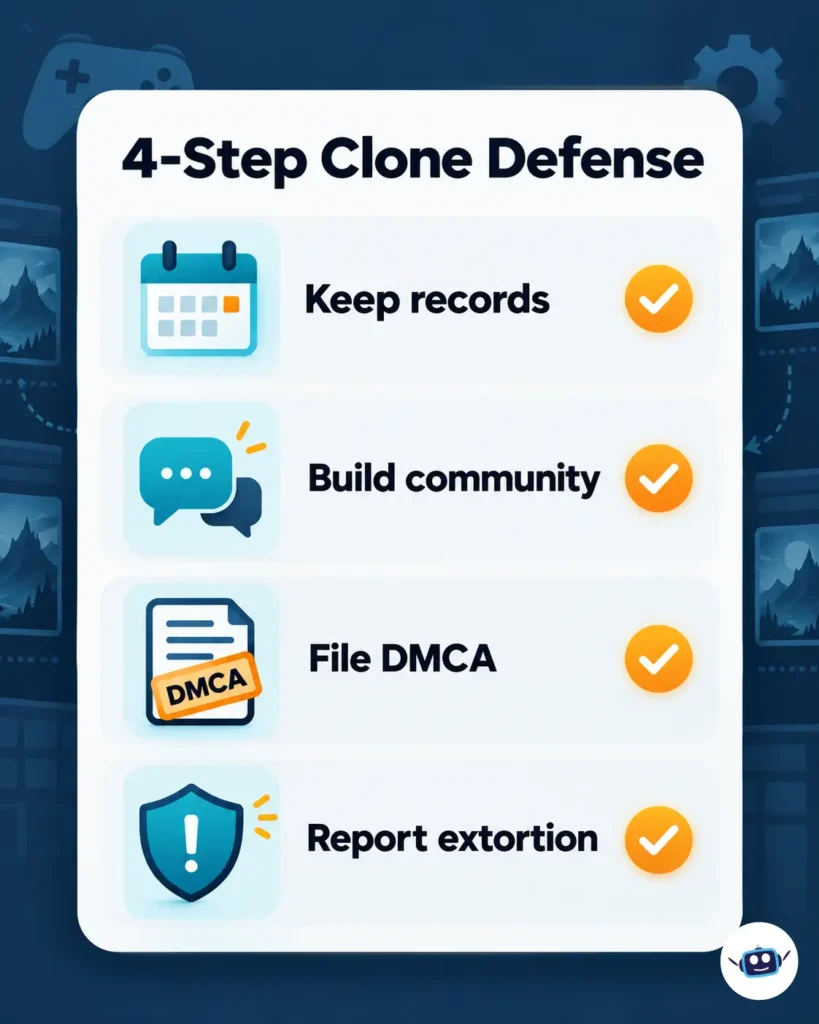
- Keep dated records. Archive builds, design documents, trailers and store-page versions with timestamps.
- Decide what to show, and where. Developers quoted by Aftermath are posting mood boards instead of gameplay, using their own websites, or planning shadow drops. Each choice trades discovery for protection.
- Build what’s hard to copy quickly. Valve points to a studio homepage, player relationships, steady updates and a distinct identity. Giardino also said this takes time and isn’t enough alone.
- Know your risk. Rami Ismail told Aftermath that small, hook-driven games are the easiest to clone fast. Simon Carless argued that complex, personality-heavy games needn’t delay demos.
- Use Steam’s data. Wilkinson’s advice was to treat wishlists as a thermometer for marketing, not a ranking lever.
What if I get an “I’ll clone your game” email?
| What you see | Likely cause | What to do |
|---|---|---|
| Email demands about $200 in Steam items within 24 hours | The reported extortion pattern; at least one reportedly lacked proof a clone existed | Don’t pay; save the email; report it to Valve and the police |
| Another game contains your file names, class names or error text | Possible copied code | Document it; file a DMCA notice via Steam |
| A game uses your title or logo | Possible trademark issue | Use Steam’s trademark form |
| A game plays like yours but shares no code or assets | Mechanic imitation | Compete on quality; consult a lawyer |
| Your demo is drowned out during Next Fest | Crowding; near-random first two days | Valve says personalized recommendations then take over |
In the cases I found, no developer reported paying.
How can players spot a clone or an AI-heavy game?
Check the store page for the developer’s AI disclosure. Players say it sits low on the page and is easy to miss. Read what it says was generated, since disclosures are free text, and look at the developer’s other titles, release history and reviews. If you meant to buy a specific game, compare the store page against the original’s official site. The third-party site SteamDB has offered a filter for AI-disclosed games since 2025, according to GamingOnLinux.
Common mistakes and misconceptions
- “Valve banned AI games.” It didn’t. Reports of a rejected game in 2023 centered on whether the developer had rights to the training data. The current rules allow AI content with disclosure.
- “Wishlists drive visibility.” Valve says they don’t.
- “The first two days of Next Fest show the whole event.” Valve says those days are near-random by design.
- “Every clone is AI-made.” Clones predate AI.
- “More games means more clones.” Next Fest’s growth also reflects more developers joining, a point Zukowski raises.
Practical Insights
These points come from the verified facts above plus reasoning. I didn’t test anything hands-on.
- Speed is the clone’s edge. A copy doesn’t need to be better, only earlier or similar enough to confuse buyers. That is why developers fear the gap between a public demo and launch.
- Risk tracks simplicity. Ismail and Carless both tie vulnerability to how few ideas carry the game.
- The legal line follows the expression. Copied code and assets give a copyright route. Imitated gameplay usually doesn’t.
- Valve’s levers are algorithmic. It said it prefers improving discovery to restricting developers, so expect any change to show up in how Steam surfaces games.
- The tools aren’t the villain in every case. AI coding assistants are accepted by many developers. Our guide to AI coding agents versus chatbots explains how capable they’ve become. Image models like Canva Craft show how fast polished key art can now be produced, one reason store pages are harder to judge at a glance.
- Watch the next event. Steamworks lists event pages for February and June 2027. Whether Valve changes the random first two days is the open question.
Should you change your plans because of AI clones?
| Your situation | Sensible move |
|---|---|
| Simple, hook-based game with a viral clip | Weigh the risk carefully; consider showing less or shortening the gap to launch |
| Complex or narrative-heavy game | Carless’s view is that delaying a demo is less necessary |
| You already received an extortion email | Don’t pay; report it |
| You suspect copied code | Document, then file a DMCA notice |
| You just want to buy a game | Check the disclosure, developer history and reviews |
FAQs
Q. What are Steam AI clone problems?
They are reports that AI tools make it fast and cheap to copy a game and release the copy on Steam or other stores. They also include extortion emails threatening such copies. Developers say this makes public demos riskier.
Q. Has Valve banned AI-made games on Steam?
No. Games can ship with AI content if the developer discloses it in the Content Survey and the game contains nothing illegal or infringing.
Q. Will Valve remove AI clones?
Valve announced no new clone-specific checks on October 27. Copyright holders can file a DMCA notice, and trademark owners can use the trademark form.
Q. Is copying a game’s mechanics illegal in the US?
Generally, copyright doesn’t protect ideas, systems or methods of operation. It can protect code, art, music and text, and trademark law can cover names and logos.
Q. How do I tell whether a Steam game uses AI?
Read the disclosure on its store page and see what it says was generated. Disclosures are free text and not a full inventory.
Q. Does Steam have an AI filter?
Valve hasn’t promised one. SteamDB, a third-party site, has offered one since 2025, according to GamingOnLinux.
Q. Should developers skip demos or Next Fest?
It’s a judgment call. Alliance Arts and Digital Sun scaled back public builds, while Carless and Zukowski urged caution about drastic decisions.
Q. What should I do about an extortion email?
Don’t pay, keep the message, and report it to Valve and the police.
Conclusion
Steam’s AI clone problem is real but narrower than the loudest headlines suggest. The hard evidence points to fast copies of viral or simple games, a flood of low-effort Next Fest entries, and extortion attempts. Valve’s response so far leaves tool choices alone and leans on discovery and developer-side defenses.
Takeaways:
- Separate clones, slop and AI-disclosed games before judging any claim.
- Keep dated records of what you build and show.
- Use DMCA for copied code or assets and the trademark form for copied names or logos.
- Treat extortion emails as scams to report, not bills to pay.
- Invest in community and updates, which Valve says a clone can’t copy overnight.
- Treat any AI-disclosure percentage as an estimate.
Related: for the wider debate on pace, read why AI’s own builders are asking for brakes, and browse our AI policy and ethics coverage and latest AI news.
Disclaimer
This article is general information about a fast-moving topic and is not legal advice. Steam’s policies, features, event details and AI-disclosure figures can change, so confirm current rules with Valve’s Steamworks documentation, and consult a qualified lawyer about copyright or trademark questions. Information current as of October 2026.