
Research checked: October 25, 2026
Zeta AI looks simple at first: choose a character, start talking and see where the story goes. The difficult questions arrive later. Does a subscription cover the better models? Why do Pieces disappear during a scene? Does making a plot private keep its contents out of AI training?
There is also a naming problem. Search results mix Scatter Lab’s character-chat app with Zeta Global’s enterprise software and other businesses using Zeta in their names. A price or feature belonging to one tells you little about another.
This guide focuses on Zeta, the interactive storytelling app operated by Scatter Lab. It explains the free experience, paid options, story-building tools, privacy choices and recent teen-protection announcements.
The most useful finding is that Zeta has several separate limits to understand: subscription benefits, spending on individual actions, public visibility and the use of your data. Knowing how those fit together makes the app much easier to evaluate.
What Is Zeta AI? The Quick Answer
Zeta AI is an AI character-chat and interactive-storytelling platform from South Korean company Scatter Lab. Users join or create fictional scenarios called Plots and influence events through conversation. Basic chat on the standard model is free, while Zeta Pass and Pieces pay for additional benefits, premium models and selected story features.
It is available through a web interface and mobile apps. It is best understood as entertainment and collaborative fiction rather than a source of verified answers.
Which Zeta AI Are You Looking For?
Several distinct products appear under similar names.
| Name | Operator or associated company | Main purpose |
|---|---|---|
| Zeta character-chat app | Scatter Lab | AI characters, roleplay and interactive stories |
| Athena by Zeta and AthenaOS | Zeta Global | Enterprise intelligence and marketing-related work |
| Zeta AI Platform | Zeta AI Technologies | Business AI tools, document processing and consulting |
| Jace | Zeta Labs | AI assistance and automation for work |
This guide covers the first row. Check the developer’s name before downloading an app or comparing subscriptions.
Zeta Global’s roadmap also needs a distinction: Athena by Zeta became generally available to Zeta Marketing Platform customers in March 2026. The separately announced AthenaOS was still in limited internal beta when unveiled on October 8, with general availability planned for the first quarter of 2027. Those business announcements do not describe upgrades to Scatter Lab’s chat app.
Similar naming confusion appears in our guide to the different Beam AI products.
How the Zeta AI Chat App Works
Scatter Lab launched Zeta in April 2024. The central idea is an unfolding story: you contribute dialogue and actions, while the AI develops the surrounding scene.
A Plot can contain a setting, character descriptions and conversation rules. You might enter a fantasy adventure, investigate a fictional mystery or create a quiet conversation between original characters.
For example, a useful starting instruction would be:
Write a mystery set in a small coastal town. I play a visiting journalist. Keep replies under 120 words, introduce clues gradually and leave my character’s decisions to me.
This gives the story a direction and sets expectations about pacing. It also makes problems easier to spot: if the AI starts deciding what your journalist says, you have a specific instruction to reinforce.
Sourcebooks: the updated name for Lorebooks
Older Zeta tutorials refer to Lorebooks. An official August 5, 2026 announcement renamed the broader feature Sourcebook, while explaining that existing Lorebook functions would continue.
The documented Lorebook mechanism associates information with keywords so relevant details can enter the conversation.
Imagine a story containing a city named Bellhaven. A short entry could establish that its harbor closes at midnight and its mayor distrusts visitors. Linking those facts to the city’s name gives the AI useful reference material when Bellhaven becomes relevant.
This is more manageable than repeating an entire fictional history in every message. Keep entries concise and avoid conflicting descriptions.
Our context engineering guide explains the wider principle: choose the information an AI needs at the moment it responds.
Useful controls are available on the free model
A June 29, 2026 announcement extended Lorebooks, Info Boxes, Style and User Response Options to the original free Zeta model, with a phased rollout.
These tools serve different purposes:
- Sourcebook/Lorebook: reference information about the world.
- Info Boxes: visible details such as story time, inventory or character state.
- Style: controls for point of view, pacing and storytelling approach.
- User Response Options: suggested actions or replies that help move a scene forward.
A paid model may still be useful, but it makes sense to try the available story controls before paying to solve a setup problem.
Is Zeta AI Free? Separate Chat, Subscription and Pieces
Basic chat on the standard Zeta model is advertised as free and unlimited, supported by advertising. That does not make every model or action free.
There are three parts to the offer:
| Part | What it covers | Main limitation |
|---|---|---|
| Standard free chat | Conversations on the original Zeta model | Advertising and standard-model capabilities |
| Zeta Pass | Subscription benefits such as ad removal and faster responses | Premium-model usage still consumes Pieces |
| Pieces | A virtual resource used for premium models and selected features | Each chargeable action reduces your balance |
The distinction matters because buying a subscription and buying premium replies are separate decisions.
What Zeta Pass includes
Zeta’s official help materials list ad removal, faster response speeds, unlimited private-character creation, background features and 200 bonus Pieces each month. The 200-Piece benefit does not apply to the one-day option.
The help center also states that the subscription itself does not improve the AI model’s performance. Choose a model separately according to the options available to your account.
Zeta Pass launched on February 25, 2026. Sales of its predecessor, Zeta Pro, ended on March 11. Tutorials describing how to buy Pro with Pieces therefore describe an older purchase system.
Zeta AI pricing: a US App Store snapshot
The US iPhone listing checked for this article displayed these purchases:
| Item | Listed US price |
|---|---|
| Zeta Pass | $14.99 |
| One-day Zeta Pass | $2.79 |
| 500 Pieces | $6.99 |
| 1,000 Pieces | $13.99 |
| 5,000 Pieces | $69.99 |
| 10,000 Pieces | $139.99 |
These are storefront prices, not worldwide offers. Taxes, promotions, purchase availability and other platforms can differ.
The listing also contains two entries named “200 pieces,” priced at $1.99 and $2.79. That duplication does not establish which offer every account will receive. The purchase screen determines the applicable offer.
The Real Cost: Premium Replies and Story Actions
An official pricing update effective August 7, 2026 set koji at 5 Pieces per turn and luca at 10 Pieces per turn.
Using the listed US packs:
- A 500-Piece purchase at $6.99 covers 100 koji turns.
- A 1,000-Piece purchase at $13.99 covers 100 luca turns.
Those examples assume no spending on other actions.
The monthly 200-Piece subscription bonus covers 40 koji turns or 20 luca turns when used only for those model replies. That is a limited allowance for someone who regularly writes long scenes.
The launch notice says subscription bonus Pieces remain valid until the next billing date. They should not be treated as a balance that automatically accumulates indefinitely.
New story features create additional spending decisions
Zeta’s August 28 announcement introduced Dice Events, Texting and Character Diary for koji and luca, subject to creator settings and gradual availability.
The published feature charges are:
| Action | Published Piece cost |
|---|---|
| Texting | 1 per turn |
| Character Diary | 15 |
| Consecutive Dice Event rerolls | 10, then 15, then 20, then 20 |
| Magic-wand response edit on koji | 5 |
| Magic-wand response edit on luca | 10 |
The response-editing charges come from the separate premium-pricing notice. An edit is another chargeable action, even when its purpose is simply to improve an existing reply.
Example: a session that exceeds the monthly bonus
Consider this illustrative session, calculated from those published rates:
| Activity | Calculation | Pieces |
|---|---|---|
| 30 koji story turns | 30 × 5 | 150 |
| Two koji response edits | 2 × 5 | 10 |
| Ten Texting turns | 10 × 1 | 10 |
| One Character Diary | 1 × 15 | 15 |
| Two consecutive dice rerolls | 10 + 15 | 25 |
| Total | 210 |
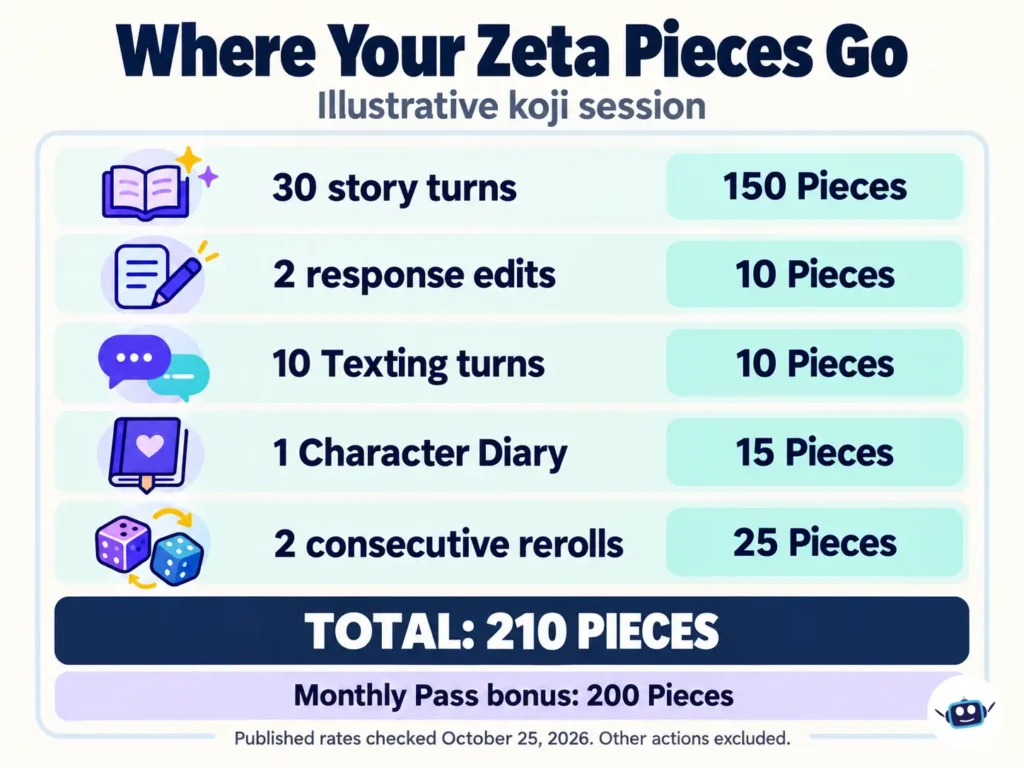
The session uses 10 more Pieces than the monthly subscription bonus. It excludes snapshots and any other chargeable actions.
This is an example, not a measured average session. Its value is showing why the model’s headline rate does not explain the whole balance change. Before repeatedly editing a scene or rerolling an outcome, consider the cost of each action.
Web payments: a useful saving with a regional limit
Zeta’s late-September web-payment notice announced US web purchases of Pieces at prices around 20% lower than in-app prices. Purchased Pieces could be used across the app and web.
That notice limited the rollout to the United States and described web payments for Zeta Pass as planned for October. It did not establish that subscription checkout had already launched everywhere.
Compare the offer available to your account. A Pieces discount should not be presented as a confirmed discount on every subscription, in every country.
Is Zeta AI Safe for Teens?
There are separate questions about age eligibility, content, time spent and purchases.
The English-language terms exclude children under 13 and require a parent or guardian to review and agree to the terms for users aged 13 to 18, or up to the applicable age of majority. Korea and Japan have separate localized terms.
The US iPhone listing shows a 13+ rating with in-app controls. An app-store rating does not guarantee that every generated conversation will be appropriate for every teenager.
What was announced on October 12, 2026?
Korean reporting on October 12 described Scatter Lab’s plan to introduce default teen limits before the end of 2026:
- Three hours of daily use.
- KRW 100,000 in monthly payments.
- Break reminders as the time limit approaches.
- Restrictions when the relevant limits are reached.
The reporting also described lawmakers’ concerns about harmful content appearing despite existing safeguards.
These were announced measures. This review did not verify their implementation across accounts, age groups or countries as of October 25. It would be inaccurate to promise that every teen account already has those protections.
Practical safeguards for a household
Set device-level time and purchase restrictions independently of any announced app controls. Review the actual content a young person encounters and agree on a stopping time before starting a session.
A fictional character may sound reassuring, upset or persuasive. Its responses are generated entertainment and should not decide a user’s health, safety or real-world relationships. If a conversation becomes distressing, stop the session and seek support from a trusted person.
Privacy: Private Plots and AI Training Are Different
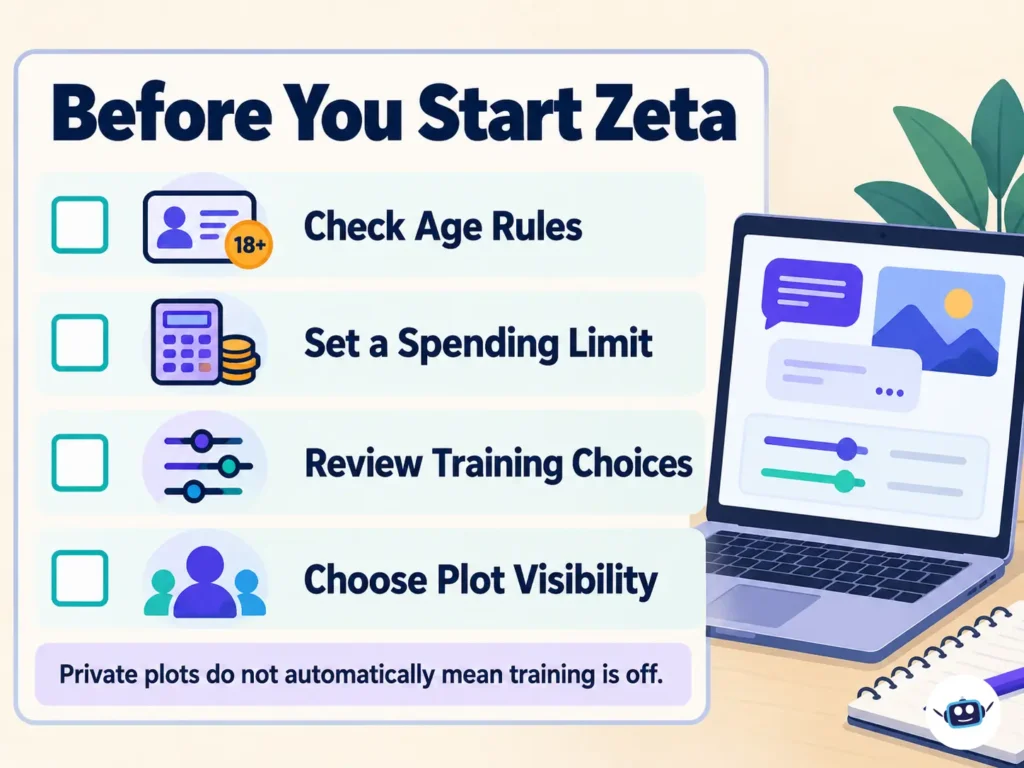
Private describes an audience setting. It does not, by itself, mean the content is excluded from AI training.
Zeta’s privacy policy says it collects conversations and creation content and uses data to operate and improve the service.
It also describes an AI Training Opt-Out request through its privacy contact or support channel. The stated effect is prospective: stopping new training use of conversation data within a reasonable period. It does not require the company to retrain models already developed, and it does not stop processing needed to deliver the service, maintain safety or meet legal obligations.
For a privacy-conscious user, the practical sequence is:
- Use fictional identities and situations.
- Review the current training policy before entering personal material.
- Request the training opt-out if desired and retain the response.
- Treat account deletion and training opt-out as separate actions.
Public creations require a separate decision
The help center says a published Plot cannot be switched back to private. The privacy policy also warns that public content may remain available after account closure.
Do not publish a “test” character containing a real friend’s private history or identifying details. Draft a fictional version first and decide deliberately whether other users should see it.
Who supplies the AI?
Scatter Lab describes its proprietary story model as Spotwrite. However, Zeta’s September 2026 service-provider disclosure also lists external AI providers, including OpenAI, Anthropic, Microsoft and Google.
The list does not establish which provider processes every feature or which underlying model corresponds to each Zeta model name. A confident claim that a particular premium model is a specific GPT, Claude or Gemini version needs more evidence than a vendor list.
Better Stories Without Unnecessary Spending
Zeta’s appeal is the ability to participate in a story as it develops. The most useful improvements often begin with clearer creative direction.
Give the AI a small, coherent setup
Start with one setting, a clear relationship and an immediate problem. Introduce additional characters when they matter.
For example, “Two explorers disagree about whether to enter a ruined observatory” gives a scene a workable conflict. Ten pages of unrelated background may make your own instructions harder to manage.
Keep a short record of important events
For a long-running story, maintain a brief continuity note: who knows the secret, what changed and which promise remains unresolved. Use the available reference tools for stable world facts.
Do not assume that a higher-priced model guarantees perfect recall. Evaluate whether it preserves the details that matter to your particular story.
Compare models on the same scene
Use the same setup when judging free Zeta, koji and luca. Look for character consistency, useful detail, obedience to your directions and the number of edits you need.
A longer reply is not automatically a better one. A reply that needs several paid corrections may be less useful than a shorter response that moves the scene forward.
For readers comparing other approaches, our Character AI, FictionLab AI and Janitor AI comparison discusses memory and customization. The Janitor AI guide explains a different model-access structure, while our DreamGen AI guide covers scenario-based storytelling. Review each platform’s age rules before considering it as an alternative.
Common mistakes to avoid
The most consequential mistakes are buying Pass expecting unlimited premium replies, ignoring charges for edits and story extras, publishing personal material, and assuming Korean prices or policy announcements apply unchanged to a US account.
Set a spending ceiling before buying Pieces. Begin with an amount you can evaluate over a few sessions rather than purchasing a large balance before understanding your usage.
Personal Experience: What I Found While Researching Zeta AI
My firsthand work for this article was reviewing the public documentation and checking its claims against the storefront and dated announcements. I did not run a paid trial, so I cannot honestly report how frequently ads appeared in a particular session or rank the models from personal gameplay.
The clearest lesson came from separating the subscription from the actions it funds. A 200-Piece monthly bonus sounds difficult to judge until you convert it into 40 koji turns or 20 luca turns. Building the sample session then showed how edits and optional features change that calculation.
The other lesson was to read labels carefully. “Private,” “premium” and “free” each answer a narrow question. None describes the whole product.
I would evaluate Zeta by keeping three simple records: which model I used, which actions consumed Pieces and which story details needed correction. Those observations would make an upgrade decision more useful than relying on the length or enthusiasm of a character’s replies.
Frequently Asked Questions About Zeta AI
1. What is Zeta AI used for?
Scatter Lab’s Zeta app is used for AI character conversations, roleplay and interactive fiction. Users can explore community-created Plots or create their own settings and characters.
2. Is Zeta AI completely free?
Standard-model chat is advertised as free and unlimited with advertising. Premium models, selected story features and the Zeta Pass subscription have separate costs.
3. How much does Zeta Pass cost?
The US iPhone listing checked for this article showed $14.99 for Zeta Pass and $2.79 for a one-day option. Your platform, country and purchase screen determine the applicable price.
4. Does Zeta Pass include unlimited koji or luca replies?
No. It includes a monthly bonus of 200 Pieces. At the published model rates, that covers 40 koji turns or 20 luca turns if no Pieces are spent elsewhere.
5. Is buying Pieces on the web cheaper?
Zeta announced US web purchases at around 20% below in-app prices in late September 2026. The announcement was regional, and its separate plan for Pass web payments should not be treated as proof of universal availability.
6. What is the difference between a Sourcebook and a Lorebook?
Zeta renamed the broader Lorebook feature Sourcebook in August 2026. The announcement said existing Lorebook functions would continue, including keyword-linked information used during conversations.
7. Can Zeta AI chats be used for training?
The privacy policy allows conversation data to be used for AI training and improvement. It provides a prospective training opt-out request, with stated limitations concerning existing models and other processing.
8. Is Zeta AI suitable for children?
The English terms prohibit use by children under 13. Older minors require guardian involvement under those terms. Eligibility is separate from suitability, so families should assess content, spending and time controls.
9. Can creators earn money from Zeta Plots?
The published Partner Program terms describe rewards converted into Free Pieces. That does not establish a general cash payout program. Do not assume virtual rewards can be withdrawn as income.
10. Is the Zeta app connected to Zeta Global’s Athena?
These are separate offerings. Scatter Lab operates the character-story app; Zeta Global provides enterprise products including Athena. Their subscriptions and features should be evaluated separately.
Conclusion: Judge Zeta AI by the Story and the Total Cost
Zeta AI offers an accessible way to explore interactive fiction, with free-model tools that are worth trying before upgrading. The paid experience requires a closer look at what you actually use.
Start with a focused Plot. Check whether the available story controls solve your problem. If you try premium models, budget for replies, edits and optional features together.
For privacy, review training choices separately from public visibility. For younger users, apply household controls without assuming announced protections have already reached every account.
The right purchase is the one that improves your particular story at a cost you understand.
Disclaimer: This article reflects public information reviewed on October 25, 2026. Prices, availability, age requirements and policies can vary by region and change over time. Cost examples are calculations, not hands-on spending measurements. This review is not an independent safety audit, and AI characters should not be relied on for professional or emergency advice.