
Picture asking your phone, from the cab of a tractor, “Which of my fields look stressed this week?” and hearing a straight answer instead of opening three apps. That is the promise of FarmBot Tech AI.
FarmBot Tech is a California startup that released an early, voice-first AI platform on October 22, 2026. It is not the open-source FarmBot garden robot. As of October 2026, what is live is spoken questions about your farm’s data and a community with grant and funding matching. Satellite insights are still on the way, and no pricing has been published. This guide separates the verified from the claimed.
At a glance (as of October 2026)
| Question | Short answer |
|---|---|
| What is it? | A voice-first AI platform for farmers, based in Sausalito, California |
| Live today | Spoken Q&A about your farm’s data, plus a community with personalized grant and funding matching (company description) |
| Coming | Satellite insights built with Pixxel Space, first applications planned for Q4 2026 |
| Price | Not stated in either launch announcement |
| Independent proof | None found. The white paper behind its statistics is described as “forthcoming” |
| Easily confused with | FarmBot (the garden robot) and Farmbot (an Australian sensor company) |
Verdict: worth a demo if you run a small or mid-size operation and your records are scattered. Don’t build compliance filings or crop decisions on it until the company shows evidence that its answers are right.
This guide is based on the company’s own releases and on public data from USDA, the U.S. Treasury and Pixxel. We have not used the platform ourselves.
Which “FarmBot” are you looking for?
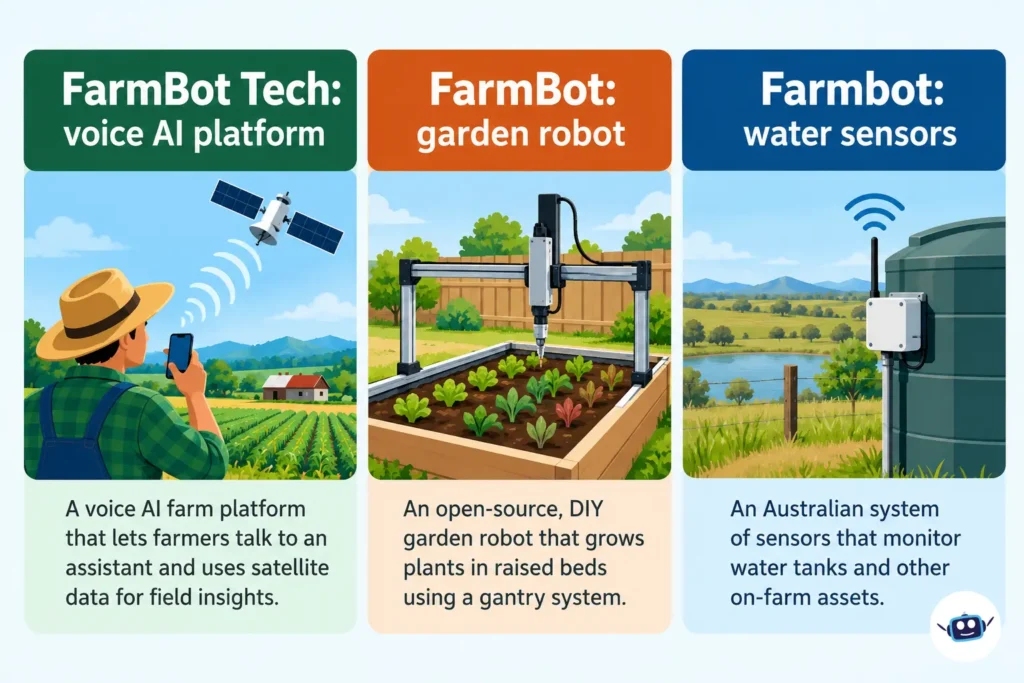
Three unrelated companies share almost the same name, and search results mix them freely.
| Name | What it is | Where it is based or how it started | Key fact |
|---|---|---|---|
| FarmBot Tech (also written FarmBot Technology) | Voice-first AI farm platform | Sausalito, California | Early version announced October 22, 2026 |
| FarmBot (FarmBot Inc.) | Open-source CNC garden robot | Founded 2013 by Rory Aronson; a California Benefit Corporation since 2016 | Genesis v1.8 lists at $5,995 and Genesis XL v1.8 at $7,995 |
| Farmbot (Australia) | Remote monitoring: water level sensors, pump control, rain gauges | Australian company founded in 2014 | Hardware plus app, no connection to the other two |
What most people miss: the FarmBot garden robot also has AI features. Its web app added GPT-powered Lua code generation in June 2023, which lets users type plain-English instructions. That is an AI feature on a robot, not the voice platform this article covers.
Look-alike domains also appear in search results. The company’s own releases give its address as FarmBotTech.com, so confirm you are on that site before entering any farm data. We ran into the same name-collision problem when we looked at Beam AI, where one name covers several different products.
What is live today, and what is only promised?
The live part is narrower than the headlines suggest. The October 22 release says farmers can ask questions out loud, in plain English, and get answers about their own farm. It also says the first release includes a community layer that connects farmers with resources, including personalized matching for grants and government funding programs.
The satellite layer is not live. The company says the Pixxel integration “comes next,” with first applications planned for the fourth quarter of 2026. They would start with grapes, coffee, cattle and dairy in the United States, the European Union and Africa.
| Feature | Status per company | Detail the releases leave out |
|---|---|---|
| Voice Q&A on your farm data | Live (early version) | Which data sources connect, and whether it works offline |
| Community and grant/funding matching | Live (early version) | Which programs it covers and how matching works |
| Satellite crop, soil and water insights | Planned, Q4 2026 | How “crop stress” or “nutrient issues” will be reported to you |
| Compliance evidence products | In development | Which programs, lenders or insurers would accept them |
| Demo access | Open | Pricing and terms |
What changed recently?
| Date | Event |
|---|---|
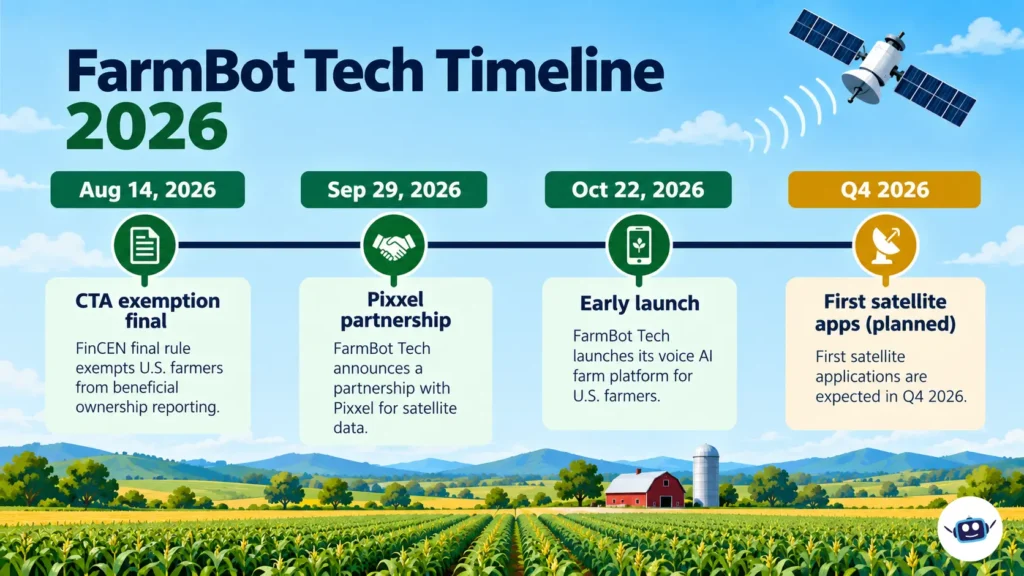
| March 2025 | FinCEN (the U.S. Treasury’s financial crimes bureau) exempts U.S.-formed companies from Corporate Transparency Act reporting in an interim rule |
| August 11, 2026 | FinCEN issues a final rule making that exemption permanent; it takes effect August 14, 2026 |
| September 29, 2026 | FarmBot Technology announces a three-year partnership with Pixxel Space, its first technology partnership, which came about through NASA’s Commercial Smallsat Data Acquisition program |
| October 22, 2026 | FarmBot Tech launches the early voice-first platform |
| Q4 2026 (planned) | First Pixxel-powered applications |
The first row matters more than it looks. The launch announcement is built around a regulatory “blind spot”: it says more than 230,000 farms were exposed to felony-level penalties under the Corporate Transparency Act before the March 2025 reprieve. That rule no longer applies to U.S.-formed entities, and the exemption is now permanent. The Act itself has not been repealed, and foreign-formed companies registered in the U.S. still have to report. Treat the story as the company’s origin pitch, not as a live compliance threat for most American farms.
How much does FarmBot Tech cost?
No price is published. Neither the September 29 nor the October 22 announcement mentions plans, a free tier or a trial. The October release points farmers to a demo request, and the September release offers early access by request. Don’t assume it is free, and don’t assume it is cheap.
One thing is certain: the garden robot is not cheap, and the sizes scale oddly. Using the prices and bed sizes listed on FarmBot’s product pages in October 2026, we ran the math:
| Kit | List price | Growing area | Cost per square meter |
|---|---|---|---|
| Genesis v1.8 | $5,995 | 1.5 m × 3 m = 4.5 m² | about $1,332 |
| Genesis XL v1.8 | $7,995 | 3 m × 6 m = 18 m² | about $444 |
The $2,000 step up from Genesis to XL buys 13.5 extra square meters, about $148 per added square meter. If you are shopping for the robot, XL is far better value per area, but it is for fixed installations only.
Do the numbers behind the pitch hold up?
Partly. The announcement leans on five figures, and they do not all come from the same place.
| Claim | What the primary data says | Caveat |
|---|---|---|
| “230,000+ farms exposed” | Company research for an unpublished white paper | Cannot be checked until the paper appears |
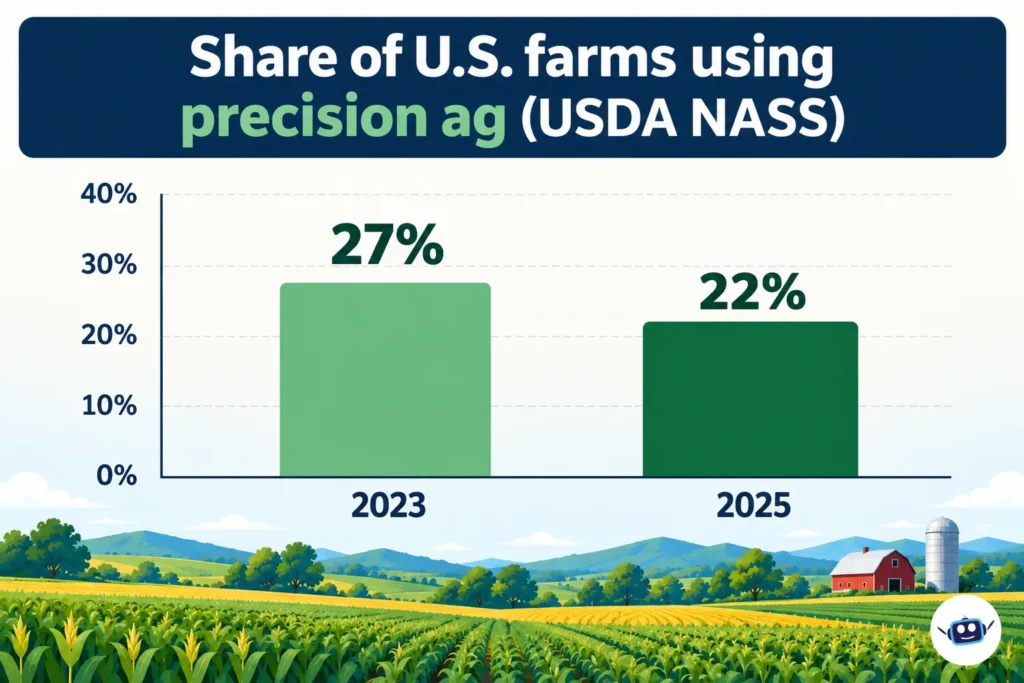
| Precision-ag use fell from 27% to 22% (2023–2025) | USDA’s National Agricultural Statistics Service (NASS) Technology Use survey, August 2025, shows the U.S. figure at 22%, down 19% in relative terms from 2023. A GAO report confirms the 27% for 2023 | The survey measures use, not price. “Even as the technology got cheaper” is the company’s framing |
| Large farms 68%, small farms 13% | USDA’s Economic Research Service (ERS) says 68% of large-scale crop farms used yield monitors, yield maps or soil maps in 2023, and that small family farms had the lowest use in every technology category | The 13% small-farm figure is not in ERS’s text summary. It appears in company materials |
| 8.4 billion voice assistants | A Juniper Research forecast from April 2020 projecting devices in use by 2024, led by smartphones | A device count, not evidence that farmers want voice tools |
| “No other platform combines voice, community and funding matching” | Based on the company’s own review of 14 agricultural AI products | The review is unpublished |
What most people miss: the 27%→22% drop and the 68% vs 13% gap come from different USDA surveys with different definitions. One covers any precision practice across all farms. The other covers specific tools on large crop farms. A strong argument can still be made for under-served small farms, but the statistics should not be stacked as if they were one dataset.
What can the satellite layer actually see?
Pixxel’s own documentation describes the Firefly satellites, which FarmBot Tech plans to use. The company’s releases say they capture “more detail” than typical imagery. Here is what that means in practice.
| Spec (Pixxel documentation) | Value | What it means for you |
|---|---|---|
| Spectral bands | 135 available, about 45 selectable per capture | Fine spectral detail, but each image uses a subset |
| Wavelength range | 470–900 nm (visible and near-infrared) | No shortwave infrared; that comes with Pixxel’s planned Honeybee satellites |
| Ground resolution | about 5.4 m | Good for fields and pastures, coarse for garden plots or narrow beds |
| Swath width | 40 km | Wide coverage per pass |
| Cloud cover threshold | under 20% | Cloudy weeks may produce no usable image |
| Revisit time | Pixxel’s pages give figures ranging from daily to four days or longer | Ask what revisit you would get at your latitude |
Two cautions apply. The releases name cattle and dairy as first applications but do not say what a satellite will tell you about them. Pasture condition is the obvious candidate, but that is our inference, not a company statement. And row crops such as corn and soybeans are not in the first wave.
Will a voice assistant work on a real farm?
It depends on your signal. In USDA’s 2025 survey, 85% of U.S. farms had internet access, 55% used a broadband connection, 74% had a cellular data plan and 82% had a smartphone. Most farms can reach a phone-based tool, but dead zones in the back forty remain. The releases do not say whether the platform works offline, which languages or accents it understands, or what happens when it mishears a field name.
Test it with your own vocabulary. Field nicknames, product names and livestock group names are where voice tools tend to stumble.
What should you ask before connecting your farm data?
The September release describes a “single source of truth” that pulls together data from platforms, machines and service providers a farm already uses. That is a lot of trust to hand over, and the releases publish no privacy terms, integration list or data-ownership policy. Ask these five questions in the demo:
- Which systems connect today, and which are only planned?
- Who owns the data, and can you export or delete it?
- Are voice recordings stored, and for how long?
- Can you see the source records behind an answer, or only the answer?
- What does it say when it doesn’t know?
Answer quality depends on what the system is given, which is the idea behind context engineering for AI tools. Start with narrow access and widen it only after the answers prove right, the approach we describe in our guide to giving personal AI agents permissions step by step.
A four-gate check before you commit
This is an illustrative framework, built from the facts above, for any early-stage farm AI tool.
| Gate | Question | Pass looks like | FarmBot Tech today |
|---|---|---|---|
| 1. Identity | Is this the company you think it is? | Official domain, clear company details | Pass, with the name-confusion caveat |
| 2. Live vs promised | Can you use the feature now? | Demo shows it working on your data | Voice Q&A and community: live. Satellite: not yet |
| 3. Data and signal | Do you know where your data goes and whether it works in your fields? | Written data terms, offline behavior stated | Not published |
| 4. Proof | Is there independent evidence the answers are right? | Published validation, farmer references | Not yet; white paper pending |
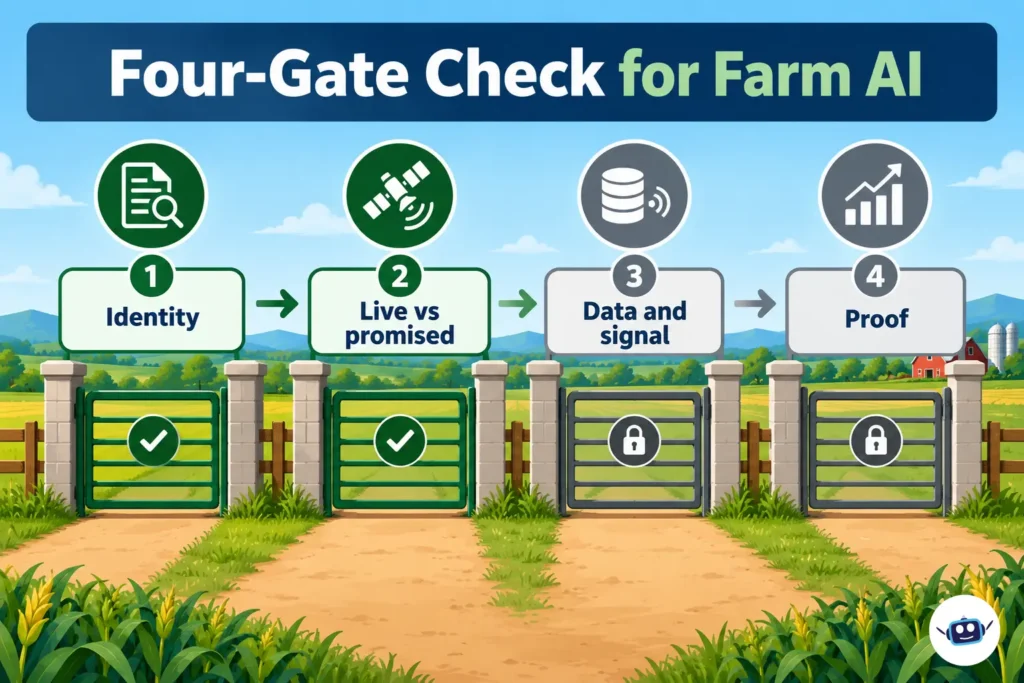
A tool that clears gates 1 and 2 is worth a demo. Don’t rely on it for decisions or filings until it also clears gates 3 and 4.
Who should try it, and who should wait?
Try it if you run a small or mid-size crop, livestock or dairy operation, your records live in several apps and spreadsheets, and you are comfortable giving feedback on an early product. The company says it is inviting farmers to shape development, and that works in your favor if you want a voice in the design.
Wait if you need a firm price before a demo, you plan to use it for regulatory or lender paperwork, or your first need is satellite analysis on a crop outside the launch list.
What are the alternatives?
| Option | Best for | Note |
|---|---|---|
| USDA farmers.gov and your local USDA Service Center | Finding federal loan and disaster programs | Free government resources; farmers.gov has long offered discovery tools for loans and disaster assistance |
| FarmBot (garden robot) | Gardens, classrooms, research beds | Open-source hardware, $5,995 or $7,995 |
| Tellia (France) | Voice, phone, WhatsApp and email capture of field data for agricultural teams | Founded in 2024; a different market from FarmBot Tech |
| Syngenta’s voice-enabled chatbot | Agronomy advice for Indian farmers, reported May 2026 | Not aimed at U.S. farms |
Tellia and Syngenta don’t disprove FarmBot Tech’s combination claim, which covers voice, community and funding together. They do show that voice-first farm tools are not unique. If the difference between a tool that answers questions and one that takes actions matters to you, our explainer on chatbots versus agents that act covers the distinction.
Myth vs fact
| Myth | Fact |
|---|---|
| FarmBot Tech makes the FarmBot garden robot | They are separate companies |
| Satellite insights are available now | First applications are planned for Q4 2026 |
| U.S. farms must still file beneficial ownership reports | U.S.-formed entities are exempt under FinCEN’s final rule, effective August 14, 2026 |
| 8.4 billion voice assistants means farmers are ready for voice | That figure is a 2020 device forecast, not a farm survey |
FAQs
Is FarmBot Tech AI free?
No price is published, so don’t assume it is. The launch announcements mention only demo requests and early access.
Is FarmBot Tech the same as FarmBot?
No. FarmBot Tech is a voice-first AI platform from Sausalito, California. FarmBot is an open-source garden robot company that began in 2013.
Is it available now?
An early version is live, according to the company’s October 22, 2026 announcement. The satellite features are planned for the fourth quarter of 2026.
Does it work offline?
The company has not said. Ask during the demo, since 74% of U.S. farms have cellular data but coverage varies by location.
Which crops and animals does it cover?
The company says the platform is built to work across crops, animals and production types. The first satellite applications target grapes, coffee, cattle and dairy.
Can it replace an agronomist or a lawyer?
Nothing published suggests that. The company describes the platform as making information easier to act on, so verify any filing or agronomic decision with the responsible professional or agency.
How do I try it?
Both announcements point to a demo request on the company’s website.
Conclusion
FarmBot Tech AI is an early-stage, voice-first farm assistant with a plausible idea, a verified satellite partner and several unproven claims. The live product is voice Q&A and a funding community. The satellite layer, compliance products and independent evidence are still to come.
Your next step: request the demo and bring the five data questions above, plus one real question about a field you know well. If the answer matches what you already know and it shows its source, you have a useful signal.
Related: Context engineering guide
Disclaimer: This article is for informational purposes only. It is not affiliated with, sponsored by or endorsed by FarmBot Tech, FarmBot, Farmbot, Pixxel or any other company mentioned. Prices, features and policies may change, and information was last verified on October 31, 2026. AI output can be inaccurate, so verify agronomic, financial and legal decisions with a qualified professional or the relevant agency.