
Google called Gemini 4 Carbon its strongest model on October 28, 2026. Two days later, most developers, businesses and Gemini subscribers still can’t touch it. Google says Carbon goes first to a subset of cyber defenders, then to more vetted partners, and only later to everyone else, with no date given.
This guide covers who can use Carbon today, what it costs once it opens up, which benchmark claims are independent and which are Google’s own, and what to do in the meantime. Everything below is accurate as of October 30, 2026.
Can you use Gemini 4 Carbon today?
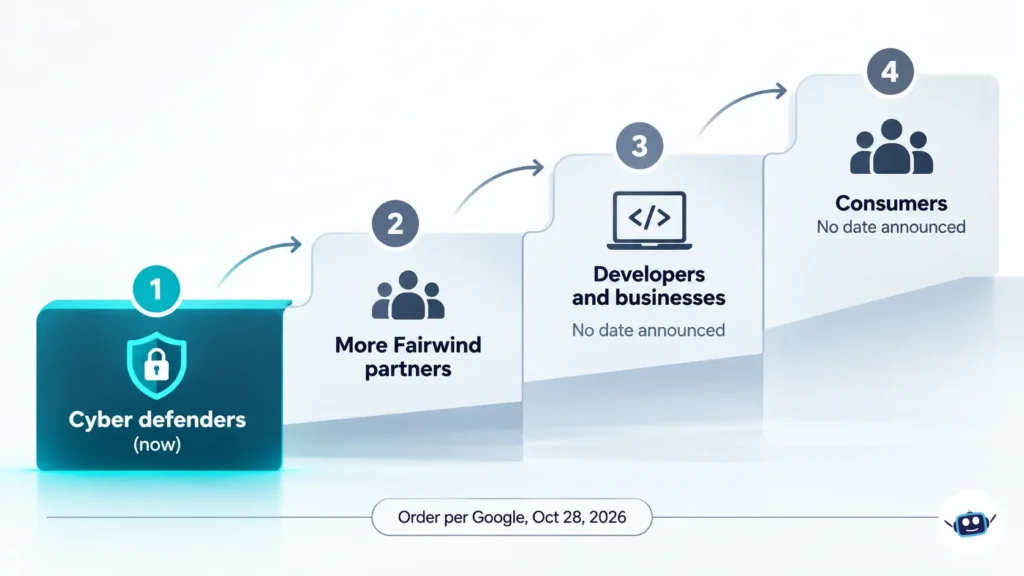
No, unless you are in Google’s Fairwind Program. Google’s announcement says Carbon is available “starting this week” to a subset of cyber defenders, with access phased to additional trusted partners. Developers, businesses and consumers come after that, “as soon as possible,” with no date attached.
Artificial Analysis, the independent benchmarking firm that ranked Carbon first, labels the model as having no publicly available API. Google’s introductory pricing is also still a stated plan rather than something you can buy.
If you want a Gemini 4 model now, Gemini 4 Argon is the one that works. Google opened it on October 13, 2026 through the paid Gemini API tier in AI Studio and the Gemini platform. Google AI Ultra and Pro subscribers can use it in the Gemini app and AI Mode in Search.
What did Google actually announce, and when?
Google announced Carbon on October 28, 2026, in a post by Koray Kavukcuoglu, SVP at Google DeepMind and Chief AI Architect. The headline claims are cybersecurity performance and long-horizon engineering work, the kind that runs for hours or days.
Carbon is the second Gemini 4 model in about a month, so the timeline matters:
| Date | What happened |
|---|---|
| Sept 2, 2026 | Google launches the Fairwind Program with Gemini 3.8 Flash Cyber (as reported at launch) |
| Sept 30, 2026 | Google announces Gemini 4 Argon |
| Oct 13, 2026 | Argon opens to developers and paying subscribers; Google begins adding hundreds more Fairwind partners |
| Oct 28, 2026 | Google announces Carbon, available first to a subset of cyber defenders |
| Oct 29, 2026 | Artificial Analysis lists Carbon first on its Intelligence Index v5.0 with a score of 59 |
| Nov 30, 2026 | Argon’s introductory price ends |
What most people miss: Google’s “two weeks ago” refers to Argon’s October 13 public opening. Argon was announced two weeks earlier than that, on September 30. The gap between announcement and access is the pattern to watch. Argon went from announced to open in 13 days, and Carbon may follow the same path, but Google has not said so.
How is Carbon different from Argon?
Carbon is positioned above Argon as the stronger model, and Google says it builds on Argon’s safety stack. It does not replace Argon today, because Argon is the one you can call.
Google’s claimed differences, all from its own announcement:
- More than 2x the success rate of Argon at generating secure code, on internal benchmarks.
- Roughly 2x fewer unsupported claims than Argon in internal testing.
- A drop of almost 80% in high-severity misalignment alerts in live coding environments with Google’s own teams.
- Reduced overreach by 26% and under-service by 29% on multi-step tasks.
- A 0.0% attack success rate on the Gray Swan indirect prompt injection benchmark, down from Argon’s 0.7%.
On independent numbers, Artificial Analysis puts Carbon at 59 on its v5.0 index versus Argon’s 50. That is a nine-point jump in two weeks, which is why Ars Technica asked whether Carbon is a new model or a post-training upgrade of Argon. Ars’s view, as reported, was that Carbon looks like a slightly better version of Argon. Google has not published architecture details, so nobody outside the company can say.
What will Gemini 4 Carbon cost?
At launch, Google lists Carbon at $2 per million input tokens and $10 per million output tokens, with cached input 95% cheaper. That is an introductory price. Google’s footnote says $4 and $20 apply after the introductory period.
The footnote for Argon gives an end date of November 30, 2026. Carbon’s does not give one, and Artificial Analysis notes no end date has been confirmed.
| Model | Standard input / output (per 1M tokens) | Cached input (per 1M) | Notes |
|---|---|---|---|
| Gemini 4 Carbon | $2 / $10 intro, then $4 / $20 | $0.10 intro, $0.20 after | Not publicly purchasable yet |
| Gemini 4 Argon | $2 / $10 until Nov 30, then $4 / $20 | Same 95% discount | Available now |
| Claude Opus 5.5 | $4 / $20 | $0.20 | Anthropic list price |
| GPT-6 Astra | $10 / $50 | $1 | OpenAI list price |
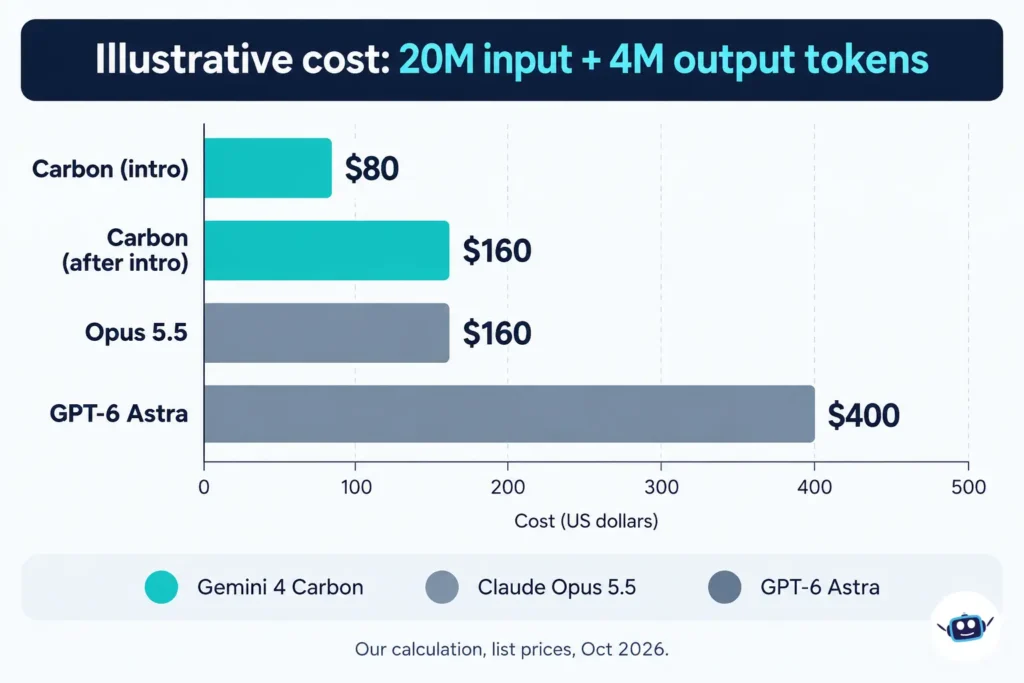
Here is the cost math for an illustrative workload of 20 million input tokens and 4 million output tokens. Assume 12 million of the input is cached in the second column. These are our calculations, not vendor quotes:
| Model | No caching | With 12M cached input |
|---|---|---|
| Carbon (intro price) | $80.00 | $57.20 |
| Carbon (after intro) | $160.00 | $114.40 |
| Claude Opus 5.5 | $160.00 | $114.40 |
| GPT-6 Astra | $400.00 | $292.00 |
Two hidden costs matter more than the rate card:
- Carbon is wordy. Artificial Analysis recorded 200 million output tokens to run its Intelligence Index, against a median of 71 million for comparable models. Output tokens are the expensive half of the bill, so a long-thinking model can cost more per task than its rate suggests.
- Artificial Analysis prices Carbon at $4 / $20. Its figure of $7.76 per Intelligence Index task uses the post-introductory rate. Under the $2 / $10 intro price, that same work would cost about half as much.
Do the benchmark claims hold up?
Partly. The one independent headline is solid, while the cybersecurity numbers are Google’s and measured without guardrails.
Independent: Artificial Analysis lists Carbon (High) at 59 on Intelligence Index v5.0, Claude Opus 5.5 (Max) at 58 and GPT-6 Astra at 57. A single point is a thin lead, and Artificial Analysis only recently rebuilt the index. Treat it as “tied at the top” rather than a decisive win.
Google-reported cybersecurity results:
| Benchmark | What it measures | Carbon |
|---|---|---|
| SEC-bench Pro | Finding real vulnerabilities | 88.2% |
| ExploitGym | Exploiting them | 54.8% |
| CWE-bench | Patching at the root cause | 71.0% |
Google says these external benchmarks were “evaluated without guardrails.” That is the model as defenders will get it inside Fairwind. Argon’s own page shows 68.0% on a CWE-bench leaderboard, so Carbon’s patching gain looks like a few points rather than a leap, though Google doesn’t state that the two figures use identical versions.
Where Carbon does not lead: Press accounts of Google’s own comparison chart show GPT-6 Astra ahead on FrontierSWE 2 (65.5% against Carbon’s 61.2%). They also show Claude Opus 5.5 ahead on the OSWorld-2.1 computer-use subset (87.2% against 81.5%). Carbon lands fourth on WebDev Arena at 1768, behind Opus 5.5, GPT-6.1 Astra and Sonnet 5.5, and second to Opus 5.5 on Arena’s Best Overall Agent board, according to The Register. On Artificial Analysis’s coding-agent index, Claude Code with Opus 5.5 scored 62 against Carbon’s 59.

The Chrome-team claim, that Carbon beat “another lab’s large frontier model” by more than 10x on patch quality, is an anecdote from Google’s own engineers. It names no model and publishes no method.
What is the Fairwind Program, and who qualifies?
Fairwind is Google DeepMind’s application-only program that gives vetted defenders early access to its most cyber-capable models. Google’s page says it works with over 650 partners globally.
Google prioritizes three groups:
- Governments and national cyber authorities
- Critical infrastructure operators, including healthcare, telecommunications, energy and financial networks
- Core technology platforms that secure widely used software foundations
Academic labs focused on defensive benchmarking can apply too. Students are pointed to CodeMender on Google Cloud instead.
Participants must agree to terms, including user-level authentication and phishing-resistant MFA. They may only give access to internal cybersecurity, incident response or penetration-testing teams, and must track who uses it. Google says it runs background checks on applicants. It also forbids partners from sharing, redistributing or selling access.
In our check of Google’s Fairwind page on October 30, 2026, its technology and FAQ sections still named Gemini 4 Argon as the exclusive model and did not yet mention Carbon. Google’s announcement says Carbon is already flowing to a subset of defenders, so expect the page to catch up. If you are a US security team in one of the priority groups, applying costs you a form.
Is anyone else claiming to offer Gemini 4 Carbon?
Be cautious about it. Because Fairwind partners cannot resell access, any third-party site offering Carbon access today is either mislabeling another model or selling something it has no right to sell.
| Name | What it is | Can you use it? |
|---|---|---|
| Gemini 4 | The model family, not a single model | N/A |
| Gemini 4 Argon | Google’s public Gemini 4 model since Oct 13 | Yes (paid API, AI Pro and Ultra) |
| Gemini 4 Carbon | Newer, stronger model announced Oct 28 | Only inside Fairwind for now |
| Gemini 3.8 Flash Cyber | Earlier Fairwind-only cyber model from Sept 2 | Only inside Fairwind |
What hasn’t Google published?
Google’s announcement doesn’t state Carbon’s context window, architecture or training cutoff. It links to the safety and security report written for Argon, so Carbon’s specific safety results come from the blog post rather than a standalone document. Artificial Analysis lists a 1 million-token context window and text, image, speech and video input, but those are the benchmarker’s listings, not Google’s statements.
Google also says it is “actively engaged in the U.S. government’s voluntary process for pre-release model testing,” but gives no details or results. The restricted rollout fits the stated reason: the same capabilities that find and patch flaws can help attackers exploit them. The gating is a safety choice, and it is also why independent testers can’t yet verify the claims.
What should you do this week?
| If you are… | Do this |
|---|---|
| A security team at a government body, critical-infrastructure operator or core platform | Apply to Fairwind and ask what Carbon access terms look like |
| A developer using Gemini | Build on Argon now, since Carbon will likely use the same API surface, though Google hasn’t confirmed this |
| Budgeting for AI spend | Model costs at $4 / $20, not $2 / $10, and test token usage on your own tasks |
| A Gemini app subscriber | Use Argon in the app; Carbon has no announced consumer date |
| Comparing models for coding | Wait for independent testing; Opus 5.5 still leads some coding-agent measures |
If you work with long-running agents, our piece on AI coding agents versus chatbots covers how to scope what they can touch, and our context engineering guide explains how to keep multi-day tasks from drifting. For how Google’s agent products fit enterprise workflows, see our look at Gemini agents for enterprise work. The release pace itself is part of a wider debate, covered in our article on frontier AI leaders and slowing down.
FAQs
Is Gemini 4 Carbon free?
No public pricing tier exists yet. Google’s launch price for API use is $2 per million input tokens and $10 per million output tokens, rising to $4 and $20 after an introductory period. Subscriber plans for Carbon haven’t been announced.
Is Gemini 4 Carbon better than Claude Opus 5.5 or GPT-6 Astra?
It leads on Artificial Analysis’s Intelligence Index v5.0 by one to two points. Opus 5.5 leads on OSWorld-2.1, WebDev Arena and the coding-agent index, and Astra leads on FrontierSWE 2. “Better” depends on your task.
When will Gemini 4 Carbon be available to everyone?
Google hasn’t said. Its wording is “as soon as possible,” after gathering feedback from defenders and tuning guardrails.
Is Gemini 4 Carbon the same as Gemini 4 Argon?
No, but they are related. Google says Carbon builds on Argon and shares its safety stack. Whether it is a new model or a post-trained Argon is unconfirmed.
Can I get Carbon through the Gemini API?
Not at launch. Google’s stated order is cyber defenders, then more Fairwind partners, then developers and businesses.
Why is Google restricting it?
Google says the model is strong at finding and exploiting vulnerabilities, not just fixing them, so it is giving defenders an early head start while it tunes safeguards.
The short version
Gemini 4 Carbon is a real step up on paper, with a one-point lead on a rebuilt independent index and strong self-reported security results. But it is gated, its best numbers are Google’s, and it trails rivals on several coding and computer-use measures. Plan around Argon now and budget at $4 / $20.
Next step: if your team qualifies, apply to Fairwind. If not, build and test on Argon today so you can switch to Carbon the day Google opens it.
Related: Why frontier AI leaders are talking about hitting the brakes
Disclaimer: This article is for informational purposes only and is not affiliated with, sponsored by or endorsed by Google, Anthropic, OpenAI or any other brand mentioned. Prices, features, access terms and benchmark rankings may change without notice. Information last verified on October 30, 2026. AI output can be inaccurate, and security tools should only be used on systems you are authorized to test.