
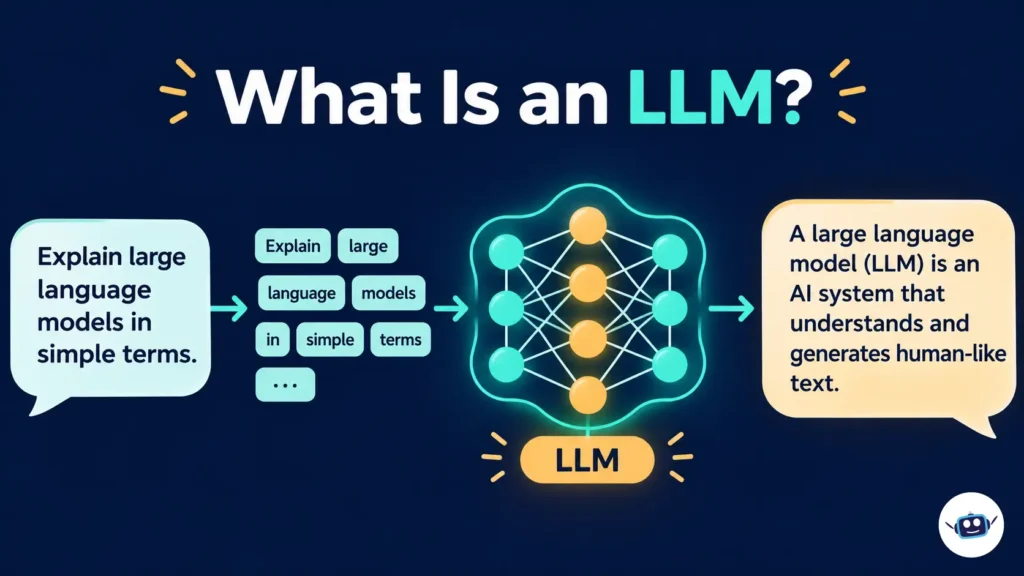
About half of U.S. adults now use AI chatbots, according to Pew Research Center’s June 2026 report, and roughly one in four use them every day. The best-known chatbots in that survey, such as ChatGPT, Gemini, Copilot, Meta AI and Claude, run on large language models. Most users have never been told what that means.
An LLM (large language model) is an AI model trained on enormous amounts of text and other data. It learns statistical patterns in language, then uses them to generate plausible responses one small piece of text at a time. It is the engine inside a chatbot, not the chat window. This guide covers how it works, what it costs to run, why it sometimes invents facts, and how to check its answers.
At a glance (as of November 2026)
- What it is: a model trained to predict the next token (a word or word fragment) in a sequence.
- What it is not: a search engine, a database, or the same thing as “AI” in general.
- Current scale: the newest Claude and GPT-6 models advertise context windows of about 1 million tokens.
- Main risk: fluent answers that are wrong. Researchers at OpenAI argue this persists partly because of how models are graded.
- Cost shape: API pricing is per token, and output tokens cost five times input tokens on every current Claude and GPT-6 model listed below.
What is an LLM in AI?
An LLM is an AI model that has learned patterns in language from very large amounts of data. The University of Arizona Libraries describes it as a model that learns how words and ideas commonly relate, then uses those patterns to predict and generate plausible responses.
The name breaks into two parts:
- Language model: software that estimates which text is likely to come next, given the text so far.
- Large: the model has a huge number of adjustable internal settings (parameters) and was trained on a huge amount of data. Fujitsu describes the scale as an order of magnitude beyond earlier AI in both data and computation.
LLMs handle many language tasks. These include answering questions, summarizing, translating, drafting, analyzing information, writing code and working through multistep problems. Many current models also accept images as input. According to Anthropic’s documentation, the current Claude models take text and images in and produce text out. Image generation is a separate model type: OpenAI’s pricing page lists its image-generation models separately from its text models.
What most people miss: an LLM does not look facts up the way a search engine does. Its answers come from patterns absorbed during training, unless the product around it is connected to search or your documents.
Which “LLM” do you mean?
The letters LLM point at several different things, and mixing them up is the most common source of confusion.
| Term | What it means | How it differs from an LLM |
|---|---|---|
| LL.M. | Master of Laws, a postgraduate law degree (from the Latin Legum Magister, per Merriam-Webster) | Unrelated to AI. This is why search results for “LLM” sometimes show law schools. |
| ChatGPT, Claude, Gemini, Copilot, Meta AI | Products you chat with | These are apps built on LLMs. The model is one component. |
| Generative AI | AI that creates new content: text, images, audio, code | LLMs are one kind of generative AI. Image and music generators are others. |
| Foundation model | A large pretrained model adaptable to many tasks | LLMs are one type. Some foundation models are multimodal. |
| SLM (small language model) | A lighter, more efficient language model, often able to run offline (Fujitsu’s description) | Same idea, smaller scale. |
| GPT | A specific series of LLMs from OpenAI | One family of LLMs, not a synonym for the category. |
| RAG | Retrieval-augmented generation: fetching outside information and handing it to the model | A technique added around an LLM, not a model. |
How does an LLM work?
An LLM turns text into numbers, learns patterns from a huge pile of examples, gets refined to follow instructions, and then generates answers one token at a time.
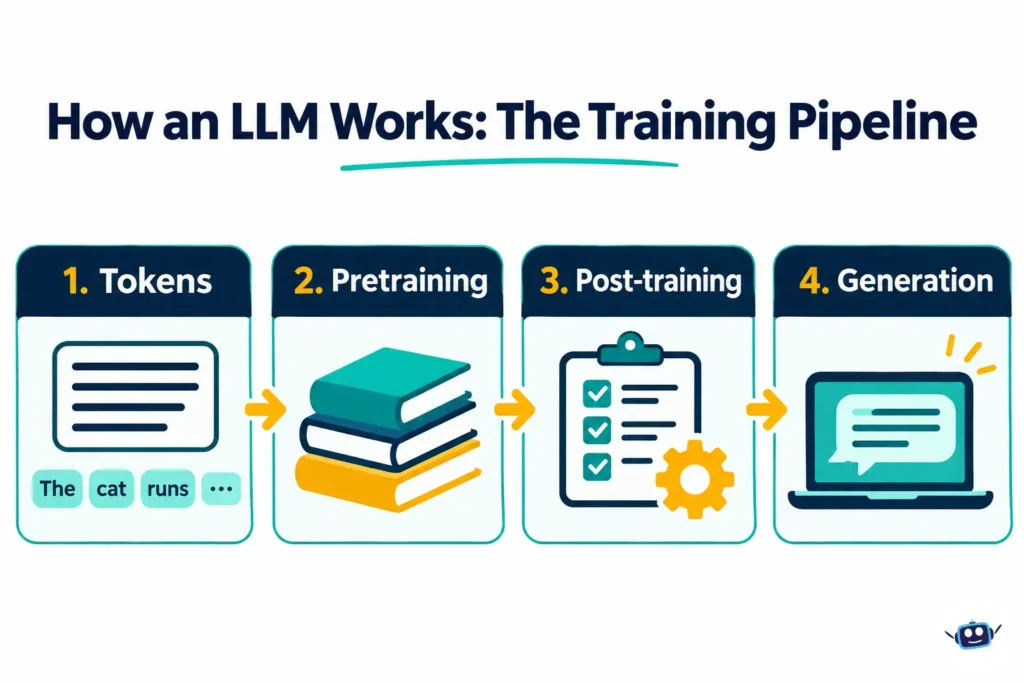
Step 1: Text becomes tokens
Models do not read words. They read tokens, which can be a character, part of a word, a whole word, or punctuation. According to OpenAI’s help center, one token is roughly four characters of English, and 100 tokens is about 75 words. Spaces and capitalization change how text splits, and other languages split differently.
What most people miss: the same text can produce different token counts on different models. OpenAI itself warns that a lower price per million tokens does not guarantee a lower total cost, because models tokenize differently and produce different amounts of output.
Step 2: Pretraining on a huge amount of text
During pretraining, the model reads enormous text collections and learns to predict what comes next. Microsoft’s Azure documentation describes two techniques. Autoregressive modeling predicts the next word in a sequence. Masked language modeling fills in hidden words.
The architecture behind most modern LLMs is the transformer, introduced in the paper “Attention Is All You Need,” posted to arXiv on June 12, 2017. Its core idea, self-attention, lets the model weigh how relevant every part of the input is to every other part. The paper’s own experiments were on machine translation, not chatbots. Some explainers date it to 2018, but the arXiv record shows 2017.
Step 3: Post-training to follow instructions
A pretrained model is good at continuing text, which is not the same as being helpful. In OpenAI’s 2022 InstructGPT research, the team collected examples of desired behavior and human rankings of outputs. They then fine-tuned the model with reinforcement learning from human feedback. Human evaluators preferred outputs from the 1.3-billion-parameter InstructGPT over the 175-billion-parameter GPT-3, despite the 100-fold size gap.
The lesson is that raw size is not the whole story. How a model is trained after pretraining matters a great deal.
Step 4: Generating an answer
When you send a prompt, the model produces output one token at a time, each choice based on everything before it. For reasoning models, OpenAI says some output tokens are internal reasoning that you never see, yet they are billed as output.
What is a context window?
A context window is the maximum amount of text, measured in tokens, that a model can work with in one request. It covers your prompt, the conversation so far, and the space needed for the reply.
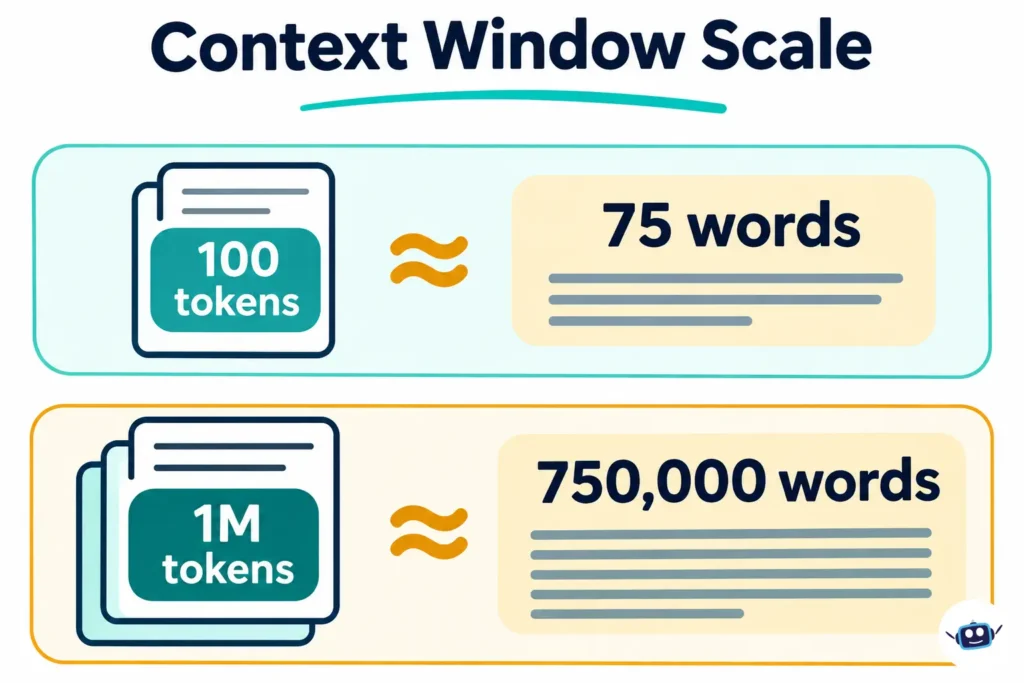
Current limits are large. As of November 2026, Anthropic’s model pages list a 1-million-token context window for Fable 5.1, Opus 5.5, Sonnet 5.5 and Haiku 5.5. OpenAI lists 1.05 million tokens for the GPT-6 family.
Using the 75-words-per-100-tokens rule, 1 million tokens is roughly 750,000 words. That is a rough conversion for English, not an exact count.
A bigger window does not make the model smarter. It only raises the ceiling on what you can paste in. What goes into the window still matters, and our context engineering guide covers how to choose it. Pricing can also change with size. OpenAI’s GPT-6 Sol model page says prompts above 272,000 input tokens are charged at double the input rate and 1.5 times the output rate for the whole request.
What most people miss: every model also has a knowledge cutoff, the point after which it has no training data. Anthropic lists June 2026 for its current models, and OpenAI lists cutoffs between April and June 2026 for the GPT-6 family. Anything newer reaches the model only if the product connects it to search or documents.
Why do LLMs make things up?
LLMs “hallucinate” because they are built to produce plausible text, and a plausible guess can be wrong. A September 2025 paper by OpenAI and Georgia Tech researchers gives two causes.
- Pretraining pressure. If a fact appears only once in the training data, the model has little to anchor it. The authors give a rule of thumb: if 20% of birthday facts appear exactly once in pretraining data, expect base models to get at least 20% of such facts wrong.
- Grading incentives. Most benchmarks score a right answer as a point and “I don’t know” as zero. Like a student on a multiple-choice exam, a model does better on the scoreboard by guessing. The authors argue that changing the scoring would reduce the problem.
In the paper’s own example, three popular models were asked for the title of one author’s dissertation. None gave the correct title or year.
The real-world cost can be high. In Mata v. Avianca, a federal court in New York sanctioned two lawyers and their firm $5,000 on June 22, 2023, after a brief cited non-existent cases generated by ChatGPT. Judge P. Kevin Castel wrote that using AI is not inherently improper. He also said lawyers must still verify their filings.
The Three-Question Reliability Check
This is an illustrative routine built from the facts above. It is not an official standard.
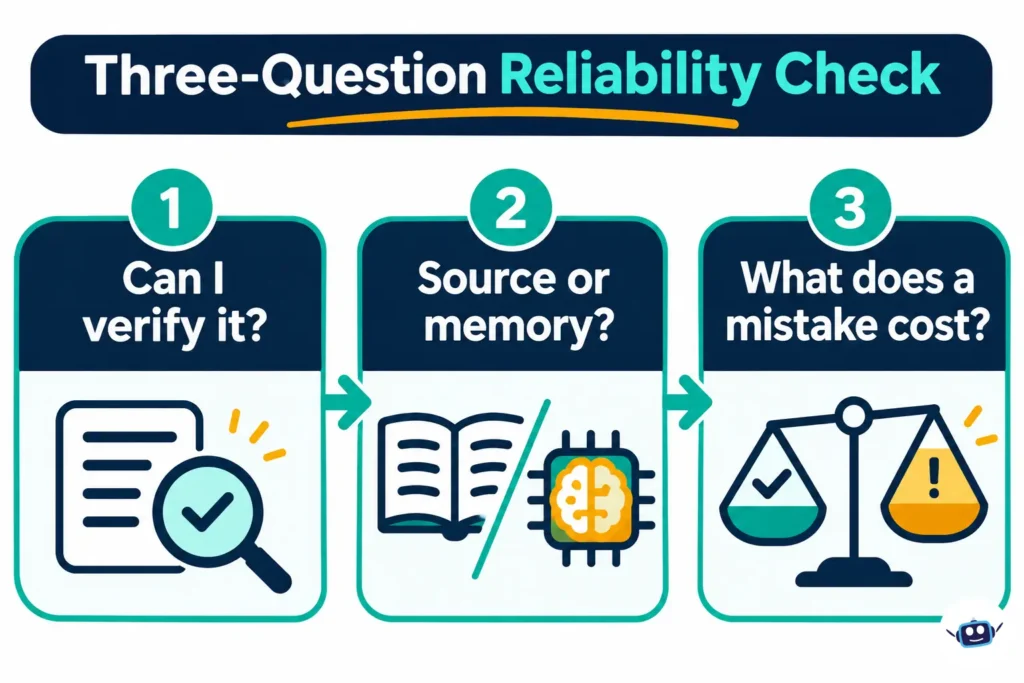
| Question | If the answer is “no” | Action |
|---|---|---|
| Can I verify this claim in a primary source in under five minutes? | The claim is unverifiable | Don’t rely on it for anything that matters. |
| Is the model reading a source I gave it, or recalling from memory? | It’s recall, so a plausible guess is likelier | Paste in the source, or confirm with a search-connected tool and open the links. |
| What does a wrong answer cost? | High (legal, medical, financial) | A qualified human checks it before you act. |
The University of Arizona Libraries adds one caution: even when a product searches the web and cites sources, the summaries can misread them. Open the original.
How much does it cost to use an LLM?
You pay per token when you use an LLM through an API. Output tokens cost more than input tokens.
Here are the listed prices as of November 2026, from Anthropic’s model documentation and OpenAI’s pricing page. Prices are for standard processing, in U.S. dollars per million tokens.
| Model | Context | Max output | Input / Output per 1M tokens |
|---|---|---|---|
| Claude Fable 5.1 | 1M | 128K | $10 / $50 |
| Claude Opus 5.5 | 1M | 128K | $4 / $20 |
| Claude Sonnet 5.5 | 1M | 128K | $2 / $10 |
| Claude Haiku 5.5 | 1M | 128K | from $0.10 / from $0.50 |
| GPT-6 Astra | 1.05M | 128K | $10 / $50 |
| GPT-6.1 Sol | 1.05M | 128K | $2 / $10 |
| GPT-6.1 Terra | 1.05M | 128K | $1 / $5 |
| GPT-6 Luna | 1.05M | 128K | $0.10 / $0.50 |
Cost math: summarizing a 3,000-word document
Using the 75-words-per-100-tokens rule, a 3,000-word input is about 4,000 tokens. A 500-word summary is about 667 tokens. The arithmetic below was run in code at the listed rates.
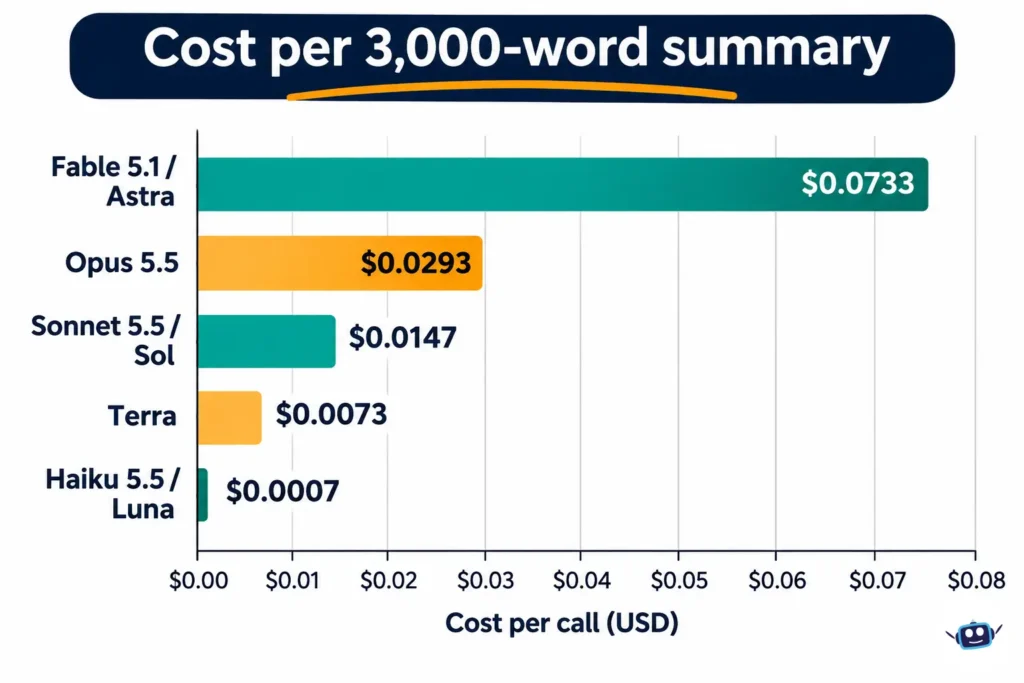
| Model | Cost per call | Cost per 1,000 calls |
|---|---|---|
| Claude Fable 5.1 / GPT-6 Astra | $0.0733 | $73.33 |
| Claude Opus 5.5 | $0.0293 | $29.33 |
| Claude Sonnet 5.5 / GPT-6.1 Sol | $0.0147 | $14.67 |
| GPT-6.1 Terra | $0.0073 | $7.33 |
| Claude Haiku 5.5 / GPT-6 Luna (base rate) | $0.0007 | $0.73 |
Hidden costs
- Output is five times input. Every model in the table above prices output at five times input. Anthropic’s cost guidance notes that in agent loops, text the model writes is fed back in as input on later turns. A long answer is therefore paid for repeatedly.
- Reasoning tokens are billed as output. Suppose a GPT-6.1 Sol call used 5,000 hidden reasoning tokens. This is an illustrative number, not a measurement. The same summary would cost about $0.065 per call, or $64.67 per 1,000 calls, instead of $14.67. For GPT-6.1 Terra it would be $32.33 instead of $7.33.
- A cheaper model can be good enough. According to Anthropic’s own documentation (a vendor claim), Haiku 5.5 scored 85% on the GPQA Diamond test, against 91% for Opus 5.5 and Sonnet 5.5, at roughly a twentieth of Opus 5.5’s cost per correct answer. Test on your own task before choosing.
- Parameter counts are not listed. The vendor model pages above list context, output limits and prices, not parameter counts.
For a closer look at one low-cost tier, see our Claude Haiku 5.5 pricing explainer. If you want to run a model yourself, hardware costs matter too. Our GPU rental pricing guide covers that. Some models, such as Meta’s Llama 4 Scout, are hosted on public model hubs like Hugging Face. That is how researchers in the 2025 hallucination paper accessed it.
What gets built on top of an LLM?
A bare LLM only turns text into text. Most products add layers around it:
- Chat interface and instructions: the app you use, plus hidden instructions that shape the model’s behavior.
- Retrieval (RAG): the system searches your documents or the web, then gives the results to the model so it answers from fresh sources. Retrieval often relies on embedding models, which turn text into numbers for matching. Our piece on an open multimodal embedding model shows what one looks like.
- Tools and agents: the model can call tools, run code and take multi-step actions. That raises the stakes, because mistakes can have side effects. See AI coding agents versus chatbots.
What changed recently?
| Date | Change | Why it matters |
|---|---|---|
| Sep 4, 2025 | OpenAI and Georgia Tech published “Why Language Models Hallucinate” | Frames hallucination as partly an evaluation-design problem. |
| Jun 17, 2026 | Pew published its Americans and AI 2026 report (survey fielded Feb 17–23, 2026) | 49% of U.S. adults say they use chatbots, and 24% use them daily. In 2024 the figure was 33%, though Pew notes the question wording changed. |
| 2026 | Million-token context windows became standard on current Claude and GPT-6 models | You can fit far more text in one request, so cost and focus matter more than fit. |
| Nov 2026 | OpenAI’s pricing page says the fine-tuning platform is being wound down and is closed to new users | If you planned to customize an OpenAI model by fine-tuning, check current options first. |
Myths versus facts
| Myth | Fact |
|---|---|
| “An LLM is a search engine.” | It generates text from learned patterns. It only retrieves live information when the product connects it to search or documents. |
| “Bigger always means better.” | In OpenAI’s InstructGPT study, a model about 100 times smaller was preferred by human evaluators after human-feedback training. |
| “A bigger context window means it remembers everything perfectly.” | The window is a size limit. It does not guarantee the model uses every part equally well. |
| “ChatGPT is the LLM.” | ChatGPT is a product. The LLM is the model underneath. |
| “If it cites sources, it’s right.” | Summaries can misread or omit context, so open the sources. |
Who should use LLMs, and who should be careful?
Good fits: drafting, summarizing text you supply, brainstorming, translating, explaining concepts and writing code you will review. Pew found that searching for information (42%) and work tasks (38% of employed adults) are the most common uses.
Be careful with: medical, legal and financial decisions. Pew also found that about 20% of U.S. adults use chatbots for medical advice. A chatbot answer is not a diagnosis, and the Mata v. Avianca sanctions show what unchecked legal output can cost.
Frequently asked questions
What does LLM stand for in AI?
Large language model. Outside AI, “LLM” usually means the law degree Master of Laws (LL.M.).
Is ChatGPT an LLM?
ChatGPT is a product built on LLMs. The University of Arizona Libraries lists it, along with Claude, Gemini, Microsoft Copilot and Meta AI, as an AI product that uses LLMs.
What’s the difference between an LLM and AI?
AI is the broad field. An LLM is one kind of AI model, focused on language. Microsoft’s documentation describes LLMs as a subset of AI.
Is an LLM the same as generative AI?
No. Generative AI covers text, image, audio and code generation. LLMs are one type.
Do LLMs understand language?
They produce output from learned statistical patterns. Whether that counts as understanding is debated. What you can verify is that the output can be fluent and wrong, so check anything important.
Can an LLM browse the internet?
Only when the product connects it to search tools. Without them, it relies on training data up to its cutoff.
How is LLM usage billed?
Through APIs, per million tokens, with separate input and output rates, as the tables above show. Consumer app plans vary, so check each app’s own pricing page.
How big is an LLM?
Sizes range from billions of parameters to hundreds of billions. In the research cited here, InstructGPT had 1.3 billion, GPT-3 had 175 billion, and the researchers’ paper describes DeepSeek-V3 as roughly 600 billion.
The short version
An LLM is a language-pattern engine trained on huge amounts of text. It is powerful for drafting, summarizing and explaining. It can also state falsehoods fluently, and costs rise with output length, reasoning and context size.
Next step: pick one task you do weekly, run it through an LLM, and apply the Three-Question Reliability Check before you trust the result.
Related: AI coding agents versus chatbots
Disclaimer
This article is for informational purposes only and is not affiliated with, sponsored by or endorsed by any company, product or organization mentioned. Prices, features, model names and policies change often, so confirm current details on each provider’s official pages. Information last verified on November 2, 2026. AI output can be inaccurate, and nothing here is medical, legal or financial advice.