
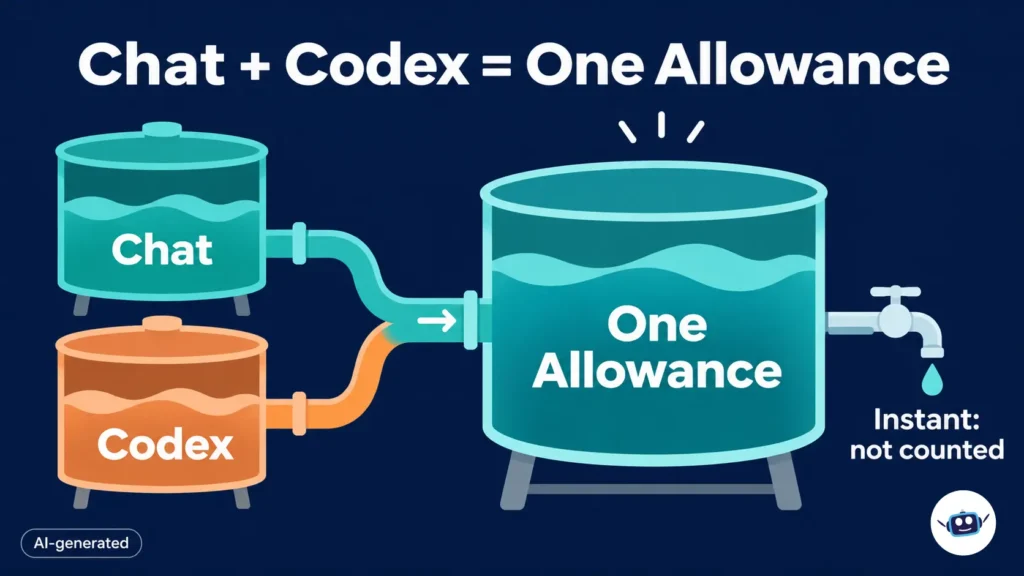
Picture a Tuesday in December. You spend the morning asking an advanced ChatGPT model to tear apart a long contract. That afternoon you hand Codex a messy refactor. Until now those two jobs came out of different limits. From December, they won’t.
OpenAI has said that ChatGPT Plus, Pro and Business plans will share one token-based usage allowance across ChatGPT and Codex. Instant chat is the one exception and doesn’t draw from it. This guide covers what OpenAI has confirmed, what it hasn’t published, and how to avoid being caught out. Everything below is current as of November 2026.
What exactly is OpenAI changing?
Starting in December, the usage allowance on Plus, Pro and Business plans will be shared across ChatGPT and Codex. According to OpenAI’s Help Center article “Understanding ChatGPT and Codex usage limits,” which was updated on October 31, 2026, the change comes as the agentic abilities of Work move into the main ChatGPT experience.
Usage is measured in tokens, the units of text a model reads and writes. How fast you burn through the allowance depends on the model you pick and the task you give it. More advanced models and more complex tasks generally cost more.
Here is the confirmed picture next to the gaps:
| Question | What OpenAI has said | Status |
|---|---|---|
| Which plans? | Plus, Pro and Business | Confirmed |
| What is shared? | One allowance for ChatGPT and Codex | Confirmed |
| Unit of measure | Tokens | Confirmed |
| Does Instant chat count? | No, it doesn’t draw from usage | Confirmed |
| Where do you check it? | Settings → Usage, which will show combined remaining usage and reset times | Confirmed |
| What at the limit? | Wait for reset, upgrade your plan, or buy credits for eligible features | Confirmed |
| Exact start day | Only “December” | Not published |
| Size of the shared allowance per plan | No figures | Not published |
| How five-hour and weekly windows work in the pool | No details | Not published |
Isn’t some of this already shared today?
Yes, and that is the detail most coverage glosses over. OpenAI’s Codex help page already says Codex, ChatGPT Work, ChatGPT for Excel and Workspace Agents draw from one shared agentic allowance and credit pool, where those features exist on your plan. Regular chat sits outside that pool.
December moves the boundary rather than creating sharing from nothing.
| Activity | Today (November 2026) | From December |
|---|---|---|
| Codex tasks | Shared agentic pool | One shared allowance |
| ChatGPT Work tasks | Shared agentic pool | One shared allowance |
| Chat with advanced models | Separate chat limits | One shared allowance |
| Instant chat | Not part of the agentic pool | Still excluded |
| Images, voice, file uploads | Separate caps and reset clocks | Not addressed in the article text |
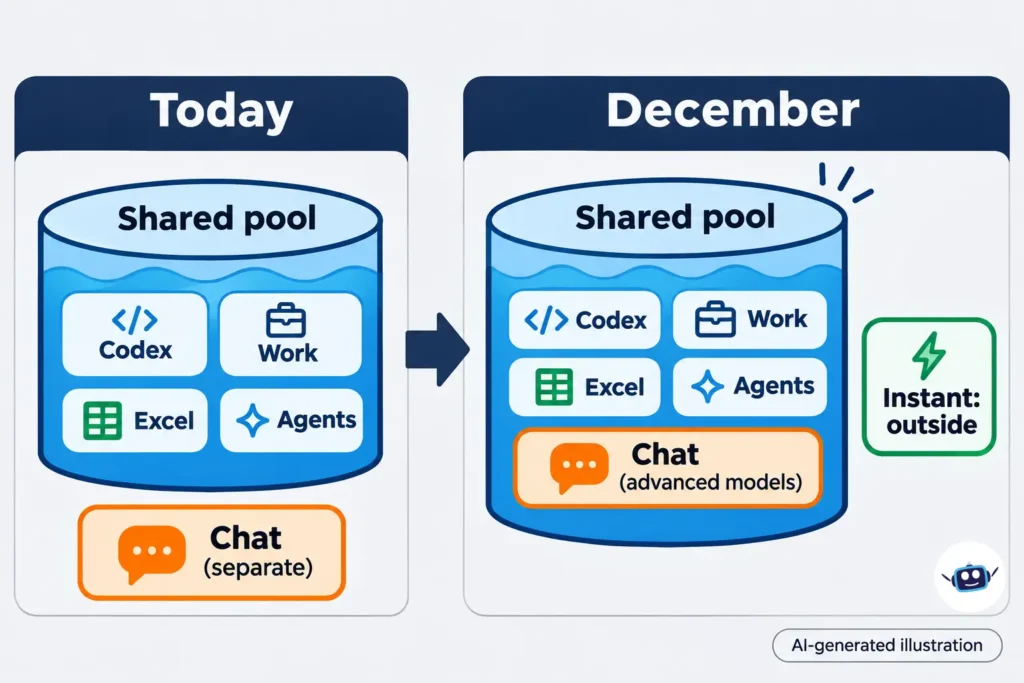
The last row matters. OpenAI’s Codex help page says image, voice and upload limits are separate from Codex today. Nothing in the December wording says that changes, but it doesn’t say they stay separate either.
When in December does it start?
OpenAI hasn’t said. The Help Center article says “starting in December” and gives no day. One finance outlet reported a December 31 start, but the published OpenAI text doesn’t support a specific day, so treat that date as unconfirmed.
A separate email to subscribers adds a wrinkle. As reported by BleepingComputer and reproduced by subscribers, it says OpenAI will begin testing a combined Chat and Work experience with a small group “in the coming weeks.” It also says Codex will stay a separate experience inside the ChatGPT desktop app. The allowance is pooled, but the interfaces are not being merged.
What most people miss: a shared allowance doesn’t mean one app. You can still open Codex separately. It just draws from the same tank as chat.
Which plans are affected, and which aren’t named?
The scope sentence names three plans: Plus, Pro and Business. Free, Go, Enterprise and Edu aren’t named in the text OpenAI published. Don’t assume they are included or excluded.
Pro is also several products under one name, which makes the confusion worse:
| Name | What it refers to | Named in the December change? |
|---|---|---|
| Plus | $20 per month plan | Yes |
| Pro | Plans at $100, $200 and $500 per month, per OpenAI’s Codex pricing page | Yes, as “Pro” |
| Business | Team plan | Yes |
| Business Premium | Higher Business tier; included in the October 29 doubling | Not separately named |
| Enterprise / Edu | Workspace plans, some on credit-based billing | No |
| API key usage | Pay-per-token through the OpenAI Platform | Not part of the ChatGPT allowance |
That last row is a real edge case. If you run Codex with an API key instead of signing in with ChatGPT, OpenAI’s pricing page says usage is charged at standard API rates. It isn’t drawn from your plan allowance, so the December pooling shouldn’t touch it.
What counts against the shared allowance?
Anything that runs on an advanced model, scaled by how much text goes in and out. OpenAI says larger tasks and more advanced models use more of your allowance, while Instant chat is free of the meter.
In practice:
- Light Instant chat: costs nothing against the pool.
- Short advanced-model answers: small draws.
- Long documents, big codebases, multi-step agent runs: large draws, because tokens add up across every step.
OpenAI’s Codex pricing page also says switching to a smaller model makes limits last longer. That advice will matter more once chat shares the pool.
The distinction between chat and agents is worth understanding before December. Our explainer on AI coding agents versus chatbots covers why agentic work burns far more tokens than a typical conversation.
What happens when you run out?
OpenAI lists three options: wait for the reset, upgrade your plan, or buy credits to keep using eligible features. Eligible Plus and Pro users can buy credits without changing plans, and OpenAI’s help pages say included usage is consumed first and credits second.
This is where the hidden cost sits. A flat subscription starts to behave like a prepaid balance with top-ups.
When OpenAI launched credit packs in October 2025, a pack was 1,000 credits for $40, which works out to $0.04 per credit. Pricing may have changed since, so check Settings → Usage for your current rate before buying.
Illustrative break-even math (using the launch price): the gap between Plus ($20) and Pro 100 ($100) is $80, which equals 2,000 credits at $0.04. If you routinely buy more than that on top of Plus, pricing out a higher tier makes sense. This is a rough trigger, not a precise one, because OpenAI doesn’t publish the allowance sizes you’d be comparing.
If you’re weighing per-token billing models more broadly, our breakdown of Claude Haiku 5.5 pricing shows how cost per call is calculated on a token-priced model.
What changed in the weeks before this announcement?
The December news lands in the middle of a turbulent stretch for OpenAI usage limits.
| Date | What happened | Source type |
|---|---|---|
| August 25, 2026 | Five-hour cap returned for Plus across Codex and Work, per 9to5Mac | Press report |
| September 29, 2026 | OpenAI emailed a planned reduction of the Pro 200 allowance | Subscriber email, reported by press |
| October 29, 2026 | OpenAI doubled Work and Codex limits for Pro 100, 200 and 500 and Business Premium, and cancelled the Pro 200 cut | OpenAI statement via Tibo Sottiaux, reported by BleepingComputer and gHacks |
| October 31, 2026 | Help Center article on shared ChatGPT and Codex usage updated | OpenAI Help Center |
| Early November 2026 | Subscriber email says Chat and Work will be tested together and ChatGPT and Codex will share an allowance | OpenAI email, reported by BleepingComputer |
| December 2026 | Shared allowance begins; no exact day published | OpenAI Help Center |
Two lessons come out of this. First, OpenAI doesn’t publish absolute usage numbers per tier, so the October doubling can’t be translated into a count of tasks. Second, Plus was reported as unchanged by the October 29 doubling, so Plus users enter December with no extra headroom.
Limits have also moved quickly and sometimes reversed. Don’t treat today’s numbers as permanent.
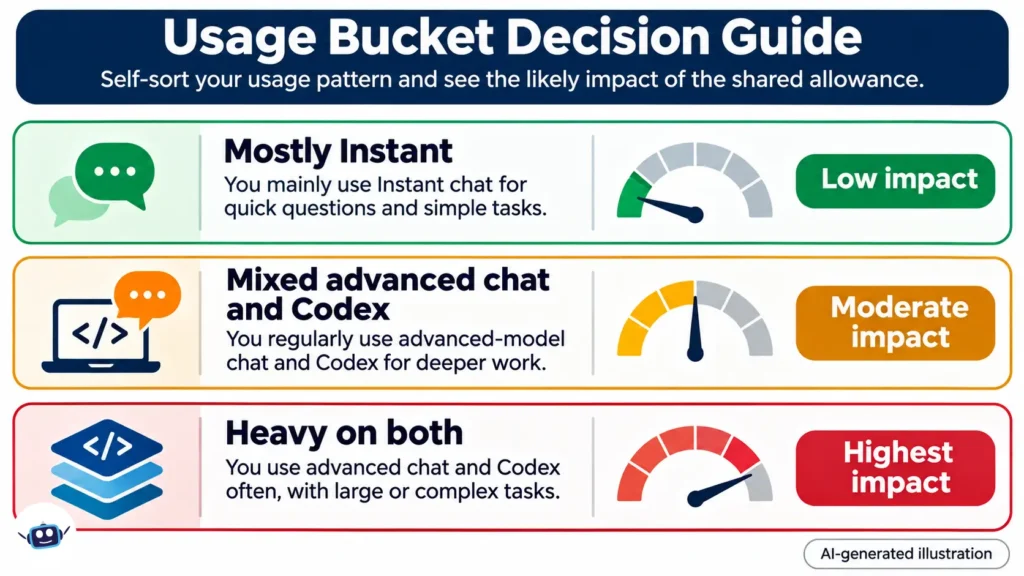
Who will feel this, and who won’t? A quick usage-bucket test
OpenAI hasn’t published the new allowance sizes, so nobody can calculate exact impact. You can still sort yourself by where your tokens go. This is an illustrative framework built on the verified rules (Instant is free; advanced models and big tasks cost more), not an OpenAI tool.
| Your pattern | Likely effect | What to do |
|---|---|---|
| Mostly Instant chat, occasional Codex | Small. Instant stays outside the meter | Watch Settings → Usage after rollout |
| Daily advanced-model chat, light Codex | Moderate. Chat now competes with a pool it never touched before | Use Instant for simple questions |
| Heavy Codex, light chat | Small. You already live inside the agentic pool | Check whether chat habits add a new drain |
| Heavy Codex plus heavy advanced-model chat | Highest. Both habits hit the same tank | Track usage weekly; price credits against a higher tier |
| Codex via API key | None from the pooling | Keep API billing separate |
OpenAI says it expects most users won’t wait for resets more often than they do now. That is the company’s expectation, not a published guarantee, and it comes without any numbers.
How do you prepare before December?
Work through this list now, while nothing has changed yet:
- Open Settings → Usage today and note your current reset times so you have a baseline.
- Sort your tasks into Instant-friendly (quick questions, rewrites) and token-heavy (long files, code, agent runs).
- Default to a smaller model for routine work, since OpenAI says that stretches your limits.
- Trim what you feed the model. Shorter, cleaner context uses fewer tokens, and our context engineering guide explains how.
- Move automation to an API key if you run scheduled or CI jobs, so they don’t compete with your personal allowance.
- Hold off on annual commitments or big credit purchases until OpenAI publishes the sizes and you’ve watched a week of real usage.
Common mistakes to avoid
- Assuming the whole of ChatGPT now drains your Codex quota. Instant chat doesn’t.
- Assuming the old limits were generous because nothing ran out. The pool was already shared among agent features.
- Buying credits on day one. You can’t evaluate value without the allowance sizes.
- Treating the doubling as permanent. OpenAI changed Pro limits twice in a few weeks.
- Mixing up API and plan usage. They’re billed on different systems.
Myth versus fact
| Myth | Fact |
|---|---|
| ChatGPT and Codex are becoming one app | The allowance is shared; Codex stays a separate experience in the desktop app, per OpenAI’s email |
| Every chat now costs tokens | Instant chat doesn’t draw from usage |
| OpenAI cut limits in December | No allowance sizes have been published, up or down |
| December 31 is the start date | OpenAI’s published text says only “December” |
| Free and Enterprise users are in | The scope sentence names only Plus, Pro and Business |
FAQs
Will ChatGPT and Codex share the same usage limit?
Yes, on Plus, Pro and Business plans from December 2026. OpenAI says the allowance will be shared and measured in tokens. Instant chat is excluded.
Does Instant chat use my allowance?
No. OpenAI says Instant chat will not draw from your usage, and its email to subscribers describes Unlimited Instant as included in your plan.
How will I see how much I have left?
Through Settings → Usage, which OpenAI says will show your combined remaining usage and reset times. In a Codex command-line session, the /status command currently shows limit information.
How big is the new shared allowance?
OpenAI hasn’t published it. The Help Center text gives no per-plan figures, so any number you see elsewhere is a guess.
What if I hit the limit?
You can wait for the reset, upgrade your plan, or buy credits for eligible features. Check your account for current credit pricing, since the original pack price dates from 2025.
Does this affect Codex used with an API key?
Per OpenAI’s pricing page, API-key usage is charged at standard API rates rather than drawn from your plan allowance. OpenAI hasn’t said anything to suggest the pooling changes that.
Should I switch plans before December?
Not yet. Without published allowance sizes, there is nothing reliable to compare. Use the next few weeks to measure your own habits instead.
Conclusion
OpenAI will pool ChatGPT and Codex into one token allowance for Plus, Pro and Business in December. Instant chat stays free of the meter, and everything else shares one tank. The start day, the allowance sizes and the window rules remain unpublished.
Key takeaways: the shared pool extends an existing Work-and-Codex pool to advanced chat; heavy users of both will feel it most; credits become part of the real cost; and limits have been changing fast.
Next step: open Settings → Usage today, record your reset times, and check them again the week December starts.
Related: Google Cloud’s Gemini agent for enterprise work, coding and content
Disclaimer
This article is for informational purposes only and is not affiliated with, sponsored by or endorsed by OpenAI or any other brand mentioned. Prices, features, limits and policies may change without notice, and OpenAI has not yet published full details of the December change. Information last verified on November 2, 2026. This is not financial advice, and AI output can be inaccurate, so confirm current terms in your own account before buying a plan or credits.